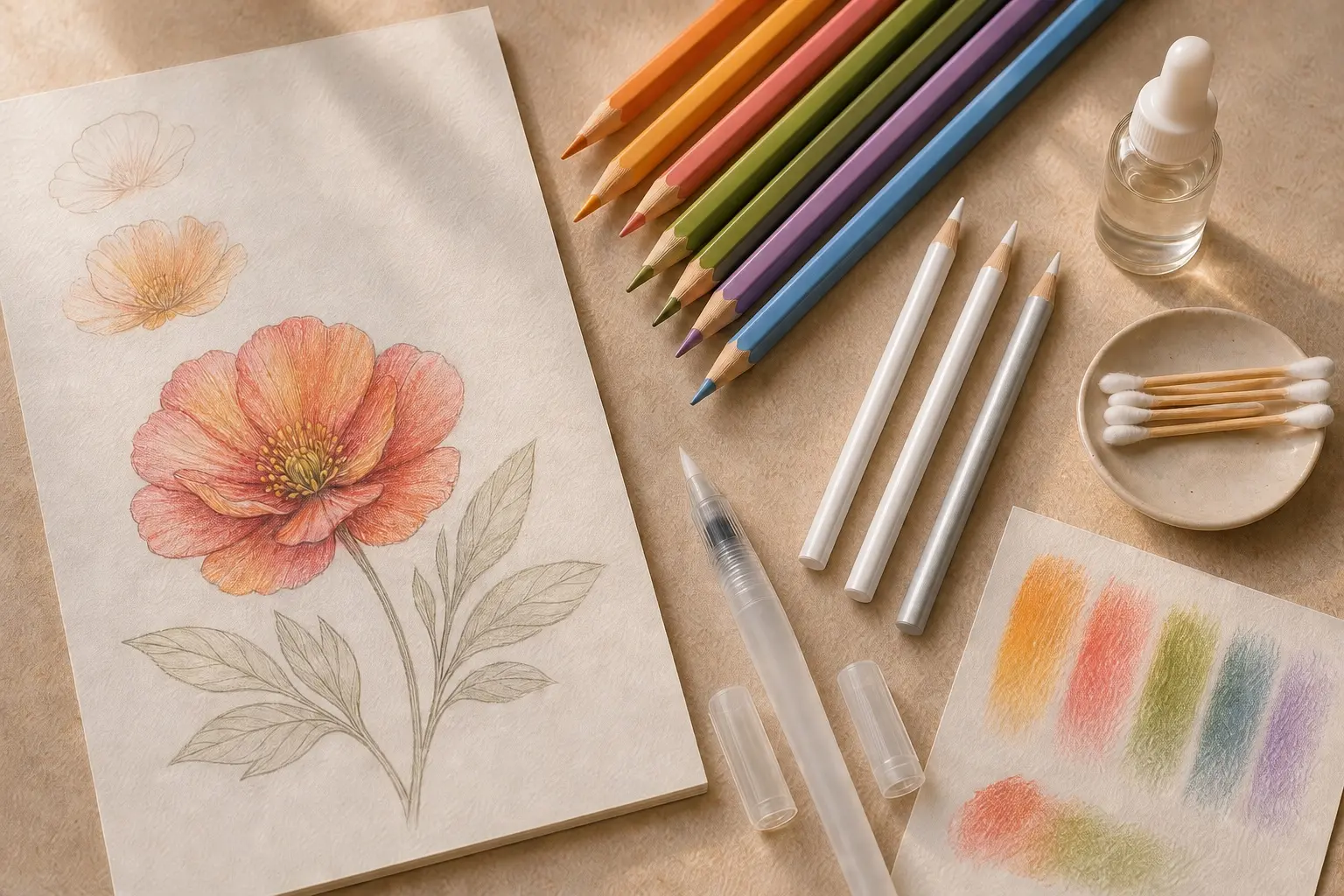
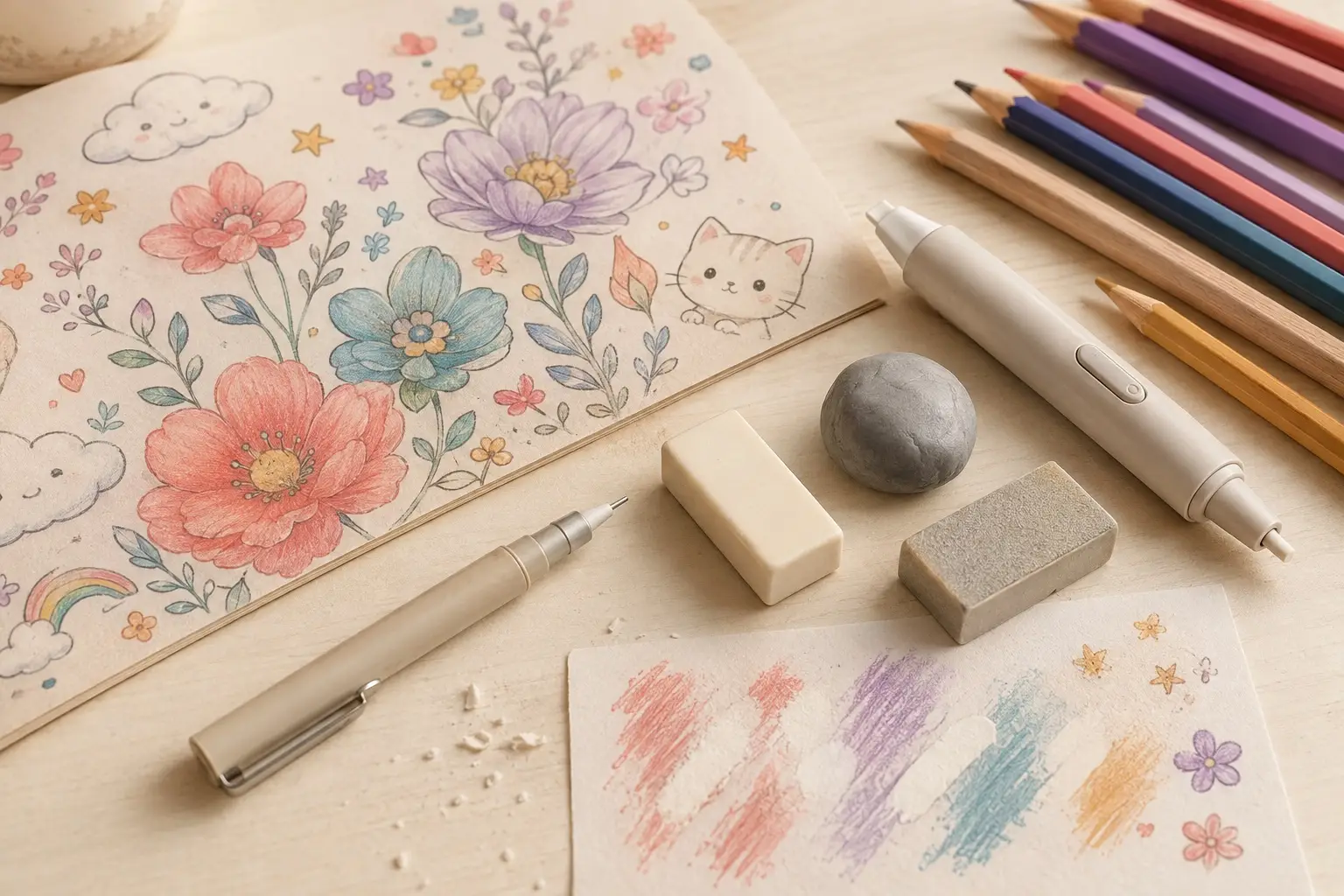
Best Erasers for Colored Pencils: Precision, Kneaded and Electric Picks. Eight research-based erasers for colored pencils, including abrasive, precision, kneaded, block, sharpenable and rechargeable electric options.. Type: Buying guide. Category: Coloring. Tags: colored-pencil-erasers, precision-erasers, kneaded-erasers, electric-erasers, coloring-tools, colored-pencil-techniques, buying-guide, cluster-coloring-supplies.

Buying guide

Best Erasers for Colored Pencils: Precision, Kneaded and Electric Picks

Our recommendation

The Tombow MONO Sand is our top research pick when the main job is actually lifting colored-pencil pigment because its natural-rubber-latex and silica-grit formula is specifically documented for colored-pencil marks. Use it lightly on sturdy paper and test first: it works through abrasion and can roughen a thin coloring-book page. For safer small corrections, choose the refillable Tombow MONO Zero 2.3 mm; for soft value lifting, choose the Faber-Castell Kneadable Eraser. The AFMAT EE03 is the powered pick for repeated pinpoint highlights. No eraser can reliably restore heavily burnished wax- or oil-based pencil to untouched white paper.

Quick picks

Top recommendations

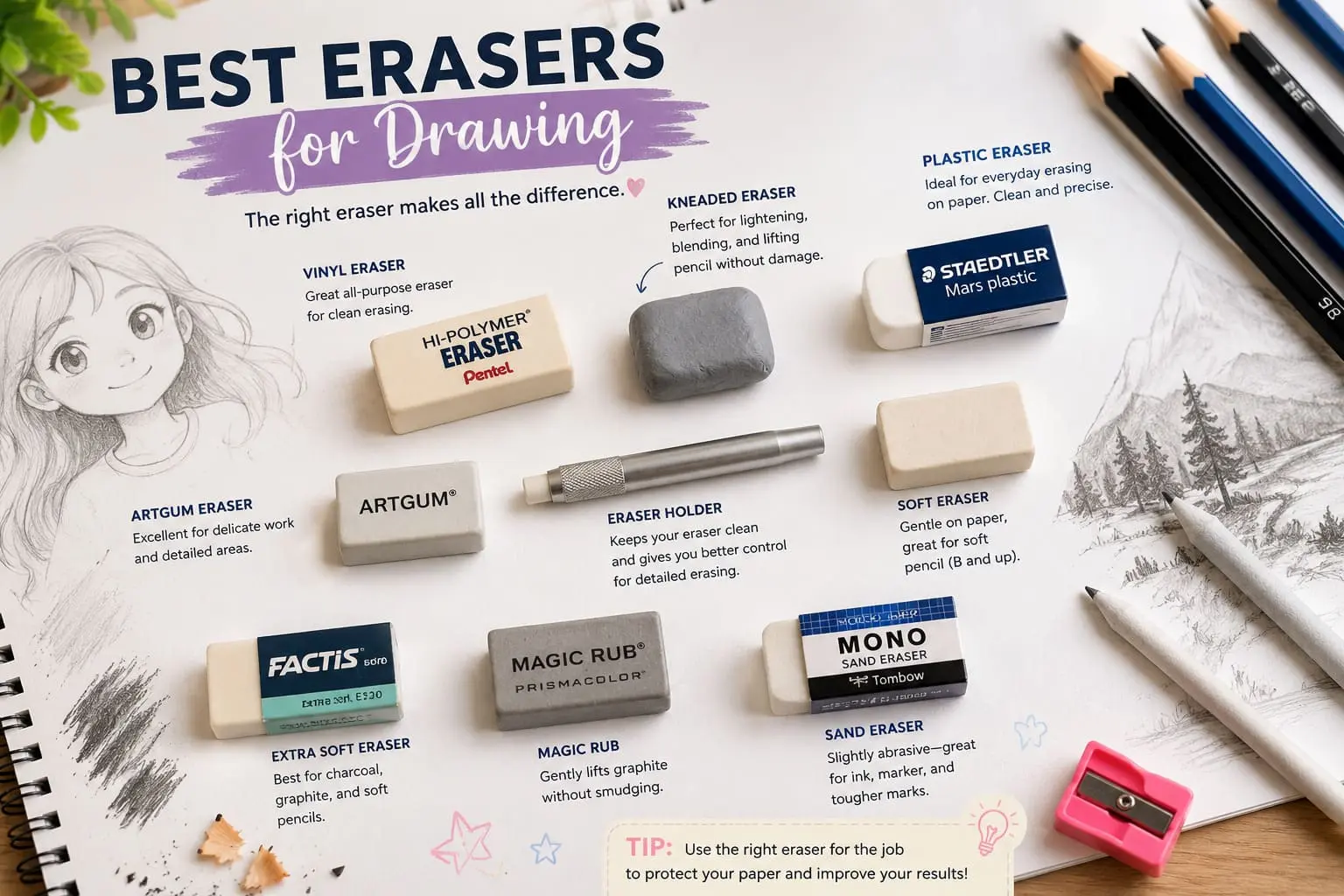
  1. 1Tombow MONO Sand Colored Pencil Eraser, 2-Pack — Best for stubborn colored pencilA natural-rubber-latex and silica-grit block specifically documented for colored-pencil and ink marks
  2. 2Tombow MONO Zero Eraser and Refill Value Pack, Round 2.3 mm — Best precision eraserA refillable pen-style eraser with a 2.3 millimeter round tip and spare refills
  3. 3Faber-Castell Kneadable Eraser for Artists in Storage Case — Best kneaded eraserA moldable absorbent eraser that can be pressed and lifted instead of scrubbed across the page
  4. 4AFMAT EE03 Rechargeable Electric Eraser with 140 Refills — Best electric eraserA rechargeable powered eraser with two holder sizes, 140 refills, a USB cable and a cleanup brush
  5. 5Faber-Castell Perfection Eraser Pencils, 2-Pack — Best sharpenable eraserTwo rubber eraser cores in wooden pencil casings that sharpen to a controllable point
  6. 6Sakura SumoGrip Premium Block Eraser B80, 3-Pack — Best broad blockA black open-cell foam block designed to grab fine graphite particles and gather waste into strands
  7. 7Tombow MONO Dust Catch Eraser 57334 — Best low-mess eraserA tacky polymer block designed to keep its own eraser residue attached
  8. 8Tombow MONO Light Eraser 57333 — Best for delicate paperA firm plastic block designed to erase graphite with a light touch on sensitive paper

Product comparison

ProductBest forWatch outPrice & shop
Tombow MONO Sand Colored Pencil Eraser, 2-Pack (opens Amazon in a new tab)Tombow · 67304 MONO Sand Eraser, 2-Pack
Best for stubborn colored pencilResearch-based review
Targeted pigment removal on sturdy paper after a normal eraser stops liftingIt contains natural rubber latex and works by abrasion, so it can roughen, thin or tear delicate paper and is unsuitable for anyone with a latex allergy
Tombow MONO Zero Eraser and Refill Value Pack, Round 2.3 mm (opens Amazon in a new tab)Tombow · 57315 MONO Zero Round 2.3 mm Value Pack
Best precision eraserResearch-based review
Tiny coloring-book overruns, slim highlights and cleaning close to printed outlinesThe narrow tip is slow over broad areas and generally lifts or softens layered pigment rather than restoring a fully colored space to white
Faber-Castell Kneadable Eraser for Artists in Storage Case (opens Amazon in a new tab)Faber-Castell · 127220 Kneadable Art Eraser
Best kneaded eraserResearch-based review
Softly lifting early colored-pencil layers, reducing value and shaping broad or narrow highlightsIt has limited effect on dense waxy or burnished colored-pencil layers and becomes less effective as it loads with pigment
AFMAT EE03 Rechargeable Electric Eraser with 140 Refills (opens Amazon in a new tab)AFMAT · EE03 White
Best electric eraserResearch-based review
Repeated pinpoint highlights and controlled lifting in detailed colored-pencil artworkMotorized friction can polish or damage paper quickly, and the bundled refill quantity is excessive for a casual colorist
Faber-Castell Perfection Eraser Pencils, 2-Pack (opens Amazon in a new tab)Faber-Castell · 185698 Perfection Eraser Pencils, 2-Pack
Best sharpenable eraserResearch-based review
Pencil-like highlight strokes, thin edges and colorists who prefer a wood-cased toolEvery sharpening consumes eraser and wood, and a hard pointed pass can score paper if pressure replaces patience
Sakura SumoGrip Premium Block Eraser B80, 3-Pack (opens Amazon in a new tab)Sakura · 50258 SumoGrip B80
Best broad blockResearch-based review
Clearing graphite underdrawing and softening larger lightly colored areas with a firm foam eraserSakura's strongest documentation is for graphite from B to 2H, so colored-pencil performance is less certain and the block cannot match a precision tip
Tombow MONO Dust Catch Eraser 57334 (opens Amazon in a new tab)Tombow · 57334 MONO Dust Catch
Best low-mess eraserResearch-based review
Shared coloring tables and finished pages where loose crumbs could drag pigment across clean paperResidue control does not make it a strong remover of dense colored-pencil layers, and its block shape is too broad for micro-highlights
Tombow MONO Light Eraser 57333 (opens Amazon in a new tab)Tombow · 57333 MONO Light
Best for delicate paperResearch-based review
Cautious correction of graphite underdrawing and pale pencil on thin or easily dented coloring pagesThe gentle formula may barely change dark, waxy or burnished colored pencil, so it is a paper-preservation pick rather than a maximum-removal pick

Selection and testing methodology

This is a research-based buying guide, not a controlled eraser test. On September 7, 2026, we opened every exact Amazon product detail page or its current Amazon-market offer, confirmed the ASIN and matched the exact variant to a direct high-resolution Amazon CDN image. We cross-checked intended use, materials, tip size, refill count and residue behavior with current Tombow USA, Faber-Castell, Sakura of America and AFMAT documentation. We excluded the previously cataloged Derwent battery-operated eraser because its exact Amazon ASIN returned Page Not Found. We favored eight tools with different jobs: abrasive colored-pencil removal, manual precision, gentle lifting, powered highlights, sharpenable details, broad foam-block cleanup, residue control and light-pressure correction. We did not measure pigment removal, paper abrasion, highlight brightness, residue, motor speed, battery life or tip durability. Paper, pencil binder, pressure and layer count can change the result, so every recommendation remains research-based.

Detailed product sections

Best for stubborn colored pencilResearch-based review

Tombow MONO Sand Colored Pencil Eraser, 2-Pack (opens Amazon in a new tab)

Tombow · 67304 MONO Sand Eraser, 2-Pack

A natural-rubber-latex and silica-grit block specifically documented for colored-pencil and ink marks

Why it fits this guide

MONO Sand is the only recommendation here whose current manufacturer page makes colored-pencil removal the central job. The abrasive grit gives it more bite than a plastic block, so it can clean small boundary mistakes or pull a brighter accent from pigment that a gentle eraser only lightens. That extra action is useful precisely because colored pencil bonds more stubbornly with paper fibers than graphite.

Honest drawback

It contains natural rubber latex and works by abrasion, so it can roughen, thin or tear delicate paper and is unsuitable for anyone with a latex allergy

Specifications

  • Exact two-pack Amazon ASIN was in stock in a US delivery context on September 7, 2026
  • Natural rubber latex and silica grit
  • Tombow item 67304, two erasers

Best forTargeted pigment removal on sturdy paper after a normal eraser stops lifting

Pros

  • Specifically documented for colored-pencil marks
  • More assertive than a normal plastic block
  • Small edge supports localized correction

Cons

  • Abrasive action can damage thin paper
  • Contains natural rubber latex
Check price on Amazon (opens Amazon in a new tab)
Best precision eraserResearch-based review

Tombow MONO Zero Eraser and Refill Value Pack, Round 2.3 mm (opens Amazon in a new tab)

Tombow · 57315 MONO Zero Round 2.3 mm Value Pack

A refillable pen-style eraser with a 2.3 millimeter round tip and spare refills

Why it fits this guide

MONO Zero solves the most common colored-pencil correction problem: removing a small mark without disturbing the surrounding color. The defined round tip is narrower and more repeatable than a worn block corner, while the push-button holder keeps a familiar pencil-like grip. Tombow also shows MONO Zero in its colored-pencil illustration workflow.

Honest drawback

The narrow tip is slow over broad areas and generally lifts or softens layered pigment rather than restoring a fully colored space to white

Specifications

  • Exact 57315 value-pack Amazon ASIN was in stock in a US delivery context on September 7, 2026
  • Round 2.3 millimeter refillable tip
  • Holder plus two replacement erasers

Best forTiny coloring-book overruns, slim highlights and cleaning close to printed outlines

Pros

  • Excellent physical control near line art
  • Refillable pen-style body
  • Less aggressive than a silica-grit block

Cons

  • Inefficient for broad cleanup
  • Tip must be cleaned to avoid pigment transfer
Check price on Amazon (opens Amazon in a new tab)
Best kneaded eraserResearch-based review

Faber-Castell Kneadable Eraser for Artists in Storage Case (opens Amazon in a new tab)

Faber-Castell · 127220 Kneadable Art Eraser

A moldable absorbent eraser that can be pressed and lifted instead of scrubbed across the page

Why it fits this guide

A kneaded eraser is the gentlest specialist in this guide. Faber-Castell documents its 127220 eraser as extremely kneadable and absorbent for correcting and lightening pencil, charcoal and pastel work. On colored pencil, its realistic role is early-stage lifting: dab a clean surface into light layers, soften an area or pinch a narrow edge for a highlight without the abrasive grit of a sand eraser.

Honest drawback

It has limited effect on dense waxy or burnished colored-pencil layers and becomes less effective as it loads with pigment

Specifications

  • Exact single grey eraser Amazon ASIN was in stock in a US delivery context on September 7, 2026
  • Faber-Castell item 127220
  • Reusable storage box included

Best forSoftly lifting early colored-pencil layers, reducing value and shaping broad or narrow highlights

Pros

  • Can be shaped for several highlight sizes
  • Press-and-lift action avoids repeated scrubbing
  • Creates no conventional pile of block-eraser crumbs

Cons

  • Weak on heavy or burnished layers
  • Needs frequent kneading to expose a clean surface
Check price on Amazon (opens Amazon in a new tab)
Best electric eraserResearch-based review

AFMAT EE03 Rechargeable Electric Eraser with 140 Refills (opens Amazon in a new tab)

AFMAT · EE03 White

A rechargeable powered eraser with two holder sizes, 140 refills, a USB cable and a cleanup brush

Why it fits this guide

AFMAT EE03 replaces the unavailable battery-operated product previously in the catalog. The current brand documentation and exact Amazon offer match on the useful details: a rechargeable body, approximately 2.3 and 5 millimeter holders, 100 small and 40 large refills, plus a brush. The smaller tip can pull dots and hairline accents while the larger tip covers a modest highlight without hand-rubbing every stroke.

Honest drawback

Motorized friction can polish or damage paper quickly, and the bundled refill quantity is excessive for a casual colorist

Specifications

  • Exact white EE03 Amazon ASIN was in stock in a US delivery context on September 7, 2026
  • Rechargeable body with USB charging cable
  • Approximately 2.3 and 5 millimeter holders with 140 total refills

Best forRepeated pinpoint highlights and controlled lifting in detailed colored-pencil artwork

Pros

  • Two tip sizes handle fine and medium highlights
  • Rechargeable instead of using disposable AAA batteries
  • Large refill supply and brush are included

Cons

  • Steeper control learning curve than a manual pen eraser
  • Bulky kit for occasional corrections
Check price on Amazon (opens Amazon in a new tab)
Best sharpenable eraserResearch-based review

Faber-Castell Perfection Eraser Pencils, 2-Pack (opens Amazon in a new tab)

Faber-Castell · 185698 Perfection Eraser Pencils, 2-Pack

Two rubber eraser cores in wooden pencil casings that sharpen to a controllable point

Why it fits this guide

The exact Perfection 185698 listing specifically identifies lead and colored-pencil use. Sharpening exposes a fresh point, so the tool can draw an erased line through fur, hair, petals or narrow reflected light with a familiar pencil grip. It is also simpler to rotate the angled point than to keep a full-size block corner away from finished color.

Honest drawback

Every sharpening consumes eraser and wood, and a hard pointed pass can score paper if pressure replaces patience

Specifications

  • Exact Faber-Castell Perfection 185698 two-pack was in stock in a US delivery context on September 7, 2026
  • Two wood-cased rubber eraser pencils
  • Exact listing specifies lead and colored-pencil correction

Best forPencil-like highlight strokes, thin edges and colorists who prefer a wood-cased tool

Pros

  • Sharpens to a narrow point
  • Familiar pencil-like control
  • Two tools allow basic light/dark palette separation

Cons

  • Sharpening creates waste and shortens the tool
  • Point can be too firm for fragile paper
Check price on Amazon (opens Amazon in a new tab)
Best broad blockResearch-based review

Sakura SumoGrip Premium Block Eraser B80, 3-Pack (opens Amazon in a new tab)

Sakura · 50258 SumoGrip B80

A black open-cell foam block designed to grab fine graphite particles and gather waste into strands

Why it fits this guide

SumoGrip is the broad manual choice for colorists who also sketch their own line art. Sakura documents microporous open-cell foam, low-pressure graphite pickup and strand-forming waste. Those features make it useful for clearing underdrawing before color and for attempting broader light lifting, while the black body makes collected graphite less visually distracting.

Honest drawback

Sakura's strongest documentation is for graphite from B to 2H, so colored-pencil performance is less certain and the block cannot match a precision tip

Specifications

  • Exact B80 three-pack Amazon ASIN was in stock in a US delivery context on September 7, 2026
  • Open-cell foam block construction
  • Small B80 format in a three-pack

Best forClearing graphite underdrawing and softening larger lightly colored areas with a firm foam eraser

Pros

  • Broad face works faster than a pen tip
  • Designed to require minimal pressure on graphite
  • Waste gathers into easier-to-lift strands

Cons

  • Primarily documented for graphite, not colored pencil
  • Corners become less precise as the block wears
Check price on Amazon (opens Amazon in a new tab)
Best low-mess eraserResearch-based review

Tombow MONO Dust Catch Eraser 57334 (opens Amazon in a new tab)

Tombow · 57334 MONO Dust Catch

A tacky polymer block designed to keep its own eraser residue attached

Why it fits this guide

MONO Dust Catch addresses cleanup rather than maximum pigment removal. Tombow explains that residue sticks to the eraser instead of remaining on illustrations or technical drawings. That matters around colored pencil, where sweeping crumbs with a hand can smear loose pigment into a pale background or press debris into the paper tooth.

Honest drawback

Residue control does not make it a strong remover of dense colored-pencil layers, and its block shape is too broad for micro-highlights

Specifications

  • Exact 57334 Amazon ASIN was in stock in a US delivery context on September 7, 2026
  • Tacky polymer formula
  • Rounded protective sleeve corners

Best forShared coloring tables and finished pages where loose crumbs could drag pigment across clean paper

Pros

  • Keeps much of its debris attached
  • Straightforward block needs no accessories
  • Useful beside finished illustrations

Cons

  • Not designed specifically for stubborn colored pencil
  • Conventional block limits detail control
Check price on Amazon (opens Amazon in a new tab)
Best for delicate paperResearch-based review

Tombow MONO Light Eraser 57333 (opens Amazon in a new tab)

Tombow · 57333 MONO Light

A firm plastic block designed to erase graphite with a light touch on sensitive paper

Why it fits this guide

When the page is more valuable than complete pigment removal, MONO Light is the sensible conservative option. Tombow specifically positions it for light-touch graphite correction and delicate materials. It is most useful before colored-pencil layers become heavy: remove the underdrawing, lift a pale edge or reduce a light mistake without immediately reaching for an abrasive tool.

Honest drawback

The gentle formula may barely change dark, waxy or burnished colored pencil, so it is a paper-preservation pick rather than a maximum-removal pick

Specifications

  • Exact 57333 Amazon ASIN was in stock in a US delivery context on September 7, 2026
  • White light-touch plastic eraser
  • Protective sleeve with rounded corners

Best forCautious correction of graphite underdrawing and pale pencil on thin or easily dented coloring pages

Pros

  • Designed around lower-pressure correction
  • Better first attempt on delicate paper
  • No refills, battery or sharpening required

Cons

  • Limited effect on dense pigment
  • Worn block corners lose precision
Check price on Amazon (opens Amazon in a new tab)

How to choose

  • Decide whether you need to remove a mistake, lift a highlight or only clean an edge. Those are different jobs, and no single eraser is best at all three.
  • Match aggression to the paper. An abrasive sand eraser can lift stubborn pigment but is the riskiest option on thin coloring-book stock; a kneaded or light-touch eraser is gentler but removes less.
  • Use a narrow tool for narrow mistakes. A 2.3 millimeter pen-style tip or sharpened eraser pencil protects the color you want to keep better than the corner of a large block.
  • Correct early. Colored pencil becomes harder to lift as layers build, pressure increases and burnishing fills the paper tooth with binder and pigment.
  • Test the exact pencil-and-paper combination on a spare page. Wax-based, oil-based and watercolor pencils do not erase identically, and printed line art may react to abrasion.
  • Keep the working surface clean. Pigment collected on an eraser can transfer into a pale area, so expose a clean kneaded surface or rub a solid tip clean on scrap paper.

Common mistakes

  • Expecting an eraser to return a heavily burnished dark area to untouched white paper.
  • Scrubbing thin paper with a silica-grit eraser until the fibers fuzz, thin or tear.
  • Using a wide block beside detailed line art and removing neighboring color along with the mistake.
  • Pressing harder when a gentle eraser stops lifting instead of accepting the remaining stain or switching to a more appropriate tool.
  • Holding an electric eraser in one spot long enough to polish or abrade the sheet.
  • Carrying red, blue or black pigment on a dirty tip into a cream, yellow or skin-tone area.
  • Erasing over printed outlines without first checking whether the printing ink can tolerate the technique.

Colored pencil is erasable—but not in the same forgiving way as graphite. A light first layer may lift cleanly enough to fix a boundary or open a highlight. A dark area built with several passes can leave a permanent tint. Once the pencil is burnished, pressure has packed pigment and binder into the paper tooth, and “erase” usually means lighten, not return to untouched white.

That difference is why the best eraser for colored pencils depends on the correction. A tiny mark outside the line calls for a precision tip. A shadow that is one step too dark may respond to a kneaded eraser. A stubborn patch on sturdy artist paper may justify an abrasive sand eraser. Repeated pinpoint highlights are where an electric eraser becomes useful.

This guide is research-based. We verified the exact current Amazon listings, ASINs and matching product images on September 7, 2026, then checked the documented materials and intended uses with Tombow USA, Faber-Castell, Sakura of America and AFMAT. We have not tested these eight erasers side by side, so we do not claim a measured winner for removal, paper wear, debris, battery life or durability.

The short answer

For most colorists, start with the Tombow MONO Zero 2.3 mm. Its narrow refillable tip gives you the control to clean a small overrun without rubbing away the petal, eye or border beside it. It is the most useful everyday shape, even though it will not completely remove every dark layer.

Choose the Tombow MONO Sand when you specifically need more pigment removal and the paper is sturdy enough to tolerate a carefully tested abrasive eraser. Tombow documents its natural-rubber-latex and silica-grit formula for colored-pencil marks. That makes it our specialist removal pick, not the safest universal pick.

The Faber-Castell Kneadable Eraser is the gentler choice for lifting value from early layers, while the AFMAT EE03 is the powered upgrade for repeated small highlights. If you prefer the motion of drawing, the Faber-Castell Perfection Eraser Pencils sharpen to a useful point.

Why colored pencil is harder to erase than graphite

Graphite sits on paper as thin plates of carbon. A good plastic eraser can grab and roll much of that material away, especially when the pencil was applied lightly.

Colored pencils carry pigment in a wax- or oil-based binder. As you layer, the binder fills the valleys in the paper texture. Pressure pushes pigment deeper and flattens the tooth. Burnishing makes the surface smoother and denser still. Watercolor pencils add another variable: once activated with water, their stain can behave very differently from a dry layer. Core feel matters as well; our guide to colored pencils for adult coloring books compares soft and firm sets.

The paper matters just as much. Thick, toothy colored-pencil paper gives pigment space to sit and may tolerate more correction. Thin coloring-book stock has less physical margin for abrasive rubbing. Smooth coated paper can show a polished patch after a hard eraser pass.

So judge success by the real goal:

  • Edge cleanup: remove a small overrun without disturbing nearby color.
  • Value lifting: make a passage lighter while accepting some remaining tint.
  • Highlight recovery: pull a dot, strand or narrow line through an existing layer.
  • Underdrawing removal: clear graphite before or after adding pale color.
  • Near-complete correction: attempt stronger removal on paper robust enough to survive it.

How to erase colored pencil without damaging the page

1. Stop before adding more layers

The earlier you notice a mistake, the easier it is to lift. Do not burnish over it and hope a stronger eraser will solve the problem later. Set the pencil down, remove loose crumbs with a clean brush and assess how much color is actually on the page.

2. Test on matching paper

Use a spare page from the same book, the back cover if appropriate, or an offcut of the same artist paper. Make a swatch with the same pencil, layer count and pressure. Printed outlines also need testing: abrasion that leaves artist paper intact may fade or smear the book’s ink.

3. Start with the least aggressive tool

Press and lift with a clean kneaded eraser, or try a light-touch block. If the mistake is narrow, use a precision tip so the corrected footprint stays small. Move to a sand or electric eraser only if the remaining pigment matters more than the risk of changing the surface.

4. Work from the outside inward

For a mark that crossed a printed border, begin outside the intended shape and move toward the line. That reduces the chance of dragging pigment farther into the clean margin. Short controlled strokes are safer than fast scrubbing.

5. Clean the eraser repeatedly

Colored pigment collects on the working surface. Fold a kneaded eraser until a clean section appears. Rub a solid tip on scrap paper, then inspect it before touching a pale area. With an electric eraser, replace or clean a stained refill rather than transferring a dark ring into a highlight.

6. Know when to stop

If the paper begins to shine, fuzz, thin or pill, the surface is changing. More pressure is unlikely to produce a clean repair. A faint stain on intact paper is often easier to blend into the design than a bright damaged patch.

Precision, kneaded, block and electric erasers compared

Precision pen erasers

The Tombow MONO Zero is best when the erased shape must stay small. A 2.3 millimeter tip can clean around eyes, whiskers, petals, lettering and narrow geometric borders. It is refillable and easy to hold, but its small surface makes broad correction tedious.

Precision does not mean greater chemical or abrasive strength. It means the tool touches less of the page. That alone can make the result look cleaner because surrounding color remains intact.

Kneaded erasers

The Faber-Castell Kneadable Eraser is moldable and absorbent. Pinch it into a wedge, flatten it into a pad, or roll it across an area. The best colored-pencil technique is usually a press-and-lift motion rather than rubbing.

Use it for light layers, soft highlights and reducing a value before adding a different color. Do not expect it to pull a heavily burnished wax layer back to white.

Abrasive sand erasers

The Tombow MONO Sand combines natural rubber latex with silica grit. It can remove colored-pencil marks because it abrades the marked surface more assertively than a normal plastic eraser.

That strength is also the drawback. Work with light pressure on sturdy paper, keep the corrected patch small and inspect the fibers after each pass. Anyone with a latex allergy should avoid it.

Electric erasers

The AFMAT EE03 rotates a small eraser tip for you. Its two holder sizes make it capable of both pinpoint dots and slightly broader highlights. The motor can save repetitive hand motion, but it also makes over-erasing happen faster.

Touch, lift and inspect. Do not lean on the tool or hold it in place. A powered eraser is an optional specialist, not a requirement for a first coloring kit.

Sharpenable eraser pencils

The Faber-Castell Perfection set places rubber eraser cores inside wood casings. Sharpening creates a point that can be drawn through color like a pencil stroke. The exact listing names colored-pencil correction, making it a useful middle ground between a refillable pen and a broad block.

The cost of that fresh point is material: sharpening consumes wood and eraser. Use the side of the point where possible, and avoid bearing down on fragile paper.

Foam and plastic blocks

The Sakura SumoGrip B80 is a firm open-cell foam block primarily documented for graphite pickup. It makes the most sense for removing graphite underdrawing and attempting broad light lifting. Its waste gathers into strands, which are easier to lift away than powdery crumbs.

The Tombow MONO Dust Catch prioritizes residue management. It keeps much of its tacky eraser debris attached, useful when loose crumbs might smear pigment across a finished background.

The Tombow MONO Light is the conservative block for delicate paper. Its documented role is light-pressure graphite removal; with colored pencil, use it early and accept that protecting the page may mean leaving some color behind.

Which eraser should you buy first?

You do not need a drawer full of erasers. A compact colored-pencil correction kit can be built in stages.

  1. Buy a precision eraser first if you use coloring books or detailed line art. MONO Zero handles the most common small overruns.
  2. Add a kneaded eraser if you draw, shade or want soft highlight control in early layers.
  3. Add MONO Sand only if stubborn pigment removal is a recurring need and your preferred paper survives a test swatch.
  4. Consider an electric eraser when you repeatedly make small highlights and already understand how your paper responds to friction.

If you sketch your own line art before coloring, a foam or light-touch block is also useful for clearing graphite. If desk mess is the bigger irritation, choose Dust Catch instead.

Paper-specific advice

Thin coloring-book paper

Stay with a precision tip, kneaded eraser or light-touch block. Support the page on a smooth firm surface. Avoid long abrasive passes, and test the printed outline before erasing across it. If corrections are a regular part of your coloring, coloring books with paper suited to colored pencils give layers more room.

Medium-tooth artist paper

This is the most flexible surface for correction. The tooth gives lightly applied pigment somewhere to sit, while the heavier sheet may tolerate cautious use of a sand or electric eraser. “May” still requires a swatch test; sizing and fiber composition vary.

Smooth Bristol

Smooth Bristol can show polished spots. Keep pressure low and watch the reflection across the page. A precision tool helps restrict any surface change to the smallest area.

Watercolor-pencil paper

Dry watercolor pencil may lift like other colored pencils, but activated pigment can stain. Wait until the page is completely dry before attempting correction. Abrasion on damp paper is especially likely to disturb fibers.

Common colored-pencil erasing mistakes

Treating every pale patch as a blank-page highlight

An erased highlight often retains a tint. Plan the brightest whites by preserving the paper from the beginning, using lighter pressure near highlight zones or reserving the area with careful negative-space coloring.

Scrubbing with a contaminated tip

A red-stained eraser can turn a yellow highlight orange. Clean the tool on scrap paper or keep separate tips for dark and light palettes.

Using solvent before deciding to erase

Solvent blending redistributes binder and pigment and can carry color deeper into the paper. Make corrections before adding solvent or reaching for a colorless blender or burnisher whenever possible. Once a passage is blended or burnished, expect lifting rather than clean removal.

Assuming a more powerful tool is safer

Sand and electric erasers are effective because they increase abrasion or concentrated motion. They do not know when to stop. The user’s pressure, contact time and paper test provide the safety margin.

Hiding damage with more pressure

If a corrected area becomes fuzzy, pressing harder with colored pencil can emphasize the damaged fibers. Stop, brush away debris and decide whether a light glaze or design adjustment will integrate the remaining mark more gracefully.

Our final recommendation

For everyday colored-pencil correction, the Tombow MONO Zero 2.3 mm is the smartest first purchase. It is precise, refillable and easy to use near line art. It will not erase every dark layer, but it minimizes the collateral damage around the mistake.

The Tombow MONO Sand is the stronger specialist and our top pick when the explicit job is removing colored-pencil pigment. Its documented silica-grit formula can succeed where a normal plastic block stalls, but it contains latex and deserves the most cautious paper test in this guide.

Choose the Faber-Castell Kneadable Eraser for gentle early-stage lifting, AFMAT EE03 for repeated powered highlights and Faber-Castell Perfection for a sharpenable pencil-like point. Pick Sakura SumoGrip for broad underdrawing cleanup, Tombow Dust Catch for tidier residue or Tombow Light when preserving delicate paper matters more than maximum removal.

The central rule is simple: correct early, keep the working area small and stop before the paper becomes the bigger problem.

Manufacturer sources checked

Amazon.com availability and exact image matching were checked separately for every selected ASIN on September 7, 2026. Prices, sellers and delivery eligibility can change and are intentionally not stored in this article.

Relevant supporting guide

Best Colored Pencils for Adult Coloring Books: 10 Smooth, Blendable SetsCompare 10 colored-pencil sets for adult coloring books by core feel, color range, detail control, layering, paper fit, storage and replacement options.
FAQ

Can you completely erase colored pencils?

Usually not after the color is heavily layered or burnished. Colored-pencil pigment and binder settle into the paper tooth, and strong pressure pushes them deeper. An eraser can often lift a light layer, soften a mistake, clean an edge or recover a highlight, but a faint stain may remain. Correcting early gives the best chance of a clean result.

What type of eraser is best for colored pencils?

For narrow mistakes, a precision eraser such as the Tombow MONO Zero is the safest place to start. For light early layers, a kneaded eraser can lift gradually. A Tombow MONO Sand can remove more stubborn pigment on sturdy paper, but its silica grit is abrasive and must be tested first.

Will a kneaded eraser work on colored pencils?

A clean kneaded eraser can lift some lightly applied colored pencil, especially before the paper tooth is filled. Press and lift rather than rubbing. It is unlikely to remove a dense, waxy or burnished area completely, but it can reduce value and create a softer highlight.

Can an electric eraser damage paper?

Yes. A rotating eraser tip concentrates friction in a small area. Use the lightest contact, touch briefly, check the result and repeat only if needed. Practice on the same paper first, because thin or soft sheets can polish, fuzz or wear through faster than expected.

What is a sand eraser, and is it safe for coloring books?

A sand eraser contains abrasive grit that removes part of the marked surface along with pigment. Tombow MONO Sand uses natural rubber latex and silica grit. It can help with colored pencil, but it may roughen or thin paper, contains latex, and is a poor first choice for fragile coloring-book pages.

How do you avoid transferring pigment with an eraser?

Check the tip after every dark correction. Fold a kneaded eraser to expose a clean surface, or rub a solid eraser gently on scrap paper until the collected color is gone. Keeping separate tools or tips for pale and dark palettes also reduces accidental transfer.