Best Mandala Coloring Books for Adults: Simple to Intricate Designs. Six research-based mandala coloring books for adults, compared by design density, page format, removability, guidance and fit for pencils or markers.. Type: Buying guide. Category: Coloring. Tags: mandala-coloring-books, adult-coloring-books, simple-mandalas, intricate-mandalas, creative-haven, coloring-gifts, screen-free-activities, buying-guide, cluster-coloring-supplies.

Buying guide

Best Mandala Coloring Books for Adults: Simple to Intricate Designs

Our recommendation

Flower Mandalas is our easiest research-based pick because its thirty floral designs come with technique guidance, colored examples and removable one-sided pages. Wonder House Mandala offers the best simple-to-intricate mix on large square tear-out sheets. Creative Haven Mandalas Color by Number is the guided option; Nature Mandalas adds organic motifs; Celtic Mandalas focuses on interlaced knotwork; and Magical Mandalas is the most intricate abstract choice. We confirmed all six exact editions in stock on Amazon.com, but KawaiiToons has not colored in or physically tested them.

Quick picks

Top recommendations

  1. 1Flower Mandalas Coloring Book — Easiest overallThirty one-sided perforated floral designs come with basic coloring instruction and finished examples for palette ideas
  2. 2Mandala: Colouring Books for Adults with Tear Out Sheets — Best mixed difficultyA sixty-four-page, roughly eleven-inch-square format combines varied complexity with sheets designed to tear out
  3. 3Creative Haven Mandalas Color by Number Coloring Book — Best guided pickForty-six numbered circular designs pair repeated geometry with a printed color key that can be followed or adapted
  4. 4Creative Haven Nature Mandalas Coloring Book — Best nature motifsThirty-one circular designs build symmetry from recognizable natural forms including dragonflies, daisies, shells, leaves, vines and trees
  5. 5Creative Haven Celtic Mandalas Coloring Book — Best knotworkThirty-one designs combine spirals and swirls with interwoven animals, birds, flowers and vines
  6. 6Creative Haven Magical Mandalas Coloring Book — Most intricateThirty-one elaborate abstract mandalas emphasize nested detail, repetition and precise color placement

Product comparison

ProductBest forWatch outPrice & shop
Flower Mandalas Coloring Book (opens Amazon in a new tab)Design Originals · 9781574219944
Easiest overallResearch-based review
Beginners who want floral designs, technique guidance and colored examplesThirty designs is the smallest selection here, and the floral theme offers less visual variety than a mixed abstract collection
Mandala: Colouring Books for Adults with Tear Out Sheets (opens Amazon in a new tab)Wonder House Books · 9789386538611
Best mixed difficultyResearch-based review
Colorists who want simple and intricate designs in one large square bookThe large square trim is less portable, and published specifications do not establish marker resistance or exact paper weight
Creative Haven Mandalas Color by Number Coloring Book (opens Amazon in a new tab)Creative Haven · 9780486797977
Best guided pickResearch-based review
Adults who like symmetry but do not want to invent every palettePrinted numbers remain visible until covered, and narrow symmetric sections can be awkward for broad marker tips
Creative Haven Nature Mandalas Coloring Book (opens Amazon in a new tab)Creative Haven · 9780486491370
Best nature motifsResearch-based review
Colorists who prefer leaves, flowers, shells and insects to purely geometric cellsFine vines, wings and borders still need controlled tools, and the natural theme is less abstract than some mandala fans expect
Creative Haven Celtic Mandalas Coloring Book (opens Amazon in a new tab)Creative Haven · 9780486814230
Best knotworkResearch-based review
Experienced colorists who enjoy tracing interlaced bands and limited palettesInterlaced paths demand close tracking, and a coloring mistake can interrupt the visual continuity of a repeated band
Creative Haven Magical Mandalas Coloring Book (opens Amazon in a new tab)Creative Haven · 9780486799872
Most intricateResearch-based review
Experienced colorists who want dense abstract projects that can span several sessionsDense cells can be tiring to track, and the book is unforgiving with broad tips or a rushed palette plan

Selection and testing methodology

This is a research-based buying guide, not a hands-on paper, print or coloring test. On September 27, 2026, we opened each exact Amazon.com detail page in a US delivery context, confirmed the ISBN-derived ASIN, an in-stock offer sold by Amazon.com with add-to-cart and buy-now controls, and a matching direct Amazon CDN cover image. We cross-checked design counts, subjects, page format, removability, trim information and stated skill level against current Dover Publications and Penguin Random House pages plus the Fox Chapel Publishing coloring catalog. KawaiiToons has not colored in these copies or measured line width, smallest cell size, print contrast, paper weight, pencil tooth, marker bleed, show-through, perforation strength or binding durability. Rankings reflect documented creative and format differences, not customer ratings, temporary prices or claims that coloring treats stress, anxiety or any health condition.

Detailed product sections

Easiest overallResearch-based review

Flower Mandalas Coloring Book (opens Amazon in a new tab)

Design Originals · 9781574219944

Thirty one-sided perforated floral designs come with basic coloring instruction and finished examples for palette ideas

Why it fits this guide

Flower Mandalas has the strongest beginner scaffolding in this group. The current exact edition pairs thirty designs with a short technique guide and colored examples, which gives a new colorist somewhere to start without turning every page into a prescribed color map. Floral petals also create more recognizable, often broader regions than knotwork or nested abstract lace. The format is beginner-friendly, not uniformly simple: leaves, borders and decorative fills can still become narrow, so an interior preview matters.

Honest drawback

Thirty designs is the smallest selection here, and the floral theme offers less visual variety than a mixed abstract collection

Specifications

  • Exact Amazon ASIN 1574219944 was in stock, sold by Amazon.com and showed add-to-cart and buy-now controls on September 27, 2026
  • Current Amazon edition lists thirty designs across seventy-two pages
  • Documented features include a basic technique guide, colored examples and one-sided perforated paper

Best forBeginners who want floral designs, technique guidance and colored examples

Pros

  • Most useful beginner guidance in the comparison
  • Floral shapes provide familiar color decisions
  • Removable one-sided pages simplify rotation and display

Cons

  • Lowest design count here
  • Some decorative sections still need a fine point
Check price on Amazon (opens Amazon in a new tab)
Best mixed difficultyResearch-based review

Mandala: Colouring Books for Adults with Tear Out Sheets (opens Amazon in a new tab)

Wonder House Books · 9789386538611

A sixty-four-page, roughly eleven-inch-square format combines varied complexity with sheets designed to tear out

Why it fits this guide

This Wonder House edition best matches the brief's full progression. Penguin Random House documents a variety of complexity levels and tear-out sheets, while the current Amazon listing shows a large square working format. That gives a colorist room to move between open designs and denser projects without changing books. The large page is useful on a table or board but less convenient in a bag, and neither source gives an exact paper-weight figure that would justify a marker-proof claim.

Honest drawback

The large square trim is less portable, and published specifications do not establish marker resistance or exact paper weight

Specifications

  • Exact Amazon ASIN 938653861X was in stock, sold by Amazon.com and showed add-to-cart and buy-now controls on September 27, 2026
  • Penguin Random House lists sixty-four pages, tear-out sheets and a variety of complexity levels
  • Current Amazon listing identifies an approximately eleven-inch-square paperback format

Best forColorists who want simple and intricate designs in one large square book

Pros

  • Broadest built-in difficulty range
  • Large square pages provide generous working space
  • Tear-out sheets are easy to rotate or place on a board

Cons

  • Bulkiest choice for travel
  • Exact paper weight is not disclosed
Check price on Amazon (opens Amazon in a new tab)
Best guided pickResearch-based review

Creative Haven Mandalas Color by Number Coloring Book (opens Amazon in a new tab)

Creative Haven · 9780486797977

Forty-six numbered circular designs pair repeated geometry with a printed color key that can be followed or adapted

Why it fits this guide

Mandalas Color by Number removes the blank-page palette decision. Dover explains that each number corresponds to a color key, while colorists remain free to substitute their own colors. Repetition makes progress easy to track ring by ring, and forty-six illustrations provide the largest project count here. The trade-off is visual noise: printed numerals and narrow repeated bands can feel busier than clean line art, even though the palette itself is guided.

Honest drawback

Printed numbers remain visible until covered, and narrow symmetric sections can be awkward for broad marker tips

Specifications

  • Exact Amazon ASIN 048679797X was in stock, sold by Amazon.com and showed add-to-cart and buy-now controls on September 27, 2026
  • Forty-six mandala illustrations across a ninety-six-page edition
  • Publisher documents a color key plus one-sided perforated pages

Best forAdults who like symmetry but do not want to invent every palette

Pros

  • Only option here with a full numbered palette system
  • Highest illustration count in the comparison
  • Repeating sections can be completed ring by ring

Cons

  • Numerals add clutter to uncolored sections
  • Fine rings still require precise tools
Check price on Amazon (opens Amazon in a new tab)
Best nature motifsResearch-based review

Creative Haven Nature Mandalas Coloring Book (opens Amazon in a new tab)

Creative Haven · 9780486491370

Thirty-one circular designs build symmetry from recognizable natural forms including dragonflies, daisies, shells, leaves, vines and trees

Why it fits this guide

Nature Mandalas softens the abstract repetition with recognizable subjects. Dover documents thirty-one designs using dragonflies, daisies, seashells, leaves, vines, trees and other natural forms. Those motifs make palette choices more intuitive for someone who wants a starting cue but dislikes printed numbers. Organic outlines can still tighten around wing veins, stems and borders, so this is a middle step rather than a guaranteed easy book.

Honest drawback

Fine vines, wings and borders still need controlled tools, and the natural theme is less abstract than some mandala fans expect

Specifications

  • Exact Amazon ASIN 0486491374 was in stock, sold by Amazon.com and showed add-to-cart and buy-now controls on September 27, 2026
  • Thirty-one designs across sixty-four pages
  • Publisher documents one-sided perforated pages and nature subjects including flowers, leaves, shells, insects and trees

Best forColorists who prefer leaves, flowers, shells and insects to purely geometric cells

Pros

  • Recognizable motifs make palette planning approachable
  • More subject variety than pure geometry
  • Removable pages can be rotated while coloring

Cons

  • Organic outlines are less predictable than broad rings
  • Exact paper weight is not published
Check price on Amazon (opens Amazon in a new tab)
Best knotworkResearch-based review

Creative Haven Celtic Mandalas Coloring Book (opens Amazon in a new tab)

Creative Haven · 9780486814230

Thirty-one designs combine spirals and swirls with interwoven animals, birds, flowers and vines

Why it fits this guide

Celtic Mandalas has the most distinctive construction in the shortlist. Dover describes spirals, swirls and interwoven natural motifs rather than a sequence of floral rosettes. A small, planned palette can make the over-under paths legible and keep the design cohesive. That same interlacing raises the difficulty: it is easy to lose a band at a crossing, and narrow curves reward a sharp pencil or fine-tip marker.

Honest drawback

Interlaced paths demand close tracking, and a coloring mistake can interrupt the visual continuity of a repeated band

Specifications

  • Exact Amazon ASIN 0486814238 was in stock, sold by Amazon.com and showed add-to-cart and buy-now controls on September 27, 2026
  • Thirty-one designs across sixty-four pages
  • Documented motifs include spirals, swirls, interwoven animals, birds, flowers and vines on one-sided perforated pages

Best forExperienced colorists who enjoy tracing interlaced bands and limited palettes

Pros

  • Most distinctive alternative to floral mandalas
  • Limited palettes suit repeated interlaced bands
  • Perforated pages can move to a firm work surface

Cons

  • Easy to lose the path at a crossing
  • Narrow bands do not suit broad tips
Check price on Amazon (opens Amazon in a new tab)
Most intricateResearch-based review

Creative Haven Magical Mandalas Coloring Book (opens Amazon in a new tab)

Creative Haven · 9780486799872

Thirty-one elaborate abstract mandalas emphasize nested detail, repetition and precise color placement

Why it fits this guide

Magical Mandalas is the deliberate challenge pick. Dover positions its thirty-one designs for experienced colorists, and the current cover and interior presentation emphasize dense, nested geometry. Symmetry still provides a plan—one motif can be repeated around the circle—but the number of small sections makes each palette decision travel farther. This is best for someone who enjoys sustained precision, not for a beginner who wants a quick first finished page.

Honest drawback

Dense cells can be tiring to track, and the book is unforgiving with broad tips or a rushed palette plan

Specifications

  • Exact Amazon ASIN 0486799875 was in stock, sold by Amazon.com and showed add-to-cart and buy-now controls on September 27, 2026
  • Thirty-one elaborate designs across sixty-four pages
  • Publisher documents one-sided perforated pages and an experienced-colorist audience

Best forExperienced colorists who want dense abstract projects that can span several sessions

Pros

  • Strongest choice for sustained fine-detail projects
  • Symmetry supports deliberate repeated palettes
  • Pages can be removed for easier rotation

Cons

  • Least approachable for a first mandala book
  • Small sections demand sharp pencils or fine tips
Check price on Amazon (opens Amazon in a new tab)

How to choose

  • Inspect an interior page, not only the cover. Wide petals and open rings are easier than nested lace, interlaced bands and tiny repeated cells.
  • Match the project length to the colorist. A simple page can finish in one sitting; an intricate page may be more satisfying when approached ring by ring over several sessions.
  • Check whether the book offers guidance. Technique notes and colored examples help a beginner, while color-by-number removes palette planning but adds printed numerals.
  • Decide whether pages need to come out. Perforated or tear-out sheets are easier to rotate, place on a board, protect from bleed-through and display.
  • Choose tools for the smallest spaces. Colored pencils and fine tips handle narrow cells better than broad markers.
  • Treat paper claims cautiously. One-sided, removable or described as thick does not prove that alcohol markers will stay on one sheet.
  • Verify the exact ISBN or ASIN. Similar mandala titles and alternate editions can have different page counts, covers and construction.

Common mistakes

  • Assuming every circular design labeled a mandala has the same visual style, difficulty or cultural purpose.
  • Buying the densest cover for a beginner without checking how small the interior cells become.
  • Choosing by illustration count alone when page size, guidance and removability affect whether the book is pleasant to use.
  • Believing a large square page automatically means large shapes; intricate line art can still contain very small regions.
  • Using alcohol markers in a bound book without removing the page or placing a nonporous barrier behind it.
  • Purchasing a huge supply set before testing the book with pencils, pens or markers already owned.
  • Presenting coloring as therapy or a guaranteed relaxation method instead of an optional creative hobby.

The word “mandala” appears on books that feel very different in use. One may offer broad floral petals, a technique page and finished examples. Another may fill the page with nested lace, interlaced bands or hundreds of small repeated shapes. A third prints numbers inside every region and chooses the palette for you.

This guide compares six exact editions with a useful difficulty curve. The rankings focus on what can be documented before buying: design count and density, page size, one-sided printing, removability, guidance and the kinds of tools likely to fit the smallest spaces.

These are research-based recommendations. We verified the current editions and their publisher-documented formats, but we did not color in the books, measure the paper or test pencils and markers on them.

Quick answer: start with the design density

  • Choose Flower Mandalas for the easiest start. Technique guidance and colored examples reduce the first-page decisions.
  • Choose Wonder House Mandala for a simple-to-intricate mix. Its large square tear-out format accommodates changing project moods.
  • Choose Mandalas Color by Number for palette guidance. Forty-six numbered designs trade a blank palette for visible numerals.
  • Choose Nature Mandalas for organic motifs. Flowers, leaves, shells, insects and trees make the symmetry feel less abstract.
  • Choose Celtic Mandalas for knotwork. Interlaced paths reward careful tracking and a fine point.
  • Choose Magical Mandalas for maximum detail. It is the strongest fit for experienced colorists who want long projects.

Commercial coloring publishers use “mandala” broadly for centered or circular designs. This guide compares the practical coloring formats of those books; it does not treat them as interchangeable with sacred or ceremonial artwork.

What makes one mandala easier than another?

Difficulty is not the number of rings alone. The smallest repeated shape usually tells you more.

Open shapes versus nested detail

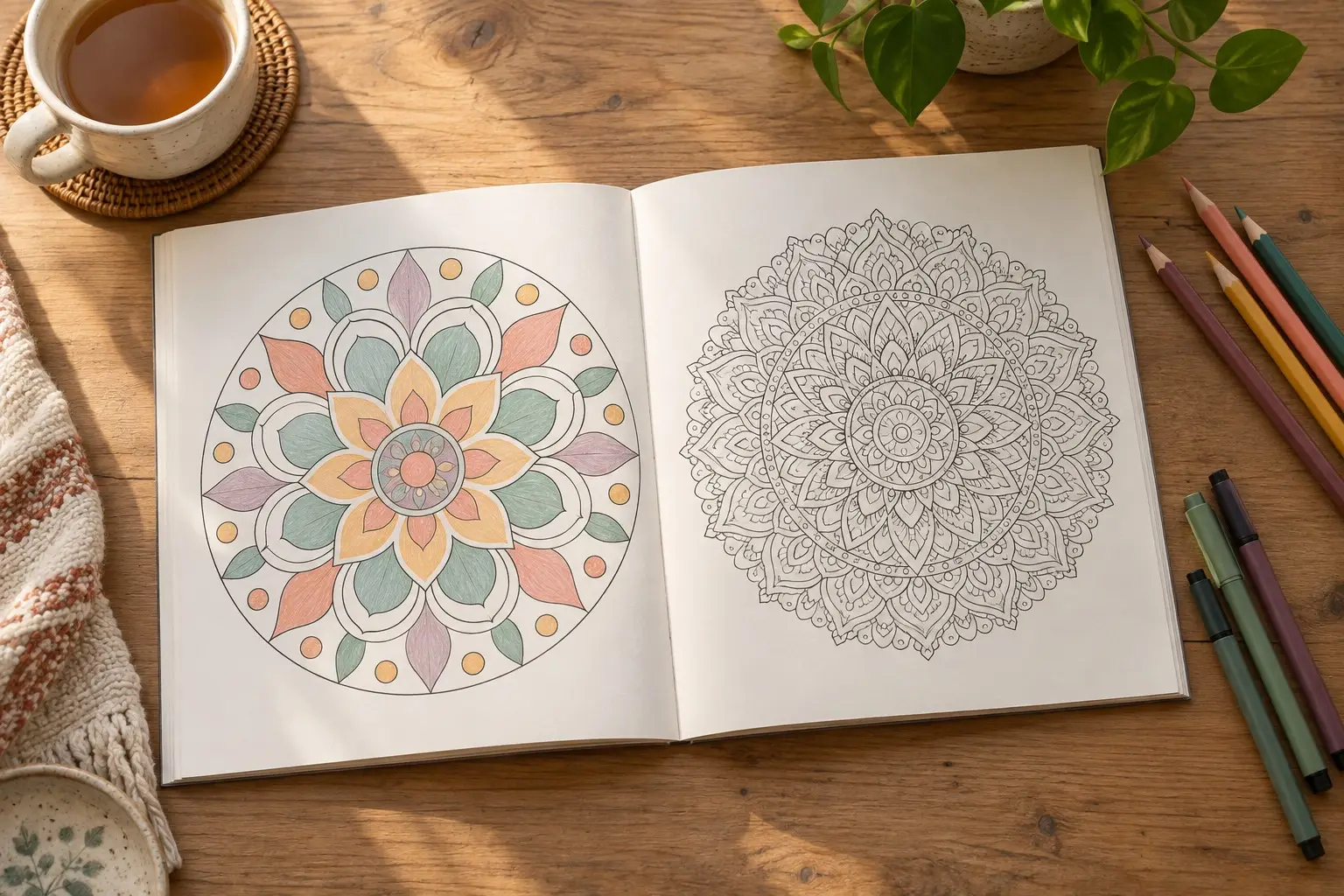
Broad petals, leaves and circles leave room for a slightly dull pencil point and make it easier to see progress. Nested lace, tiny scallops and repeated borders require more edge work. Because a motif repeats around the circle, one small section may need to be colored eight or twelve times before the ring is complete.

Enlarge an interior preview to the approximate printed size. A design that looks clean on a phone can reveal very small cells when viewed at the real page width.

Guidance versus a blank palette

Technique notes and finished examples are useful when someone wants ideas without strict rules. Color-by-number goes further: it assigns colors to printed numerals. That reduces palette planning, but it does not necessarily reduce fine motor demands. A numbered section can still be tiny.

For an unnumbered book, a limited palette is usually easier than opening a large pencil case. Pick three to six colors, add a lighter and darker version of one hue, and repeat them consistently around the page.

Removable pages

Every selection here documents perforated or tear-out sheets. Removal lets a colorist rotate the page instead of twisting the wrist, place it on a firm board and keep a barrier directly underneath. It also reduces pressure near a glued gutter.

Remove carefully. Fold along a perforation first, support the sheet close to the line and pull slowly. “Tear-out” describes the page construction; it does not guarantee every sheet will separate perfectly.

The best adult mandala coloring books

Flower Mandalas Coloring Book — easiest overall

Fox Chapel Publishing identifies Flower Mandalas Coloring Book by artist Thaneeya McArdle and ISBN 978-1-57421-994-4. The current exact Amazon edition lists thirty designs, a basic technique guide, colored examples and one-sided perforated pages.

The instructional material is why it ranks first for beginners. A finished example can suggest how many colors to use, where to repeat them and how much contrast a design needs. Floral forms also give intuitive cues: leaves can share a family, central petals can carry the strongest accent and background rings can stay quieter.

Do not read “beginner-friendly” as “large print.” Borders, veins and decorative fills may still narrow. Look at an interior image and compare the smallest shapes with the intended pencil or marker tip.

Choose it for a first mandala book or a gift recipient who likes flowers and wants visual starting points.

Mandala: Colouring Books for Adults with Tear Out Sheets — best mixed difficulty

Penguin Random House lists this Wonder House edition at sixty-four pages and documents tear-out sheets plus designs with varied complexity. The current Amazon listing presents it as a large, approximately eleven-inch-square paperback.

That range is useful when the same person sometimes wants a short project and sometimes wants a dense one. A large square page also provides more working room than a compact travel book, especially after the sheet is removed and placed on a board.

Large does not automatically mean easy. An intricate design can use the extra space for more cells rather than wider cells. The publisher also does not provide an exact paper weight, so claims about marker resistance would be speculation.

Choose it when variety matters more than a single consistent difficulty level.

Creative Haven Mandalas Color by Number — best guided pick

Dover documents Mandalas Color by Number as forty-six designs whose printed numbers correspond to a color key. The key can guide the page or be replaced with a personal palette. Pages are printed on one side and perforated.

The format suits a colorist who enjoys symmetry but hesitates at an empty palette. Repeated numbers show how one color should travel around a ring, and a page can be completed from the center outward without losing its overall logic.

The numerals are also the main compromise. They add visual clutter before the region is covered, and the narrowest bands still need a sharp pencil or fine tip. This is palette-easy, not necessarily hand-easy.

Choose it for someone who wants guidance and the largest project count in this comparison.

Creative Haven Nature Mandalas — best nature motifs

Dover’s Nature Mandalas contains thirty-one designs built from dragonflies, daisies, seashells, leaves, vines, trees and other natural subjects. The sixty-four-page edition uses one-sided perforated pages.

Recognizable forms make palette planning more intuitive without printing numbers. A colorist can begin with familiar greens and flower colors, then move toward fantasy palettes later. The subject changes also provide more variety than a collection made only from geometric rings.

Nature does not guarantee broad shapes. Wing veins, stems, shells and small border leaves can become precise work. This book sits in the middle of the difficulty curve rather than at the easy end.

Choose it for a nature fan who still wants circular rhythm and symmetry.

Creative Haven Celtic Mandalas — best knotwork

Dover describes Celtic Mandalas as thirty-one designs using spirals, swirls and interwoven animals, birds, flowers and vines. The pages are one-sided and perforated.

Knotwork changes how the page is solved. Instead of filling one enclosed petal at a time, the colorist may follow a band through multiple crossings. A limited palette helps: assign one or two colors to the main ribbons, then reserve contrasting colors for background shapes and small accents.

The challenge is continuity. Losing the path at an over-under crossing can interrupt the pattern, so this is better for someone who enjoys close visual tracking than for a first-time colorist.

Choose it for distinctive interlaced structure rather than floral repetition.

Creative Haven Magical Mandalas — most intricate

Dover positions Magical Mandalas for experienced colorists. The book contains thirty-one elaborate designs on one-sided perforated pages.

This is the long-project choice. Dense repeated cells support careful gradients, alternating rings and tightly controlled color families. Symmetry offers a map, but it also multiplies every decision: a small motif selected near the center must remain consistent as it repeats around the circle.

Use a sharp pencil, a fine-tip water-based marker or a gel pen that has been tested on an edge. Broad markers will cross narrow boundaries quickly. A swatch map is especially useful when a page continues across several sessions.

Choose it only when intricate detail is the attraction, not merely because the cover looks impressive.

Best tools for mandala pages

The right tool depends on the smallest cell, not the page size.

Colored pencils

Colored pencils are the most forgiving option. Light pressure keeps the paper surface available for later layers, and a sharp point reaches narrow scallops and knotwork. For large petals, tilt the pencil slightly and use small overlapping strokes to reduce streaks.

Start with the pencils already owned. Our colored-pencil guide compares core feel, point retention and practical set sizes for adult coloring books.

Water-based markers and gel pens

Fine-tip water-based markers produce flat, crisp color in repeated cells. Gel pens can add opaque accents but may take longer to dry. Work from the center outward or rotate a removed page so the hand does not drag across fresh ink.

Even water-based ink can show through or soften ordinary book paper, which is why we compare markers marketed as no-bleed for thin pages separately. Place a smooth barrier beneath the active sheet and test the darkest color near an outside edge.

Alcohol markers

Alcohol ink normally passes through coloring-book paper. Remove the page or place a nonporous barrier directly beneath it. A spare sheet of copier paper may absorb ink without preventing transfer to the design below.

One-sided printing protects artwork on the reverse; it does not make paper bleed-proof. None of the documentation we checked supplies a test result that would support a marker-proof claim.

A simple palette method for intricate designs

An elaborate page does not require an elaborate supply set.

  1. Choose three anchor colors. A warm, cool and neutral combination is easier to repeat than a dozen unrelated shades.
  2. Add one light and one dark value. These create separation when neighboring motifs use similar hues.
  3. Make a swatch map. Draw a small circle or write the motif name beside each color.
  4. Complete one repeated unit. Test a single petal, knot or scallop before carrying the palette around the page.
  5. Check at arm’s length. If adjacent sections merge, change their lightness rather than adding more colors immediately.
  6. Store the swatch with the page. This keeps a multi-session project consistent.

For the guided version of this process, compare our adult color-by-number guide.

Final take

Flower Mandalas is the best first book because its instruction, examples and familiar floral shapes reduce the decisions that stop a beginner from starting. Wonder House Mandala is the stronger one-book progression from simple to intricate, especially for someone who likes large square removable sheets.

Mandalas Color by Number wins for palette guidance. Nature Mandalas provides recognizable organic subjects, Celtic Mandalas offers the most distinctive interlaced structure and Magical Mandalas supplies the densest abstract challenge.

Inspect the interior at printed size before buying. A beautiful finished cover cannot tell you whether the smallest cells, page handling and intended tools will make the first uncolored page inviting.

Sources checked

Relevant supporting guide

Best Colored Pencils for Adult Coloring Books: 10 Smooth, Blendable SetsCompare 10 colored-pencil sets for adult coloring books by core feel, color range, detail control, layering, paper fit, storage and replacement options.
FAQ

What is the easiest mandala coloring book for adults?

Flower Mandalas is the easiest starting point in this comparison because it includes basic technique guidance, colored examples and floral designs that often use more recognizable shapes than dense abstract knotwork. Check an interior preview because some decorative sections are still small.

Are mandala coloring books suitable for beginners?

Yes, when the interior designs use broad petals, open rings and clear outlines. Beginners should avoid judging by the cover alone; compare the smallest cells, choose pencils or fine tips that fit them and start with one repeated motif rather than the entire page.

Are colored pencils or markers better for mandala coloring books?

Colored pencils are the most forgiving for narrow cells, light layers and palette changes. Fine-tip water-based markers can create crisp flat color but still need a backing sheet. Alcohol markers normally bleed through coloring-book paper and should be used only with a removed page or nonporous barrier.

Do perforated or tear-out pages prevent marker bleed?

No. Removable pages protect the next design only after the active sheet is taken out or isolated. They do not prove the paper is marker-proof, so test a dark color near an edge and place a nonporous barrier underneath.

How do you choose colors for an intricate mandala?

Start with three to six colors, assign each to one repeated motif, and make a small swatch map before filling the whole ring. Include light, middle and dark values so adjacent sections remain distinct, then add extra colors only when the design genuinely needs them.