Best Acrylic Paint Markers for Coloring and Crafts. Compare acrylic paint markers for coloring books, rock painting and crafts, with tips on tip sizes, opacity, dark paper and which surfaces they suit.. Type: Buying guide. Category: Coloring. Tags: acrylic paint markers, paint pens, rock painting, coloring books, cluster-coloring-supplies.

Buying guide

Best Acrylic Paint Markers for Coloring and Crafts

Our recommendation

For a small first set for paper art, our research pick is Sharpie Creative Brush 12 because it needs no priming. Choose Arrtx Dual-Tip 32 if you want more colors and a fixed fine end alongside a brush. For pastel rock and wood decorations, choose POSCA PC-5M Soft Colors; for tiny finishing lines, choose the 0.7 mm PC-1MR instead. Buy for the project and tip size first. No marker here comes with our guarantee of bleed-free coloring pages, waterproof glass art or washable fabric designs.

Choose by use case

Tip and paint-flow comparison

Compare the exact selected formats. Nominal tip dimensions do not guarantee the width of every stroke.

Selected setTipStarting methodMain limitation
Sharpie Creative Assorted 12Flexible brushNo primingSmall palette; no fixed detail end
Arrtx Dual-Tip 32Brush plus fixed fineNo nib pumpingFine end is not ultra-fine
POSCA PC-5M Soft Colors 8Medium bullet, 1.8–2.5 mmShake capped, prime on scrapNo black; medium-sized marks
POSCA PC-1MR 8Calibrated extra-fine, 0.7 mmShake capped, prime on scrapSlow for fills; colors may vary

Research-based format comparison. No measured opacity, drying-time or durability scores are assigned.

Product comparison

ProductBest forWatch outPrice & shop
Sharpie Creative Acrylic Markers, Brush Tip, Assorted 12 (opens Amazon in a new tab)Sharpie · 2196907 — Brush Tip, 12 Count
Compact no-prime brush choiceResearch-based review
Paper art, bold coloring accents and a first brush setA flexible brush takes control for small edges, and twelve colors are a limited palette. Sharpie's no-bleed claim does not establish how your book handles repeated wet layers, rubbing or page-to-page transfer.
Arrtx 32 Colors Dual-Tip Acrylic Paint Markers (opens Amazon in a new tab)Arrtx · B1000406 — 32 colors, brush and fine tips
Broader dual-tip paletteResearch-based review
Coloring and card designs needing brush fills and fixed outlinesThe fixed end is not an ultra-fine technical pen. More significantly, the manufacturer recommends sealing dried work for outdoor or water exposure, despite the listing's broad water-resistance language. Do not buy it expecting unsealed waterproof crafts.
POSCA PC-5M Medium Paint Markers, Soft Colors, 8 Pack (opens Amazon in a new tab)POSCA · PC-5M — Soft Colors, 1.8–2.5 mm
Soft-color craft paletteResearch-based review
Pastel rock painting, wood tags and medium-sized decorationsThere is no black in this assortment, and the medium tip is too broad for miniature features. Valve priming and surface-specific preparation add steps that the no-prime brush choices do not require.
POSCA PC-1MR Ultra-Fine Paint Markers, 8 Pack (opens Amazon in a new tab)POSCA · PC-1MR — 0.7 mm, eight-pack
Extra-fine finishing toolResearch-based review
Small outlines, dots, card details and decorative letteringFilling a large background with a 0.7 mm tip is tedious. The checked eight-pack listing warns that colors may vary, so confirm the assortment before buying it for one essential color. Do not assume the PC-5M's reversible-tip feature applies to this nib.

How we researched this guide

Research date
Hands-on testing
None of the 4 picks — all are research-based

This is a research-based comparison, not a hands-on test. We checked manufacturer descriptions, use and surface instructions, and the exact Amazon.com variants with active US ordering options and matching product images. Recommendations reflect documented tool formats and likely project fit. We did not rank measured coverage or durability, and sellers and stock can change.

What we compared

  • Brush, fixed fine, medium and calibrated extra-fine tip formats
  • No-prime versus pump-valve operation
  • Exact set size and palette, including limitations of soft-color assortments
  • Manufacturer opacity claims, distinguished from results on a particular paper
  • Documented paper and craft surfaces, preparation and fixing requirements
  • Confirmed tip maintenance options rather than assumed refillability

What we did not test

  • We have not physically used these markers for this guide
  • Comparative one-coat opacity, streaking or color accuracy
  • Bleed-through on individual coloring books
  • Drying time, paint capacity or tip lifespan
  • Weather resistance, washing, food-contact suitability or archival permanence

Product details and drawbacks

Compact no-prime brush choiceResearch-based review

Sharpie Creative Acrylic Markers, Brush Tip, Assorted 12 (opens Amazon in a new tab)

Sharpie · 2196907 — Brush Tip, 12 Count

Twelve assorted water-based acrylic brush markers that Sharpie says need no priming.

Why it fits this guide

This is the simplest starting format here for someone who wants to uncap a marker and draw on paper. The brush can vary the stroke with pressure and angle. Sharpie lists paper, metal, wood, ceramic, glass, rock and canvas as supported surfaces, and advertises color on light and dark backgrounds. Those are maker claims, not our results on every surface.

Honest drawback

A flexible brush takes control for small edges, and twelve colors are a limited palette. Sharpie's no-bleed claim does not establish how your book handles repeated wet layers, rubbing or page-to-page transfer.

Specifications

  • Model 2196907
  • 12 assorted colors
  • Brush tips
  • Water-based acrylic; no priming required

Best forPaper art, bold coloring accents and a first brush set

Pros

  • No pump-valve preparation
  • A modest set for starting with one project

Cons

  • No separate fixed detail end
  • Paper and surface compatibility still need checking
Check price on Amazon (opens Amazon in a new tab)
Broader dual-tip paletteResearch-based review

Arrtx 32 Colors Dual-Tip Acrylic Paint Markers (opens Amazon in a new tab)

Arrtx · B1000406 — 32 colors, brush and fine tips

Thirty-two colors with a brush and fixed fine end on each marker.

Why it fits this guide

The dual format offers a practical switch between filling a flower petal and outlining another shape in the same color. Arrtx describes opaque water-based ink and no need to press the nib for paint. The maker identifies 31 colors plus white. The selected listing specifies a 1.99 mm fine end and 3.2 mm brush; those are listed tip dimensions, not measured stroke widths.

Honest drawback

The fixed end is not an ultra-fine technical pen. More significantly, the manufacturer recommends sealing dried work for outdoor or water exposure, despite the listing's broad water-resistance language. Do not buy it expecting unsealed waterproof crafts.

Specifications

  • 32 colors, including white
  • Brush and fine tips
  • Water-based opaque ink per maker
  • No nib pumping required

Best forColoring and card designs needing brush fills and fixed outlines

Pros

  • Two tip shapes for each color
  • More palette choices than the compact brush set

Cons

  • Fine end is relatively broad for tiny patterns
  • Water or outdoor exposure needs a finishing plan
Check price on Amazon (opens Amazon in a new tab)
Soft-color craft paletteResearch-based review

POSCA PC-5M Medium Paint Markers, Soft Colors, 8 Pack (opens Amazon in a new tab)

POSCA · PC-5M — Soft Colors, 1.8–2.5 mm

Eight soft colors with POSCA's 1.8–2.5 mm medium bullet tip.

Why it fits this guide

Choose this for a coordinated soft palette rather than the biggest color count. POSCA specifically identifies the PC-5M for porous, irregular materials including wood and stone. Its documented reversible, replaceable tip is a useful maintenance feature. The checked Soft Colors listing includes white, sunshine yellow, apricot, light pink, coral pink, lavender, light blue and aqua green.

Honest drawback

There is no black in this assortment, and the medium tip is too broad for miniature features. Valve priming and surface-specific preparation add steps that the no-prime brush choices do not require.

Specifications

  • PC-5M medium bullet tip, 1.8–2.5 mm
  • 8 Soft Colors
  • Water-based paint
  • Reversible and replaceable tip

Best forPastel rock painting, wood tags and medium-sized decorations

Pros

  • Coordinated pastel-style palette
  • Documented tip maintenance options

Cons

  • No black in the selected set
  • Priming needed; not an extra-fine tool
Check price on Amazon (opens Amazon in a new tab)
Extra-fine finishing toolResearch-based review

POSCA PC-1MR Ultra-Fine Paint Markers, 8 Pack (opens Amazon in a new tab)

POSCA · PC-1MR — 0.7 mm, eight-pack

Eight paint markers with rigid 0.7 mm calibrated tips ringed in metal.

Why it fits this guide

The PC-1MR is a different tool from the PC-1M and PC-5M: its small calibrated tip is intended for consistent fine lines. It makes sense when a medium bullet feels oversized for the design, or when you want small finishing marks after a base layer has dried. POSCA describes opaque paint, but we have not measured how many passes a particular color needs over a dark base.

Honest drawback

Filling a large background with a 0.7 mm tip is tedious. The checked eight-pack listing warns that colors may vary, so confirm the assortment before buying it for one essential color. Do not assume the PC-5M's reversible-tip feature applies to this nib.

Specifications

  • PC-1MR calibrated extra-fine tip
  • 0.7 mm
  • 8 markers; supplied colors may vary
  • Water-based paint; valve priming required

Best forSmall outlines, dots, card details and decorative lettering

Pros

  • Rigid small tip for contours and dots
  • Useful as a detail format alongside existing supplies

Cons

  • Inefficient for broad fills
  • Assortment must be checked if a specific color matters
Check price on Amazon (opens Amazon in a new tab)

How to choose

  • Start with one project and its surface. A coloring page, garden rock and fabric bag have different finishing needs.
  • Match the smallest shapes to the tip. A brush point can make thin strokes, but it is not the same tool as a rigid extra-fine nib.
  • Choose a palette you will use. Check for white, black and useful light colors instead of buying by count alone.
  • Check whether the exact range needs priming. Keep pump-valve preparation off the finished piece.
  • Budget for appropriate paper or finishing materials before a second marker set. These recommendations are alternatives, not a shopping checklist.

Common mistakes

  • Buying ordinary permanent Sharpies when the intended product is Sharpie Creative Acrylic.
  • Pumping a no-prime brush marker as if it were a POSCA valve marker.
  • Covering printed outlines with opaque paint, then expecting them to remain visible.
  • Scrubbing a damp coloring-book page or closing it before the paint has dried.
  • Treating water-resistant, permanent, weatherproof and machine-washable as interchangeable claims.

What acrylic paint markers do differently

Paint markers are useful when you want a visible layer of color: a pale flower on dark card, a dot over a dried background or a decorative motif on a suitable craft surface. Opacity is the buying reason, but it is not a promise that every light color covers every dark base in one pass.

“Paint pen,” “acrylic marker” and “water-based paint marker” can overlap in shopping descriptions. Check the exact range rather than assuming every water-based marker contains opaque paint. Ordinary dye-based brush markers can be transparent, while Sharpie Creative is a separate line from the familiar permanent Sharpie.

Alcohol markers serve a different goal: transparent color that can be layered and blended on compatible paper. Choose our alcohol-marker guide if gradients are your priority. This page focuses on opaque paper art and decorative crafts; the wider coloring-supplies hub helps with other media.

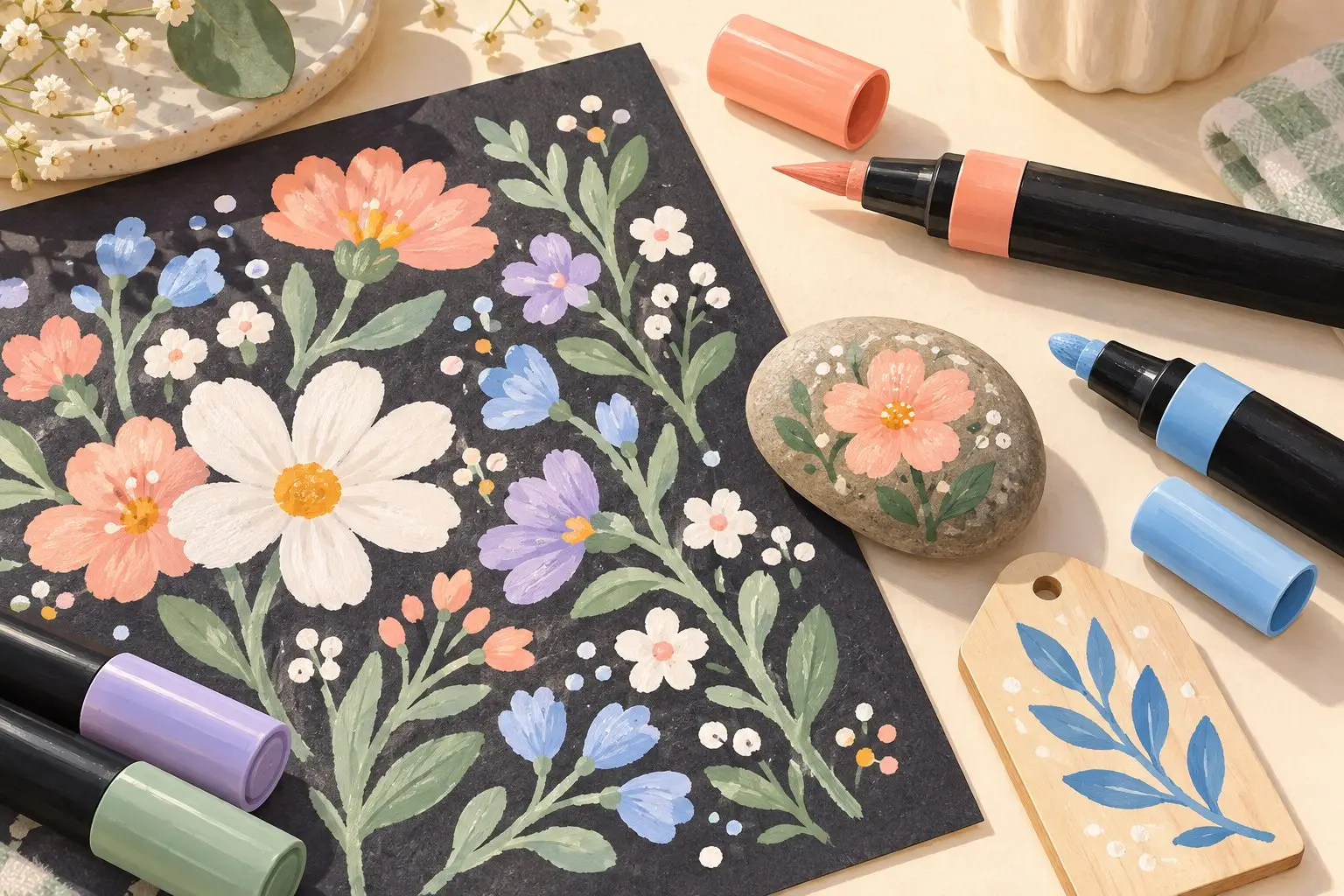
The featured image is an original conceptual illustration. It is not a photograph of these products, a coverage swatch or evidence of a finished test project.

Which sets make sense for coloring books?

For a first experiment with bold shapes or small decorative accents, start with the Sharpie brush set. Its no-prime operation removes one setup step. If your pages need more color choices and you prefer a fixed end for edges, the Arrtx 32 is the more versatile format. These are project-fit recommendations based on their documented design, not a comparative test of smoothness.

Opaque color can cover a book’s black outlines as well as unwanted marks. Work inside the outline if you want to retain it, or plan an illustration that deliberately redraws details after the base dries. Do not expect the line art to remain visible through a heavy paint layer the way it can through transparent ink.

Acrylic markers are not an automatic solution for thin, double-sided books. Before a finished page:

  1. Put a protective sheet behind the page.
  2. Try a small patch on an inconspicuous area of the same paper.
  3. Let it dry, then inspect the reverse and the paper surface.
  4. Add a second dried layer only if you need one, and check again.
  5. Leave the book open until the paint is dry enough not to transfer.

Stop if the sheet becomes fuzzy, soft or distorted. That is paper damage even if no color reaches the back. For a broader choice of ink types, see markers for coloring books and our thin-paper marker guidance. A no-bleed label does not remove the need to try your own paper.

Rock painting and wood crafts

The POSCA PC-5M Soft Colors set suits a project built around pastel petals, leaves, dots and simple lettering. Its medium bullet is a more natural fit for those shapes than an ultra-fine tip. The eight colors form a coordinated palette; they are not a complete spectrum. There is no black for dark outlines in this exact pack.

POSCA’s mineral guidance calls for a clean, dry surface and notes that stone can absorb paint differently. A smooth pebble and a porous rock may need different numbers of layers. Let a coat dry before deciding whether to add another; pressing harder does not turn an absorbent surface into a sealed one.

For wooden tags and decorations, distinguish unfinished wood from an already coated object. The maker’s wood instructions discuss preparing treated surfaces and the possibility of several coats. Follow the guidance for the actual finish rather than treating every wooden item alike. A flat practice offcut is a useful place to check the color and finish before decorating the final piece.

The Arrtx set is an alternative when you want a wider palette and a brush end for organic shapes. Its maker lists rock and wood among supported surfaces, but also recommends sealing work that will be outdoors or exposed to water. That limitation matters more than a broad “waterproof” shopping headline.

Fine, extra-fine and brush tips

Fixed fine tips make a repeated line without needing to vary brush pressure. The Arrtx dual-tip format is useful for switching between fills and edges, but its listed fine tip is around 2 mm. “Fine” is relative: it is not a substitute for a technical drawing pen.

Extra-fine tips suit small dots, contours and finishing marks. The PC-1MR’s nominal 0.7 mm calibrated nib is the detail option here. Choose it when your shapes are small, rather than buying it to cover a full-page background. PC-1MR and PC-1M are different nib formats; check the complete model name at checkout.

Brush tips vary the mark with angle and pressure. They suit petals, decorative strokes and larger areas, with a point for lighter touches. A brush’s pointed appearance does not guarantee that it will make consistently tiny lines in every hand.

For a first purchase, decide whether filling or detailing occupies most of your project. One well-matched set can be more useful than buying all four formats. If you already own a working color set and only lack a highlight or outline color, compare the exact white or black you need before committing to another assortment. The PC-1MR listing warns that pack colors can vary, so it is not a guaranteed route to one essential shade.

Dark paper, soft colors and metallics

The makers describe these ranges as opaque or suitable for visible color on dark backgrounds. That supports considering them for dark paper; it does not support our assigning a one-coat coverage score. Test the lightest color over the actual background and judge it after drying.

The POSCA soft palette is useful when you want a coordinated gentle color scheme. A small soft-color set can also duplicate colors you own while leaving gaps such as black. Check the assortment rather than assuming every eight-pack contains the same basics.

Metallic is a finish, not another word for opaque. A metallic assortment can be useful for accents, but it should be an optional extension after you know what the base colors and paper do. None of the four selected purchases is being represented as a metallic set, and no unverified metallic product is needed to complete a first kit.

Surfaces — what works and what needs more care

Surface names on a box describe where you can make marks. They do not, by themselves, explain how those marks survive handling, water or washing.

Surface Practical starting point What to confirm
Paper or cardstock Try a small dried patch and a second layer on the actual sheet Bleed, surface damage, buckling and transfer
Wood Identify whether it is unfinished, painted or varnished Preparation, absorption and the compatible finish
Stone Clean it and allow it to dry Porosity, layer count and protection for its intended setting
Glass Use clean, dry glass for decorative work Removability and fixing; no assumption of food or dishwasher suitability
Fabric Follow the exact marker’s textile instructions Preparation, fixing and how the finished item may be cared for

For loose-sheet work, our marker-paper guide explains surface and weight choices. A paper recommended for transparent alcohol ink is not automatically the best surface for several paint layers.

On glass, POSCA explicitly describes removable decoration and gives separate fixing advice. This is a reason to plan a decorative object, not assume a painted drinking rim or plate is safe for use with food. Sealing does not establish food-contact safety.

For textiles, POSCA’s fabric instructions describe washing suitable new fabric first, protecting underneath and fixing the dried design according to the material. Do not transfer that process to another brand unless it gives the same instructions. Sharpie’s selected Creative page does not list fabric among its featured surfaces, so fabric is not a reason to choose that set here.

Starting paint markers without a puddle

There are two different starting routines. Identify yours before pressing the nib.

Sharpie Creative needs no priming. The selected Arrtx dual-tip range also says there is no need to press the nib to obtain paint. Uncap, try a line on scrap and follow the package instructions. Pumping a no-prime brush is unnecessary.

For POSCA, follow the maker’s starting instructions:

  1. With the cap firmly on, shake to mix the paint.
  2. Remove the cap and prime on spare paper, never over the finished piece.
  3. Use controlled presses and pause to check whether the tip is saturated.
  4. Draw a test line. If it pools, absorb excess on scrap before returning to the design.
  5. If flow weakens later, recap before shaking and re-prime on scrap as needed.

Do not hold a valve open over your artwork while waiting for more coverage. Let a patch dry before correcting a gap instead of repeatedly scrubbing the wet spot. A scrap sheet beside your work is useful both for starting and checking flow during the session.

Sealing, storage and keeping the kit useful

Decide on a finish according to the marker, material and intended use, rather than applying one universal spray to everything. POSCA gives water-based spray-varnish advice for wood, minerals and glass, while its textile instructions use a different fixing process. Arrtx recommends a sealer for the selected range when water or outdoor exposure is expected.

Try the whole paint-and-finish combination on a spare piece, follow the finish manufacturer’s drying and application directions, and check that it is intended for the material and setting. A dried surface is not proof of a fully cured finish. A protective coating also does not promise indefinite outdoor life or turn decorative glass into food-safe tableware.

For storage, recap promptly and follow the range’s instructions; Sharpie recommends keeping Creative markers horizontal. Keep the scrap swatch with the set so you can see the dried colors rather than relying only on cap colors.

Maintenance features differ. POSCA documents reversible and replaceable PC-5M tips; do not assume that means the PC-1MR has the same nib or that either is part of a confirmed refill system. No refillability claim has been established here for these four exact purchases. If replacing one frequently used color or nib is your main long-term concern, verify that specific compatible part before choosing the set.

FAQ

Are acrylic markers good for coloring books?

They can suit bold shapes, opaque accents and highlights when the paper accepts the paint. Start with light layers on a spare or inconspicuous part of the actual book. Opaque paint can hide printed outlines, and a damp sheet can buckle or pill even without visible bleed-through. For transparent gradients and keeping line art visible, consider conventional coloring markers instead.

Do acrylic paint markers bleed through paper?

It depends on the marker, paper and how much wet material you apply. Sharpie advertises no bleed-through for Creative markers, but that is not our guarantee for every book or technique. Check the reverse of a representative test patch, let layers dry and put a protective sheet underneath. Bleed-through, show-through, surface damage and wet-paint transfer are different problems.

Acrylic markers vs alcohol markers — which should I buy?

Choose paint markers for opaque decorative marks, covering color with another dried layer and suitable craft surfaces. Choose alcohol markers for transparent layered color and gradients on compatible paper, accepting that ink can bleed through. A brush tip describes the tool shape, not the chemistry; both categories can have brush ends. Neither type is a universal choice for thin double-sided books.

Are acrylic paint markers waterproof once dry?

Do not assume that across brands and surfaces. Arrtx recommends sealing the selected dual-tip range for outdoor or water exposure. POSCA distinguishes permanent marks on porous materials from removable marks on many smooth non-porous surfaces, and publishes fixing instructions for each material. Water resistance does not prove dishwasher safety, washability, outdoor lifespan or food-contact suitability.

How do you start acrylic markers without flooding the tip?

First check the range. Sharpie Creative and the selected Arrtx dual-tip markers do not need nib pumping. For POSCA, shake with the cap on, then press the tip on scrap paper until paint reaches it and test the flow. Use controlled presses rather than holding the valve down over your project. If paint pools, absorb the excess on scrap and check the next line before returning to the artwork.

Final recommendation

Start with Sharpie Creative Brush 12 for a compact no-prime paper-art kit, or Arrtx Dual-Tip 32 if a wider palette and fixed fine end matter more. Pick the POSCA Soft Colors set for medium-sized pastel craft shapes, and PC-1MR for small finishing lines. Choose one useful format first and try it on the actual surface before committing to a finished project.

Corrections

Spotted an error or outdated detail? Read how we handle corrections.