
Quick picks
- Best no-show-through sketchbookRENDR Hardbound Sketchbook 8.5x11 (opens Amazon in a new tab)
- Best for blending and layeringStrathmore 400 Series Marker Paper Pad 9x12 (opens Amazon in a new tab)
- Best value marker padCanson XL Marker Paper 9x12 (opens Amazon in a new tab)


Product comparison
| Product | Best for | Watch out | Price & shop |
|---|---|---|---|
| Ohuhu 9x12 Double-Sided Bleedproof Marker Pad (opens Amazon in a new tab) Best overallResearch-based review | Colorists who want a heavy double-sided pad for alcohol-marker artwork | The heavy stock is bulkier than traditional thin marker paper, and we have not yet measured whether it uses more ink or blends differently than lighter coated sheets | |
| RENDR Hardbound Sketchbook 8.5x11 (opens Amazon in a new tab) Best no-show-through sketchbookResearch-based review | Alcohol-marker users who want to color on both sides inside a hardbound book | You pay for the hardbound format, and bound pages are less convenient than loose paper when you want to print, scan flat, rearrange or mount individual coloring pages | |
| Strathmore 400 Series Marker Paper Pad 9x12 (opens Amazon in a new tab) Best for blending and layeringResearch-based review | Detailed marker coloring where a smooth surface and controlled edges matter most | The 24-sheet count is the smallest among the dedicated marker pads in this guide, so it is a less economical choice for casual practice and swatching | |
| Canson XL Marker Paper 9x12 (opens Amazon in a new tab) Best value marker padResearch-based review | Practice, swatching and frequent coloring on purpose-made marker paper | The very thin semi-translucent sheet is less satisfying when you want a sturdy finished coloring page that can be handled, gifted or displayed without mounting | Budget-friendlyCheck price on Amazon (opens Amazon in a new tab) |
| Bianyo A4 Bleedproof Marker Paper Pad (opens Amazon in a new tab) Best A4 coated marker paperResearch-based review | One-sided alcohol-marker coloring and A4 line art | Only the intended drawing side should be treated as usable artwork space; the reverse coating is there for bleed control rather than two-sided coloring | Budget-friendlyCheck price on Amazon (opens Amazon in a new tab) |
| Bee Paper Artist Marker Paper 8.5x11 (opens Amazon in a new tab) Best heavyweight loose sheetsResearch-based review | Finished marker pages you want to scan, store or frame individually | Loose sheets are less convenient for travel, and heavyweight paper should not be treated as automatically immune to every level of alcohol-marker saturation | |
| Bienfang Graphics 360 Marker Paper 9x12 (opens Amazon in a new tab) Best translucent practice paperResearch-based review | Tracing, swatches, marker studies and repeated technique practice | The 60 gsm paper is intentionally thin and translucent, so finished coloring pages can feel delicate unless you mount or back them | Budget-friendlyCheck price on Amazon (opens Amazon in a new tab) |
| Shuttle Art 180 gsm Marker Pad 8.9x8.3 (opens Amazon in a new tab) Best portable square padResearch-based review | Beginners who want heavyweight marker paper in a compact spiral format | Forty sheets is modest compared with the 100-sheet value pads, and the square format does not match common letter-size or A4 printable coloring files | |
| Canson XL Bristol Smooth 9x12 (opens Amazon in a new tab) Best for markers and colored pencilsResearch-based review | Mixed-tool coloring that combines marker base layers with pencil detail or shading | The paper is not marketed as dedicated No Show-Thru alcohol-marker stock, so heavy marker saturation can still require a barrier sheet underneath | |
| Hammermill Premium Color Copy Cover 60 lb (opens Amazon in a new tab) Best for printable coloring pagesResearch-based review | Home-printing line art on sturdier paper before coloring with markers | This is printer-oriented cover paper, not purpose-made bleedproof marker paper, so alcohol markers can still bleed through when you build up wet layers |
Detailed product sections
Ohuhu 9x12 Double-Sided Bleedproof Marker Pad (opens Amazon in a new tab)
A 9x12 spiral pad with 50 sheets of smooth 280 gsm paper marketed as double-sided and bleedproof

Why it fits this guide
Ohuhu is the most complete all-round marker-paper option in this shortlist because it combines a substantial 280 gsm sheet with a surface specifically sold for alcohol markers and a double-sided design. That matters for coloring because you are not relying on paper weight alone: the product is positioned around the exact problem marker users are trying to solve, while the spiral format keeps a large page easy to rotate as you work.
Honest drawback
The heavy stock is bulkier than traditional thin marker paper, and we have not yet measured whether it uses more ink or blends differently than lighter coated sheets
Best forColorists who want a heavy double-sided pad for alcohol-marker artwork
Pros
- 50 sheets provide 100 usable sides according to the listing
- Heavy 160 lb/280 gsm smooth paper is designed for alcohol markers
- Spiral binding is convenient for full-page coloring
Cons
- Bulkier than thin marker pads
- Hands-on testing is still needed for comparative blending and ink-use claims
RENDR Hardbound Sketchbook 8.5x11 (opens Amazon in a new tab)
A 48-sheet, 180 gsm hardbound sketchbook built around RENDR's No Show-Thru marker paper

Why it fits this guide
RENDR is the specialist pick when the goal is not just a loose bleed-resistant sheet but an actual marker sketchbook. The paper is engineered and marketed for alcohol markers, while the hardbound Smyth-sewn construction is designed to open flat. For someone who wants a self-contained coloring or illustration book rather than removable pages, that is a meaningful advantage.
Honest drawback
You pay for the hardbound format, and bound pages are less convenient than loose paper when you want to print, scan flat, rearrange or mount individual coloring pages
Best forAlcohol-marker users who want to color on both sides inside a hardbound book
Pros
- Purpose-built No Show-Thru paper for alcohol and water-based markers
- 48 sheets provide 96 bound pages
- Hardbound construction is designed to open flat
Cons
- Higher cost per sheet than practice pads
- Not suitable for printer-fed coloring pages
Strathmore 400 Series Marker Paper Pad 9x12 (opens Amazon in a new tab)
A 24-sheet premium marker pad with a silky smooth surface and bleed- and feather-resistant positioning

Why it fits this guide
Strathmore's 400 Series Marker Paper is built around how markers behave on the surface rather than simply around sheet thickness. The paper is described for fine artists who blend and layer color, which is particularly relevant for alcohol-marker coloring where smooth transitions, crisp printed outlines and controlled feathering can matter more than having a very thick page.
Honest drawback
The 24-sheet count is the smallest among the dedicated marker pads in this guide, so it is a less economical choice for casual practice and swatching
Best forDetailed marker coloring where a smooth surface and controlled edges matter most
Pros
- Marker-focused surface designed for blending and layering
- Bleed- and feather-resistant positioning
- Smooth paper suits detailed line art
Cons
- Only 24 sheets per pad
- A protective sheet is still sensible when heavily saturating alcohol markers
Canson XL Marker Paper 9x12 (opens Amazon in a new tab)
One hundred semi-translucent 70 gsm sheets made specifically for pen, pencil and alcohol or solvent markers

Why it fits this guide
Canson XL Marker Paper is the clearest example of why gsm is not a complete bleed-through metric. At only 70 gsm it is much thinner than the heavyweight pads here, yet it is specifically designed for marker use and sold around resistance to marker penetration. With 100 sheets, it also makes more sense for frequent practice than a small premium pad.
Honest drawback
The very thin semi-translucent sheet is less satisfying when you want a sturdy finished coloring page that can be handled, gifted or displayed without mounting
Best forPractice, swatching and frequent coloring on purpose-made marker paper
Pros
- 100 sheets provide strong practice value
- Purpose-made for alcohol and solvent markers
- Semi-translucent paper can help with tracing line art
Cons
- Much thinner than Bristol or cardstock
- Finished artwork can feel less substantial
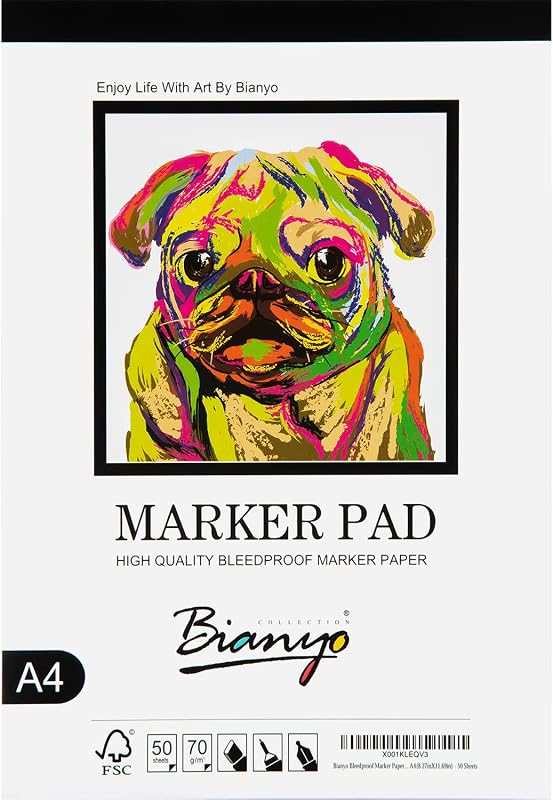
Bianyo A4 Bleedproof Marker Paper Pad (opens Amazon in a new tab)
A lightweight 50-sheet A4 pad that uses a coated reverse to help keep marker color from passing through
Why it fits this guide
Bianyo is useful when you prefer the A4 format and care more about protecting the reverse than coloring on both sides. Its construction is intentionally asymmetric: the drawing side is smooth and the reverse has the barrier treatment. That makes it a practical one-sided page for alcohol-marker coloring, but buyers need to understand that the coating is not a bonus second coloring surface.
Honest drawback
Only the intended drawing side should be treated as usable artwork space; the reverse coating is there for bleed control rather than two-sided coloring
Best forOne-sided alcohol-marker coloring and A4 line art
Pros
- Convenient A4 sheet size
- Reverse-side coating is designed around bleed control
- Lightweight pad is easy to store and carry
Cons
- Backside is not intended for drawing
- Thin stock is less rigid than heavyweight marker paper
Bee Paper Artist Marker Paper 8.5x11 (opens Amazon in a new tab)
Fifty smooth 8.5x11 loose marker sheets in a heavyweight 110 lb format

Why it fits this guide
Bee Paper gives you a very different workflow from a bound pad. The sheets are already loose, so it is easy to place one on a light box, turn it while coloring, scan it after finishing, or move it into a portfolio. The heavier stock also gives completed pages more physical presence than translucent layout paper.
Honest drawback
Loose sheets are less convenient for travel, and heavyweight paper should not be treated as automatically immune to every level of alcohol-marker saturation
Best forFinished marker pages you want to scan, store or frame individually
Pros
- Heavy 110 lb marker paper
- Letter-size loose format is easy to scan or mount
- Smooth surface is intended for marker and ink work
Cons
- Needs separate storage or a portfolio
- Heavyweight does not remove the need to test your exact markers
Bienfang Graphics 360 Marker Paper 9x12 (opens Amazon in a new tab)
A 100-sheet ultra-smooth translucent pad for permanent and watercolor marker work

Why it fits this guide
Bienfang Graphics 360 makes sense when you are practicing techniques rather than trying to create a thick final page. Its translucent surface helps with tracing and design transfer, while the large sheet count gives you space to test palettes, repeat blends and practice shadow placement without treating each sheet as precious.
Honest drawback
The 60 gsm paper is intentionally thin and translucent, so finished coloring pages can feel delicate unless you mount or back them
Best forTracing, swatches, marker studies and repeated technique practice
Pros
- 100 sheets suit frequent practice
- Translucent paper is useful for tracing line art
- Designed for permanent and watercolor markers
Cons
- Thin 60 gsm construction
- Less substantial for finished artwork
Shuttle Art 180 gsm Marker Pad 8.9x8.3 (opens Amazon in a new tab)
A 40-sheet 180 gsm marker pad with a smooth surface, perforated pages and an included protective sheet

Why it fits this guide
Shuttle Art is the practical portable option. The page tears down to a roughly square format that works well for compact illustrations and social-friendly artwork, while the 180 gsm sheet is specifically positioned for beginner alcohol-marker drawing. The included transparent backing sheet is also a sensible touch for anyone still learning how much ink a marker can deposit.
Honest drawback
Forty sheets is modest compared with the 100-sheet value pads, and the square format does not match common letter-size or A4 printable coloring files
Best forBeginners who want heavyweight marker paper in a compact spiral format
Pros
- 110 lb/180 gsm smooth marker paper
- Spiral binding with perforated easy-tear pages
- Includes a transparent backing sheet
Cons
- Only 40 sheets
- Square format is less convenient for standard printable pages
Canson XL Bristol Smooth 9x12 (opens Amazon in a new tab)
A sturdy 260 gsm smooth Bristol pad that supports marker, pen, pencil and colored-pencil work

Why it fits this guide
Canson XL Bristol is not the purest alcohol-marker paper in this list, but it earns a place because many coloring workflows mix media. A smooth Bristol surface can take marker fills and then give colored pencils or fineliners a substantial sheet to work on. It is the better choice when the finished page matters as much as maximizing marker-specific bleed resistance.
Honest drawback
The paper is not marketed as dedicated No Show-Thru alcohol-marker stock, so heavy marker saturation can still require a barrier sheet underneath
Best forMixed-tool coloring that combines marker base layers with pencil detail or shading
Pros
- Heavy 100 lb/260 gsm construction
- Smooth bright-white surface supports markers and dry media
- Sturdy enough for finished artwork and mixed-tool coloring
Cons
- Only 25 sheets
- Not dedicated bleedproof alcohol-marker paper
Hammermill Premium Color Copy Cover 60 lb (opens Amazon in a new tab)
A 250-sheet letter-size 60 lb cover stock designed for high-quality color printing rather than dedicated marker use

Why it fits this guide
Hammermill solves a different problem: getting your own digital coloring pages onto paper that feels sturdier than ordinary office copy stock. The 8.5x11 format and 250-sheet ream are practical for repeated printing, and the bright white surface is intended for high-quality color output. It is especially attractive for water-based markers or lighter marker applications where printability matters most.
Honest drawback
This is printer-oriented cover paper, not purpose-made bleedproof marker paper, so alcohol markers can still bleed through when you build up wet layers
Best forHome-printing line art on sturdier paper before coloring with markers
Pros
- 250 sheets are practical for frequent printable coloring pages
- 60 lb cover stock is sturdier than ordinary copy paper
- Letter-size format works with common home printers
Cons
- Not dedicated bleedproof marker paper
- Printer compatibility with 60 lb cover stock should be checked first
Related guides
Best Brush Markers for Coloring Books: 10 Picks for Shading & Blending
Find the best brush markers for coloring books, including water-based and alcohol picks for shading, blending, fine details, and bold fills.
Best Coloring Supplies for Adults: Markers, Pencils, Gel Pens & More
The best coloring supplies for adults, including markers, colored pencils, gel pens, fineliners, and watercolor pencils for different papers and styles.
Best Markers for Coloring Books: 10 Picks for Adults & Kids
The best markers for coloring books, from washable sets to dual-tip and alcohol markers. Compare tip control, bleed risk, and the best use for each.
Best Alcohol Markers for Coloring Books: 10 Sets for Smooth Blending
The best alcohol markers for coloring books, from brush-tip starter sets to refillable Copic options. Compare tips, colors, blending, and bleed-through.


