
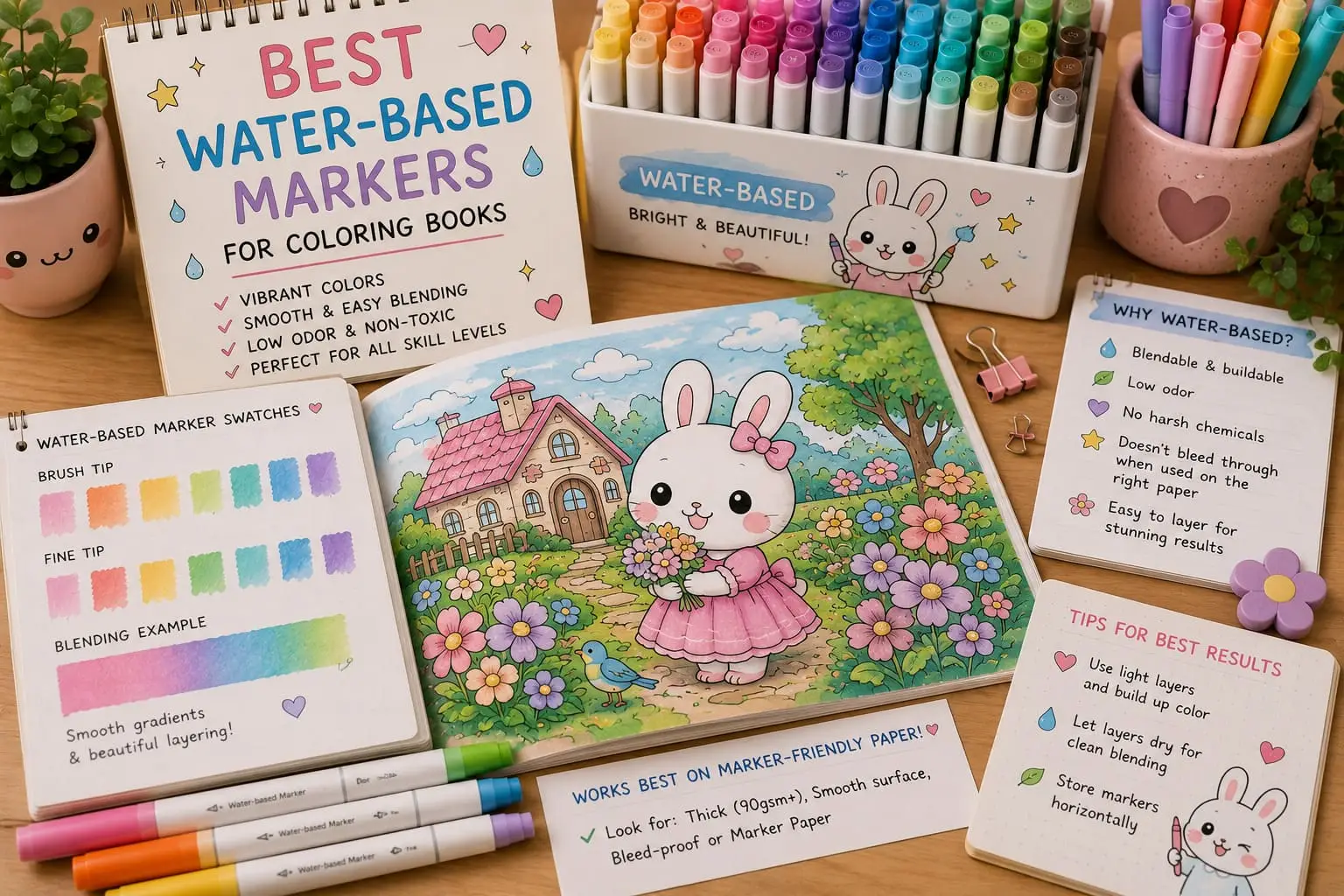
Quick picks
- Best budget color rangeCrayola Super Tips Washable Markers 100 Count (opens Amazon in a new tab)
- Best for tiny detailsSTAEDTLER Triplus Fineliner 60 Colors (opens Amazon in a new tab)


Product comparison
| Product | Best for | Watch out | Price & shop |
|---|---|---|---|
| Ohuhu Maui 60-Color Water-Based Markers (opens Amazon in a new tab) Best overallResearch-based review | Adult coloring books that mix intricate details with medium and larger shapes | The Amazon listing itself cautions that thin paper can still bleed, so the water-based formula should not be treated as a guarantee on lightweight or heavily layered coloring pages | |
| Crayola Super Tips Washable Markers 100 Count (opens Amazon in a new tab) Best budget color rangeResearch-based review | Families and colorists who want many washable colors without paying for artist-grade brush markers | The single Super Tip is less precise in tiny coloring-book spaces than a dedicated 0.3 or 0.4 mm fineliner, and repeated passes can still saturate thin stock | Budget-friendlyCheck price on Amazon (opens Amazon in a new tab) |
| Tombow Dual Brush Marker 10-Piece Set: Primary (opens Amazon in a new tab) Best for blendingResearch-based review | Colorists who want brush control, fine details, and water-based blending from the same marker | The 10-piece Primary set offers a small palette compared with the larger collections here, and wet blending can overwork thin coloring-book paper | |
| STAEDTLER Triplus Fineliner 60 Colors (opens Amazon in a new tab) Best for tiny detailsResearch-based review | Mandalas, patterned pages, miniature shapes, and intricate adult coloring books | A 0.3 mm point is deliberately narrow, so coloring large skies, walls, clothing, or other open areas takes much longer than using a brush or Super Tip | |
| Paper Mate Flair Felt Tip Pens 12 Count (opens Amazon in a new tab) Best low-bleed everyday pickResearch-based review | Small shapes, doodles, and coloring pages where controlled ink laydown matters more than a huge palette | Twelve colors provide limited shade depth, and the writing-pen format becomes tedious on broad backgrounds | Budget-friendlyCheck price on Amazon (opens Amazon in a new tab) |
| BIC Intensity Fineliner Marker Pens 24 Count (opens Amazon in a new tab) Best precise low-bleed finelinerResearch-based review | Fine patterns and small coloring areas where a narrow line and lower saturation are useful | The 0.4 mm point is excellent for precision but inefficient for filling broad areas, and paper-dependent bleed performance still needs to be tested in each book | Budget-friendlyCheck price on Amazon (opens Amazon in a new tab) |
| Zebra Mildliner No Bleed Brush Pens 25 Pack (opens Amazon in a new tab) Best soft colorsResearch-based review | Calm palettes, pastel-adjacent coloring, and pages where translucent color is preferable to heavy saturation | The muted translucent palette will not satisfy colorists who want dense, highly saturated fills, and repeated brush layers can still increase show-through on thin paper | |
| ARTEZA Real Brush Pens 48 Colors (opens Amazon in a new tab) Best watercolor-style brush pensResearch-based review | Heavier coloring paper and colorists who want gradients, washes, and expressive brush effects | Watercolor-style blending adds moisture, so thin or double-sided paper can warp, pill, feather, or bleed if you work the same area repeatedly | |
| Faber-Castell Pitt Artist Dual Markers 20 Colors (opens Amazon in a new tab) Best premium pickResearch-based review | Adult colorists who want premium dual tips and permanent water-based India ink | The set is expensive for 20 colors, and permanent ink is less forgiving if you accidentally cross a printed outline | |
| Tombow TwinTone Marker Set Bright 12-Pack (opens Amazon in a new tab) Best for double-sided pagesResearch-based review | Doodle-style and double-sided books where lighter ink laydown matters more than maximum saturation | The Bright set contains only 12 colors and is more writing-and-journaling oriented than a large artist marker collection | Budget-friendlyCheck price on Amazon (opens Amazon in a new tab) |
Detailed product sections
Ohuhu Maui 60-Color Water-Based Markers (opens Amazon in a new tab)
A 60-color water-based set pairing a 0.4 mm fineliner with a flexible 1–6 mm brush tip

Why it fits this guide
Ohuhu's Maui 60-color set is the most versatile all-round choice in this shortlist because each marker gives you two genuinely different tools. The fine tip can stay inside detailed printed outlines, while the brush end can cover petals, clothing, leaves, and other medium-sized shapes more efficiently. The large palette also reduces the need to buy a second set immediately.
Honest drawback
The Amazon listing itself cautions that thin paper can still bleed, so the water-based formula should not be treated as a guarantee on lightweight or heavily layered coloring pages
Best forAdult coloring books that mix intricate details with medium and larger shapes
Pros
- 60 colors provide broad shade variety in one set
- Dual tips combine a 0.4 mm fineliner with a flexible 1–6 mm brush
- Water-based, acid-free and odorless ink suits varied creative use
Cons
- Thin paper can still bleed or show through when saturated
- Flexible brush tips require more control than a fixed bullet nib
Crayola Super Tips Washable Markers 100 Count (opens Amazon in a new tab)
A 100-color washable water-based set with versatile Super Tips for thicker and thinner strokes

Why it fits this guide
Crayola Super Tips make sense when palette size, washability, and value matter more than having separate brush and fine tips. The 100-color assortment gives you far more ready-to-use shades than most inexpensive writing-marker packs, and the shaped tip can change line width depending on how it meets the paper.
Honest drawback
The single Super Tip is less precise in tiny coloring-book spaces than a dedicated 0.3 or 0.4 mm fineliner, and repeated passes can still saturate thin stock
Best forFamilies and colorists who want many washable colors without paying for artist-grade brush markers
Pros
- 100 assorted colors give strong palette variety
- Washable water-based ink is practical for family craft tables
- Tip can produce thicker and thinner strokes
Cons
- Less micro-detail control than a dedicated fineliner
- Heavy layering can still increase show-through or bleed risk
Tombow Dual Brush Marker 10-Piece Set: Primary (opens Amazon in a new tab)
A compact blendable set with flexible brush and fine tips for coloring, illustration, and watercolor-style effects

Why it fits this guide
Tombow Dual Brush Pens are built around technique rather than maximum color count. The flexible brush tip is useful for variable-width fills and gradients, while the fine tip handles small printed areas and outlines. The water-based ink is designed to blend, which makes this set useful when you want to create transitions rather than simply place flat color.
Honest drawback
The 10-piece Primary set offers a small palette compared with the larger collections here, and wet blending can overwork thin coloring-book paper
Best forColorists who want brush control, fine details, and water-based blending from the same marker
Pros
- Flexible brush tip and fine tip cover two different coloring jobs
- Water-based ink is designed to blend
- Acid-free and odorless formulation
Cons
- Small palette requires more sets for broad shade variety
- Wet techniques are better suited to sturdier paper
STAEDTLER Triplus Fineliner 60 Colors (opens Amazon in a new tab)
Sixty water-based colors delivered through a precise 0.3 mm fineliner point

Why it fits this guide
STAEDTLER Triplus Fineliner is the specialist pick when the printed spaces are too small for a brush or broad marker. The 0.3 mm point gives controlled placement around narrow borders, geometric patterns, and detailed line art, while the 60-color assortment provides more shade choice than most conventional fineliner packs.
Honest drawback
A 0.3 mm point is deliberately narrow, so coloring large skies, walls, clothing, or other open areas takes much longer than using a brush or Super Tip
Best forMandalas, patterned pages, miniature shapes, and intricate adult coloring books
Pros
- 0.3 mm point is well suited to intricate printed details
- 60 colors provide broad variety for a fineliner set
- Water-based ink and dry-safe design support everyday creative use
Cons
- Very slow for large areas
- Fixed fineliner point cannot create expressive brush strokes
Paper Mate Flair Felt Tip Pens 12 Count (opens Amazon in a new tab)
A familiar 0.7 mm felt-tip pen with water-based ink marketed to resist bleeding through paper

Why it fits this guide
Paper Mate Flair is not a dedicated artist-marker system, but that restraint can be useful on coloring-book paper. The 0.7 mm point is easier to control than a broad brush, and the current product information specifically emphasizes bleed-through resistance. It is a practical choice when you want basic assorted colors for detail work without a highly saturated alcohol-marker feel.
Honest drawback
Twelve colors provide limited shade depth, and the writing-pen format becomes tedious on broad backgrounds
Best forSmall shapes, doodles, and coloring pages where controlled ink laydown matters more than a huge palette
Pros
- 0.7 mm medium point is controllable in many printed shapes
- Water-based ink is marketed for reduced bleed-through on paper
- Compact set is easy to store and carry
Cons
- Only 12 assorted colors
- Medium felt tip is slow for large fills
BIC Intensity Fineliner Marker Pens 24 Count (opens Amazon in a new tab)
Twenty-four water-based colors with a metal-supported 0.4 mm fineliner tip

Why it fits this guide
BIC Intensity Fineliner combines a useful 24-color range with a narrow 0.4 mm point, making it easier to place color into tiny shapes without repeatedly touching the surrounding outline. The listing also calls out bleed-through resistance while acknowledging that results can vary with paper characteristics, which is the right caveat for coloring books.
Honest drawback
The 0.4 mm point is excellent for precision but inefficient for filling broad areas, and paper-dependent bleed performance still needs to be tested in each book
Best forFine patterns and small coloring areas where a narrow line and lower saturation are useful
Pros
- 0.4 mm point offers strong control for small shapes and patterns
- 24 assorted colors give more variety than basic writing sets
- Water-based ink is marketed for bleed-through control
Cons
- Fine line is slow for backgrounds and large shapes
- Results can vary with paper characteristics and saturation
Zebra Mildliner No Bleed Brush Pens 25 Pack (opens Amazon in a new tab)
Twenty-five mild water-based colors with a brush tip and fine tip in each marker

Why it fits this guide
Zebra Mildliner is useful when a traditional marker palette feels too loud. Its softer colors can work particularly well for cozy illustrations, journals, botanical pages, and understated backgrounds, while the dual-tip design lets you switch between brush strokes and smaller details without changing pens.
Honest drawback
The muted translucent palette will not satisfy colorists who want dense, highly saturated fills, and repeated brush layers can still increase show-through on thin paper
Best forCalm palettes, pastel-adjacent coloring, and pages where translucent color is preferable to heavy saturation
Pros
- Dual tips support both brush strokes and finer details
- 25 soft colors create a calmer palette than many bright sets
- Amazon product information identifies the ink base as water
Cons
- Muted colors do not suit every illustration style
- Layering can still increase paper saturation
ARTEZA Real Brush Pens 48 Colors (opens Amazon in a new tab)
Forty-eight water-based colors with flexible nylon brush tips for watercolor-style coloring

Why it fits this guide
ARTEZA Real Brush Pens are the most painting-oriented option in this guide. Their flexible nylon tips can create tapered strokes, broader fills, and watercolor-style transitions, and the 48-color palette gives you enough range to use them without constant color mixing. They are a better fit for sturdy single-sided pages than delicate mass-market coloring stock.
Honest drawback
Watercolor-style blending adds moisture, so thin or double-sided paper can warp, pill, feather, or bleed if you work the same area repeatedly
Best forHeavier coloring paper and colorists who want gradients, washes, and expressive brush effects
Pros
- 48 colors provide a broad watercolor-style palette
- Flexible nylon brush tips support expressive strokes and gradients
- Amazon product information identifies the ink base as water
Cons
- Better suited to sturdier stock than very thin coloring pages
- Brush control has a learning curve in tiny enclosed details
Faber-Castell Pitt Artist Dual Markers 20 Colors (opens Amazon in a new tab)
Twenty highly pigmented colors with a flexible brush tip and a 0.8 mm fiber tip

Why it fits this guide
Faber-Castell Pitt Artist Dual Markers are the premium choice for finished artwork rather than casual disposable coloring. Their water-based India ink is designed to become waterproof when dry, and the two tips cover broad artistic strokes plus controlled details. The current listing also says the ink will not bleed through most paper, although that still needs to be treated as paper-dependent guidance rather than a universal guarantee.
Honest drawback
The set is expensive for 20 colors, and permanent ink is less forgiving if you accidentally cross a printed outline
Best forAdult colorists who want premium dual tips and permanent water-based India ink
Pros
- Flexible brush and 0.8 mm fiber tips cover broad and detailed work
- Water-based India ink is acid-free, pH neutral and waterproof when dry
- Listing states the ink will not bleed through most paper
Cons
- Premium cost for a 20-color palette
- Permanent ink leaves less room for correction
Tombow TwinTone Marker Set Bright 12-Pack (opens Amazon in a new tab)
Twelve bright water-based dual-tip markers designed to sit lightly on paper without heavy saturation

Why it fits this guide
Tombow TwinTone is a useful specialist when you want a marker that behaves more like a precise journaling pen than a juicy art brush. The broad bullet and extra-fine tips cover two line widths, and Tombow describes the water-based ink as sitting lightly on paper and resisting bleed-through on most papers. That makes it a sensible research pick for double-sided books, provided you still test the exact stock first.
Honest drawback
The Bright set contains only 12 colors and is more writing-and-journaling oriented than a large artist marker collection
Best forDoodle-style and double-sided books where lighter ink laydown matters more than maximum saturation
Pros
- Broad bullet and extra-fine tips support thick and precise lines
- Water-based ink is designed to dry quickly without heavily saturating paper
- Compact set is easy to add to a larger coloring kit
Cons
- Only 12 colors in the Bright set
- Less coverage and shade depth than larger coloring-marker sets
Related guides
Best Alcohol Markers for Coloring Books: 10 Sets for Smooth Blending
The best alcohol markers for coloring books, from brush-tip starter sets to refillable Copic options. Compare tips, colors, blending, and bleed-through.
Best Brush Markers for Coloring Books: 10 Picks for Shading & Blending
Find the best brush markers for coloring books, including water-based and alcohol picks for shading, blending, fine details, and bold fills.
Best Colored Pencils for Adult Coloring Books: 10 Smooth, Blendable Sets
Compare 10 colored-pencil sets for adult coloring books by core feel, color range, detail control, layering, paper fit, storage and replacement options.
Best Coloring Books for Alcohol Markers: Thick, Single-Sided Picks
Six research-based coloring books for alcohol markers, compared by single-sided layout, documented paper stock, perforations, binding and artwork detail.


