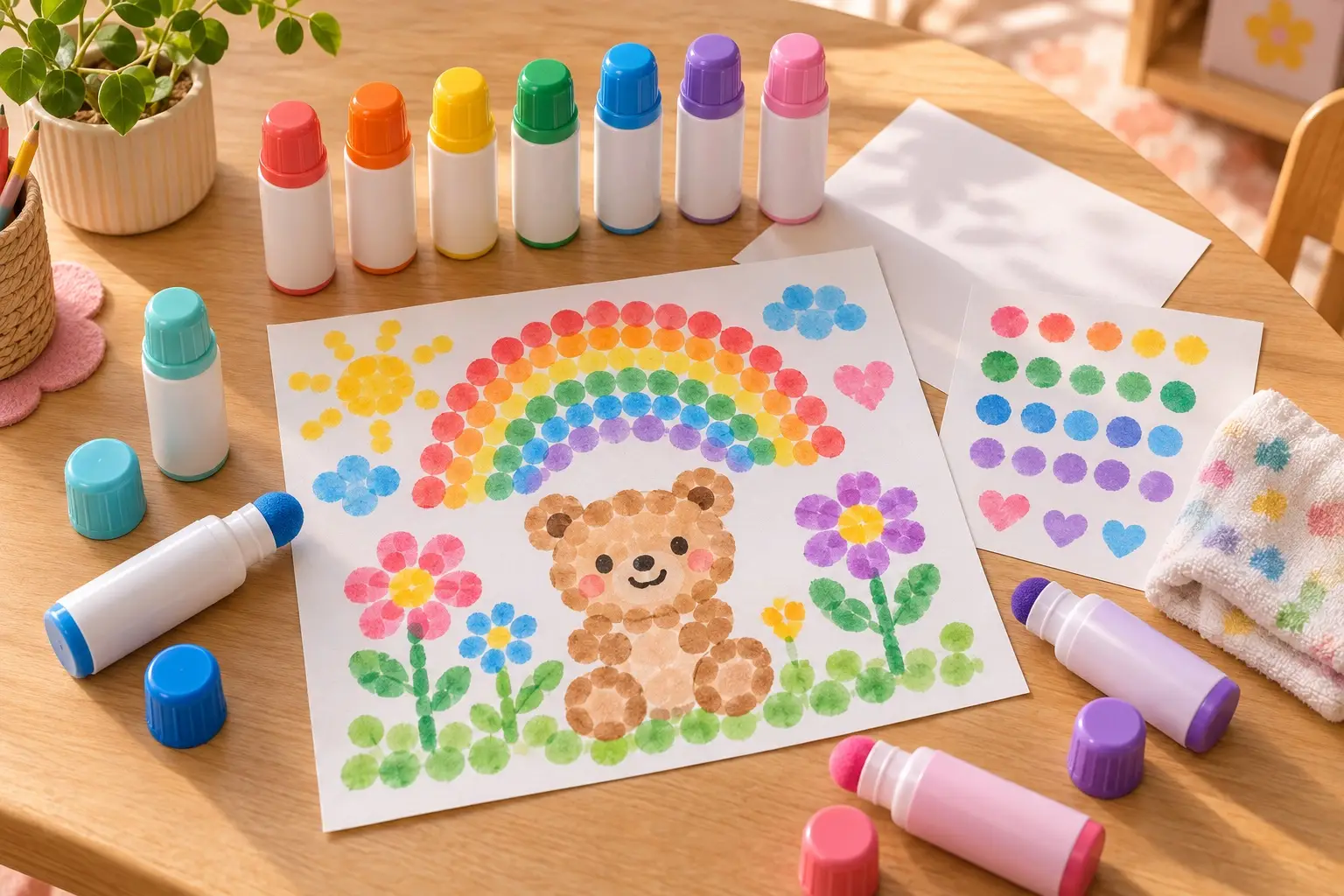
Best Dot Markers for Toddlers and Preschoolers. Seven research-based dot marker sets for toddlers and preschoolers, compared by age guidance, grip, color count, activity pages and cleanup claims.. Type: Buying guide. Category: Coloring. Tags: dot-markers, toddler-art-supplies, preschool-art, washable-markers, fine-motor-activities, screen-free-activities, buying-guide, cluster-coloring-supplies.

Buying guide

Best Dot Markers for Toddlers and Preschoolers

Our recommendation

Do A Dot Art Rainbow 6 is our best research-based dot marker set for most preschoolers ages 3+ because its six useful rainbow colors, full-size easy-grip bottles and spill-resistant sponge tips make it a balanced first set. For a child who is 2, Chalkola 6 is the only pick here whose current manufacturer page explicitly starts at age 2, but it still requires close supervision. Choose the Crayola Activity Set when you want ready-made learning pages, Shuttle Art 15 for more colors, or the Shuttle Art 14-marker bundle for siblings and classrooms. Dot markers are washable art tools, not mess-free toys: follow the exact package age label, count caps and protect the table.

Quick picks

Top recommendations

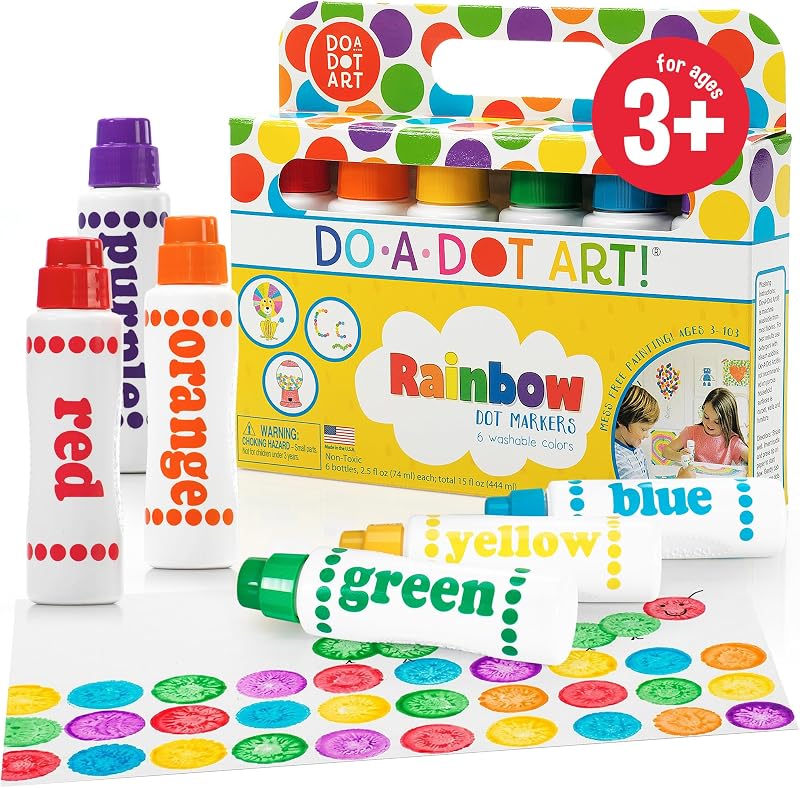
  1. 1Do A Dot Art! Rainbow Washable Paint Markers, 6 Count — Best overallSix classic washable colors in easy-grip 2.5-ounce bottles with spill-resistant sponge tips
  2. 2Chalkola Washable Dot Markers for Toddlers, 6 Count — Best for age 2+Six chunky washable dot markers with a current maker-stated minimum of age 2 and printable activities
  3. 3Crayola Washable Dot Markers Activity Set — Best first activity kitFour full-size washable dot markers paired with 30 pages for letters, numbers, colors and shapes
  4. 4Shuttle Art Washable Dot Markers, 15 Colors — Best color rangeFifteen washable colors in compact bottles with access to downloadable pattern pages
  5. 5Shuttle Art Dot Markers with Five Activity Books, 14 Colors — Best big activity bundleFourteen washable dot markers with five themed books containing 135 patterns
  6. 6Jar Melo Washable Dot Markers for Toddlers, 6 Colors — Best large-capacity kitSix 60 mL washable dot markers with 10 printed sheets and a downloadable activity library
  7. 7Do A Dot Art! Ultra Bright Shimmer Dot Markers, 5 Count — Best shimmer setFive pastel-bright shimmer colors in the same full-size washable Do A Dot format

Product comparison

ProductBest forWatch outPrice & shop
Do A Dot Art! Rainbow Washable Paint Markers, 6 Count (opens Amazon in a new tab)Do A Dot Art! · Rainbow Washable 6-Pack
Best overallResearch-based review
Preschoolers ages 3+ who need one balanced full-size rainbow setIt is not labeled for children under 3, and six dot colors cannot make narrow lines or cover every ordinary coloring-book job
Chalkola Washable Dot Markers for Toddlers, 6 Count (opens Amazon in a new tab)Chalkola · Toddler Starter 6-Pack
Best for age 2+Research-based review
Closely supervised two-year-olds who need explicit current manufacturer age guidanceA 2+ label does not make caps, mouthing, wet ink or off-paper stamping safe without an adult beside the child
Crayola Washable Dot Markers Activity Set (opens Amazon in a new tab)Crayola · Item 811494, 4 Markers and 30 Activity Pages
Best first activity kitResearch-based review
Ages 3+ who benefit from an obvious page-and-marker starting pointFour colors limit open-ended pictures, and the value of the kit drops after the 30 consumable pages are finished
Shuttle Art Washable Dot Markers, 15 Colors (opens Amazon in a new tab)Shuttle Art · 15-Color Standard Dot Marker Set
Best color rangeResearch-based review
Preschoolers who want more shades without an oversized activity bundleThe current maker and Amazon pages market the set to toddlers and preschoolers but do not state a precise minimum age, and each compact bottle holds much less ink than a full-size marker
Shuttle Art Dot Markers with Five Activity Books, 14 Colors (opens Amazon in a new tab)Shuttle Art · 14 Markers, 5 Books and 135 Patterns
Best big activity bundleResearch-based review
Siblings, preschool groups and families that want many prepared pagesIt needs much more storage than a six-marker starter set, can overwhelm a new user and lacks a precise published minimum age on the current pages
Jar Melo Washable Dot Markers for Toddlers, 6 Colors (opens Amazon in a new tab)Jar Melo · 60 mL 6-Color Set with Activity Pages
Best large-capacity kitResearch-based review
Ages 3+ who repeatedly use a small core paletteSix large bottles are bulky in a travel bag, and the basic palette offers less color choice than the Shuttle Art alternatives
Do A Dot Art! Ultra Bright Shimmer Dot Markers, 5 Count (opens Amazon in a new tab)Do A Dot Art! · Ultra Bright Shimmer 5-Pack
Best shimmer setResearch-based review
Ages 3+ adding sparkle accents after buying a standard rainbow setThe five-color pastel shimmer palette omits several basic rainbow colors and should be treated as an add-on rather than a child's first dot-marker box

Selection and testing methodology

This is a research-based buying guide, not a hands-on toddler-use or stain test. On September 8, 2026, we opened the exact Amazon.com detail page for every recommendation in a US delivery context, confirmed its ASIN, found a current in-stock offer with add-to-cart and buy-now controls, and matched the selected variant to its direct high-resolution Amazon CDN image. We cross-checked age guidance, count, bottle format, included pages, washable claims and safety statements against current Do A Dot Art, Crayola, Chalkola, Shuttle Art and Jar Melo sources. We favored sets that solve distinct jobs without turning small differences into invented performance rankings. We did not give these markers to children, measure grip comfort, dot diameter, ink capacity beyond documented specifications, drying time, leakage, bleed-through, color strength, cap fit or stain removal. Cleanup and ease of use depend on the exact formula, surface, paper, child and supervision, so all recommendations remain explicitly research-based.

Detailed product sections

Best overallResearch-based review

Do A Dot Art! Rainbow Washable Paint Markers, 6 Count (opens Amazon in a new tab)

Do A Dot Art! · Rainbow Washable 6-Pack

Six classic washable colors in easy-grip 2.5-ounce bottles with spill-resistant sponge tips

Why it fits this guide

The Rainbow 6 set covers the most common first activities without asking a child to manage a huge palette. Red, orange, yellow, green, blue and purple work for color matching, simple patterns, letters and open-ended pictures. Do A Dot Art publishes a clear ages-3+ minimum, a washable dye-based formula and ASTM D-4236 conformance. The full-size bottles are deliberately shaped for little hands, and the sponge tip keeps paint in the marker rather than an open cup.

Honest drawback

It is not labeled for children under 3, and six dot colors cannot make narrow lines or cover every ordinary coloring-book job

Specifications

  • Exact Rainbow 6 Amazon ASIN was in stock in a US delivery context on September 8, 2026
  • Six classic colors in 2.5-ounce bottles
  • Do A Dot Art specifies ages 3+ with supervision and ASTM D-4236 conformance

Best forPreschoolers ages 3+ who need one balanced full-size rainbow set

Pros

  • Useful first rainbow palette
  • Full-size easy-grip bottles
  • Spill-resistant sponge tips require no paint cups or brushes

Cons

  • Not labeled for children under 3
  • Specialized tips cannot draw fine lines
Check price on Amazon (opens Amazon in a new tab)
Best for age 2+Research-based review

Chalkola Washable Dot Markers for Toddlers, 6 Count (opens Amazon in a new tab)

Chalkola · Toddler Starter 6-Pack

Six chunky washable dot markers with a current maker-stated minimum of age 2 and printable activities

Why it fits this guide

Age guidance is the deciding feature here. Chalkola's current product page specifically states ages 2+, while the other clearly dated products in this guide begin at 3 or leave the minimum unclear. Six bright colors keep the first setup small, and the maker provides downloadable pages built around standard dot activities. This is a better evidence match for a two-year-old than relying on a vague toddler phrase elsewhere.

Honest drawback

A 2+ label does not make caps, mouthing, wet ink or off-paper stamping safe without an adult beside the child

Specifications

  • Exact six-count Amazon ASIN was in stock in a US delivery context on September 8, 2026
  • Six washable water-based dot markers with chunky barrels
  • Chalkola's current product page specifies ages 2+ and downloadable activity pages

Best forClosely supervised two-year-olds who need explicit current manufacturer age guidance

Pros

  • Clearest current age fit for supervised two-year-olds
  • Manageable six-color palette
  • Printable pages support simple first activities

Cons

  • Still demands direct adult supervision
  • Smaller palette than preschool-focused sets
Check price on Amazon (opens Amazon in a new tab)
Best first activity kitResearch-based review

Crayola Washable Dot Markers Activity Set (opens Amazon in a new tab)

Crayola · Item 811494, 4 Markers and 30 Activity Pages

Four full-size washable dot markers paired with 30 pages for letters, numbers, colors and shapes

Why it fits this guide

This set removes the blank-page problem. The 30 included pages give a preschooler large, recognizable targets from the first session, and four colors keep the table simple. Crayola publishes the exact item number, marker volume, activity count, ages-3+ guidance and a formula-specific washability claim covering skin, most washable clothing and most painted walls. It is the easiest gift when the adult does not want to find or print separate dot pages.

Honest drawback

Four colors limit open-ended pictures, and the value of the kit drops after the 30 consumable pages are finished

Specifications

  • Exact Crayola item 811494 Amazon ASIN was in stock in a US delivery context on September 8, 2026
  • Four 2.5-ounce washable dot markers and 30 activity pages
  • Crayola specifies ages 3+

Best forAges 3+ who benefit from an obvious page-and-marker starting point

Pros

  • Complete first activity in one box
  • Low color count is easy to manage
  • Manufacturer publishes precise cleanup and age guidance

Cons

  • Only four colors
  • Included pages are consumable
Check price on Amazon (opens Amazon in a new tab)
Best color rangeResearch-based review

Shuttle Art Washable Dot Markers, 15 Colors (opens Amazon in a new tab)

Shuttle Art · 15-Color Standard Dot Marker Set

Fifteen washable colors in compact bottles with access to downloadable pattern pages

Why it fits this guide

Shuttle Art 15 is the palette upgrade. It adds intermediate colors, neutrals and black without requiring five physical books or a classroom quantity. The compact 0.42-ounce bottles are lighter and take less room than the full-size alternatives, so the set suits a child who values choice more than maximum ink per color. A QR card links to printable dot patterns when a blank sheet feels too open-ended.

Honest drawback

The current maker and Amazon pages market the set to toddlers and preschoolers but do not state a precise minimum age, and each compact bottle holds much less ink than a full-size marker

Specifications

  • Exact 15-color Amazon ASIN was in stock in a US delivery context on September 8, 2026
  • Fifteen washable colors in compact 0.42-ounce bottles
  • Downloadable patterns are available through the included QR card

Best forPreschoolers who want more shades without an oversized activity bundle

Pros

  • Broadest marker-only palette in this guide
  • Compact bottles are light and space-efficient
  • Includes access to printable pattern activities

Cons

  • No precise minimum age on current pages
  • Less ink per color than full-size bottles
Check price on Amazon (opens Amazon in a new tab)
Best big activity bundleResearch-based review

Shuttle Art Dot Markers with Five Activity Books, 14 Colors (opens Amazon in a new tab)
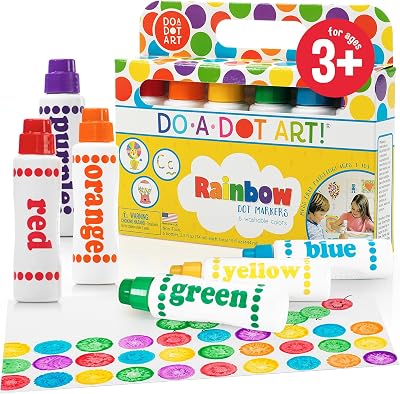
Shuttle Art · 14 Markers, 5 Books and 135 Patterns

Fourteen washable dot markers with five themed books containing 135 patterns

Why it fits this guide

The five books make this the most substantial ready-to-use library in the guide. Their themes include letters, numbers, animals, foods and vehicles, so an adult can choose a page that matches the child's current interest. Fourteen colors add enough variety for matching and repeating patterns. The bundle makes most sense when several children will share it or when dot pages are already a proven favorite.

Honest drawback

It needs much more storage than a six-marker starter set, can overwhelm a new user and lacks a precise published minimum age on the current pages

Specifications

  • Exact 14-marker and five-book Amazon ASIN was in stock in a US delivery context on September 8, 2026
  • Five themed books contain 135 activity patterns
  • Fourteen washable colors with ASTM D-4236-conforming ink according to Shuttle Art

Best forSiblings, preschool groups and families that want many prepared pages

Pros

  • Large library of immediately usable pages
  • Enough colors for matching and varied pictures
  • Practical for siblings or small groups

Cons

  • Bulky for one occasional user
  • No precise minimum age on current pages
Check price on Amazon (opens Amazon in a new tab)
Best large-capacity kitResearch-based review

Jar Melo Washable Dot Markers for Toddlers, 6 Colors (opens Amazon in a new tab)

Jar Melo · 60 mL 6-Color Set with Activity Pages

Six 60 mL washable dot markers with 10 printed sheets and a downloadable activity library

Why it fits this guide

Jar Melo keeps the palette simple while emphasizing capacity. Each current listing bottle holds 60 mL, or 2.1 fluid ounces, which is close to a full-size Do A Dot or Crayola bottle and far more than the compact Shuttle Art 15 markers. Ten physical pages make the set usable immediately, while the downloadable library extends it. Jar Melo's current site places its washable dot markers in the 3+ range.

Honest drawback

Six large bottles are bulky in a travel bag, and the basic palette offers less color choice than the Shuttle Art alternatives

Specifications

  • Exact six-color Amazon ASIN was in stock in a US delivery context on September 8, 2026
  • Six 60 mL (2.1-fluid-ounce) dot markers
  • Ten physical activity sheets plus downloadable pages; current Jar Melo guidance is 3+

Best forAges 3+ who repeatedly use a small core palette

Pros

  • Large ink capacity per color
  • Printed and downloadable activities
  • Six-color setup remains manageable

Cons

  • Bulky for travel
  • Limited palette
Check price on Amazon (opens Amazon in a new tab)
Best shimmer setResearch-based review

Do A Dot Art! Ultra Bright Shimmer Dot Markers, 5 Count (opens Amazon in a new tab)

Do A Dot Art! · Ultra Bright Shimmer 5-Pack

Five pastel-bright shimmer colors in the same full-size washable Do A Dot format

Why it fits this guide

Ultra Bright Shimmer changes the finish without changing the familiar press-and-lift motion. Aqua, yellow, lavender, coral and magenta are well suited to cards, flowers, mermaids and seasonal pictures. The bottles retain the full-size 2.5-ounce format and the maker's 3+ supervision guidance. It is the strongest specialty choice here because the effect is visibly different, not because it performs ordinary rainbow jobs better.

Honest drawback

The five-color pastel shimmer palette omits several basic rainbow colors and should be treated as an add-on rather than a child's first dot-marker box

Specifications

  • Exact Ultra Bright Shimmer five-pack Amazon ASIN was in stock in a US delivery context on September 8, 2026
  • Five colors in full-size 2.5-ounce bottles
  • Do A Dot Art specifies ages 3+ with supervision

Best forAges 3+ adding sparkle accents after buying a standard rainbow set

Pros

  • Distinct shimmer finish for cards and accents
  • Full-size easy-grip bottles
  • Uses the same spill-resistant sponge-tip format as the Rainbow set

Cons

  • Incomplete palette for a first set
  • Only five colors
Check price on Amazon (opens Amazon in a new tab)

How to choose

  • Begin with the exact package age label, not the word toddler in a marketplace title. Most picks here are clearly 3+, while Chalkola currently publishes a 2+ minimum for its six-pack.
  • Choose a small palette for a first session. Four to six colors are easier to count and cap; fourteen or fifteen make more sense for an older preschooler, siblings or a classroom table.
  • Match the barrel to the activity. Full-size 2- to 2.5-ounce bottles are easy to wrap a hand around and hold more ink, while compact bottles take less space and feel lighter.
  • Decide whether you need pages. A marker-only set supports open-ended art, while an activity kit gives children obvious circles, letters, numbers or pictures to fill from the first session.
  • Treat washable as a formula- and surface-specific claim. Protect porous furniture, wallpaper, carpet, unfinished wood and clothing even when the marker is designed to clean from named surfaces.
  • Prefer standard rainbow colors for a first set. Shimmer and other special effects are useful additions only after the child has the basic red, yellow, green, blue and purple range.
  • Use sturdy single-sided paper with a scrap sheet underneath. Repeated dabs put more liquid in one place than a light crayon stroke and can soften or soak through thin pages.

Common mistakes

  • Buying a product for a one-year-old because an Amazon title says toddlers even though the maker gives a higher minimum age or no precise age at all.
  • Leaving all caps on the table during use instead of opening one marker at a time and counting caps immediately after the activity.
  • Assuming non-toxic means edible, suitable for face or body painting, or safe for unsupervised mouthing.
  • Giving a new user fifteen colors when four or six would create a calmer, easier-to-finish first activity.
  • Expecting a dot marker to trace narrow outlines or replace crayons and regular markers in a conventional coloring book.
  • Dotting repeatedly in one spot on thin paper, then blaming the marker when the page pills, buckles or bleeds through.
  • Promising stain-free furniture because the bottle says washable instead of following the maker's directions for the exact surface.
  • Choosing shimmer before buying a practical rainbow palette.

Dot markers turn painting into one very understandable motion: press, lift, repeat. That makes them inviting for toddlers and preschoolers who are not ready to steer a narrow felt tip through a small outline. A child can fill a circle, build a pattern or add spots to an animal without an open paint cup, brush or palette.

They are not automatically the safest or cleanest marker for every young child. Most of the clearly labeled sets we verified begin at age 3. Caps still need an adult’s attention. A concentrated dab can soak through thin paper, and the word washable does not promise that every sofa, rug or wall will return to normal.

For most preschoolers ages 3+, Do A Dot Art Rainbow 6 is our best research-based starting point. It has the basic colors children actually need, full-size easy-grip bottles and clear manufacturer guidance. For a two-year-old, Chalkola 6 is the only product in this guide whose current maker page explicitly begins at age 2—and even then, it belongs in a directly supervised table activity.

This guide compares seven exact sets that were available from Amazon.com on September 8, 2026. The ranking comes from current product documentation and listing verification, not from giving the markers to children or running stain, leak, grip or paper tests.

The short answer

  • Best overall for ages 3+: Do A Dot Art Rainbow 6
  • Best clearly labeled option for age 2+: Chalkola 6
  • Best first activity kit: Crayola Washable Dot Markers Activity Set
  • Best color range: Shuttle Art 15
  • Best big activity bundle: Shuttle Art 14 Markers with Five Books
  • Best large-capacity kit: Jar Melo 6
  • Best shimmer add-on: Do A Dot Art Ultra Bright Shimmer 5

If dot art is new, buy a small standard palette before a glittery or oversized set. Four to six colors are enough for matching, patterns, letters, simple animals and open-ended dabbing. A fourteen- or fifteen-color box earns its shelf space only when the child already enjoys the activity or several children will share it. For the crayons, markers and pencils that sit alongside dot art, see our kids’ coloring supplies guide.

Dot markers by age: read the package, not the headline

Marketplace titles use toddler loosely. One listing may put “toddlers 1–3” beside a product whose manufacturer says 2+. Another may say “kids and toddlers” without publishing a precise minimum age at all. Those phrases are search language, not a substitute for the label on the exact product.

For a supervised two-year-old

Among the products we verified, Chalkola Washable Dot Markers 6 has the clearest current evidence. Chalkola’s product page says ages 2+ and describes a water-based, non-toxic formula in chunky barrels.

That does not make it an independent-play supply. Sit beside the child, open one color at a time, keep every cap in your hand or in a small adult-controlled container, and end the session if the marker or cap goes toward the mouth. Use a short activity and a protected table rather than handing over the full box.

For ages 3 and up

Do A Dot Art Rainbow 6, Crayola’s Activity Set, Jar Melo 6 and Do A Dot Ultra Bright Shimmer 5 all have current 3+ maker guidance. This is the strongest part of the market: children can choose from straightforward rainbow sets, prepared activity pages, larger-capacity bottles or a special finish.

The Shuttle Art sets are currently marketed for toddlers and preschoolers, and their product pages describe child-focused safety standards and easy-grip formats, but we did not find a precise minimum age on the current pages. That uncertainty is a reason to check the package in hand and use them with preschoolers under close supervision—not to infer that they suit a younger toddler.

Why caps still matter

Dot markers are chunky, but their caps are separate objects. A product can have non-toxic ink and still be unsuitable for unsupervised play because a young child mouths objects, wanders with the marker or loses caps under the table.

Use a simple cap routine:

  1. Put only two or three colors on the table.
  2. The adult removes the first cap.
  3. The child dots while the adult holds or parks the cap.
  4. Recap that color before opening the next.
  5. Count caps and bottles before the child leaves the table.

What makes a good first dot marker?

A useful palette, not the biggest number

Red, yellow, green, blue and purple cover most first activities. Orange and pink are useful extras. A child learning to press a dot inside a large circle does not gain much from choosing among fifteen closely related shades.

That is why the six-color Do A Dot Rainbow and Chalkola sets rank above larger palettes for first use. The Crayola Activity Set goes smaller still with four colors, but compensates with 30 prepared pages.

The Shuttle Art 15 set becomes interesting when an older preschooler has moved beyond basic matching and wants varied pictures. It includes neutrals and intermediate colors, but it also creates fifteen bottles and caps to manage.

A barrel that fits the session

Full-size dot-marker bottles hold more liquid and give a small hand a broad cylinder to grasp. Do A Dot and Crayola list 2.5 ounces per marker, while the Jar Melo listing gives 60 mL, or 2.1 fluid ounces.

Compact markers trade capacity for lighter weight and smaller storage. The Shuttle Art 15 listing specifies 0.42-ounce bottles. That can be convenient in a small caddy, but a classroom or frequent user will reach the end of a favorite color sooner.

We have not measured the diameter, full weight or grip comfort of these bottles. “Easy grip” in this guide describes the documented chunky format, not an observed ergonomic result for a particular child.

A sponge tip that matches the paper

A broad sponge dauber is designed to stamp a circle when pressed vertically. It also holds liquid at the paper surface. A clean dot needs less force than many beginners expect.

Show one slow motion: touch, press gently, lift straight up. Twisting or grinding the tip can roughen the paper and spread the mark. Repeatedly hitting the same spot adds enough moisture to soften thin activity sheets.

Dot markers are poor tools for narrow outlines, tiny coloring-book eyes or handwriting practice. Keep chunky toddler crayons or ordinary washable markers nearby for lines, and use dotters for the large shapes and repeated marks they handle well.

Marker-only sets versus activity kits

Choose marker-only for open-ended play

Do A Dot Rainbow 6, Chalkola 6, Shuttle Art 15 and Do A Dot Ultra Bright Shimmer 5 focus on the markers. Some include access to downloadable pages, but the main value is a reusable art supply rather than a stack of consumable sheets.

These sets work well when you already own a dot activity book, print pages at home or prefer blank-paper prompts. Draw a large cloud and ask the child to add rain. Outline a tree and add dot leaves. Make the first three marks of a red-blue-red-blue pattern and let the child continue it.

Choose an activity kit for immediate structure

The Crayola Washable Dot Markers Activity Set is the simplest all-in-one beginning. Its 30 pages cover letters, numbers, colors and shapes, and four markers keep the table uncluttered.

Jar Melo 6 sits between a marker set and a kit: it includes ten physical sheets plus a larger downloadable library. Shuttle Art’s 14-marker bundle goes furthest, pairing the palette with five books and 135 patterns.

Prepared pages are useful, but they do not automatically create learning. Name the color, take turns, count a short row or talk about the picture. Stop before accuracy becomes a struggle. A cheerful five-minute activity is more age-appropriate than pushing a child to finish every circle.

Best dot-marker activities for toddlers and preschoolers

Color matching

Draw or print a row of large circles in two or three colors. Ask the child to place the matching marker on each circle. Start with widely separated targets so accidental overlap does not feel like failure.

Simple patterns

Begin with an AB pattern such as red-blue-red-blue. Move to AAB or ABB only when the child enjoys predicting what comes next. A line of six dots is enough for a first pattern; the goal is noticing the sequence, not filling a page.

Letter and number outlines

Write one large uppercase letter or numeral in a thick outline. The child can dot along the path or fill the interior. This is a recognition activity, not a claim that dotting teaches handwriting by itself.

Dot pictures

Large flowers, caterpillars, balloons, ladybugs, rainbows and tree canopies are natural fits. Use ordinary crayons for stems, faces and outlines, then add broad dot color. Combining tools keeps the dot marker in the role it handles best.

Collaborative paper

Tape a long sheet of sturdy paper to the table and assign each person two colors. One child makes a row; another continues it. This is a better use for a 14- or 15-color set than placing every bottle in front of one new user.

Paper, bleed-through and table setup

Dot markers can be low-setup without being mess-free. A single dab is controlled, but repeated dabs contain enough water-based ink to travel through absorbent paper. For trips and restaurants, our mess-free travel coloring picks rely on special paper or water instead.

Use:

  • sturdy single-sided activity pages;
  • cardstock for keepsake art;
  • a scrap sheet under every active page;
  • a washable mat or old cloth beneath the paper; and
  • a shallow tray or caddy that keeps bottles upright.

Avoid beginning on a double-sided coloring book unless you are willing to lose the reverse image. Test one dot on the back page, let it dry and inspect both sides before committing to the main picture.

If the mark looks pale or broken, the tip may need a gentle first press on scrap paper according to the maker’s directions. Do not teach a child to pound the bottle. If the page becomes shiny, fuzzy or soft, move to a fresh area and let the wet spot dry.

What washable really means

Washable is not a universal guarantee. It describes a maker’s formula and named cleaning conditions. Fresh ink on skin may respond differently from dried pigment on carpet, unfinished wood, matte wall paint or an upholstered chair.

Crayola gives the clearest product-specific claim in this group: its dot markers are described as washing from skin, most washable clothing and most painted walls. The words most and washable matter. The company publishes separate stain directions and advises prompt care.

For every brand:

  1. Keep markers on paper.
  2. Protect porous or valuable surfaces.
  3. Blot or rinse promptly instead of spreading the mark.
  4. Follow the exact marker maker’s directions and the fabric care label.
  5. Avoid heat-drying a stained garment until the color is gone.
  6. Never use solvents to clean a child’s skin.

The CPSC advises close supervision, small working amounts, handwashing and keeping food and drinks out of the art area. Those habits matter even when a product is labeled non-toxic.

Safety labels to look for

The U.S. Consumer Product Safety Commission explains that art materials must undergo toxicological review for chronic hazards and carry an ASTM D-4236 conformance statement where practicable. The Art & Creative Materials Institute’s AP seal is a separate certification showing that a product was evaluated for use as intended and does not contain materials in sufficient quantities to be toxic or injurious.

These labels are useful checks; they are not permission for mouthing, eating or body painting. Read the complete package, use the marker on its intended paper surface and supervise according to the child’s actual behavior.

Avoid substituting ordinary adult bingo daubers simply because they make the same shape. A game-supply dauber may use a different ink and may not be labeled as a washable children’s art material.

Which set should you buy?

Choose Do A Dot Art Rainbow 6 when the child is 3+ and you want one conventional first palette with full-size bottles. It is the easiest default because the colors and use are straightforward.

Choose Chalkola 6 for a supervised two-year-old only after confirming the package still says 2+. Its lower current manufacturer age is the reason it ranks—not an assumption that it is impossible to misuse.

Choose the Crayola Activity Set when you want to open a box and begin without printing or drawing a page. Its four colors are limited, but that simplicity can be helpful in a first session.

Choose Shuttle Art 15 for an older preschooler who already loves dot art and asks for more color choice. Choose the Shuttle Art five-book bundle when siblings or a small group will use the prepared library often enough to justify its size.

Choose Jar Melo 6 when large-capacity bottles and included starter pages matter more than palette breadth. Choose Do A Dot Ultra Bright Shimmer 5 only as an accent set after a standard rainbow palette is already covered.

Our final recommendation

Do A Dot Art Rainbow 6 is the best first set for most preschoolers ages 3+. Six classic colors are enough to feel creative without making cap management chaotic, the 2.5-ounce bottles are built around a child’s broad grip, and the current manufacturer page is unusually clear about age, supervision and ASTM conformance.

For a two-year-old, Chalkola 6 is the evidence-based alternative because its current maker page starts at age 2. Keep the activity short and directly supervised.

The other sets are problem-solvers. Crayola supplies the page, Shuttle Art supplies more colors or a larger activity library, Jar Melo supplies more ink per basic color, and Ultra Bright Shimmer supplies a special finish. None is automatically better because it contains more pieces.

Start with three bottles, sturdy paper and one simple prompt. Protect the table, hold the caps and let the satisfying rhythm of press-lift-repeat do the rest.

Sources checked

Amazon.com availability, exact ASINs and matching direct Amazon CDN images were checked separately for every recommendation on September 8, 2026. Prices, sellers, coupons, package designs and delivery dates can change and are intentionally not stored here.

Relevant supporting guide

Best Coloring Supplies for Kids: Easy, Washable & Fun PicksThe best coloring supplies for kids, from washable markers and crayons to no-sharpen pencils, easy-grip paint sticks and fun dot markers.
FAQ

What are the best dot markers for toddlers?

For most preschoolers ages 3+, Do A Dot Art Rainbow 6 is our best research-based choice because it combines a practical six-color palette, full-size easy-grip bottles and clear maker guidance. For a supervised two-year-old, Chalkola 6 is the only verified pick here whose current manufacturer page explicitly begins at age 2.

Can a two-year-old use dot markers?

Only choose a set whose current package includes that age, and supervise directly. Chalkola currently labels its six-pack 2+, but caps, mouthing, wet ink and off-paper stamping still require an adult beside the child. Most other clearly labeled picks in this guide begin at age 3.

Are dot markers washable from clothes and furniture?

Washability depends on the exact formula, fabric, surface, stain age and cleaning method. Follow the marker maker's directions promptly and test delicate finishes. Protect wallpaper, unfinished wood, carpet, upholstery and other porous or hard-to-launder materials rather than assuming washable means stain-proof.

Do dot markers bleed through paper?

They can. Repeated dabs place a concentrated amount of liquid in one spot, so thin pages may soften, buckle or bleed. Use sturdy single-sided paper, add a scrap sheet underneath and teach a press-and-lift motion instead of grinding the sponge tip into the page.

How many dot marker colors should a toddler start with?

Four to six is usually easier to manage for a first short session. Open only a few bottles, match each cap as the color changes and count every cap afterward. Larger 14- and 15-color sets suit older preschoolers, siblings or groups that will use the extra choice.

Are dot markers the same as bingo daubers?

The press-and-dab format is similar, but adult bingo daubers are not automatically suitable for children. Buy a washable product specifically labeled as a children's art material, verify its age and safety statements, and avoid an unlabeled game-supply dauber with unknown ink.

Do dot markers help fine motor skills?

Pressing, lifting, aiming at a circle and repeating a pattern can practice hand-eye coordination and controlled hand movement. This guide does not claim a therapy outcome, and a consumer art supply should not replace advice or tools recommended by a child's occupational therapist.

What can preschoolers make with dot markers?

Good first projects include filling large circles, matching colors, making AB or ABB patterns, tracing a large letter with dots, adding leaves to a tree, decorating paper plates and creating dot rainbows or flowers. Keep shapes broad and use single-sided paper.