Quick picks
- Best for coloring-book detailsCrayola Super Tips Washable Markers, 50 Count (opens Amazon in a new tab)
- Best no-sharpen pencilsCrayola Twistables Colored Pencil Set, 50 Count (opens Amazon in a new tab)


Product comparison
| Product | Best for | Watch out | Price & shop |
|---|---|---|---|
| Crayola Ultra Clean Washable Markers, Broad Line, 40 Count (opens Amazon in a new tab) Best overallResearch-based review | Most families who want washable everyday coloring markers | Broad tips are less precise in tiny printed spaces than Super Tips or skinnier markers | Budget-friendlyCheck price on Amazon (opens Amazon in a new tab) |
| Crayola Super Tips Washable Markers, 50 Count (opens Amazon in a new tab) Best for coloring-book detailsResearch-based review | Kids who want washable markers that can switch between thinner and thicker strokes | The multi-width tip rewards more control and may be less immediately predictable for very young colorists | Budget-friendlyCheck price on Amazon (opens Amazon in a new tab) |
| Crayola Pip-Squeaks Skinnies Washable Markers, 16 Count (opens Amazon in a new tab) Best compact markersResearch-based review | Smaller hands, travel kits and narrow coloring spaces | The 16-color palette gives children far fewer shade choices than the larger Crayola sets | Budget-friendlyCheck price on Amazon (opens Amazon in a new tab) |
| Mr. Sketch Scented Washable Markers, 14 Count (opens Amazon in a new tab) Most funResearch-based review | Kids who enjoy a sensory novelty and bold marker strokes | Fragrance is not appropriate for every household, particularly when a child or adult is scent-sensitive | |
| Crayola Twistables Colored Pencil Set, 50 Count (opens Amazon in a new tab) Best no-sharpen pencilsResearch-based review | Kids who like pencil precision without sharpeners or shavings | The plastic-barrel design cannot be sharpened to a custom needle-fine point like a traditional wood pencil | Budget-friendlyCheck price on Amazon (opens Amazon in a new tab) |
| Crayola Large Ultra-Clean Washable Crayons, Colors of the World, 24 Count (opens Amazon in a new tab) Best washable crayonsResearch-based review | Younger children who benefit from large crayons and easier cleanup | The 24 shades are focused on skin tones, so this should not be a child's only crayon palette | |
| Faber-Castell Jumbo Grip Colouring Pencils, 12 Count (opens Amazon in a new tab) Best premium easy-grip pencilsResearch-based review | Children who prefer a chunky triangular pencil with a textured grip | The 12-color palette is small and the premium format costs more than basic school colored pencils | |
| Crayola Colors of the World Colored Pencils, 24 Count (opens Amazon in a new tab) Best skin-tone pencilsResearch-based review | People, portrait and character coloring pages | It is a specialist skin-tone set rather than a complete everyday rainbow palette | Budget-friendlyCheck price on Amazon (opens Amazon in a new tab) |
| OOLY Chunkies Easy Grip Tempera Paint Sticks, 12 Count (opens Amazon in a new tab) Best paint sticksResearch-based review | Big shapes, poster paper and children who want a paint-like look without brush setup | The wide paint-stick format is too broad for detailed printed coloring-book outlines | |
| Do A Dot Art! Rainbow Washable Paint Markers, 6 Count (opens Amazon in a new tab) Best dot markersResearch-based review | Preschool dot-art worksheets, patterns and large open shapes | Six colors and a dot applicator make this much less versatile for conventional line-art coloring |
Detailed product sections
Crayola Ultra Clean Washable Markers, Broad Line, 40 Count (opens Amazon in a new tab)
A 40-color broad-line set that balances easy coverage, palette variety and a cleanup-focused washable formula

Why it fits this guide
Crayola Ultra Clean is the most practical first purchase in this guide because the 40-color palette is broad enough for everyday coloring while the wide tips make quick work of larger kid-style shapes. The listing specifically emphasizes washability from skin, washable clothing and most painted walls, which matters more on a family craft table than a minor difference in artistic precision.
Honest drawback
Broad tips are less precise in tiny printed spaces than Super Tips or skinnier markers
Best forMost families who want washable everyday coloring markers
Pros
- Forty assorted colors give kids a broad everyday palette
- Ultra Clean formula is marketed for easier cleanup from common washable surfaces
- Broad line is efficient for larger coloring-book shapes and free-form art
Cons
- Broad tips are less precise in very small printed spaces
- Caps still require careful storage and age-appropriate supervision
Crayola Super Tips Washable Markers, 50 Count (opens Amazon in a new tab)
A 50-color washable marker set with a versatile tip that can handle detail work and broader strokes

Why it fits this guide
Super Tips earn a separate spot from broad-line markers because their tip geometry is more flexible on pages that mix narrow details with medium-size fills. That makes the set especially useful once children are ready to control angle and pressure rather than simply covering large shapes.
Honest drawback
The multi-width tip rewards more control and may be less immediately predictable for very young colorists
Best forKids who want washable markers that can switch between thinner and thicker strokes
Pros
- Fifty colors provide substantial shade variety
- Tip design supports both thin and thicker strokes
- Washable water-based format suits shared family craft tables
Cons
- Large color count takes more sorting and cap management
- Not as precise as a dedicated fine-liner for micro-details
Crayola Pip-Squeaks Skinnies Washable Markers, 16 Count (opens Amazon in a new tab)
Sixteen compact washable markers that are easier to pack and better suited to smaller shapes than a broad-line set

Why it fits this guide
Pip-Squeaks Skinnies are useful when a full 40- or 50-marker box is unnecessary. The compact format is easy to carry for restaurant, plane or waiting-room activities, and the narrower format makes more sense on smaller coloring-book spaces.
Honest drawback
The 16-color palette gives children far fewer shade choices than the larger Crayola sets
Best forSmaller hands, travel kits and narrow coloring spaces
Pros
- Compact marker bodies are easy to pack for travel or restaurant activities
- Skinnier format is useful for smaller printed areas
- Washable format is practical for family use
Cons
- Only 16 colors
- Smaller barrels may feel less comfortable to older kids with larger hands
Mr. Sketch Scented Washable Markers, 14 Count (opens Amazon in a new tab)
A 14-color scented marker set that turns ordinary coloring into a more playful sensory activity

Why it fits this guide
Mr. Sketch is here because motivation matters with children's art supplies. The scents make the set feel different from a standard marker box, and the large barrels plus chisel-style tips are designed around bold, easy-to-see marks. It is a novelty pick rather than the most universally practical option.
Honest drawback
Fragrance is not appropriate for every household, particularly when a child or adult is scent-sensitive
Best forKids who enjoy a sensory novelty and bold marker strokes
Pros
- Fourteen colors have corresponding playful scents
- Large barrels are designed for easier kid handling
- Chisel-style tip supports multiple line widths
Cons
- Not a good choice for scent-sensitive households
- Smaller palette than large Crayola marker sets
Crayola Twistables Colored Pencil Set, 50 Count (opens Amazon in a new tab)
Fifty twist-up colored pencils that remove sharpening from the coloring routine

Why it fits this guide
Twistables solve one of the most common friction points with kids' colored pencils: broken points and constant sharpening. The protected twist-up core makes them convenient for family rooms, travel bags and homework desks while preserving the slower, more controlled feel of a pencil.
Honest drawback
The plastic-barrel design cannot be sharpened to a custom needle-fine point like a traditional wood pencil
Best forKids who like pencil precision without sharpeners or shavings
Pros
- No sharpening or pencil shavings
- Fifty colors give kids strong palette variety
- Twist-down design helps protect exposed tips during storage
Cons
- Cannot create a needle-sharp point like a traditional colored pencil
- Plastic barrels are bulkier than standard wood-cased pencils
Crayola Large Ultra-Clean Washable Crayons, Colors of the World, 24 Count (opens Amazon in a new tab)
Twenty-four large Ultra-Clean washable crayons focused on diverse skin tones and small-hand-friendly handling

Why it fits this guide
These crayons combine three useful kid-oriented ideas: a larger body, double wrapping and a washable formula. The Colors of the World palette is especially useful for people and family drawings, making this a strong companion box for children who already have classic rainbow crayons.
Honest drawback
The 24 shades are focused on skin tones, so this should not be a child's only crayon palette
Best forYounger children who benefit from large crayons and easier cleanup
Pros
- Large size is designed for smaller hands
- Ultra-Clean formula is marketed to wash from skin, clothing and painted walls
- Twenty-four Colors of the World shades expand skin-tone choices
Cons
- Specialized palette does not replace a full classic rainbow crayon box
- Large crayons are less precise for tiny coloring-book details
Faber-Castell Jumbo Grip Colouring Pencils, 12 Count (opens Amazon in a new tab)
A 12-color jumbo triangular pencil set with grip dots and water-soluble pigments

Why it fits this guide
Faber-Castell's Jumbo Grip pencils are the ergonomic specialist in this shortlist. The triangular body and raised grip area are designed to make the pencil easier to hold securely, while the water-soluble pigments add an optional watercolor-style extension for supervised art projects.
Honest drawback
The 12-color palette is small and the premium format costs more than basic school colored pencils
Best forChildren who prefer a chunky triangular pencil with a textured grip
Pros
- Jumbo triangular barrel supports an easy-grip hold
- Water-soluble pigments can be used for watercolor-style effects
- Leads are marketed as break-resistant through Faber-Castell's bonding system
Cons
- Only 12 colors
- Premium price relative to basic kids' colored pencils
Crayola Colors of the World Colored Pencils, 24 Count (opens Amazon in a new tab)
A 24-pencil skin-tone palette that gives kids more options for coloring people than a basic school set

Why it fits this guide
Many standard pencil boxes devote only a few slots to beige and brown shades. Colors of the World is a useful specialist add-on because the palette is built around a broader range of skin tones, helping children color families, portraits and characters with more nuance.
Honest drawback
It is a specialist skin-tone set rather than a complete everyday rainbow palette
Best forPeople, portrait and character coloring pages
Pros
- Twenty-four shades expand skin-tone choices
- Useful for portraits, family drawings and character coloring
- Budget-friendly way to supplement a classic color set
Cons
- Specialist palette is not a complete rainbow set
- Traditional pencils still require sharpening
OOLY Chunkies Easy Grip Tempera Paint Sticks, 12 Count (opens Amazon in a new tab)
Twelve chunky twist-up tempera sticks for bold paper color without separate brushes or water cups

Why it fits this guide
Chunkies are not the first choice for intricate coloring books, but they expand a child's coloring toolkit in a genuinely useful way. They make broad, paint-like marks while keeping setup simpler than jars of tempera paint, which is helpful for quick after-school art sessions.
Honest drawback
The wide paint-stick format is too broad for detailed printed coloring-book outlines
Best forBig shapes, poster paper and children who want a paint-like look without brush setup
Pros
- No brush or water cup required
- Chunky twist-up barrel is easy to grip
- Quick-drying tempera format reduces liquid-paint setup
Cons
- Too broad for small printed coloring-book details
- Best used on protected art surfaces despite the reduced setup
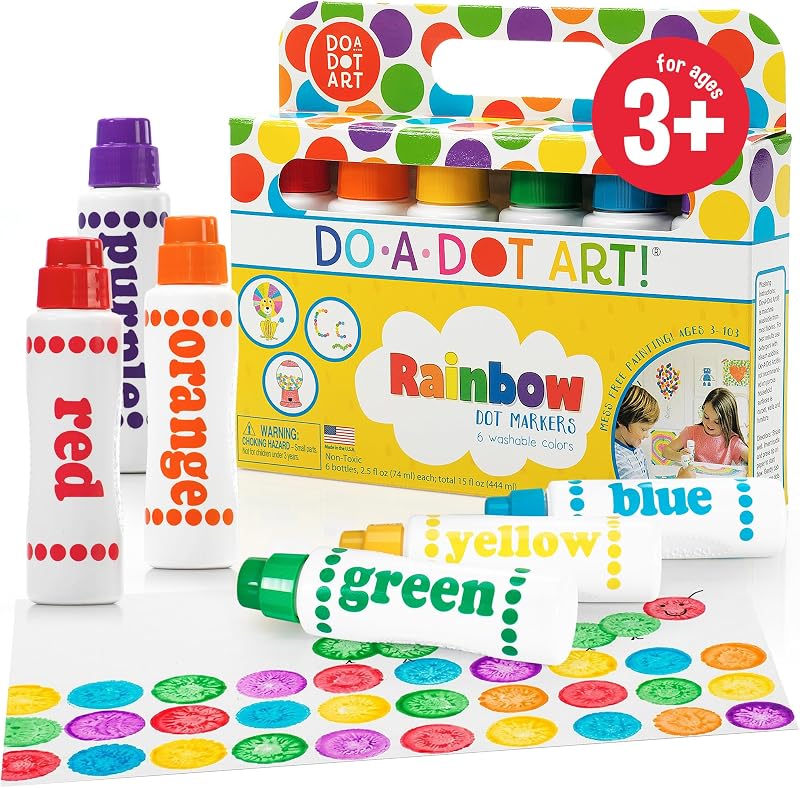
Do A Dot Art! Rainbow Washable Paint Markers, 6 Count (opens Amazon in a new tab)
A six-color washable dot-marker set built for stamping, pattern play and simple preschool art
Why it fits this guide
Do A Dot markers are deliberately specialized. Instead of asking a young child to control a narrow marker point, the applicator makes large dots that suit alphabet worksheets, counting pages, pattern activities and big open illustrations. It works best as an activity tool beside, not instead of, regular crayons or markers.
Honest drawback
Six colors and a dot applicator make this much less versatile for conventional line-art coloring
Best forPreschool dot-art worksheets, patterns and large open shapes
Pros
- Six rainbow colors support simple color-recognition and pattern activities
- No separate paint cups or brushes
- Large dot marks work well on preschool activity sheets and open shapes
Cons
- Only six colors
- Not suitable for fine outlines or intricate coloring-book spaces
Related guides
Best Colored Pencils for Adult Coloring Books: 10 Smooth, Blendable Sets
Compare 10 colored-pencil sets for adult coloring books by core feel, color range, detail control, layering, paper fit, storage and replacement options.
Best Coloring Books for Colored Pencils: Paper That Layers Well
Six research-based coloring books for colored pencils, compared by paper tooth, page format, binding, artwork detail and room for layered shading.
Best Coloring Supplies for Adults: Markers, Pencils, Gel Pens & More
The best coloring supplies for adults, including markers, colored pencils, gel pens, fineliners, and watercolor pencils for different papers and styles.
Best Water-Based Markers for Coloring Books: 10 Low-Bleed Picks
The best water-based markers for coloring books, including low-bleed dual-tip, brush and fineliner picks. Compare tips, colors and paper use.


