Best Skin-Tone Colored Pencils for Portrait Coloring. Compare eight skin-tone colored-pencil sets for portrait coloring by shade range, core feel, blending, detail control, storage and documented light resistance.. Type: Buying guide. Category: Coloring. Tags: colored-pencils, skin-tone-pencils, portrait-coloring, portrait-drawing, adult-coloring, coloring-supplies, drawing-supplies, buying-guide, cluster-coloring-supplies.

Buying guide

Best Skin-Tone Colored Pencils for Portrait Coloring

Our recommendation

Prismacolor Premier Portrait 24 is our top research pick for most portrait coloring because its soft core and balanced mix of peach, pink, ochre, umber and brown shades support gradual layering without forcing you to navigate a giant general-purpose set. Choose KALOUR PDAS 36 for the most complete budget bundle with 35 colors, a blender, chart and tutorial, Black Widow Dark Skin Tones 12 when deeper values are missing from your current pencils, Crayola Colors of the World 24 for children and classrooms, and Caran d'Ache Luminance Portrait 20 for display work backed by manufacturer-documented ASTM D6901 light resistance. Every recommendation is research-based rather than hands-on tested, and each exact Amazon.com variant was checked on August 31, 2026.

Quick picks

Top recommendations

  1. 1Prismacolor Premier Portrait Colored Pencils, 24 Count — Best overallTwenty-four creamy portrait colors balance light peach, pink, ochre, terracotta, umber, deep brown and white in a compact tin
  2. 2Castle Art Supplies Portrait Colored Pencil Set, 24 Count — Best guided starterTwenty-four selected colors, centered 3.3 mm cores and an included tutorial create a structured first portrait set
  3. 3KALOUR PDAS Skin Tones Colored Pencils, 36-Piece Set — Best budget rangeThirty-five named skin-tone pencils, a colorless blender, chart and tutorial provide the most complete budget bundle in this shortlist
  4. 4Black Widow Dark Skin Tones Colored Pencils, 12 Count — Best deep-tone add-onTwelve hexagonal 4 mm wax-core pencils add a focused range of deeper portrait colors without duplicating a full rainbow set
  5. 5Derwent Coloursoft Skintones Colored Pencils, 6 Count — Best compact add-onSix Coloursoft shades in a slim tin add Cream, Blush Pink, Pink, Ochre, Dark Terracotta and Brown Earth without much storage
  6. 6Crayola Colors of the World Colored Pencils, 24 Count — Best for childrenTwenty-four specially formulated Almond, Golden and Rose families provide an accessible way for children to color more people
  7. 7Shuttle Art Skin Tone Colored Pencils, 36 Count — Best large beginner setThirty-six named and numbered soft-core colors arrive with a chart and step-by-step portrait tutorial
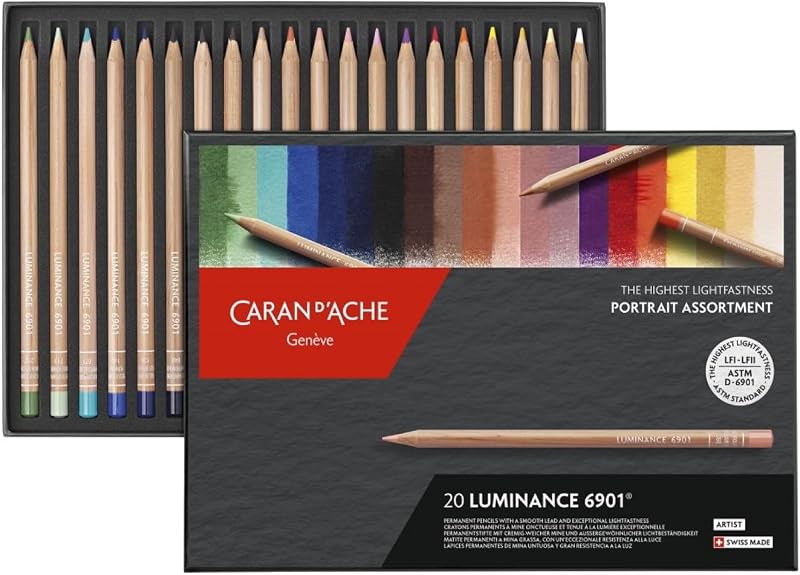
  8. 8Caran d'Ache Luminance 6901 Portrait Colored Pencils, 20 Count — Best lightfast splurgeTwenty creamy Swiss-made portrait colors pair a 3.8 mm core with manufacturer-documented ASTM D6901 light resistance
Product comparison

ProductBest forWatch outPrice & shop
Prismacolor Premier Portrait Colored Pencils, 24 Count (opens Amazon in a new tab)Prismacolor · Premier Portrait 25085R
Best overallResearch-based review
Adult colorists wanting one manageable soft-core palette for a broad range of portrait layersThe palette still leans warm and cannot replace the muted violets, greens, blues and greys that more advanced portraits may need for reflected light and complex shadows.
Castle Art Supplies Portrait Colored Pencil Set, 24 Count (opens Amazon in a new tab)Castle Art Supplies · Portraits Themed Palette 24-Piece Tin
Best guided starterResearch-based review
Beginners who want a portrait-specific tin, numbered colors and a step-by-step tutorialCastle Arts does not provide the same complete open-stock replacement system as the major professional ranges, so a finished favorite shade may require replacing the set.
KALOUR PDAS Skin Tones Colored Pencils, 36-Piece Set (opens Amazon in a new tab)KALOUR · PDAS 36 Skin Tones Portrait Set
Best budget rangeResearch-based review
Beginners wanting many neighboring portrait shades plus a blender and swatch chartThe brand does not publish the same color-by-color archival documentation or complete open-stock system as the premium artist ranges.
Black Widow Dark Skin Tones Colored Pencils, 12 Count (opens Amazon in a new tab)Black Widow · Dark Skin Tones 12-Pencil Set
Best deep-tone add-onResearch-based review
Colorists whose existing collection lacks enough medium-deep and deep complexion valuesTwelve deep-focused colors are not a complete portrait palette; highlights, blush, reflected colors, hair and background shades must come from another set.
Derwent Coloursoft Skintones Colored Pencils, 6 Count (opens Amazon in a new tab)Derwent · Coloursoft Skintones 2300217
Best compact add-onResearch-based review
Artists who already own a broad palette and want six notably soft portrait transition colorsSix colors cannot describe a broad range of complexions by themselves, and the soft 4 mm core is less naturally suited to tiny eye and hair details.
Crayola Colors of the World Colored Pencils, 24 Count (opens Amazon in a new tab)Crayola · Colors of the World 24-Count
Best for childrenResearch-based review
Family tables, classrooms and children's coloring pages that need a more inclusive complexion rangeThese are general children's colored pencils rather than a documented artist or lightfast range, so adult colorists may want softer cores and more nuanced shadow colors.
Shuttle Art Skin Tone Colored Pencils, 36 Count (opens Amazon in a new tab)Shuttle Art · 36 Skin Tone Soft Core Set
Best large beginner setResearch-based review
New portrait colorists who want 36 labeled colors and a tutorial without a separate blender pencilThe set lacks the colorless blender included with KALOUR, and the brand does not provide a complete open-stock or color-by-color archival system.
Caran d'Ache Luminance 6901 Portrait Colored Pencils, 20 Count (opens Amazon in a new tab)Caran d'Ache · Luminance 6901 Portrait 6901.920
Best lightfast splurgeResearch-based review
Portrait artwork intended for framing, gifting or display rather than pages kept inside a bookThe luxury price is difficult to justify for casual coloring, and 20 colors still need a broader set for vivid clothing, backgrounds and some reflected shadow hues.

Selection and testing methodology

This is a research-based buying guide, not a hands-on ranking. On August 31, 2026, we checked the exact Amazon.com detail page, ASIN, current offer or active buying-option evidence and matching direct Amazon CDN image for every recommendation. Color count, core diameter, barrel shape, included materials, age guidance and light-resistance claims came from current manufacturer pages or the brand's exact current product documentation. We prioritized a useful spread of light, medium and deep values, warm and cool undertones, controllable layering, a distinct reason to choose each set and honest limitations. We did not measure pigment load, color accuracy, breakage, sharpening frequency, blending, paper performance, skin-tone coverage or lightfastness ourselves. Prices, sellers, packaging and availability can change, so recheck the linked detail page before buying.

Detailed product sections

Best overallResearch-based review

Prismacolor Premier Portrait Colored Pencils, 24 Count (opens Amazon in a new tab)

Prismacolor · Premier Portrait 25085R

Twenty-four creamy portrait colors balance light peach, pink, ochre, terracotta, umber, deep brown and white in a compact tin

Why it fits this guide

Prismacolor offers the most coherent bridge between a small specialist palette and a full artist range. The manufacturer-selected colors include light, warm, rosy and deep values plus white and indigo, while the soft cores are positioned for shading, layering and blending.

Honest drawback

The palette still leans warm and cannot replace the muted violets, greens, blues and greys that more advanced portraits may need for reflected light and complex shadows.

Specifications

  • Exact Amazon.com ASIN showed an in-stock offer on August 31, 2026
  • 24 portrait colors in a metal tin
  • Soft thick cores intended for shading, layering and blending

Best forAdult colorists wanting one manageable soft-core palette for a broad range of portrait layers

Pros

  • Thoughtful mix of highlight, transition and shadow colors
  • Creamy core is designed for smooth overlapping layers
  • Colors belong to the wider Premier range, making many shades individually replaceable

Cons

  • Soft points wear faster than firmer cores
  • Specialist palette still needs extra cool shadow and hair colors
Check price on Amazon (opens Amazon in a new tab)
Best guided starterResearch-based review

Castle Art Supplies Portrait Colored Pencil Set, 24 Count (opens Amazon in a new tab)

Castle Art Supplies · Portraits Themed Palette 24-Piece Tin

Twenty-four selected colors, centered 3.3 mm cores and an included tutorial create a structured first portrait set

Why it fits this guide

Castle Arts packages the learning aids with the palette. The 24 pencils are named and numbered, the tin keeps the set together, and the included tutorial gives a new portrait colorist a finite project instead of a blank-page start.

Honest drawback

Castle Arts does not provide the same complete open-stock replacement system as the major professional ranges, so a finished favorite shade may require replacing the set.

Specifications

  • Exact Amazon.com ASIN showed an in-stock offer on August 31, 2026
  • 24 portrait colors in a special-edition metal tin
  • Strong centered 3.3 mm cores and a step-by-step tutorial

Best forBeginners who want a portrait-specific tin, numbered colors and a step-by-step tutorial

Pros

  • Tutorial lowers the barrier to a first layered portrait
  • Numbered colors simplify swatching and repeating blends
  • Tin protects the dedicated palette between sessions

Cons

  • Limited individual replacement availability
  • Twenty-four colors still require outside hues for some hair, eyes and cool shadows
Check price on Amazon (opens Amazon in a new tab)
Best budget rangeResearch-based review

KALOUR PDAS Skin Tones Colored Pencils, 36-Piece Set (opens Amazon in a new tab)

KALOUR · PDAS 36 Skin Tones Portrait Set

Thirty-five named skin-tone pencils, a colorless blender, chart and tutorial provide the most complete budget bundle in this shortlist

Why it fits this guide

KALOUR reduces the amount of mixing a beginner has to invent immediately. The 35 colored pencils cover more small value steps than the 12- and 24-count sets, and the included chart encourages swatching before committing to the portrait page.

Honest drawback

The brand does not publish the same color-by-color archival documentation or complete open-stock system as the premium artist ranges.

Specifications

  • Exact Amazon.com ASIN showed an in-stock offer on August 31, 2026
  • 35 colored pencils plus one colorless blender
  • Named and numbered barrels with a DIY color chart and tutorial

Best forBeginners wanting many neighboring portrait shades plus a blender and swatch chart

Pros

  • Broad dedicated range reduces jumps between values
  • Colorless blender and chart are included
  • Budget positioning suits a first specialist palette

Cons

  • No complete published lightfastness system comparable with premium ranges
  • Limited open-stock replacement information
Check price on Amazon (opens Amazon in a new tab)
Best deep-tone add-onResearch-based review

Black Widow Dark Skin Tones Colored Pencils, 12 Count (opens Amazon in a new tab)

Black Widow · Dark Skin Tones 12-Pencil Set

Twelve hexagonal 4 mm wax-core pencils add a focused range of deeper portrait colors without duplicating a full rainbow set

Why it fits this guide

Black Widow gives this common palette gap its own box. The Dark Tones set is designed as a 12-color portrait supplement, and the brand documents named and numbered pencils, hexagonal barrels and open-stock replacements.

Honest drawback

Twelve deep-focused colors are not a complete portrait palette; highlights, blush, reflected colors, hair and background shades must come from another set.

Specifications

  • Exact Dark Skin Tones Amazon.com ASIN showed an in-stock offer on August 31, 2026
  • 12 assorted skin-tone colors with 4 mm wax cores
  • Hexagonal named and numbered barrels with open-stock pencils available

Best forColorists whose existing collection lacks enough medium-deep and deep complexion values

Pros

  • Directly addresses missing deep values in pale-heavy collections
  • Hexagonal barrels resist rolling
  • Individual replacements protect frequently used shades

Cons

  • Requires a companion set for highlights and surrounding portrait colors
  • Manufacturer lightfastness documentation is limited
Check price on Amazon (opens Amazon in a new tab)
Best compact add-onResearch-based review

Derwent Coloursoft Skintones Colored Pencils, 6 Count (opens Amazon in a new tab)

Derwent · Coloursoft Skintones 2300217

Six Coloursoft shades in a slim tin add Cream, Blush Pink, Pink, Ochre, Dark Terracotta and Brown Earth without much storage

Why it fits this guide

Derwent's six-pencil selection is deliberately small and useful. The 4 mm Coloursoft core is intended for quick color building and blending, while the compact tin makes sense beside an existing 24-, 36- or 72-color collection.

Honest drawback

Six colors cannot describe a broad range of complexions by themselves, and the soft 4 mm core is less naturally suited to tiny eye and hair details.

Specifications

  • Exact Amazon.com ASIN showed a current in-stock offer on August 31, 2026
  • Six selected Coloursoft shades in a metal tin
  • Round 4 mm soft core designed for quick color building

Best forArtists who already own a broad palette and want six notably soft portrait transition colors

Pros

  • Compact supplement avoids duplicating a full collection
  • Soft core favors smooth cheek and forehead layers
  • Colors come from Derwent's wider 72-color Coloursoft range

Cons

  • Far too limited as a stand-alone portrait set
  • Large soft core needs more sharpening for micro-details
Check price on Amazon (opens Amazon in a new tab)
Best for childrenResearch-based review

Crayola Colors of the World Colored Pencils, 24 Count (opens Amazon in a new tab)

Crayola · Colors of the World 24-Count

Twenty-four specially formulated Almond, Golden and Rose families provide an accessible way for children to color more people

Why it fits this guide

Crayola organizes the set around three shade families with lighter and darker steps, which is easier for children to navigate than a professional portrait range. The brand positions the pencils for coloring books, school projects and representation in children's drawings.

Honest drawback

These are general children's colored pencils rather than a documented artist or lightfast range, so adult colorists may want softer cores and more nuanced shadow colors.

Specifications

  • Exact Amazon.com ASIN and current detail-page availability were checked August 31, 2026
  • 24 skin-tone colors across Almond, Golden and Rose shade families
  • Current Crayola guidance for this colored-pencil line begins at age 5

Best forFamily tables, classrooms and children's coloring pages that need a more inclusive complexion range

Pros

  • Broad, inclusive range at an accessible level
  • Clear shade-family naming helps children compare values
  • Small box is easy to share and store

Cons

  • Not positioned as an archival artist range
  • Firmer school-pencil feel needs more layering than soft artist cores
Check price on Amazon (opens Amazon in a new tab)
Best large beginner setResearch-based review

Shuttle Art Skin Tone Colored Pencils, 36 Count (opens Amazon in a new tab)

Shuttle Art · 36 Skin Tone Soft Core Set

Thirty-six named and numbered soft-core colors arrive with a chart and step-by-step portrait tutorial

Why it fits this guide

Shuttle Art offers a large specialist palette with straightforward organization. The named barrels and DIY chart make it easier to record a blend, while the included tutorial gives the set a useful first project.

Honest drawback

The set lacks the colorless blender included with KALOUR, and the brand does not provide a complete open-stock or color-by-color archival system.

Specifications

  • Exact Amazon.com ASIN showed an active purchase offer on August 31, 2026
  • 36 named and numbered skin-tone colored pencils
  • Soft cores with a DIY color chart and tutorial

Best forNew portrait colorists who want 36 labeled colors and a tutorial without a separate blender pencil

Pros

  • Broad palette offers many nearby portrait values
  • Labels and chart support repeatable color recipes
  • Tutorial helps a beginner start with a guided project

Cons

  • No colorless blender in the box
  • Limited open-stock and lightfastness documentation
Check price on Amazon (opens Amazon in a new tab)
Best lightfast splurgeResearch-based review

Caran d'Ache Luminance 6901 Portrait Colored Pencils, 20 Count (opens Amazon in a new tab)

Caran d'Ache · Luminance 6901 Portrait 6901.920

Twenty creamy Swiss-made portrait colors pair a 3.8 mm core with manufacturer-documented ASTM D6901 light resistance

Why it fits this guide

Luminance has a purpose beyond luxury packaging. Caran d'Ache documents permanent creamy leads, high pigment concentration, individual color availability and ASTM D6901 compliance, all relevant when a finished portrait will be exposed to light.

Honest drawback

The luxury price is difficult to justify for casual coloring, and 20 colors still need a broader set for vivid clothing, backgrounds and some reflected shadow hues.

Specifications

  • Exact Amazon.com ASIN showed active buying options on August 31, 2026
  • 20-color Portrait assortment, product reference 6901.920
  • Swiss-made 3.8 mm creamy permanent cores documented to ASTM D6901

Best forPortrait artwork intended for framing, gifting or display rather than pages kept inside a book

Pros

  • Documented light resistance supports display work
  • Creamy core combines coverage with controlled lines
  • Individual colors can be replaced

Cons

  • Luxury price band
  • Specialist palette still needs companion colors for a complete page
Check price on Amazon (opens Amazon in a new tab)

How to choose

  • Look for value range before pencil count. A portrait palette needs useful highlights, middle values and deep shadows, not thirty versions of light peach.
  • Check undertones as well as depth. Ochres and golden browns help with warm complexions, while muted rose, mauve, olive, violet and cool brown can keep shadows from looking flat or orange.
  • Decide whether the set will stand alone or supplement pencils you already own. Six- and twelve-pencil kits are easy add-ons; a 24- or 36-pencil portrait palette gives a beginner more room to work without borrowing as many colors.
  • Match the core to the page. Softer pencils make it easier to fill broad cheeks and foreheads, while a firmer point helps around eyes, lips, hairlines and small printed features.
  • Treat the printed barrel color as a label, not a promise. Make a swatch on paper similar to the coloring page, then write the pencil name or number beside it.
  • Pay for documented light resistance only when the finished portrait will be displayed. It adds little value to a page that stays closed inside a coloring book.
  • Check replacement options if you draw portraits often. Highlights, transition shades and favorite deep browns usually run down at different rates.

Common mistakes

  • Choosing a palette with many pale peaches but too few medium and deep browns.
  • Using one pencil as a complete complexion instead of layering several transparent colors.
  • Reaching for black too early and making every shadow look grey or muddy.
  • Pressing hard on the first layer, flattening the paper tooth before undertones and adjustments are in place.
  • Assuming a set labeled skin tone can represent every complexion without help from reds, violets, blues, greens, greys or a broader companion set.
  • Using white as a universal blender without testing how much it lightens and cools the colors underneath.
  • Copying a face from the barrel or package instead of observing the reference image and the lighting on that specific face.

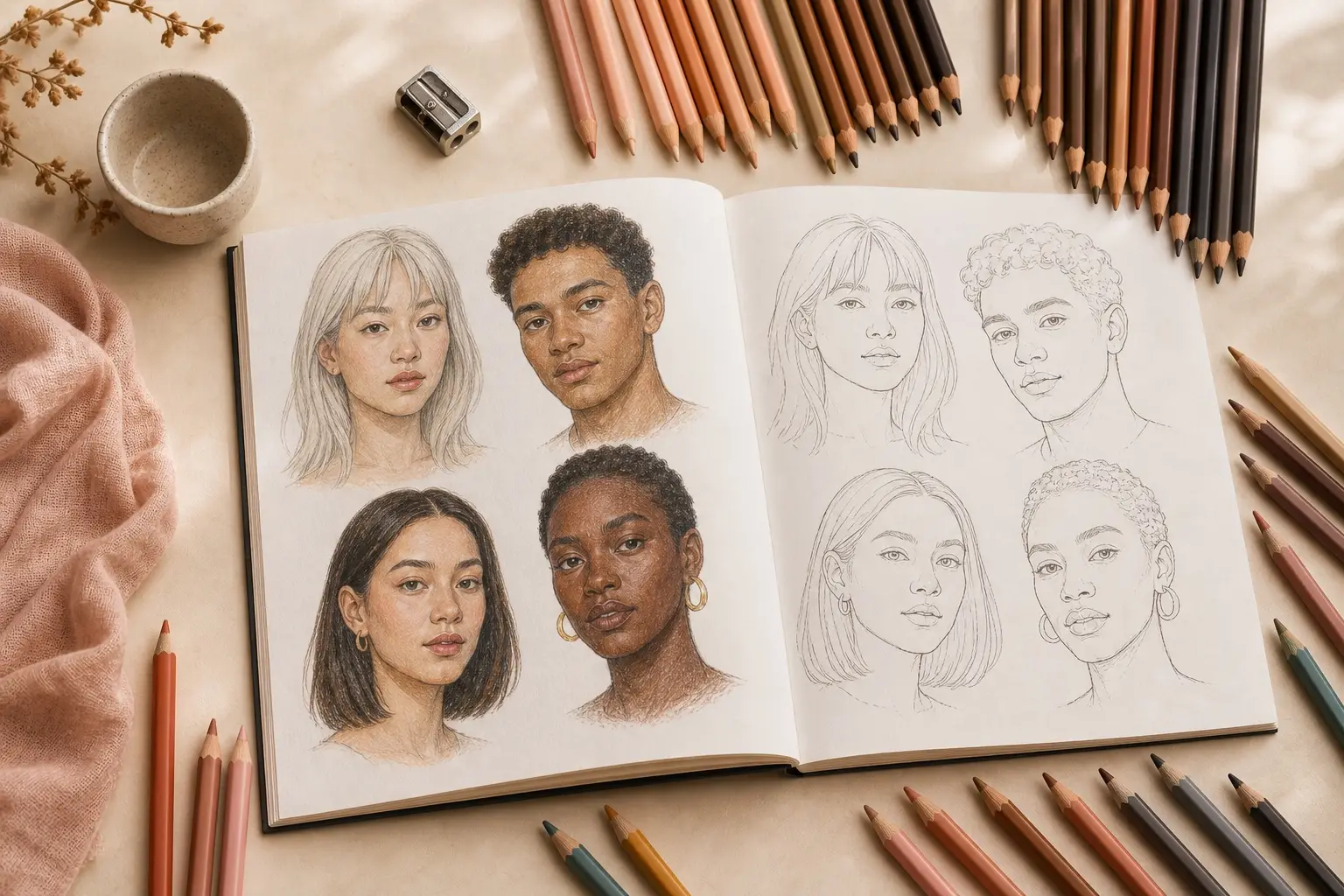
Portrait coloring asks more from a pencil than finding one beige or brown that looks close enough. A face contains highlights, half-tones, reflected color, blush, cool recesses and deep accents. Even one small coloring-book portrait may need four or five overlapping pencils before it begins to look dimensional.

That is why the best skin-tone pencil set is not automatically the one with the most pale peaches. A useful palette needs a real value range, several undertones and enough control to keep the eyes, lips and hairline clean.

This guide compares eight exact sets by those practical differences. The recommendations are based on current manufacturer documentation and Amazon.com listing evidence, not physical testing by KawaiiToons.

Quick answer: which skin-tone pencil set should you buy?

Choose Prismacolor Premier Portrait 24 if you want one balanced specialist set for adult portrait coloring. Its palette moves from cream and light peach through rose, ochre, terracotta, umber and dark brown, while the soft Premier core is designed for layering and blending.

Choose Castle Arts Portrait 24 if a guided first project matters more than open-stock replacement. It includes named and numbered pencils, a tin and a step-by-step tutorial.

Choose KALOUR PDAS 36 when you want the most complete budget bundle here. It includes 35 skin-tone colors, a colorless blender, a chart and a tutorial. Shuttle Art 36 is the closest alternative, with 36 colored pencils but no separate blender.

Choose Black Widow Dark Skin Tones 12 when your existing collection has plenty of pale colors but jumps too quickly through medium-deep and deep values. It is a supplement, not a complete portrait box.

For children, Crayola Colors of the World 24 is the clearest choice. For artwork that will be framed or displayed, Caran d’Ache Luminance Portrait 20 is the specialist splurge because Caran d’Ache documents its light resistance to ASTM D6901.

What a useful portrait palette actually contains

“Skin tone” is not one hue. It is a moving relationship between the subject, the light and the colors nearby.

A warm lamp can push a complexion toward gold and orange. Window light may create cooler planes. A bright shirt can reflect color into the jaw or neck. The shadow beside the nose may be red-brown, violet, olive or cool grey rather than a darker version of the cheek.

A useful specialist set therefore needs more than a row of similar peach pencils.

Highlights and pale transition colors

Cream, ivory, pale peach and muted pink can preserve lighter planes and soften transitions. White can blend and lighten, but it is not a transparent eraser. Heavy white pressure may cool the colors underneath and fill the paper tooth, so save it until the main hue is established.

Warm middle values

Ochre, golden brown, sienna, terracotta and warm rose build the middle of many portrait mixtures. They are useful, but a palette made only from warm colors can make every face look orange. Look for neutral and cool counterweights.

Deep values that do not jump straight to black

Umber, cocoa, sepia, deep red-brown, indigo and muted violet create a more gradual path into shadow. Black can be useful in pupils, hair and the smallest deepest accents, but it often looks abrupt when it becomes the default shading pencil.

Colors that do not look like skin in the tin

Portraits often benefit from tiny amounts of olive, blue, violet, grey and red. These colors can describe reflected light, the cool plane beside a warm cheek, a shadow beneath the jaw or the subtle color shift around eyes and lips.

No dedicated portrait set includes every one of those possibilities. Think of it as the center of the palette, then borrow surrounding colors from a general colored-pencil set when the reference calls for them.

Soft versus firm cores for portrait coloring

Core feel changes the route to the same result.

Softer pencils build visible color quickly and can make broad facial planes look smoother with fewer passes. Prismacolor Premier, Derwent Coloursoft and the budget soft-core sets emphasize that kind of laydown. The tradeoff is point wear. Small eyelashes, nostrils and hair strands may need a fresh short point more often.

Firmer or more controlled cores deposit less color in one light layer. They can preserve detail and leave more paper tooth for later adjustments. Castle Arts documents a centered 3.3 mm core; its portrait tin sits closer to this controlled approach than the softest options here.

Neither feel is inherently more realistic. The better choice is the one that matches the page. A large close-up face rewards smooth broad layers. A page of tiny kawaii characters rewards point control.

The eight best skin-tone colored pencils for portrait coloring

1. Prismacolor Premier Portrait 24: best overall

Prismacolor’s Portrait set contains 24 colors selected from the Premier range: Cream, Jasmine, Yellow Ochre, Goldenrod, Sand, several pink and peach steps, Beige, Rosy Beige, Clay Rose, Indigo Blue, Light Umber, Burnt Ochre, Sienna Brown, Terra Cotta, Henna, Tuscan Red, Dark Umber, Dark Brown and White.

That list explains why it is the most balanced dedicated set here. It has light, rosy, golden, red-brown and deep values rather than treating portrait coloring as a peach-to-brown gradient. Indigo also gives the box one cool dark option for neutralizing warm shadows.

The Premier soft core is designed for shading, layering and smooth laydown. That makes the set approachable on ordinary coloring-book paper, where a very hard pencil can leave a dry-looking first layer.

Its limit is the limit of every compact portrait tin. You will still need hair colors, eye colors and occasional olive, violet, blue or grey from a broader set. Think of this as a strong portrait center, not a complete studio.

2. Castle Arts Portrait 24: best guided starter

The Castle Arts Portrait set pairs 24 selected colored pencils with a special-edition tin and a step-by-step tutorial. Castle Arts documents centered 3.3 mm cores intended to sharpen for facial detail while still layering and blending.

The tutorial is the meaningful difference. A first-time portrait colorist does not have to invent a subject, choose a palette and decide on the layer order all at once. The numbered pencils also make it easier to write down a recipe such as “two light layers of 031, then 044 around the jaw.”

Castle Arts is less compelling for someone who draws portraits every week and expects to replace individual favorites indefinitely. The brand does not offer the same complete open-stock system as Prismacolor or Caran d’Ache.

Choose it for organization and a guided start, not because the tin alone guarantees realistic color.

3. KALOUR PDAS 36: best budget range

KALOUR’s exact set includes 35 colored pencils and one colorless blender, plus a DIY color chart and a step-by-step tutorial. The pencils are named and numbered, which is essential when several browns look almost identical in the tray.

The advantage of 35 portrait colors is smaller jumps. A beginner can move gradually from a light value to a middle value without mixing every transition from two distant pencils. The colorless blender can compress and merge the final layers without adding white.

The compromise is documentation. KALOUR’s current colored-pencil collection does not provide the same complete color-by-color archival system as premium artist ranges. If the finished portrait will live inside a book, that may not matter. If it will hang in a bright room, choose a range with published light-resistance information.

4. Black Widow Dark Skin Tones 12: best deep-tone add-on

Many general colored-pencil sets include several pale peach shades, one medium brown and one dark brown. That is not a useful value ladder for deeper complexions.

The Black Widow Dark Tones set addresses the gap directly with 12 portrait colors. The brand documents a 4 mm wax core, hexagonal barrels, names and number codes, and open-stock replacement pencils.

Open stock matters in a small specialist box. The transition shade used across every cheek may disappear long before the deepest accent color. Replacing one pencil is better than retiring the other eleven.

This is still an add-on. It needs highlights, surrounding reflected colors, hair shades and perhaps the sibling Light Tones range or a broad general collection. Its value is focus: it expands the area where many starter sets are weakest.

5. Derwent Coloursoft Skintones 6: best compact add-on

Derwent’s six-pencil Portrait tin contains Cream, Blush Pink, Pink, Ochre, Dark Terracotta and Brown Earth from the wider 72-color Coloursoft range.

This is the set for someone who already owns colors, not someone building a first portrait palette. The six shades cover highlights, blush, warmth and a deeper earth value, and the slim tin does not duplicate another 24 or 36 pencils.

Derwent describes Coloursoft as its softest pencil, with a round 4 mm core made to build color quickly. That softness suits broad cheeks and foreheads. It is less convenient for the tiniest printed eyes and hair strands, where the point will need more attention.

The advantage of using colors from a full artist range is expansion. If these six suit your style, related Coloursoft colors can be added without changing core feel.

6. Crayola Colors of the World 24: best for children

Crayola Colors of the World organizes 24 skin-tone colored pencils into Almond, Golden and Rose families, with lighter and deeper steps inside those groups. Crayola describes the line as a way for children to represent more people in coloring pages and drawings.

The naming system is easy to understand at a shared table. A child can compare Light Golden with Deep Golden without needing an artist’s color-theory vocabulary. The small cardboard box also travels and stores more simply than a three-tray tin.

These are children’s coloring pencils, not a documented archival portrait system. Adult colorists may find them firmer and less immediately creamy than Prismacolor or Coloursoft. Their strength is accessibility and inclusion, not luxury handling.

Current Crayola guidance for the colored-pencil product begins at age five. Follow the package guidance and supervise sharpening based on the child’s age and skill.

7. Shuttle Art Skin Tone 36: best large beginner set

Shuttle Art’s 36-pencil set provides named and numbered portrait colors, a DIY chart and a guided tutorial. The brand’s current pencil catalog lists the skin-tone range as a soft-core set for drawing, coloring, shading, layering and blending.

Like KALOUR, the large count reduces the distance between neighboring values. A colorist who does not yet feel confident mixing two pencils can choose a closer middle shade, then learn to overlap them gradually.

The distinction is in the box contents. Shuttle Art includes 36 colored pencils but no separate colorless blender. That is not necessarily a loss—a blender is most useful near the end, and light pencil layers can make a smoother transition without it—but KALOUR offers the more complete all-in-one accessory package.

Shuttle Art does not publish a complete open-stock or color-by-color lightfastness system, so it makes the most sense for hobby coloring and practice rather than display work.

8. Caran d’Ache Luminance Portrait 20: best lightfast splurge

The Luminance Portrait assortment contains 20 Swiss-made colors with creamy permanent 3.8 mm leads. Caran d’Ache documents high pigment concentration, individual color availability and compliance with ASTM D6901 for light resistance.

That makes it the clearest choice when the finished portrait will be removed, framed or gifted. Lightfastness does not make a pencil smoother, easier to blend or more accurate. It addresses one specific risk: visible color change under light exposure.

The set is expensive and still specialized. Twenty portrait colors do not fill a background, color a bright shirt or provide every reflected hue. For pages that stay inside a closed coloring book, the archival premium is difficult to justify.

Buy Luminance Portrait for artwork with a life outside the book. For casual evening coloring, Prismacolor, Castle Arts or one of the larger value palettes is more practical.

A simple layering method for more dimensional faces

The pencil set matters less if the first layer is pressed into the paper as hard as possible. Preserve the tooth so the page can hold several colors.

1. Make a labeled swatch strip

Use paper similar to the coloring page. Draw each color lightly and heavily, then write its pencil name or number beside it. Group the swatches from light to dark, but also notice which lean rosy, golden, olive, red or cool.

Barrel paint and screen photos are only navigation aids. The swatch is the more useful prediction.

2. Map the lightest and darkest planes

Before filling the face, identify the brightest highlight, the main middle value and the deepest shadow in the reference. Keep the highlight close to the paper at first. Place the deepest value lightly so it can still be adjusted. Erased colored pencil often keeps a tint, so an eraser for colored pencils is better for lightening a passage than recovering a clean highlight.

This simple value map prevents a common problem: coloring the whole face at middle pressure, then having nowhere to go for either light or shadow.

3. Build transparent layers from light to dark

Hold the pencil farther back than you would for writing. Use small overlapping circles or short strokes with minimal pressure. Change direction between layers so the next pass reaches gaps left by the first.

Introduce undertones before the darkest shadows. A light golden layer under brown behaves differently from a rosy layer under the same brown. Test the combination on the swatch strip before repeating it on the face.

4. Keep feature colors connected to the skin

Lips are rarely one flat pink, and the whites of the eyes are rarely pure white. Carry a little of the surrounding complexion into these features, then add the local color. This keeps them from looking pasted onto the face.

For hairlines and eyebrows, begin with the direction of growth and several related colors rather than outlining a solid shape in black.

5. Burnish only after the color is right

Burnishing compresses pigment and paper tooth into a smoother final surface. A light pencil may soften and shift the hue; a colorless blender or burnisher compresses the existing colors without adding a visible pigment of its own.

Both reduce the page’s ability to accept new layers. Save them for the end, after the highlights, undertones and shadow temperatures are working together.

How to avoid flat or muddy portrait color

Flat color usually comes from using one pencil at one pressure. Mud often comes from adding too many dark or complementary colors after the tooth is already filled.

Keep the early layers light enough to see the paper. Use two or three neighboring colors before introducing the deepest accent. If a shadow looks too orange, a small amount of muted violet, blue or olive may neutralize it more naturally than grey or black. Always test the mixture first.

Pay attention to the boundary between light and shadow. A hard outline around the nose or jaw can make a face look cut out. Let the value change describe the form, keeping hard edges only where the reference actually has them.

Finally, stop comparing the page to a single printed color name. “Medium Golden” or “Dark Umber” tells you where to start looking. The reference and the layers determine where the portrait ends.

Sharpening and storage for soft portrait pencils

Tiny facial features need a clean point, but a long needle point can expose too much of a soft core. Use a sharp blade that supports the barrel and stop once the cone is formed. A shorter point is often safer for broad shading; sharpen again for eyes, lashes and individual hairs.

Our artist pencil sharpener guide explains barrel fit and point shapes in more detail, and our sharpeners for soft colored pencils roundup focuses on supported points. Test an unfamiliar sharpener on a less-used pencil before feeding it your favorite transition shade.

Return pencils to the labeled tray or tin after each session. When several similar browns are loose on the table, the swatch number becomes much harder to match. Storage also protects the cores from drops, which can create internal fractures that appear later as repeated breakage during sharpening.

Final recommendation

Start with Prismacolor Premier Portrait 24 if you want a balanced, manageable specialist palette for adult portrait coloring. The soft core and thoughtful combination of light, warm, rosy, earth and deep values make it the most flexible dedicated set in this research shortlist.

Choose Castle Arts Portrait 24 for a guided tutorial and organized tin, or KALOUR PDAS 36 for the most complete budget bundle and included blender. Shuttle Art 36 is the alternative large beginner set.

Add Black Widow Dark Skin Tones 12 when your current pencils run out of useful deep values, or Derwent Coloursoft Skintones 6 when you only need a small soft-core portrait supplement.

Pick Crayola Colors of the World 24 for children, classrooms and family coloring. Spend more on Caran d’Ache Luminance Portrait 20 only when documented light resistance matters because the finished portrait will be displayed.

The best result will not come from finding one perfect “skin-color” pencil. It will come from choosing a useful value range, observing the light and building several gentle layers.

Relevant supporting guide

Best Colored Pencils for Adult Coloring Books: 10 Smooth, Blendable SetsCompare 10 colored-pencil sets for adult coloring books by core feel, color range, detail control, layering, paper fit, storage and replacement options.
FAQ

How many skin-tone colored pencils do I need for portrait coloring?

A six- or twelve-pencil set works as an add-on to a broad collection. If this is your first portrait palette, 20 to 36 well-spaced colors provide more highlights, middle values, undertones and deep shadows without requiring as much mixing immediately.

Can one pencil match a person's skin tone?

Usually not convincingly. Skin changes with lighting, surrounding color and different areas of the face. Several light transparent layers create more variation than one heavy flat fill.

Are skin-tone pencils only brown and peach?

No. Useful portrait shadows and reflected light can include muted rose, ochre, olive, violet, blue, grey and red. A dedicated set is a starting palette, not a complete rulebook for every complexion or lighting condition.

Should I use black for the darkest portrait shadows?

Reserve black for the very deepest accents, if it is needed at all. Dark brown, indigo, violet, deep red or complementary layers can create a more gradual shadow before black is introduced.

Do I need lightfast pencils for coloring-book portraits?

Not if the page stays closed in a book. Documented light resistance matters most when the finished portrait will be removed, framed or displayed where light exposure can change colors over time.