
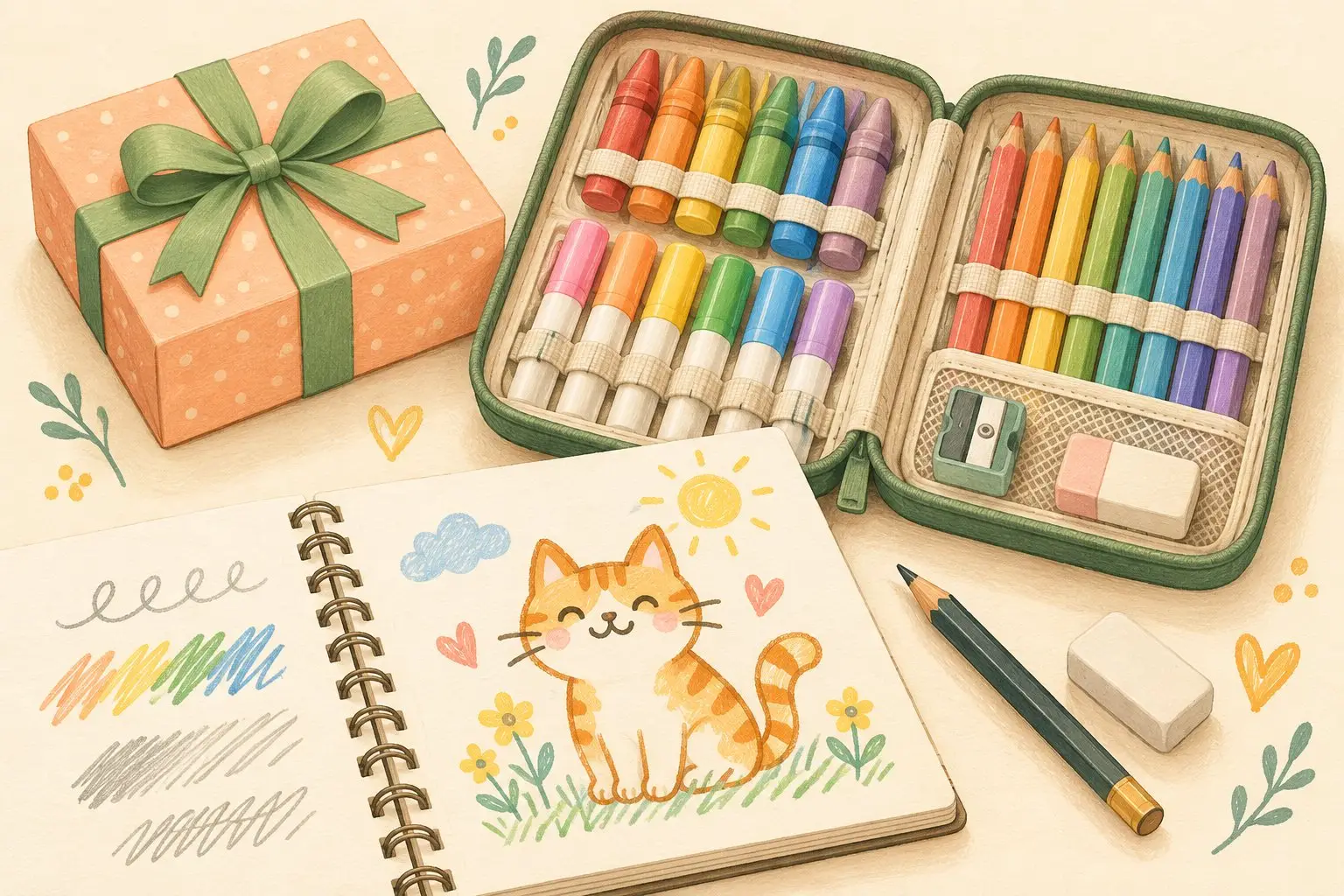
Choose by use case
If you wantAges 3+ and contained marker coloring

Crayola Color Wonder Mess Free Coloring Activity Set
Research-based reviewA special-paper coloring and stamping activity with its own carrying case.
If you wantAges 6–8 starting a drawing collection

Crayola Inspiration Art Case Coloring Set, 140pc Space Theme
Research-based reviewA space-themed case of crayons, washable markers, short colored pencils and starter paper.
If you wantAges 9–12 curious about sketching technique

Faber-Castell Do Art Drawing & Sketching Kit
Research-based reviewGraphite and black drawing tools paired with illustrated lessons for ages 9+.
Product comparison
| Product | Best for | Watch out | Price & shop |
|---|---|---|---|
| Crayola Color Wonder Mess Free Coloring Activity Set (opens Amazon in a new tab) Research-based review | Ages 3+ and contained marker coloring | The paper is consumable, and ordinary paper does not activate the ink. It is less flexible than a general drawing kit; Amazon also says the jungle or ocean theme may vary. | |
| Crayola Inspiration Art Case Coloring Set, 140pc Space Theme (opens Amazon in a new tab) Research-based review | Ages 6–8 starting a drawing collection | Only the markers are described here as washable; that claim does not extend to every tool or surface. Fifteen sheets are a starting supply, and the case duplicates basics in an already well-stocked home. | |
| Faber-Castell Do Art Drawing & Sketching Kit (opens Amazon in a new tab) Research-based review | Ages 9–12 curious about sketching technique | This is a graphite-and-black-ink direction, not a large color set, and the lessons will not suit every child. Older Amazon description text differs on pen and sketchbook counts, so confirm the current package if those details matter. No washability claim is established here for the ink pens. |
How we researched this guide
- Research date
- Hands-on testing
- None of the 3 picks — all are research-based
- Labels explained
- How we test and label products
Research-based gift selections checked October 18, 2026 using manufacturer information and the exact Amazon.com listings. All three selected variants had active new purchase offers sold and shipped by Amazon.com for the browser's US delivery destination when checked. We compared documented age guidance, included supplies, paper requirements, storage and whether the gift supports a different activity. We have not purchased, borrowed, received or physically tested these kits. Mess descriptions are based on the materials and maker claims, not cleanup trials. Stock, packaging and seller offers can change.
What we compared
- A distinct gift purpose for preschool coloring, early elementary exploration or older-child sketching.
- Manufacturer age guidance checked alongside the exact Amazon variant; conflicting range-level ages are not silently applied to a different package.
- Included paper, supplies and storage reviewed so the buyer knows what is needed to begin.
- An active Amazon.com purchase offer and a matching direct product image for each recommendation.
- Refill needs and duplication risk considered alongside the initial gift.
What we did not test
- Washability, staining, ink drying, pencil breakage, grip comfort and case durability.
- How long a child will stay interested or how quickly drawing skills will improve.
- Independent product-safety certification or compliance testing.
Testing status by pick
- Crayola Color Wonder Mess Free Coloring Activity SetResearch-based review
- Crayola Inspiration Art Case Coloring Set, 140pc Space ThemeResearch-based review
- Faber-Castell Do Art Drawing & Sketching KitResearch-based review
Sources
Product details and drawbacks
Crayola Color Wonder Mess Free Coloring Activity Set (opens Amazon in a new tab)
A special-paper coloring and stamping activity with its own carrying case.

Why it fits this guide
The included pages, five markers and stamps make this a ready-to-start gift rather than a marker refill without paper. Crayola describes the ink as revealing color on compatible Color Wonder paper instead of skin, fabric or furniture. Choose it when the family wants that restriction and the child enjoys coloring and stamping.
Honest drawback
The paper is consumable, and ordinary paper does not activate the ink. It is less flexible than a general drawing kit; Amazon also says the jungle or ocean theme may vary.
Specifications
- Maker age guidance 3+
- 24 Color Wonder pages
- 5 markers and 5 stamps
- Storage case; theme may vary
Best forAges 3+ and contained marker coloring
Pros
- Compatible paper included
- Coloring and stamping in one case
Cons
- Requires special refill paper
- Not an ordinary-paper drawing system
Crayola Inspiration Art Case Coloring Set, 140pc Space Theme (opens Amazon in a new tab)
A space-themed case of crayons, washable markers, short colored pencils and starter paper.

Why it fits this guide
For a child without a full supply box, this gathers three familiar color tools in one organized present. The exact Space listing includes 64 crayons, 40 washable markers, 20 short colored pencils and 15 drawing sheets. It suits a child who likes switching between outlining, coloring and free drawing. The listing markets it for ages 5–8; check the received package rather than applying another Inspiration variant's age label.
Honest drawback
Only the markers are described here as washable; that claim does not extend to every tool or surface. Fifteen sheets are a starting supply, and the case duplicates basics in an already well-stocked home.
Specifications
- Exact Amazon Space variant
- 140-piece count includes the case and paper
- 64 crayons; 40 washable markers; 20 short pencils
- 15 drawing sheets
Best forAges 6–8 starting a drawing collection
Pros
- Several everyday drawing media together
- Case provides a defined home for the tools
Cons
- More pieces to put away
- Extra paper will be needed for continued drawing
Faber-Castell Do Art Drawing & Sketching Kit (opens Amazon in a new tab)
Graphite and black drawing tools paired with illustrated lessons for ages 9+.

Why it fits this guide
Choose Do Art when the child's next question is how to draw a shadow or add texture. The maker specifies four graphite pencils, black drawing pens and a 20-page instruction booklet. It offers a focused activity for a child who wants instruction, rather than another rainbow assortment. The maker also lists a sketchbook, practice papers, grid, eraser and sharpener.
Honest drawback
This is a graphite-and-black-ink direction, not a large color set, and the lessons will not suit every child. Older Amazon description text differs on pen and sketchbook counts, so confirm the current package if those details matter. No washability claim is established here for the ink pens.
Specifications
- Maker age guidance 9+
- 4 graphite pencils
- Black drawing pens
- 20-page illustrated instruction booklet
Best forAges 9–12 curious about sketching technique
Pros
- Tools connected to a clear learning activity
- Includes drawing and practice materials
Cons
- Technique-focused rather than a broad color gift
- Some listing contents text is inconsistent
Corrections
Spotted an error or outdated detail? Read how we handle corrections.
Related guides
Best Craft Kits for Kids Ages 6–8: 10 Fun Projects They Can Actually Do
The best craft kits for kids ages 6–8, with 10 realistic projects including foil art, rock painting, weaving, sewing, gardening and more, plus age and adult-help notes.
Best Craft Kits for Tweens Ages 9–12: 10 Creative Projects That Aren't Too Childish
The best craft kits for tweens ages 9–12, from pottery and sewing to jewelry, crochet, string art and clay. Compare age fit, mess, skill level and finished projects.
Best Drawing Supplies for Kids: 10 Easy Starter Picks for Young Artists
Best drawing supplies for kids, from washable markers and crayons to pencils, paper and art kits. Compare age guidance, grip, mess and value.
Best Gifts for Artists: Thoughtful Art Supply Gift Ideas
Gift ideas for artists who draw, color, paint or journal, sorted by budget and skill level, with tips for choosing supplies they will actually use.


