
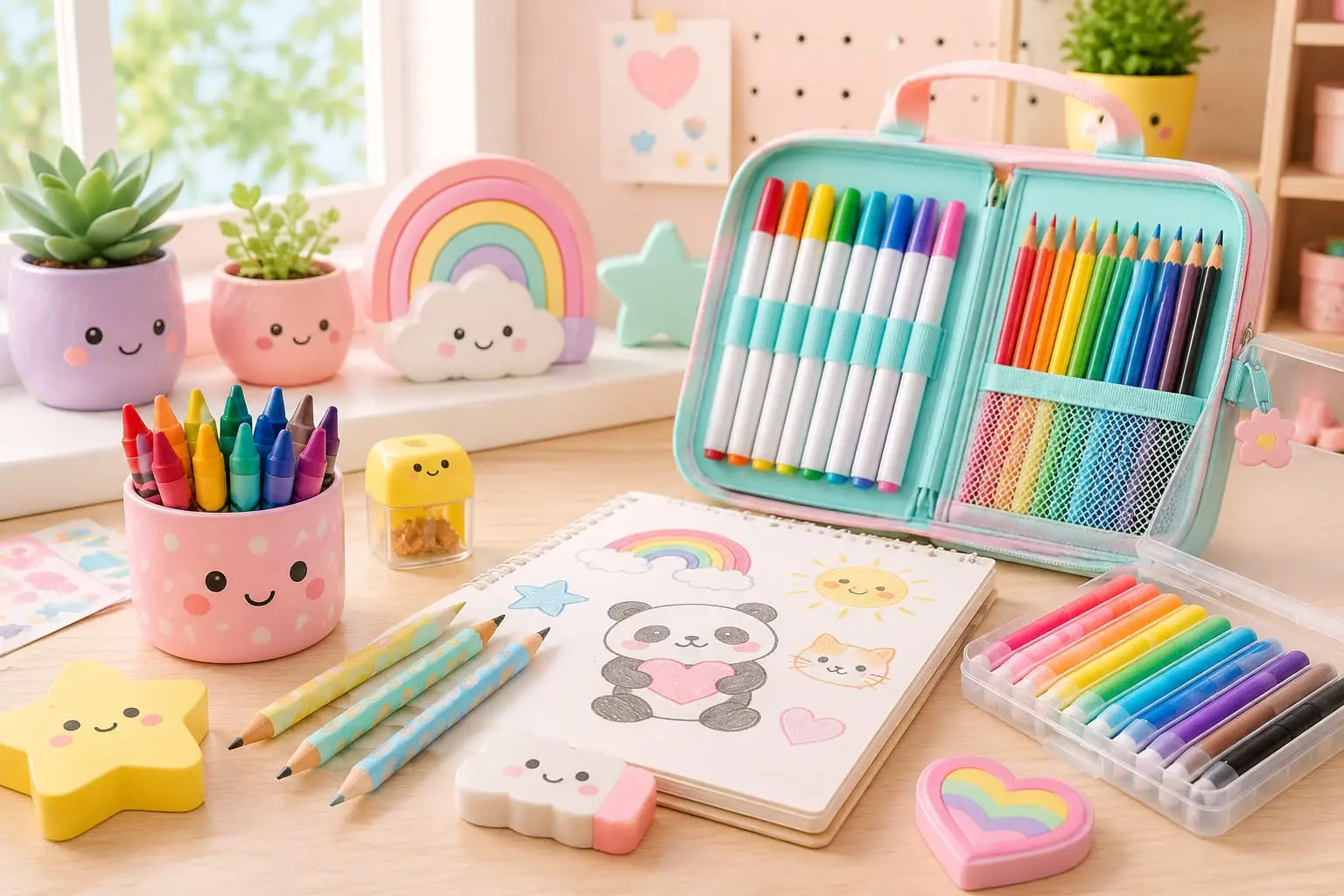
Quick picks
- Best overall starter setCrayola Inspiration Art Case Coloring Set, 140pc Space Theme (opens Amazon in a new tab)
- Best no-sharpen colored pencilsCrayola Twistables Colored Pencil Set, 50 Count (opens Amazon in a new tab)
- Best washable markersCrayola Super Tips Washable Markers, 50 Count (opens Amazon in a new tab)
- Best for older kids learning techniqueFaber-Castell Do Art Drawing & Sketching Kit (opens Amazon in a new tab)


Product comparison
| Product | Best for | Watch out | Price & shop |
|---|---|---|---|
| Crayola Inspiration Art Case Coloring Set, 140pc Space Theme (opens Amazon in a new tab) Best overall starter setResearch-based review | Young artists who need crayons, washable markers, colored pencils, paper, and storage in one place | The large case is more than a child needs if the household already owns plenty of basic crayons, markers, and paper | |
| Crayola Twistables Colored Pencil Set, 50 Count (opens Amazon in a new tab) Best no-sharpen colored pencilsResearch-based review | Kids who enjoy colored pencils but do not want to stop and sharpen wooden cores | The plastic twist-up format feels different from a conventional artist pencil and uses more plastic than a wood-cased set | Budget-friendlyCheck price on Amazon (opens Amazon in a new tab) |
| Crayola Super Tips Washable Markers, 50 Count (opens Amazon in a new tab) Best washable markersResearch-based review | Kids who want bold color plus a marker tip that can make both narrower and broader strokes | Washable ink is easier to live with than permanent ink, but it is not a promise that every mark will disappear from every household surface | Budget-friendlyCheck price on Amazon (opens Amazon in a new tab) |
| Faber-Castell Grip Colored EcoPencils, 12 Count (opens Amazon in a new tab) Best ergonomic colored pencilsResearch-based review | Children who want a traditional colored pencil with a triangular barrel and tactile grip dots | The pencils still need sharpening, and 12 colors offer much less shade variety than a 36- or 50-color set | Budget-friendlyCheck price on Amazon (opens Amazon in a new tab) |
| Ticonderoga My First Wood-Cased Pencils, 12 Count (opens Amazon in a new tab) Best first graphite pencilsResearch-based review | Young beginners practicing basic sketching, shapes, lines, and pencil control | A single | Budget-friendlyCheck price on Amazon (opens Amazon in a new tab) |
| Melissa & Doug Drawing Pad, 9 x 12, 50 Sheets (opens Amazon in a new tab) Best drawing paperResearch-based review | Kids who need a dedicated blank pad for frequent pencil, crayon, and everyday marker practice | It is general drawing paper, not specialist watercolor paper or heavy stock designed for aggressive wet-media layering | Budget-friendlyCheck price on Amazon (opens Amazon in a new tab) |
| Faber-Castell Do Art Drawing & Sketching Kit (opens Amazon in a new tab) Best for older kids learning techniqueResearch-based review | Ages 9+ who want guided practice in sketching, shading, texture, and composition | The structured lessons and more advanced tools are unnecessary for younger children who mainly want open-ended drawing time | |
| My First Crayola Palm-Grip Crayons, 6 Count (opens Amazon in a new tab) Best for toddlersResearch-based review | Very young artists making broad first marks with a whole-hand or palm-style grip | The chunky shape and six-color palette are intentionally basic and will feel limiting once a child wants detailed line work | Budget-friendlyCheck price on Amazon (opens Amazon in a new tab) |
| Crayola Color Wonder Markers, 10 Count (opens Amazon in a new tab) Best mess-free optionResearch-based review | Travel, restaurants, shared living spaces, and parents who want marker-style color with less household staining risk | The markers are tied to the Color Wonder paper system and are therefore much less flexible than ordinary washable markers | Budget-friendlyCheck price on Amazon (opens Amazon in a new tab) |
| Crayola Light Up Tracing Pad, Pink (opens Amazon in a new tab) Best tracing toolResearch-based review | Kids ages 6+ who enjoy copying shapes, characters, and line art before adding their own details | The light pad requires three AA batteries sold separately, and tracing should sit beside free drawing rather than become the only way a child practices |
Detailed product sections
Crayola Inspiration Art Case Coloring Set, 140pc Space Theme (opens Amazon in a new tab)
A 140-piece case that covers the core coloring and drawing tools most kids reach for first

Why it fits this guide
The Crayola Inspiration Art Case earns the top spot because it is broad without being an advanced artist kit. The current 140-piece version combines 64 crayons, 40 washable markers, 20 short colored pencils, 15 large drawing sheets, and a reusable case, so a child can switch between broad coloring, line drawing, and pencil work without needing several separate purchases.
Honest drawback
The large case is more than a child needs if the household already owns plenty of basic crayons, markers, and paper
Best forYoung artists who need crayons, washable markers, colored pencils, paper, and storage in one place
Pros
- Covers crayons, washable markers, colored pencils, and paper in one starter case
- Reusable case gives every tool a designated storage position
- Broad enough for siblings or children who like switching mediums
Cons
- Bulkier than a small single-medium starter set
- A 140-piece collection can be harder for very young children to keep organized
Crayola Twistables Colored Pencil Set, 50 Count (opens Amazon in a new tab)
Fifty twist-up colored pencils that trade a traditional wood barrel for easy, sharpener-free use

Why it fits this guide
Twistables removes one of the most common interruptions in children's colored-pencil sessions: a dull or broken point that needs sharpening. The core advances by twisting the barrel, and the 50-color palette gives children plenty of choice without adding a separate sharpener to a travel kit or craft table.
Honest drawback
The plastic twist-up format feels different from a conventional artist pencil and uses more plastic than a wood-cased set
Best forKids who enjoy colored pencils but do not want to stop and sharpen wooden cores
Pros
- No routine sharpening required
- Fifty colors provide a large beginner palette
- Protected twist-up format is convenient for travel and shared spaces
Cons
- Plastic construction will not appeal to families who prefer traditional wooden pencils
- Large color count is unnecessary for a child who is happier with a small core palette
Crayola Super Tips Washable Markers, 50 Count (opens Amazon in a new tab)
A 50-color washable marker set with versatile conical tips for drawing, lettering, and coloring

Why it fits this guide
Super Tips works well as the marker component of a child's drawing box because the conical nib can be used at different angles for different line widths. That makes the set more flexible than a purely broad-tip coloring marker when a child wants to outline, doodle, write a title, or fill a larger shape with the same tool.
Honest drawback
Washable ink is easier to live with than permanent ink, but it is not a promise that every mark will disappear from every household surface
Best forKids who want bold color plus a marker tip that can make both narrower and broader strokes
Pros
- Fifty assorted colors provide lots of choice
- Conical Super Tips design supports thinner and broader marks
- Washable positioning is practical for family craft spaces
Cons
- Caps still need to be replaced promptly to reduce dry-out risk
- Cleanup can vary by the exact fabric or surface
Faber-Castell Grip Colored EcoPencils, 12 Count (opens Amazon in a new tab)
A simple 12-color wood-cased set designed with a triangular shape and raised grip texture

Why it fits this guide
Faber-Castell's Grip Colored EcoPencils is the more traditional alternative to Twistables. The triangular barrel helps keep the pencil from rolling around the table, while the raised dots add texture where fingers contact the pencil. The 12-color count is also intentionally manageable for children who do not need dozens of near-duplicate shades.
Honest drawback
The pencils still need sharpening, and 12 colors offer much less shade variety than a 36- or 50-color set
Best forChildren who want a traditional colored pencil with a triangular barrel and tactile grip dots
Pros
- Triangular barrel provides a stable, tactile hold
- Raised grip dots distinguish it from smooth round pencils
- Twelve pre-sharpened colors keep the setup straightforward
Cons
- Requires a sharpener as the points wear down
- Limited palette compared with larger colored-pencil sets
Ticonderoga My First Wood-Cased Pencils, 12 Count (opens Amazon in a new tab)
Oversized pre-sharpened

Why it fits this guide
Before a child needs six graphite grades, blending tools, or technical pencils, a dependable HB pencil is enough for most early sketching. Ticonderoga My First uses a larger 13/32-inch diameter than a standard school pencil and arrives pre-sharpened, making it a sensible bridge between chunky preschool tools and ordinary writing pencils.
Honest drawback
A single
Best forYoung beginners practicing basic sketching, shapes, lines, and pencil control
Pros
- Oversized barrel provides more surface to grip
- Pre-sharpened pencils are ready for immediate drawing
- HB core works for basic sketching and everyday writing
Cons
- Needs a larger-hole sharpener once blunt
- One graphite grade limits advanced value studies
Melissa & Doug Drawing Pad, 9 x 12, 50 Sheets (opens Amazon in a new tab)
Fifty 9 x 12 inch sheets that make it easy to give young artists their own stack of blank drawing space

Why it fits this guide
Good starter supplies are wasted if a child feels every sheet is too precious to use. This Melissa & Doug pad gives them 50 generously sized blank sheets, enough to draw repeatedly, abandon experiments, and start again. The 9 x 12 inch format also gives more room for full characters and scenes than a small notebook page.
Honest drawback
It is general drawing paper, not specialist watercolor paper or heavy stock designed for aggressive wet-media layering
Best forKids who need a dedicated blank pad for frequent pencil, crayon, and everyday marker practice
Pros
- Fifty sheets encourage frequent practice
- 9 x 12 inch pages provide room for complete scenes
- Works as a simple shared base for common children's drawing tools
Cons
- Not a substitute for watercolor paper
- Heavy marker use can behave differently from dry media on general drawing stock
Faber-Castell Do Art Drawing & Sketching Kit (opens Amazon in a new tab)
A technique-focused kit pairing graphite and drawing pens with a 20-page illustrated instruction booklet

Why it fits this guide
This is the pick for a child who has moved beyond simply wanting more colors and is asking how to make drawings look more dimensional. The kit introduces structured concepts such as sketching, shading, texture, smudging, and composition, while the included graphite grades and black drawing pens give older kids tools that can actually demonstrate those differences.
Honest drawback
The structured lessons and more advanced tools are unnecessary for younger children who mainly want open-ended drawing time
Best forAges 9+ who want guided practice in sketching, shading, texture, and composition
Pros
- Includes a 20-page illustrated instruction booklet
- Multiple graphite hardnesses support more varied marks
- Black drawing pens introduce line-art techniques alongside pencil work
Cons
- Recommended for ages 9 and up rather than preschool beginners
- Less open-ended than a basic crayon, paper, and marker setup
My First Crayola Palm-Grip Crayons, 6 Count (opens Amazon in a new tab)
Six chunky egg-shaped crayons designed around toddler hands rather than a mature pencil grip

Why it fits this guide
A toddler does not need a miniature version of an adult pencil case. My First Crayola Palm-Grip Crayons uses a broad egg-like form that can be held with the palm, making it the most age-specific choice in this guide for early scribbles, arcs, dots, and broad marks on large paper.
Honest drawback
The chunky shape and six-color palette are intentionally basic and will feel limiting once a child wants detailed line work
Best forVery young artists making broad first marks with a whole-hand or palm-style grip
Pros
- Palm-grip shape is designed for very young hands
- Washable and non-toxic positioning suits supervised early art activities
- Six colors keep the activity simple
Cons
- Too broad for fine details
- Only six colors are included
Crayola Color Wonder Markers, 10 Count (opens Amazon in a new tab)
Ten special markers designed to show color on compatible Color Wonder paper rather than ordinary surfaces

Why it fits this guide
Color Wonder solves a different problem from washable markers. Instead of relying mainly on cleanup after a stray mark, the system is designed so the marker color appears on compatible Color Wonder paper. That can make it useful for travel or supervised drawing in spaces where a conventional marker feels unnecessarily risky.
Honest drawback
The markers are tied to the Color Wonder paper system and are therefore much less flexible than ordinary washable markers
Best forTravel, restaurants, shared living spaces, and parents who want marker-style color with less household staining risk
Pros
- Special ink is designed for compatible Color Wonder paper
- Ten colors are enough for compact travel activities
- Reduces the appeal of ordinary marker use on furniture or clothing in mess-sensitive situations
Cons
- Requires Color Wonder paper to reveal the intended colors
- Not a general replacement for standard markers on blank drawing pads
Crayola Light Up Tracing Pad, Pink (opens Amazon in a new tab)
An illuminated tracing surface with starter pencils, tracing sheets, and blank paper for guided line practice

Why it fits this guide
Tracing can be a useful side activity for children who enjoy the satisfaction of following an image and then decorating it. Crayola's light-up pad includes the illuminated surface, 12 short colored pencils, 10 tracing sheets, 10 blank sheets, and a graphite pencil, creating a complete guided activity rather than requiring parents to assemble each part separately.
Honest drawback
The light pad requires three AA batteries sold separately, and tracing should sit beside free drawing rather than become the only way a child practices
Best forKids ages 6+ who enjoy copying shapes, characters, and line art before adding their own details
Pros
- Lighted surface makes tracing lines easier to see through paper
- Includes tracing sheets, blank sheets, colored pencils, and a graphite pencil
- Gives children a structured activity when a completely blank page feels intimidating
Cons
- Requires three AA batteries sold separately
- More specialized than basic drawing paper and pencils
Related guides
Best Drawing Kits for Beginners: 10 Starter Sets That Are Actually Useful
The best drawing kits for beginners, with useful graphite, charcoal, blending and sketching tools instead of filler. Compare 10 practical starter sets.
Best Sketchbooks for Pencil Drawing: 10 Picks for Sketching & Shading
Compare 10 of the best sketchbooks for pencil drawing, from budget spiral pads to premium heavyweight and toned paper picks for shading.

Best Charcoal Pencils for Drawing: 10 Picks for Beginners & Shading
The best charcoal pencils for drawing and shading, compared for beginners, portraits, soft gradients, white highlights, woodless coverage and value.
Best Charcoal Sticks for Drawing: Vine, Willow and Compressed Picks
Compare four research-based vine, willow and compressed charcoal picks for gesture drawing, value studies, varied line widths and deep dark accents.


