

Quick picks
- Best complete beginner kitPANDAFLY Professional Charcoal Pencils Drawing Set, 24 Pieces (opens Amazon in a new tab)
- Best traditional artist setDerwent Charcoal Pencils, Metal Tin, 6 Count (opens Amazon in a new tab)


Product comparison
| Product | Best for | Watch out | Price & shop |
|---|---|---|---|
| KALOUR Professional Charcoal Pencils Drawing Set, 12 Pieces (opens Amazon in a new tab) Best overallResearch-based review | Beginners who want a straightforward multi-grade charcoal-pencil set | It does not include the blending, erasing and stick-based tools found in more complete charcoal kits. | Budget-friendlyCheck price on Amazon (opens Amazon in a new tab) |
| PANDAFLY Professional Charcoal Pencils Drawing Set, 24 Pieces (opens Amazon in a new tab) Best complete beginner kitResearch-based review | New charcoal artists who need pencils, sticks, blending, sharpening and erasing tools together | The extra tools make the kit less appealing if you already own kneaded erasers, blending stumps and sharpening supplies. | Budget-friendlyCheck price on Amazon (opens Amazon in a new tab) |
| Derwent Charcoal Pencils, Metal Tin, 6 Count (opens Amazon in a new tab) Best traditional artist setResearch-based review | Artists who want a compact charcoal-pencil tin from a familiar drawing brand | Six pencils give you less redundancy and fewer specialty choices than larger sets. | |
| Faber-Castell Charcoal Sketch Set, 7 Piece (opens Amazon in a new tab) Best compact mixed-charcoal setResearch-based review | Beginners learning the difference between charcoal pencils, natural charcoal and compressed charcoal | There are fewer actual charcoal pencils than in a dedicated 10- or 12-pencil assortment. | |
| MARKART Professional Charcoal Pencils for Drawing, 10 Pack (opens Amazon in a new tab) Best for portraitsResearch-based review | Portrait and figure artists who want black, white and warm earth-tone charcoal pencils | The specialty colors reduce the number of black pencils compared with a monochrome-only pack. | Budget-friendlyCheck price on Amazon (opens Amazon in a new tab) |
| Mont Marte Woodless Charcoal Pencils, 3 Piece (opens Amazon in a new tab) Best woodless charcoalResearch-based review | Artists who like broad side shading but still want a pencil-shaped charcoal tool | Only three pencils are included, with no white, tinted or accessory options. | Budget-friendlyCheck price on Amazon (opens Amazon in a new tab) |
| Cretacolor Charcoal Pencil Set (opens Amazon in a new tab) Best for hatching and smudgingResearch-based review | Sketchers who want a focused charcoal-pencil set for line work and blended tones | The current Amazon listing is less explicit about the full grade breakdown, so buyers should confirm package details before ordering. | |
| Galart Supplies Charcoal Drawing Set with Organizer Tray, 12 Pieces (opens Amazon in a new tab) Best organized starter setResearch-based review | Beginners who want black grades and white charcoal stored together in a small organizer tray | It is not as tool-complete as kits that include sticks, blenders, erasers and sharpening accessories. | Budget-friendlyCheck price on Amazon (opens Amazon in a new tab) |
| Arteza Drawing Set for Adults, 33 Piece (opens Amazon in a new tab) Best mixed sketching kitResearch-based review | Beginners who need graphite and charcoal supplies in one broader drawing set | Much of the 33-piece count is not dedicated charcoal, so charcoal-only buyers get better focus elsewhere. | |
| Derwent Tinted Charcoal Pencils, 4mm Core, Metal Tin, 12 Count (opens Amazon in a new tab) Best tinted charcoalResearch-based review | Artists who want muted color while preserving a charcoal-style drawing experience | It is a specialist second set rather than the most practical first charcoal purchase for a beginner learning basic value control. |
Detailed product sections
KALOUR Professional Charcoal Pencils Drawing Set, 12 Pieces (opens Amazon in a new tab)
A focused 12-pencil set covering soft, medium and hard charcoal without overcomplicating the starting kit

Why it fits this guide
KALOUR earns our top research pick because a beginner can learn value control with a dedicated set of multiple charcoal grades instead of sorting through a large mixed-media case. It is simple enough for first charcoal studies but still broad enough for outlines, midtones and darker shading.
Honest drawback
It does not include the blending, erasing and stick-based tools found in more complete charcoal kits.
Best forBeginners who want a straightforward multi-grade charcoal-pencil set
Pros
- Dedicated 12-piece charcoal-pencil assortment
- Includes soft, medium and hard charcoal options
- Simple format is easy for beginners to understand and organize
Cons
- Does not provide the broader accessory selection of an all-in-one drawing kit
- Exact feel and darkness of each grade still need hands-on comparison
PANDAFLY Professional Charcoal Pencils Drawing Set, 24 Pieces (opens Amazon in a new tab)
A 24-piece setup built around multiple black grades, white charcoal and the basic accessories used in charcoal practice

Why it fits this guide
PANDAFLY is the most complete charcoal-specific starter option in this shortlist. The listing includes ten black charcoal pencils across extra-soft, soft, medium and hard grades, three white charcoal pencils, charcoal and willow sticks, plus blending, erasing and sharpening tools.
Honest drawback
The extra tools make the kit less appealing if you already own kneaded erasers, blending stumps and sharpening supplies.
Best forNew charcoal artists who need pencils, sticks, blending, sharpening and erasing tools together
Pros
- Ten black charcoal pencils span extra-soft, soft, medium and hard options
- Includes three white charcoal pencils for toned-paper highlights and contrast
- Adds charcoal sticks, willow sticks, blending, sharpening and erasing tools
Cons
- More pieces to organize than a pencil-only set
- The included art knife requires more care than a standard pencil sharpener
Derwent Charcoal Pencils, Metal Tin, 6 Count (opens Amazon in a new tab)
A six-pencil Derwent set that favors a compact, traditional charcoal workflow over a large accessory bundle

Why it fits this guide
Derwent is a strong fit for artists who prefer a smaller, recognizable pencil set rather than a large beginner case. The Amazon listing describes a charcoal-and-clay formulation intended for smooth laydown and blending, and the metal tin keeps the set easy to store.
Honest drawback
Six pencils give you less redundancy and fewer specialty choices than larger sets.
Best forArtists who want a compact charcoal-pencil tin from a familiar drawing brand
Pros
- Compact six-pencil format is easy to carry and store
- Metal tin protects and organizes the pencils
- Amazon describes the charcoal-and-clay formulation as suitable for smooth, blendable marks
Cons
- Smaller selection than 10- to 24-piece charcoal kits
- Limited accessories compared with complete starter sets
Faber-Castell Charcoal Sketch Set, 7 Piece (opens Amazon in a new tab)
A seven-piece learning set that pairs charcoal pencils and sticks with a white pencil, blender and kneaded eraser

Why it fits this guide
Faber-Castell stands out because the set is not only a pencil pack. It lets a beginner compare natural and compressed charcoal formats while keeping a charcoal pencil, white pencil, blender and kneaded eraser close at hand.
Honest drawback
There are fewer actual charcoal pencils than in a dedicated 10- or 12-pencil assortment.
Best forBeginners learning the difference between charcoal pencils, natural charcoal and compressed charcoal
Pros
- Combines natural and compressed charcoal formats in one small set
- Includes a white pencil for contrast and highlights on toned surfaces
- Adds a paper blender and kneaded eraser for basic value studies
Cons
- Not the best choice if you want many duplicate pencil grades
- Mixed-media contents make it less focused than a pencil-only pack
MARKART Professional Charcoal Pencils for Drawing, 10 Pack (opens Amazon in a new tab)
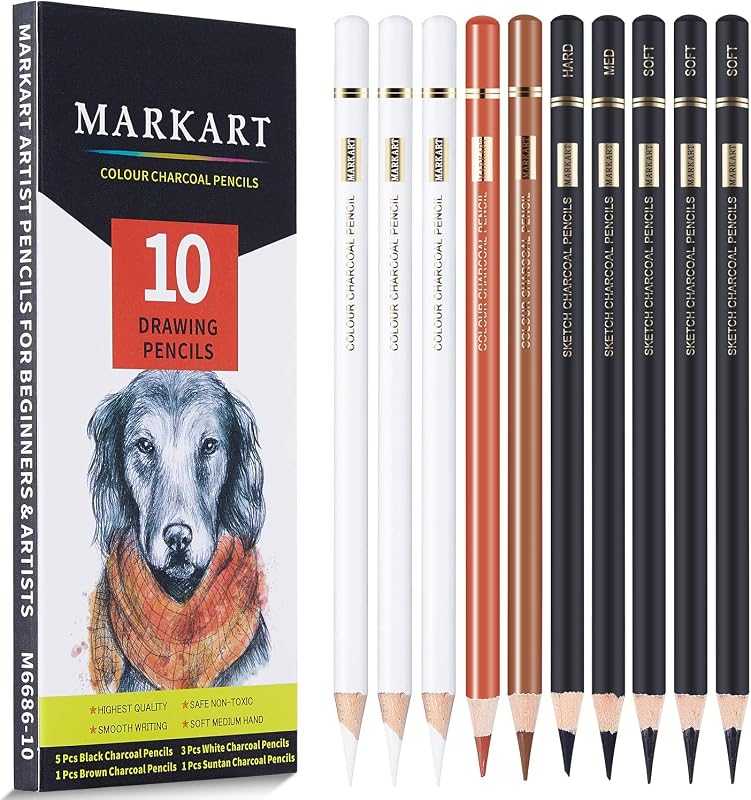
A 10-pencil set that adds white, brown and suntan options to a core group of black charcoal grades
Why it fits this guide
MARKART is useful when portraits and toned-paper drawing are the priority. Alongside five black charcoal pencils, the current listing includes three white pencils plus brown and suntan pencils, giving you more ways to build highlights and warm passages without switching to a separate colored-pencil set.
Honest drawback
The specialty colors reduce the number of black pencils compared with a monochrome-only pack.
Best forPortrait and figure artists who want black, white and warm earth-tone charcoal pencils
Pros
- Includes five black charcoal pencils across soft, medium and hard grades
- Adds three white pencils plus brown and suntan pencils
- Useful for portraits and toned-paper sketches that need light and warm accents
Cons
- Fewer black charcoal pencils than some dedicated monochrome sets
- Specialty colors may be unnecessary for artists who only want black charcoal
Mont Marte Woodless Charcoal Pencils, 3 Piece (opens Amazon in a new tab)
Three woodless charcoal pencils in soft, medium and hard grades for broad strokes and sharper details

Why it fits this guide
Mont Marte is the most direct woodless choice in this guide. With no wooden casing, the body can be used at an angle for broader shading, while the tip can still be sharpened for controlled marks.
Honest drawback
Only three pencils are included, with no white, tinted or accessory options.
Best forArtists who like broad side shading but still want a pencil-shaped charcoal tool
Pros
- Includes soft, medium and hard woodless charcoal grades
- Woodless body can be angled for broad shading
- Compact three-pencil set is easy to add to an existing drawing kit
Cons
- Only three pencils are included
- No white charcoal or additional drawing accessories
Cretacolor Charcoal Pencil Set (opens Amazon in a new tab)
A compact Cretacolor set aimed at drawing, hatching and smudging without the bulk of a full beginner kit

Why it fits this guide
Cretacolor fits artists who already own basic accessories and mainly want charcoal pencils. The Amazon listing emphasizes uniform strokes, charcoal lines, hatching and smudging, making it a focused alternative to mixed-media kits.
Honest drawback
The current Amazon listing is less explicit about the full grade breakdown, so buyers should confirm package details before ordering.
Best forSketchers who want a focused charcoal-pencil set for line work and blended tones
Pros
- Focused charcoal-pencil set from a specialist drawing-material brand
- Suitable for line work, hatching and smudging techniques
- Compact option for artists who do not need a large accessory kit
Cons
- Current Amazon listing provides less grade-detail than several competing kits
- No large accessory bundle for beginners starting from scratch
Galart Supplies Charcoal Drawing Set with Organizer Tray, 12 Pieces (opens Amazon in a new tab)
A 12-piece set covering soft, medium, hard and white charcoal with simple tray storage

Why it fits this guide
Galart Supplies is an easy-to-read starter option: the listing clearly calls out soft, medium, hard and white charcoal pencils, and the organizer tray makes the set less likely to turn into a loose pile in a sketching drawer.
Honest drawback
It is not as tool-complete as kits that include sticks, blenders, erasers and sharpening accessories.
Best forBeginners who want black grades and white charcoal stored together in a small organizer tray
Pros
- Includes soft, medium and hard charcoal options
- Adds white charcoal for toned-paper work
- Organizer tray keeps the set easier to store and scan
Cons
- Fewer supporting tools than a complete charcoal kit
- No woodless or tinted charcoal options
Arteza Drawing Set for Adults, 33 Piece (opens Amazon in a new tab)
A 33-piece drawing kit that combines charcoal options with graphite, blenders, erasers and sharpening tools

Why it fits this guide
Arteza makes the most sense when charcoal is one part of a wider drawing practice. The set includes charcoal pencils, a white charcoal pencil and woodless pencils alongside graphite and common sketching tools, so a beginner can move between construction drawing and charcoal shading from one case.
Honest drawback
Much of the 33-piece count is not dedicated charcoal, so charcoal-only buyers get better focus elsewhere.
Best forBeginners who need graphite and charcoal supplies in one broader drawing set
Pros
- Includes charcoal pencils, a white charcoal pencil and woodless drawing pencils
- Adds blenders, erasers, sharpener and hobby knife
- Useful for beginners who are building a complete sketching kit rather than buying charcoal alone
Cons
- Much of the 33-piece count is not dedicated charcoal
- Broader kit takes more space than a simple charcoal-pencil pack
Derwent Tinted Charcoal Pencils, 4mm Core, Metal Tin, 12 Count (opens Amazon in a new tab)
A 12-color, 4 mm-core tinted charcoal set for atmospheric sketches, landscapes and expressive color

Why it fits this guide
Derwent Tinted Charcoal expands the medium beyond black and white. The 12 muted colors are useful when you want restrained color in landscapes, portraits or mixed-media drawings while keeping charcoal's smudge-and-blend character.
Honest drawback
It is a specialist second set rather than the most practical first charcoal purchase for a beginner learning basic value control.
Best forArtists who want muted color while preserving a charcoal-style drawing experience
Pros
- Twelve muted tinted-charcoal colors
- 4 mm cores provide more material for expressive drawing
- Metal tin keeps the color set organized
Cons
- More specialized than a basic black hard-medium-soft starter set
- Artists focused only on monochrome studies may not need the color range
Related guides
Best Drawing Kits for Beginners: 10 Starter Sets That Are Actually Useful
The best drawing kits for beginners, with useful graphite, charcoal, blending and sketching tools instead of filler. Compare 10 practical starter sets.
Best Drawing Pencils for Beginners: 10 Sets for Sketching & Shading
Compare the best drawing pencils for beginners for sketching and shading, including graphite grades, starter tools, accessories, and practical trade-offs.
Best Portable Drawing Kits for Travel: 10 Compact Sketching Sets
The best portable drawing kits for travel, from graphite tins to mixed-media cases. Compare pencils, pads, storage, portability, and travel trade-offs.
Best Sketchbooks for Pencil Drawing: 10 Picks for Sketching & Shading
Compare 10 of the best sketchbooks for pencil drawing, from budget spiral pads to premium heavyweight and toned paper picks for shading.


