
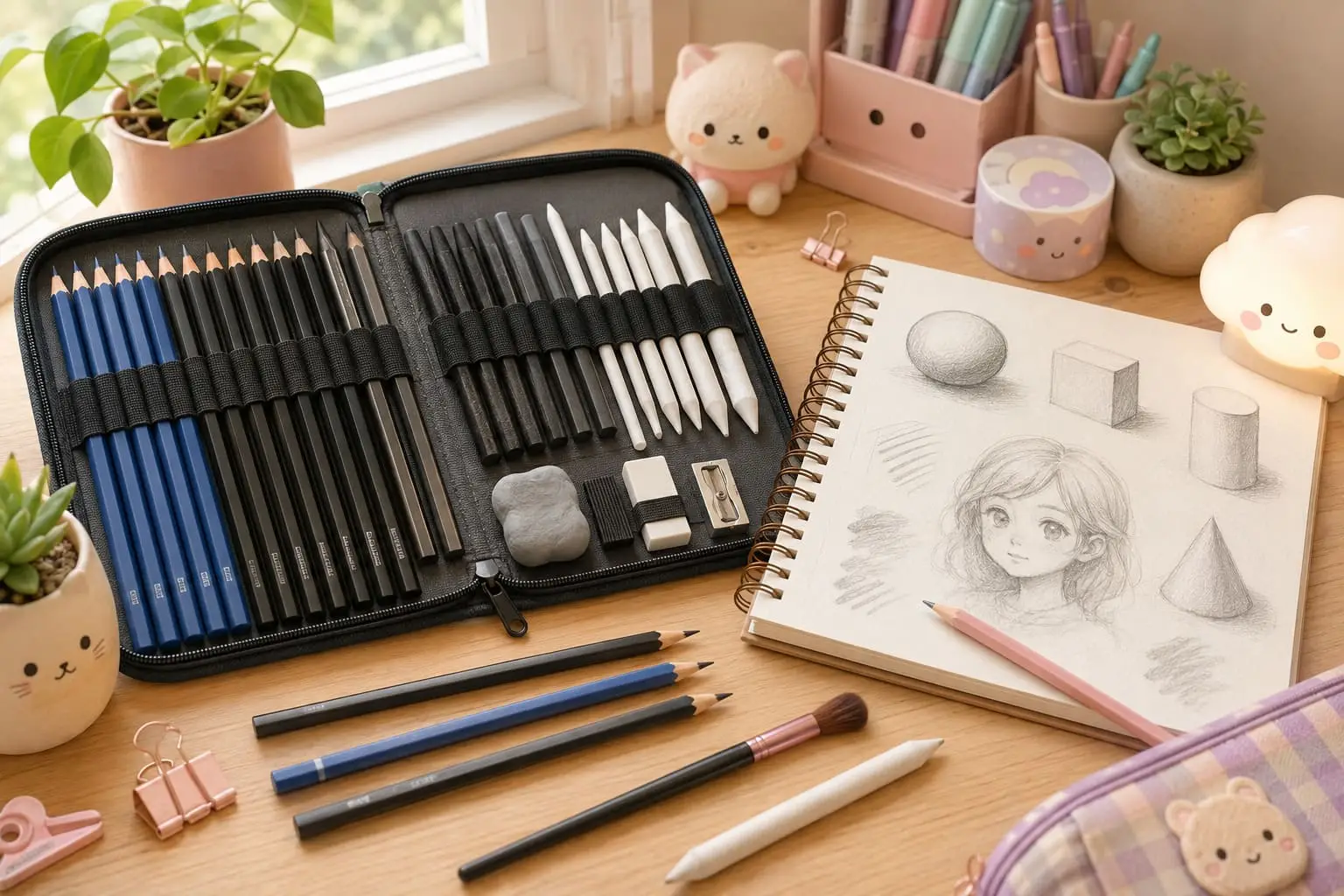
Quick picks
- Best premium all-in-oneCastle Art Supplies 60 Piece Drawing and Sketching Set (opens Amazon in a new tab)
- Best for trying different mediaH & B 72PCS Drawing Pencils & Sketch Kit (opens Amazon in a new tab)


Product comparison
| Product | Best for | Watch out | Price & shop |
|---|---|---|---|
| Prina 50 Piece Drawing Set Sketch Kit (opens Amazon in a new tab) Best overallResearch-based review | Beginners who want pencils, charcoal, blending tools and a sketchbook in one box | The kit introduces many tools at once, and the included 6 x 9 inch sketchbook is more portable than spacious | |
| Castle Art Supplies 60 Piece Drawing and Sketching Set (opens Amazon in a new tab) Best premium all-in-oneResearch-based review | Beginners who want one organized case for graphite, charcoal, pastel, water-soluble drawing and ink details | It costs more than focused graphite kits and includes media a brand-new artist may not need during the first few weeks | |
| H & B 72PCS Drawing Pencils & Sketch Kit (opens Amazon in a new tab) Best for trying different mediaResearch-based review | Curious beginners who want graphite plus colored, watercolor, metallic and charcoal pencils | The large piece count spreads the kit across many media instead of going deep on one drawing discipline | |
| KALOUR 33 Pro Drawing Kit Sketching Pencils Set (opens Amazon in a new tab) Best portable caseResearch-based review | Students and beginners who want graphite and charcoal tools in a travel-friendly organizer | No paper is included, so the set is not truly ready to use until you add a sketchbook or drawing pad | |
| KALOUR 28 Pro Sketching Drawing Pencils Set (opens Amazon in a new tab) Best graphite grade rangeResearch-based review | Beginners who want to study subtle value changes from hard pencils through extra-soft 14B graphite | The extreme grade range is more than a true beginner needs, and there is no paper in the package | |
| PANDAFLY 22 Piece Drawing Sketching Pencil Set (opens Amazon in a new tab) Best budget kitResearch-based review | Beginners who want the core graphite and charcoal tools without paying for a large mixed-media case | The smaller graphite selection skips intermediate grades, and you still need to supply your own paper | Budget-friendlyCheck price on Amazon (opens Amazon in a new tab) |
| Faber-Castell Pitt Graphite Matte Pencil Set (opens Amazon in a new tab) Best for dark matte valuesResearch-based review | Beginners who want a small graphite kit centered on deeper values rather than dozens of accessories | Four grades are not enough for someone who specifically wants a complete hard-to-soft graphite progression | |
| STAEDTLER Mars Lumograph 12 Pencil Set (opens Amazon in a new tab) Best minimalist graphite setResearch-based review | Beginners who want to learn pressure, line and value with pencils before buying a large art kit | It is a pencil set, not a complete starter kit, so you need to add basic accessories and paper separately | |
| Prismacolor Premier Graphite Drawing Pencils 18-Piece Set (opens Amazon in a new tab) Best for graphite techniquesResearch-based review | Beginners moving beyond standard pencils into woodless and water-soluble graphite | Its specialty graphite formats add complexity for someone who has not yet learned basic pencil pressure and value control | |
| Prismacolor Scholar Manga Drawing Set 10-Piece Kit (opens Amazon in a new tab) Best for manga beginnersResearch-based review | New manga artists who want construction pencils, graphite and black line tools in one small kit | The specialized 10-piece selection is too narrow for a beginner who wants charcoal, broad graphite grade coverage or general mixed-media exploration | Budget-friendlyCheck price on Amazon (opens Amazon in a new tab) |
Detailed product sections
Prina 50 Piece Drawing Set Sketch Kit (opens Amazon in a new tab)
A practical 50-piece kit with 15 graphite grades, charcoal tools, core accessories and a compact white-tan-black sketchbook

Why it fits this guide
Prina earns the top spot because its contents map neatly to the exercises a beginner is likely to attempt first. You can make light construction lines, build graphite values, try charcoal, lift highlights with a kneaded eraser, blend selected passages and work directly in the included sketchbook instead of immediately shopping for several missing basics.
Honest drawback
The kit introduces many tools at once, and the included 6 x 9 inch sketchbook is more portable than spacious
Best forBeginners who want pencils, charcoal, blending tools and a sketchbook in one box
Pros
- Fifteen graphite grades cover 5H through 12B
- Includes charcoal pencils and sticks, blending stumps, erasers and sharpening tools
- Compact sketchbook includes white, tan and black paper for different exercises
Cons
- Larger assortment requires more organization than a simple pencil set
- Small sketchbook is less suitable for large observational studies
Castle Art Supplies 60 Piece Drawing and Sketching Set (opens Amazon in a new tab)
A 60-piece mixed-media drawing case with graphite, charcoal, pastel, water-soluble tools, fineliners and guided instruction

Why it fits this guide
Castle Art Supplies makes sense for a motivated beginner who already knows they want to explore beyond ordinary pencil. The zip case brings together dry drawing tools, water-soluble options, fineliners and supporting accessories, while the included 28-page booklet gives the extra media a clearer purpose than a generic high-piece-count art case.
Honest drawback
It costs more than focused graphite kits and includes media a brand-new artist may not need during the first few weeks
Best forBeginners who want one organized case for graphite, charcoal, pastel, water-soluble drawing and ink details
Pros
- Broad mix of graphite, charcoal, pastel and water-soluble drawing tools
- Includes fineliners, water brushes, blenders and supporting accessories
- Portable case and instructional booklet help keep a large set usable
Cons
- Higher upfront cost than smaller starter sets
- Broad media choice can distract from basic pencil fundamentals
H & B 72PCS Drawing Pencils & Sketch Kit (opens Amazon in a new tab)
A 72-piece kit built for experimentation across graphite, charcoal and several colored-pencil formats

Why it fits this guide
H & B is the broadest experimentation pick here. Alongside a useful 5H-to-8B graphite range, it includes oil-colored pencils, watercolor pencils, metallic pencils and charcoal pencils. That is more variety than a beginner needs for basic sketching, but it can be valuable when you are still figuring out whether monochrome drawing, color or water-activated techniques hold your interest.
Honest drawback
The large piece count spreads the kit across many media instead of going deep on one drawing discipline
Best forCurious beginners who want graphite plus colored, watercolor, metallic and charcoal pencils
Pros
- Twelve graphite pencils span 5H through 8B
- Includes oil-colored, watercolor, metallic and charcoal pencils
- A5 sketch pad and core accessories let you begin practicing immediately
Cons
- Many beginners will not use every included medium
- A5 paper is compact for larger studies
KALOUR 33 Pro Drawing Kit Sketching Pencils Set (opens Amazon in a new tab)
A compact 33-piece graphite-and-charcoal kit organized in a zippered travel case

Why it fits this guide
KALOUR's 33 Pro set is less sprawling than the mixed-media cases and easier to understand as a drawing kit. The 12 graphite grades, three charcoal pencil hardnesses, sticks, erasers and blending tools cover common sketching techniques, while the zip case makes it practical for classes, café sketching or keeping supplies contained at home.
Honest drawback
No paper is included, so the set is not truly ready to use until you add a sketchbook or drawing pad
Best forStudents and beginners who want graphite and charcoal tools in a travel-friendly organizer
Pros
- Twelve graphite grades from 5H through 8B
- Adds charcoal pencils, sticks, erasers and blending tools
- Zippered case improves portability and organization
Cons
- Requires a separate sketchbook or drawing pad
- Does not extend as far into very soft graphite as some larger sets
KALOUR 28 Pro Sketching Drawing Pencils Set (opens Amazon in a new tab)
A 28-piece dry-media set whose 14 graphite pencils span 5H all the way to 14B

Why it fits this guide
This KALOUR set is useful when the graphite progression itself is the reason you are buying a kit. Fourteen grades give you more steps between light construction work and deep darks than a minimal pencil tin, while black and white charcoal plus blending and erasing accessories let you experiment with value and contrast without turning the case into a general craft set.
Honest drawback
The extreme grade range is more than a true beginner needs, and there is no paper in the package
Best forBeginners who want to study subtle value changes from hard pencils through extra-soft 14B graphite
Pros
- Fourteen graphite pencils span 5H through 14B
- Includes black and white charcoal plus compressed charcoal sticks
- Adds blending stumps, two eraser types and sharpening tools
Cons
- Several extreme grades may see little use at first
- No sketchbook is included
PANDAFLY 22 Piece Drawing Sketching Pencil Set (opens Amazon in a new tab)
A compact 22-piece set with graphite, black and white charcoal, blending stumps, erasers and a sharpener

Why it fits this guide
PANDAFLY keeps the starter formula relatively lean. Eight graphite grades are enough to practice light lines, mid-tones and dark shading, while the charcoal pencils and sticks introduce a second monochrome medium without adding dozens of colored tools. It is the kit to consider when budget and simplicity matter more than a premium case or a very fine grade progression.
Honest drawback
The smaller graphite selection skips intermediate grades, and you still need to supply your own paper
Best forBeginners who want the core graphite and charcoal tools without paying for a large mixed-media case
Pros
- Eight graphite grades cover 2H through 12B
- Includes multiple black charcoal hardnesses plus a white charcoal pencil
- Blending stumps, kneaded eraser, vinyl eraser and sharpener cover useful basics
Cons
- Fewer graphite grades than larger drawing kits
- No sketchbook is included
Faber-Castell Pitt Graphite Matte Pencil Set (opens Amazon in a new tab)
Four Pitt Graphite Matte pencils in 2B, 6B, 10B and 14B with an eraser and metal sharpener

Why it fits this guide
This is the opposite of a 50-piece starter case. Faber-Castell gives you only four graphite grades, but they are deliberately spaced from moderately soft to very dark. That makes the set easy to understand for value studies, portraits and dark shading when you would rather add your own sketchbook and blending tools than buy a bundle of extras.
Honest drawback
Four grades are not enough for someone who specifically wants a complete hard-to-soft graphite progression
Best forBeginners who want a small graphite kit centered on deeper values rather than dozens of accessories
Pros
- Focused 2B, 6B, 10B and 14B matte graphite selection
- Includes a PVC-free eraser and metal sharpener
- Compact format minimizes filler accessories
Cons
- No hard graphite grades for very light construction work
- No charcoal, blending stumps or paper included
STAEDTLER Mars Lumograph 12 Pencil Set (opens Amazon in a new tab)
A classic 12-pencil graphite progression from 6B to 4H packed in a simple metal case

Why it fits this guide
STAEDTLER Mars Lumograph is the strongest argument for buying fewer things. Twelve graphite grades give a beginner enough range for construction, hatching, tonal scales and finished pencil drawings, while the lack of bundled extras forces you to choose your own paper, eraser and sharpener. For someone serious about fundamentals, that simplicity can be an advantage rather than a missing feature.
Honest drawback
It is a pencil set, not a complete starter kit, so you need to add basic accessories and paper separately
Best forBeginners who want to learn pressure, line and value with pencils before buying a large art kit
Pros
- Twelve graphite grades span 6B to 4H
- Metal case keeps the grade sequence organized
- Focused pencil-only format suits value and line-control exercises
Cons
- No eraser, sharpener, blending tools or paper included
- No charcoal or mixed media for experimentation
Prismacolor Premier Graphite Drawing Pencils 18-Piece Set (opens Amazon in a new tab)
An 18-piece graphite toolkit combining graded pencils, woodless graphite, water-soluble graphite and core erasing and sharpening tools

Why it fits this guide
Prismacolor's 18-piece set is more educational than its size suggests because the pieces are not merely duplicate pencil grades. Seven traditional Turquoise pencils cover light through dark values, four woodless pencils can be used for detail or broader coverage, and three water-soluble graphite pencils add wash techniques. Two eraser types, a sharpener and sanding board round out the workflow.
Honest drawback
Its specialty graphite formats add complexity for someone who has not yet learned basic pencil pressure and value control
Best forBeginners moving beyond standard pencils into woodless and water-soluble graphite
Pros
- Seven graded pencils cover 8B through 6H
- Four woodless and three water-soluble graphite pencils expand technique options
- Includes kneaded and vinyl erasers, steel sharpener and sanding board
Cons
- No sketchbook or blending stumps included
- Specialty graphite may be unnecessary for an absolute first lesson
Prismacolor Scholar Manga Drawing Set 10-Piece Kit (opens Amazon in a new tab)
A focused 10-piece manga kit with erasable construction colors, four graphite grades, fine and brush markers, eraser and guide

Why it fits this guide
Prismacolor Scholar Manga is useful because every tool supports a recognizable drawing sequence. The non-photo blue and crimson pencils can be used for construction, graphite refines the sketch, and the fine and brush black markers handle line work. It is a much better fit for a manga learner than a generic 70-piece case full of media that never enter that workflow.
Honest drawback
The specialized 10-piece selection is too narrow for a beginner who wants charcoal, broad graphite grade coverage or general mixed-media exploration
Best forNew manga artists who want construction pencils, graphite and black line tools in one small kit
Pros
- Four graphite grades include 2H, 2B, 4B and 6B
- Erasable crimson and non-photo blue pencils support construction sketching
- Fine and brush black markers plus a how-to guide support manga line work
Cons
- Narrow graphite range and no charcoal
- Specialized for manga rather than general observational drawing
Related guides

Best Charcoal Pencils for Drawing: 10 Picks for Beginners & Shading
The best charcoal pencils for drawing and shading, compared for beginners, portraits, soft gradients, white highlights, woodless coverage and value.
Best Drawing Pencils for Beginners: 10 Sets for Sketching & Shading
Compare the best drawing pencils for beginners for sketching and shading, including graphite grades, starter tools, accessories, and practical trade-offs.
Best Portable Drawing Kits for Travel: 10 Compact Sketching Sets
The best portable drawing kits for travel, from graphite tins to mixed-media cases. Compare pencils, pads, storage, portability, and travel trade-offs.
Best Drawing Supplies for Kids: 10 Easy Starter Picks for Young Artists
Best drawing supplies for kids, from washable markers and crayons to pencils, paper and art kits. Compare age guidance, grip, mess and value.


