
Quick picks
- Best desktop organizerMarbrasse 360-Degree Rotating Pen Holder (opens Amazon in a new tab)



Product comparison
| Product | Best for | Watch out | Price & shop |
|---|---|---|---|
| ArtBin 3-Tray Art Supply Box (opens Amazon in a new tab) Best overallResearch-based review | Mixed art and craft supplies that need both quick-access trays and deeper portable storage | The hard case takes noticeably more shelf and desk space than a simple pencil case, marker rack or rotating desktop caddy | |
| Marbrasse 360-Degree Rotating Pen Holder (opens Amazon in a new tab) Best desktop organizerResearch-based review | Frequently used pens, pencils, markers, brushes and scissors that should stay visible beside a workspace | Open storage does not protect supplies from dust and cannot absorb a large marker collection or bulky craft materials | Budget-friendlyCheck price on Amazon (opens Amazon in a new tab) |
| SANFURNEY Art Marker Storage Rack for 120 Markers (opens Amazon in a new tab) Best for markersResearch-based review | Large marker collections that are easier to use when individual colors remain visible and separated | It is specialized for markers, and buyers should confirm both barrel fit and the recommended storage orientation for the exact marker brand they own | |
| IRIS USA 10-Drawer Rolling Storage Organizer (opens Amazon in a new tab) Best rolling cartResearch-based review | Larger craft collections that need separate categories and storage that can move beside a desk or table | The cart needs clear floor space, and its shallow drawers are more appropriate for sorted small and medium materials than very tall bottles or oversized supplies | |
| BTSKY 3-Layer Plastic Dividing Storage Box (opens Amazon in a new tab) Best budget portable boxResearch-based review | Small mixed craft supplies that need adjustable dividers and a carry handle without a large hard case | The compact layered format is less useful for sketchbooks, tall paint bottles and other oversized materials | Budget-friendlyCheck price on Amazon (opens Amazon in a new tab) |
| ArtBin Super Satchel Double Deep Compartment Box (opens Amazon in a new tab) Best stackable craft binResearch-based review | Bulkier craft materials that benefit from deep storage, removable compartments and stackable shelf organization | Its larger general-purpose compartments do not provide the individual pen or marker slots that a dedicated writing-tool organizer offers | |
| Deflecto Caddy Organizer (opens Amazon in a new tab) Best modular caddyResearch-based review | Small craft categories that should travel together but remain removable during a project | Three main containers provide less detailed sorting than a multi-drawer cabinet and the design is not specialized for individual marker storage | |
| Akro-Mils 64-Drawer Plastic Storage Cabinet (opens Amazon in a new tab) Best for tiny craft partsResearch-based review | Beads, clips, findings, erasers, refills and small accessories that disappear inside ordinary bins | The small drawers are unsuitable as primary storage for long markers, paint bottles, paper, sketchbooks or oversized tools | |
| Toprema Marker Pen Case Holder for 120 Markers (opens Amazon in a new tab) Best travel marker caseResearch-based review | Carrying a large marker collection to classes, craft days or another workspace | A fully packed soft case can become bulky, and real capacity depends on the diameter of the marker barrels you use | |
| Lbxgap 300 Slots Colored Pencil Case (opens Amazon in a new tab) Best for pencils and gel pensResearch-based review | Very large colored-pencil or gel-pen collections that need individual elastic organization in a portable case | A layered case takes longer to scan than an open rack and can become bulky once hundreds of writing tools are loaded inside |
Detailed product sections
ArtBin 3-Tray Art Supply Box (opens Amazon in a new tab)
A hard-plastic three-tray art box that separates smaller tools above a deeper compartment for bulkier supplies

Why it fits this guide
The ArtBin 3-Tray Art Supply Box is the most flexible starting point in this shortlist because it is not locked into one supply type. The tiered trays can hold pens, brushes, cutters and smaller tools while the deeper lower section leaves room for paint bottles, glues, scissors and other bulkier materials. That combination makes it easier to keep one active project kit together without forcing markers, tools and bottles into the same undivided cavity.
Honest drawback
The hard case takes noticeably more shelf and desk space than a simple pencil case, marker rack or rotating desktop caddy
Best forMixed art and craft supplies that need both quick-access trays and deeper portable storage
Pros
- Three-tray design plus in-lid storage separates different supply sizes
- Deep bottom section accommodates bulkier bottles, scissors, glues and tools
- Carry handle and hard-plastic body make it practical for moving supplies between rooms
Cons
- Larger footprint than a compact desktop organizer or pen case
- Very small loose items may still benefit from smaller inner containers or pouches
Marbrasse 360-Degree Rotating Pen Holder (opens Amazon in a new tab)
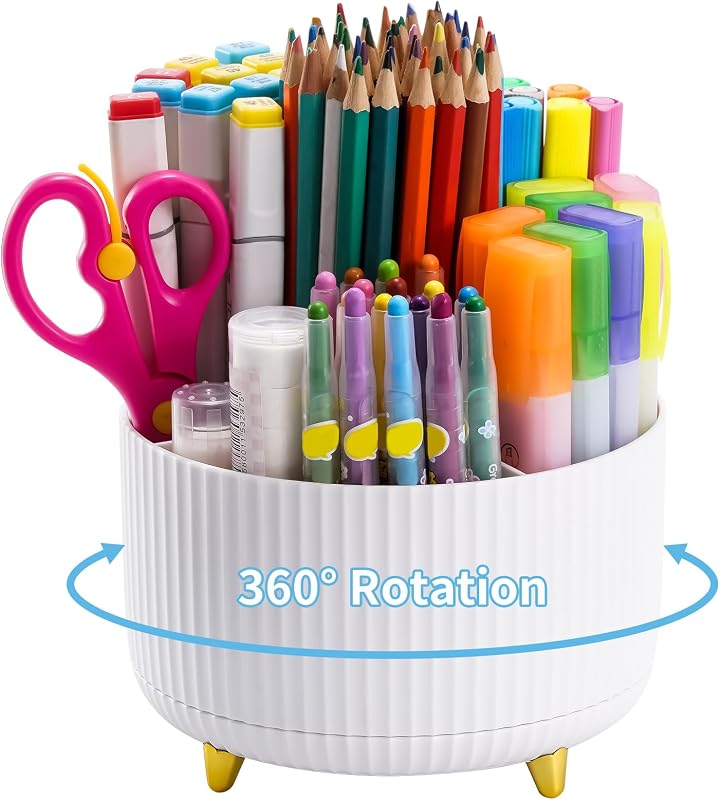
A five-compartment pen holder with a rotating base for fast access to everyday art and stationery tools
Why it fits this guide
Marbrasse is the simplest recommendation here for a desk that needs less friction rather than more storage volume. Five open compartments give you obvious homes for pens, pencils, brushes, scissors and other frequently used tools, and the 360-degree rotating base helps when the organizer sits near the back or side of a desk. It is particularly useful when the problem is scattered daily tools rather than a whole-room craft collection.
Honest drawback
Open storage does not protect supplies from dust and cannot absorb a large marker collection or bulky craft materials
Best forFrequently used pens, pencils, markers, brushes and scissors that should stay visible beside a workspace
Pros
- Rotating base provides access from multiple sides of a desk
- Five compartments separate pens, pencils, brushes, scissors and other daily tools
- Compact vertical layout uses less surface area than spreading several cups across the desk
Cons
- Open compartments do not protect supplies from dust
- Not designed for storing a very large marker collection or bulky bottles
SANFURNEY Art Marker Storage Rack for 120 Markers (opens Amazon in a new tab)
A vertical tabletop rack with dedicated storage for up to 120 markers and configurable internal dividers

Why it fits this guide
SANFURNEY solves a different problem from a general craft box: it turns a loose marker collection into a visible color library. Dedicated slots make it easier to scan the collection without emptying a drawer or pouch, while the vertical format concentrates many markers into a relatively narrow desk area. The adjustable and removable dividers also make the layout more configurable than a one-piece molded rack.
Honest drawback
It is specialized for markers, and buyers should confirm both barrel fit and the recommended storage orientation for the exact marker brand they own
Best forLarge marker collections that are easier to use when individual colors remain visible and separated
Pros
- Provides dedicated storage for up to 120 markers
- Adjustable and removable dividers allow the internal layout to be configured
- Vertical tabletop design makes a large marker collection easier to scan than a deep bin
Cons
- Specialized for markers rather than mixed bulky craft supplies
- Marker barrel dimensions and recommended storage orientation should be checked before buying
IRIS USA 10-Drawer Rolling Storage Organizer (opens Amazon in a new tab)
A tall ten-drawer organizer with removable casters for category-based storage in a craft room, classroom or studio

Why it fits this guide
The IRIS USA cart is the step up when several small organizers are no longer enough. Ten drawers let you create separate zones for paper, stickers, markers, adhesives, punches, tools or works in progress, while the casters let the whole system move closer to a table during a project. The vertical layout is especially useful when floor space is available but you do not want to dedicate a full cabinet or shelving unit to supplies.
Honest drawback
The cart needs clear floor space, and its shallow drawers are more appropriate for sorted small and medium materials than very tall bottles or oversized supplies
Best forLarger craft collections that need separate categories and storage that can move beside a desk or table
Pros
- Ten drawers make it easy to assign separate categories to different supplies
- Removable casters let the organizer function as a rolling cart or stationary drawer unit
- Drawer stops help keep drawers from being pulled out unintentionally during normal use
Cons
- Requires more floor space than a desktop organizer
- Shallow drawers are not ideal for tall paint bottles or oversized art materials
BTSKY 3-Layer Plastic Dividing Storage Box (opens Amazon in a new tab)
A compact three-layer craft box with adjustable spacers for separating small tools, beads and project supplies

Why it fits this guide
BTSKY makes sense when you need more separation than a single open tote but do not need a full rolling cart. Its three stacked layers can divide different categories inside one handled box, and the adjustable spacers help accommodate supplies that are not all the same size. It is a practical bridge between a small desktop caddy and a larger tackle-style art box.
Honest drawback
The compact layered format is less useful for sketchbooks, tall paint bottles and other oversized materials
Best forSmall mixed craft supplies that need adjustable dividers and a carry handle without a large hard case
Pros
- Three-layer design separates multiple categories in one portable box
- Adjustable spacers make the compartment layout more flexible for different small supplies
- Integrated handle makes it convenient to move between a desk, shelf and craft table
Cons
- Not designed for very large or tall art materials
- Lower layers take longer to access than an open desktop caddy
ArtBin Super Satchel Double Deep Compartment Box (opens Amazon in a new tab)
An extra-deep transparent craft case that can remain open or be divided into as many as eight sections

Why it fits this guide
The Super Satchel is more shelf-storage system than pencil case. Its deeper body handles bulkier materials that overwhelm small divided boxes, while removable compartments let you switch between a mostly open interior and more structured category storage. The transparent case also makes sense when you plan to stack several project or supply boxes and want to identify contents before pulling one down.
Honest drawback
Its larger general-purpose compartments do not provide the individual pen or marker slots that a dedicated writing-tool organizer offers
Best forBulkier craft materials that benefit from deep storage, removable compartments and stackable shelf organization
Pros
- Extra-deep case can be configured with up to eight removable compartments
- Transparent body makes stored supplies visible without opening every case
- Stackable shape, handle and snap-tight latches suit shelf-based craft storage
Cons
- Larger footprint than a marker rack or desktop organizer
- Does not provide individual slots for pens or markers
Deflecto Caddy Organizer (opens Amazon in a new tab)
A portable caddy with three detachable lidded containers that can also stack with compatible units

Why it fits this guide
Deflecto's caddy is useful when the same supplies move between a shelf and an active craft table. The three containers can stay locked together for transport, then separate so different materials can sit exactly where they are needed during a project. That modular idea is more flexible than one fixed bin, especially if you later add compatible caddies to the same system.
Honest drawback
Three main containers provide less detailed sorting than a multi-drawer cabinet and the design is not specialized for individual marker storage
Best forSmall craft categories that should travel together but remain removable during a project
Pros
- Three removable storage containers can be used together or separately
- Hinged snap-tight lids help keep small craft supplies contained
- Compatible caddies can stack using the lift-and-lock design
Cons
- Only three main containers for category separation
- Optional wall-mount components are separate from the basic caddy
Akro-Mils 64-Drawer Plastic Storage Cabinet (opens Amazon in a new tab)
A 64-drawer cabinet built around fine-grained small-parts organization rather than general art-tool storage

Why it fits this guide
Akro-Mils earns a place here because some craft supplies are too small for ordinary organizer bins. Sixty-four individual drawers let you give beads, clips, charms, refills, erasers, sharpeners, findings and other tiny items their own categories instead of mixing everything together. It is a specialist solution, but for a detail-heavy craft setup it can solve a problem that large totes and rolling drawers do not.
Honest drawback
The small drawers are unsuitable as primary storage for long markers, paint bottles, paper, sketchbooks or oversized tools
Best forBeads, clips, findings, erasers, refills and small accessories that disappear inside ordinary bins
Pros
- Sixty-four drawers provide extensive separation for small craft components
- Shallow cabinet depth works well on a workbench, shelf or craft-room station
- Dedicated drawers reduce the need to mix many tiny supply types in one box
Cons
- Not suitable as primary storage for long pens, large paint bottles or paper
- Fixed cabinet format is less portable than a handled craft box or caddy
Toprema Marker Pen Case Holder for 120 Markers (opens Amazon in a new tab)
A soft zippered dual-compartment case designed to carry up to 120 markers with a handle and shoulder strap

Why it fits this guide
Toprema is the stronger choice when the marker collection needs to leave the desk. The case keeps a large number of markers together inside two zippered sections and adds both a carry handle and shoulder strap, which is more travel-friendly than moving a filled tabletop rack. It also keeps the collection enclosed when stored on a shelf or taken to a class.
Honest drawback
A fully packed soft case can become bulky, and real capacity depends on the diameter of the marker barrels you use
Best forCarrying a large marker collection to classes, craft days or another workspace
Pros
- Designed to carry up to 120 markers in a zippered case
- Dual compartments help divide a large marker set into two sections
- Carry handle and shoulder strap make it more travel-friendly than a tabletop rack
Cons
- Soft case offers less rigid protection than a hard plastic art box
- Slower for instant color access on a desk than an open marker rack
Lbxgap 300 Slots Colored Pencil Case (opens Amazon in a new tab)
A five-layer high-capacity case designed for hundreds of pencils or a large collection of gel pens

Why it fits this guide
Lbxgap is the high-capacity specialist for people who want individual writing tools separated instead of dropped into cups or drawers. The five-layer layout is designed to hold up to 300 colored pencils, while the current listing also positions it for a large gel-pen collection. It is a better match for someone who wants to browse a portable library of pencils or pens than for someone storing paint bottles and general craft tools.
Honest drawback
A layered case takes longer to scan than an open rack and can become bulky once hundreds of writing tools are loaded inside
Best forVery large colored-pencil or gel-pen collections that need individual elastic organization in a portable case
Pros
- High-capacity case is designed to hold up to 300 colored pencils or a large gel-pen collection
- Five-layer layout keeps many writing tools separated instead of piled together
- Handle and shoulder strap support carrying the collection between locations
Cons
- Slower to scan than an open desktop organizer because the collection is split across layers
- Not intended for bulky paint bottles, scissors or large craft tools
Related guides
Best Desk Organizers for Art Supplies: 10 Picks for a Clutter-Free Workspace
The best desk organizers for art supplies, from rotating caddies to marker racks. Compare capacity, footprint, access, storage style, and portability.
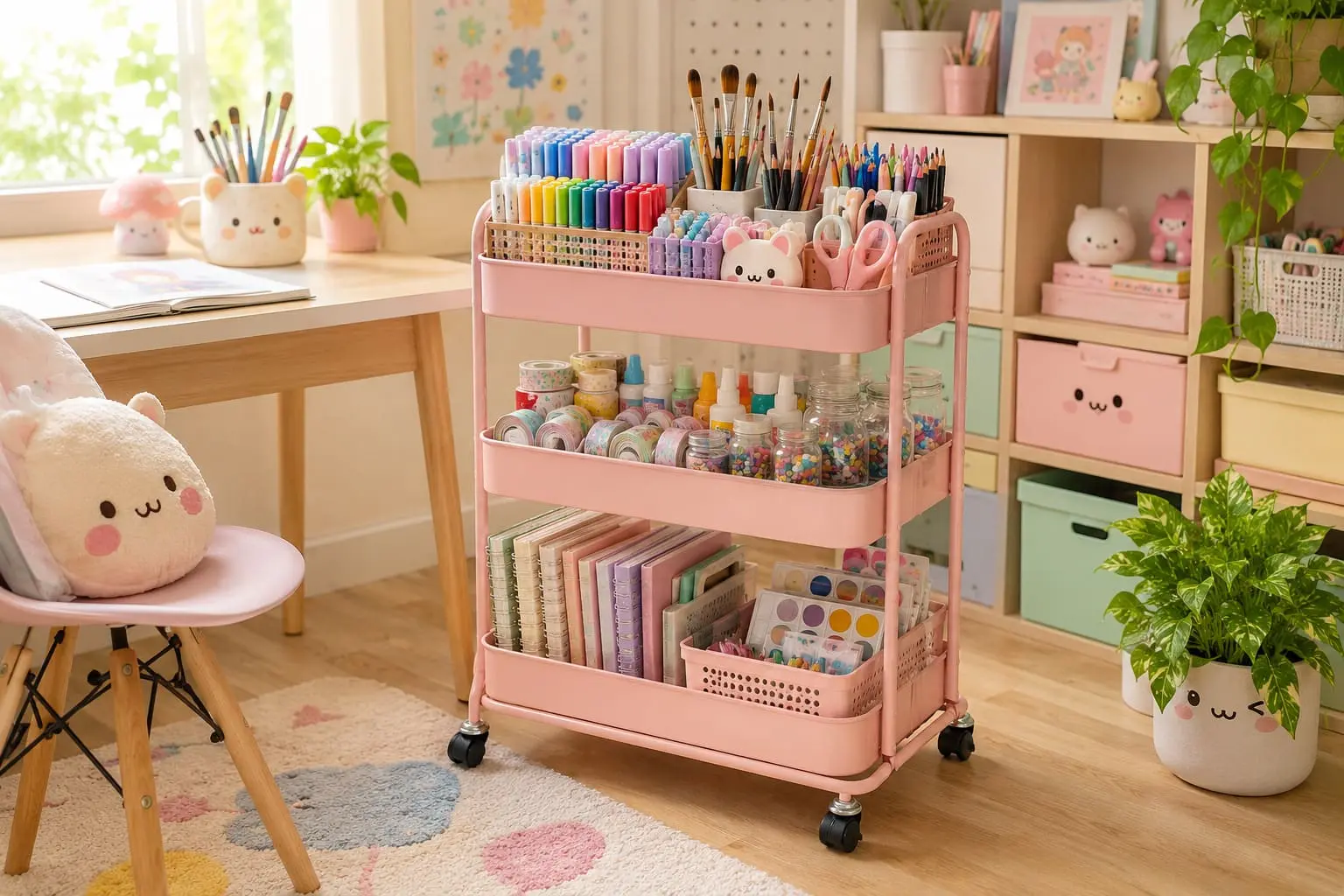
Best Rolling Art Carts and Craft Carts
Compare 10 rolling art cart and craft cart picks, from open 3-tier carts to drawer carts, foldable carts, worktop carts and wooden studio carts.
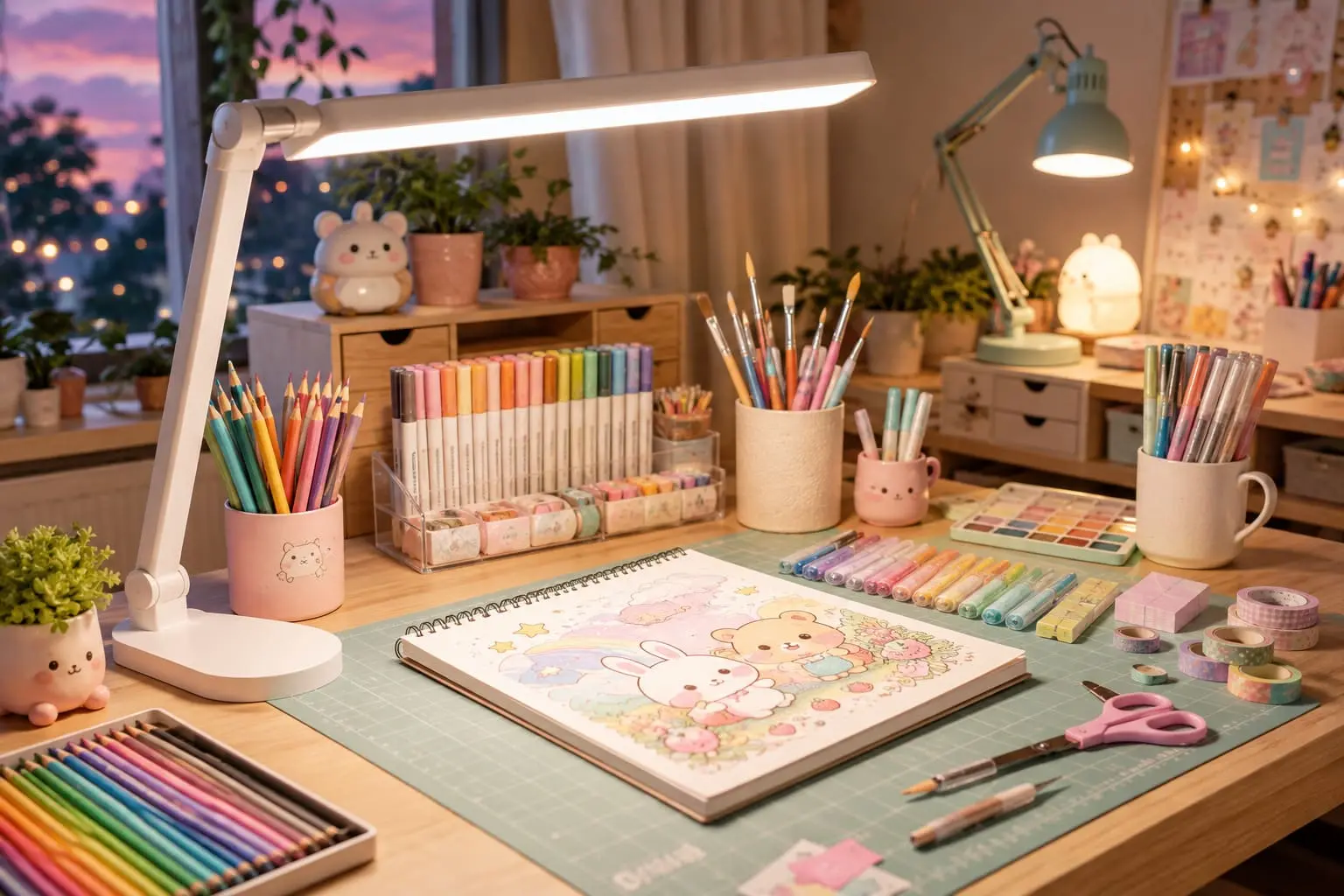
Best Desk Lamps for Drawing, Coloring & Crafts: 10 Bright Picks
The best desk lamps for drawing, coloring and crafts, from budget LEDs to bright wide task lamps. Compare CRI, brightness, coverage and controls.
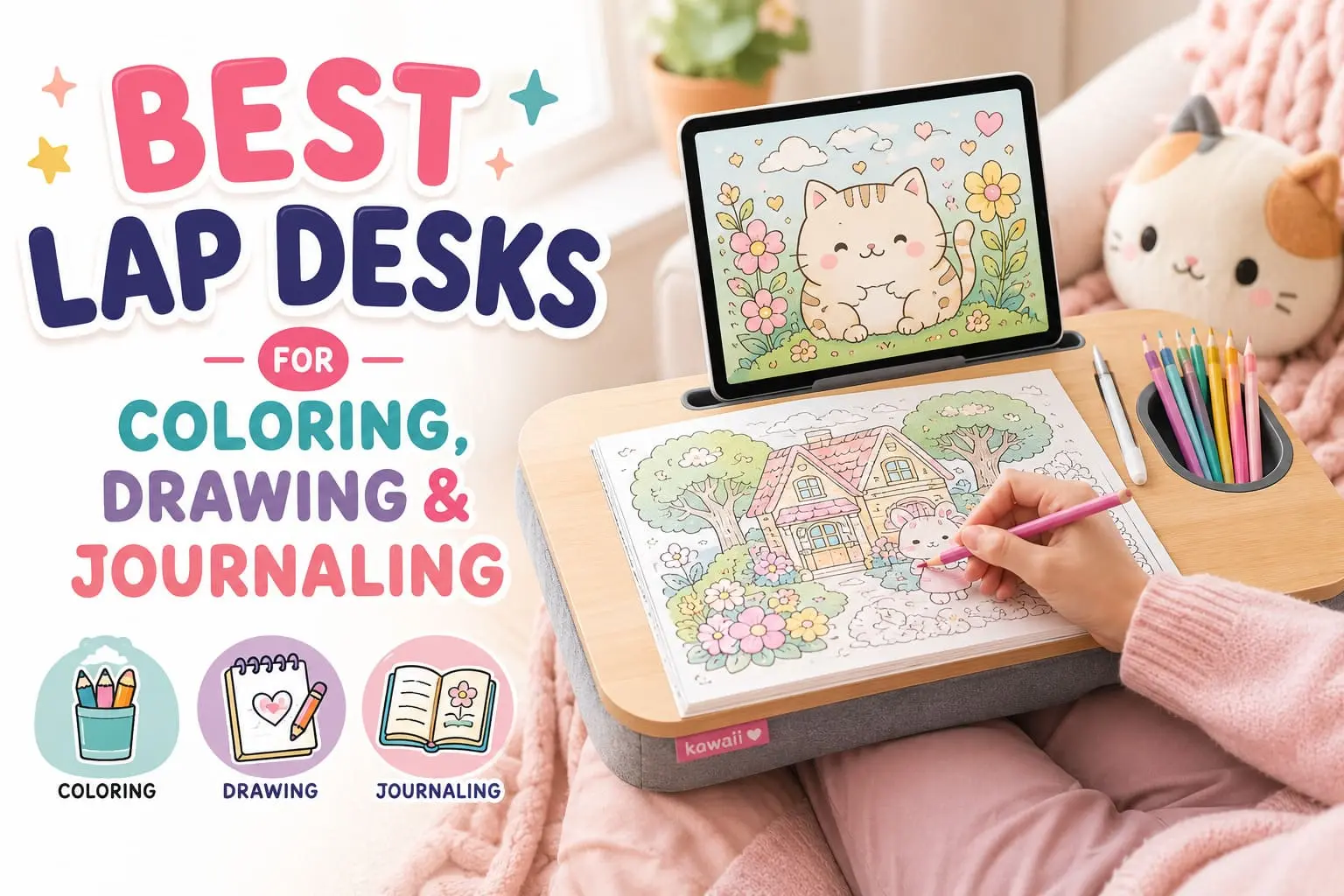
Best Lap Desks for Coloring, Drawing & Journaling: 10 Comfortable Picks
The best lap desks for coloring, drawing and journaling, from cushioned flat tops to adjustable easels. Compare size, tilt, storage and support.


