
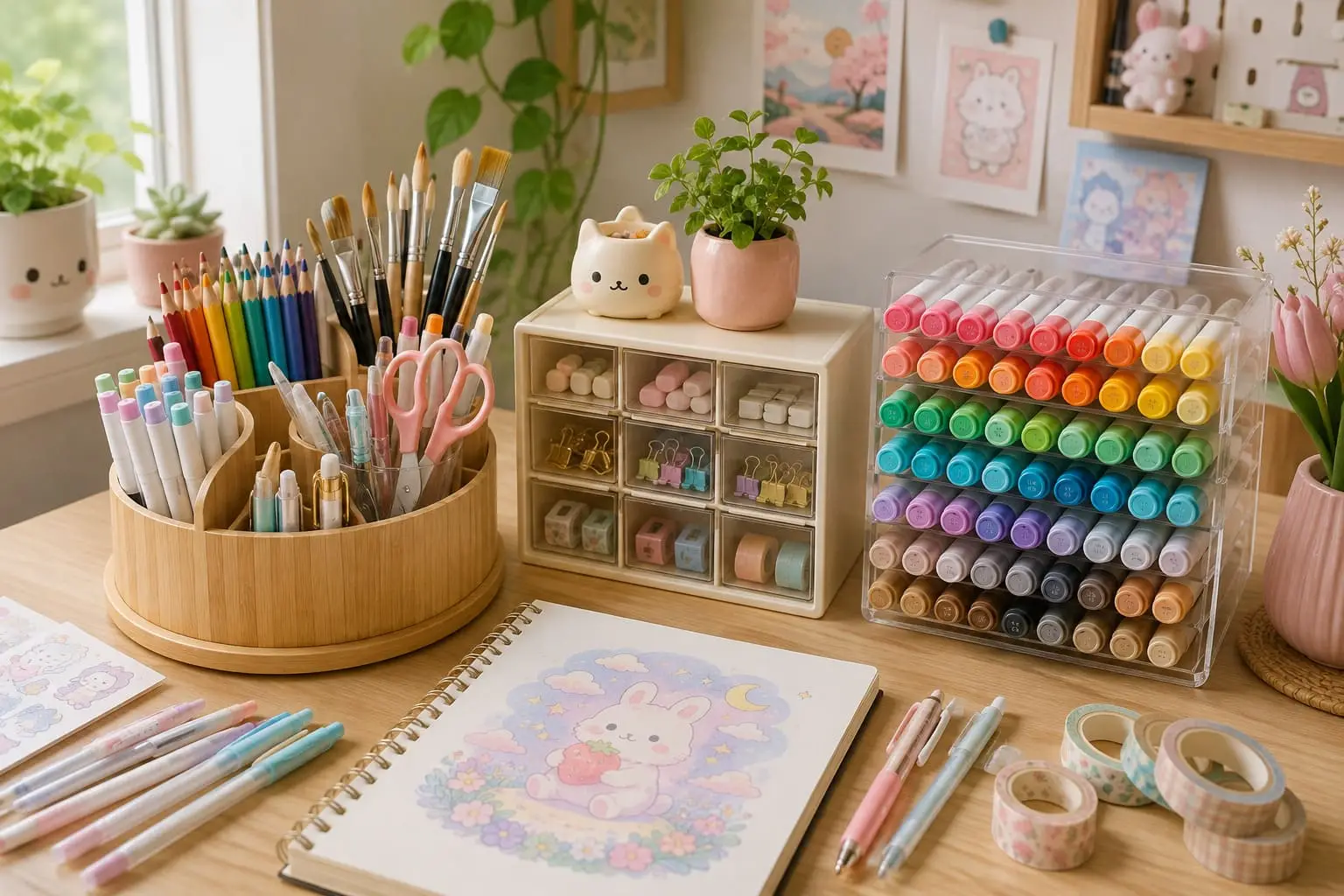
Quick picks
- Best with drawersMarbrasse Pen Organizer with 2 Drawers (opens Amazon in a new tab)
- Best horizontal marker storageTOOLI-ART 72 Art Marker Storage Tray (opens Amazon in a new tab)
- Best vertical marker organizerBEYGORM Acrylic Vertical Marker Organizer for 150 Markers (opens Amazon in a new tab)


Product comparison
| Product | Best for | Watch out | Price & shop |
|---|---|---|---|
| Utoplike Bamboo Rotating Art Supply Desk Organizer (opens Amazon in a new tab) Best overallResearch-based review | Artists who want flexible, all-around access to mixed pens, pencils, crayons and brushes | Its circular footprint uses more desk depth than a slim rectangular organizer pushed against a wall | |
| SKYDUE 360 Rotating Desk Pen Organizer (opens Amazon in a new tab) Best budgetResearch-based review | Small creative desks that need an inexpensive home for frequently used pens, pencils, markers and brushes | Five open sections are practical for daily tools but not enough for a large marker collection or many tiny accessories | Budget-friendlyCheck price on Amazon (opens Amazon in a new tab) |
| Marbrasse Pen Organizer with 2 Drawers (opens Amazon in a new tab) Best with drawersResearch-based review | Artists who want tall tools visible but erasers, sharpeners, clips and small accessories hidden | The small drawers are useful for accessories but too shallow for bulky craft supplies | Budget-friendlyCheck price on Amazon (opens Amazon in a new tab) |
| TOOLI-ART 72 Art Marker Storage Tray (opens Amazon in a new tab) Best horizontal marker storageResearch-based review | Marker users who want modular trays that can stack or expand with the collection | A tray system consumes more horizontal or shelf space than a compact rotating cup | |
| BEYGORM Acrylic Vertical Marker Organizer for 150 Markers (opens Amazon in a new tab) Best vertical marker organizerResearch-based review | Marker-heavy desks that need high visible capacity in a relatively narrow footprint | The fixed vertical rack is less portable and less adaptable to bulky craft tools than a removable-bin caddy | |
| Learning Resources Create-a-Space Storage Center (opens Amazon in a new tab) Best for shared craft tablesResearch-based review | Families, homeschool setups and classrooms where several people need supplies at once | The 12-inch diameter is generous for a shared table but bulky on a narrow personal desk | |
| Creative Caddy Rotating Art Supply Organizer (opens Amazon in a new tab) Best for kidsResearch-based review | Kids' desks, homeschool stations and classroom-style creative spaces | Its colorful design and roughly 10-inch footprint are less suited to minimalist adult workspaces | |
| mDesign 3-Section Desk Organizer (opens Amazon in a new tab) Best for small desksResearch-based review | Minimal art setups with only a few categories of frequently used tools | Three compartments do not offer enough separation for a large marker palette or a broad mixed-media collection | Budget-friendlyCheck price on Amazon (opens Amazon in a new tab) |
| FASTRYF 8-Pack Marker Organizer Trays (opens Amazon in a new tab) Best for drawersResearch-based review | Artists who want shallow, visible marker and pencil storage inside drawers or cabinets | The tray format is less convenient for grab-and-go desk use and does not suit bulky scissors, glue bottles or wider craft tools | |
| SANFURNEY 204-Slot Marker Organizer (opens Amazon in a new tab) Best for large marker collectionsResearch-based review | Artists with 200-plus markers who want each pen separated and visible | At about 15 inches wide and 10.2 inches high, it requires a dedicated desk or shelf zone |
Detailed product sections
Utoplike Bamboo Rotating Art Supply Desk Organizer (opens Amazon in a new tab)
A rotating bamboo caddy with removable divider sections that balances everyday capacity, access and a studio-friendly look

Why it fits this guide
Utoplike is the most balanced all-purpose desk organizer in this shortlist because it is designed around mixed art tools rather than one pen size. The rotating base makes several sections reachable without lifting the caddy, while the removable divider gives you more freedom to combine pencils, markers, crayons and brushes than a rack built around fixed marker slots.
Honest drawback
Its circular footprint uses more desk depth than a slim rectangular organizer pushed against a wall
Best forArtists who want flexible, all-around access to mixed pens, pencils, crayons and brushes
Pros
- Rotating design keeps supplies accessible from different sides of a desk
- Bamboo construction gives the organizer a furniture-like look
- Removable divider design provides more flexibility than fixed single-size cups
Cons
- Round footprint uses more depth than a slim organizer placed against a wall
- Open compartments do not hide small visual clutter
SKYDUE 360 Rotating Desk Pen Organizer (opens Amazon in a new tab)
A compact five-section plastic organizer with a 360-degree rotating base and a 5.8-inch square footprint

Why it fits this guide
SKYDUE gives you the core benefit of a rotating art caddy without taking over the desk. Five open compartments let you sort everyday tools by type or color family, and the listing documents a compact 5.8 by 5.8 inch footprint that is easier to place beside a notebook, tablet or coloring book than a large classroom caddy.
Honest drawback
Five open sections are practical for daily tools but not enough for a large marker collection or many tiny accessories
Best forSmall creative desks that need an inexpensive home for frequently used pens, pencils, markers and brushes
Pros
- Compact 5.8 x 5.8 inch footprint suits smaller desks
- Five compartments separate frequently used tools
- 360-degree rotation makes supplies easy to reach without lifting the organizer
Cons
- Limited capacity compared with dedicated marker racks
- Open-top design does not contain tiny loose items as well as drawers
Marbrasse Pen Organizer with 2 Drawers (opens Amazon in a new tab)
A compact vertical organizer that combines open pen storage with two small front drawers

Why it fits this guide
Marbrasse solves a different clutter problem than a simple pencil cup. The open upper sections keep pens and tools in reach, while two drawers give small loose items a defined place so they do not collect around the base of the organizer. The current listing measures it at 8.2 inches deep, 4.2 inches wide and 6.3 inches high.
Honest drawback
The small drawers are useful for accessories but too shallow for bulky craft supplies
Best forArtists who want tall tools visible but erasers, sharpeners, clips and small accessories hidden
Pros
- Two drawers help keep small items out of sight
- Open top sections keep pens and tools immediately accessible
- Compact vertical layout uses desk height instead of spreading storage sideways
Cons
- Small drawers are not designed for bulky paint or craft items
- Fixed compartment layout offers less flexibility than removable dividers
TOOLI-ART 72 Art Marker Storage Tray (opens Amazon in a new tab)
Six modular trays with adjustable dividers designed to organize up to 72 art markers

Why it fits this guide
TOOLI-ART is the strongest fit here when your marker brand or personal workflow calls for horizontal storage. Instead of dropping every marker into a cup, the six trays separate tools into visible rows. Adjustable dividers also make the system more flexible for different pens, pencils and brushes than a fixed honeycomb rack.
Honest drawback
A tray system consumes more horizontal or shelf space than a compact rotating cup
Best forMarker users who want modular trays that can stack or expand with the collection
Pros
- Designed around a 72-marker capacity
- Adjustable dividers accommodate different pens, pencils and brushes
- Modular trays can be stacked or expanded as the workspace changes
Cons
- Takes more setup space than a compact cup-style organizer
- Less convenient for loose small accessories that can slip between larger tools
BEYGORM Acrylic Vertical Marker Organizer for 150 Markers (opens Amazon in a new tab)
A clear acrylic rack with 13 angled compartments designed to hold about 150 markers

Why it fits this guide
BEYGORM uses height efficiently. The listing states that its 13 compartments hold about 150 markers while the organizer measures roughly 10.2 by 4 by 9.8 inches. That makes it a useful middle ground between a basic pencil cup and a very large dedicated marker wall.
Honest drawback
The fixed vertical rack is less portable and less adaptable to bulky craft tools than a removable-bin caddy
Best forMarker-heavy desks that need high visible capacity in a relatively narrow footprint
Pros
- High claimed capacity of about 150 markers
- Thirteen compartments help group colors or pen types
- Vertical layout saves desk depth compared with spreading markers across flat trays
Cons
- Fixed compartment sizes are less adaptable to bulky tools
- Tall acrylic rack is better as a stationary setup than a carry-around caddy
Learning Resources Create-a-Space Storage Center (opens Amazon in a new tab)
A 12-inch round storage center with nine removable compartments for shared markers, crayons, pencils, scissors and glue

Why it fits this guide
The Create-a-Space Storage Center is built around sharing rather than squeezing the most tools into the smallest footprint. Its nine removable compartments can be lifted out individually, so one person can take colored pencils while another takes markers or scissors without moving the entire organizer.
Honest drawback
The 12-inch diameter is generous for a shared table but bulky on a narrow personal desk
Best forFamilies, homeschool setups and classrooms where several people need supplies at once
Pros
- Nine removable compartments support shared use
- Designed for markers, crayons, colored pencils, scissors and glue sticks
- Individual sections can be carried to different seats without moving the whole center
Cons
- Twelve-inch diameter needs more table space than compact pen cups
- Bright classroom styling may not suit every adult workspace
Creative Caddy Rotating Art Supply Organizer (opens Amazon in a new tab)
A colorful rotating organizer with seven removable bins that can be passed around or grouped by supply type

Why it fits this guide
Creative Caddy combines two useful features for shared kids' art: rotation and removable bins. The seven sections can be separated for different seats or projects, then returned to the spinning base when cleanup time comes. The bright color coding also makes simple sorting rules easier to explain.
Honest drawback
Its colorful design and roughly 10-inch footprint are less suited to minimalist adult workspaces
Best forKids' desks, homeschool stations and classroom-style creative spaces
Pros
- Seven removable bins make supplies easy to distribute
- Rotating design improves access from different seats
- Colorful sections are useful for sorting by tool or color family
Cons
- Ten-inch footprint is larger than compact desktop cups
- Bright kid-focused appearance may not fit a minimal studio aesthetic
mDesign 3-Section Desk Organizer (opens Amazon in a new tab)
A slim three-section organizer measuring about 2.8 by 7.6 by 4.5 inches

Why it fits this guide
mDesign is useful when the goal is to reduce clutter without introducing another large storage object. Three compartments are enough for a simple split such as pens, pencils and scissors, while the narrow footprint can sit along the back edge of a desk or move into a drawer or cabinet between projects.
Honest drawback
Three compartments do not offer enough separation for a large marker palette or a broad mixed-media collection
Best forMinimal art setups with only a few categories of frequently used tools
Pros
- Slim footprint works well along the back edge of a desk
- Three compartments separate common writing and craft tools
- Can also be moved into a drawer or cabinet when the desk needs to be cleared
Cons
- Limited capacity for large art-supply collections
- No drawers or individual marker slots for detailed sorting
FASTRYF 8-Pack Marker Organizer Trays (opens Amazon in a new tab)
Eight stackable shallow trays that can lie flat or build upward depending on the available drawer or shelf space

Why it fits this guide
FASTRYF is less about display and more about turning an existing drawer or cabinet into organized art storage. The trays can be used flat or stacked, so pencils and markers stay in shallow visible rows instead of disappearing into a deep bin.
Honest drawback
The tray format is less convenient for grab-and-go desk use and does not suit bulky scissors, glue bottles or wider craft tools
Best forArtists who want shallow, visible marker and pencil storage inside drawers or cabinets
Pros
- Eight trays support larger collections and category-based sorting
- Stackable design can adapt to desk, drawer or cabinet storage
- Shallow slots make individual pens and pencils easier to see than a deep bin
Cons
- Requires more horizontal space when trays are laid flat
- Not designed for bulky scissors, glue bottles or wide craft tools
SANFURNEY 204-Slot Marker Organizer (opens Amazon in a new tab)
A dedicated desktop rack with 204 individual marker slots and a 15-inch-wide footprint

Why it fits this guide
SANFURNEY is the specialist option for a collection that has outgrown cups and small caddies. The listing specifies 204 individual slots, which makes colors easier to scan and prevents markers from piling on top of one another. It is a true collection organizer rather than a general-purpose craft caddy.
Honest drawback
At about 15 inches wide and 10.2 inches high, it requires a dedicated desk or shelf zone
Best forArtists with 200-plus markers who want each pen separated and visible
Pros
- Holds up to 204 markers in individual slots
- Visible layout makes it easier to scan a large color collection
- Individual slots prevent one marker from burying another in a deep cup
Cons
- Large 15-inch-wide footprint needs dedicated workspace
- Fixed individual slots are less useful for oversized tools and general craft supplies
Related guides
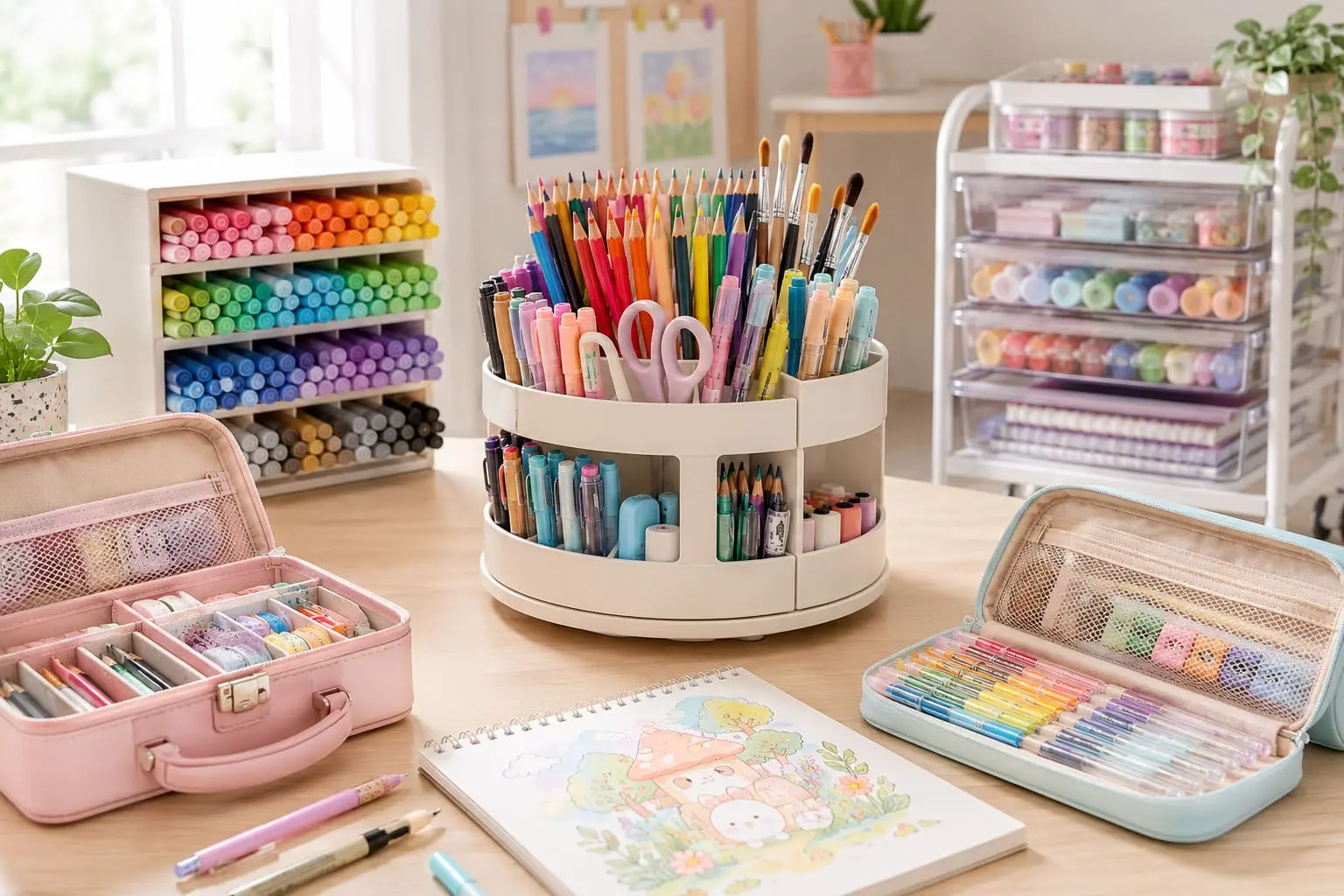
Best Art Supply Organizers and Storage Ideas
Compare the best art supply organizers and storage ideas, from desktop caddies and marker racks to craft boxes, rolling drawers and small-parts cabinets.
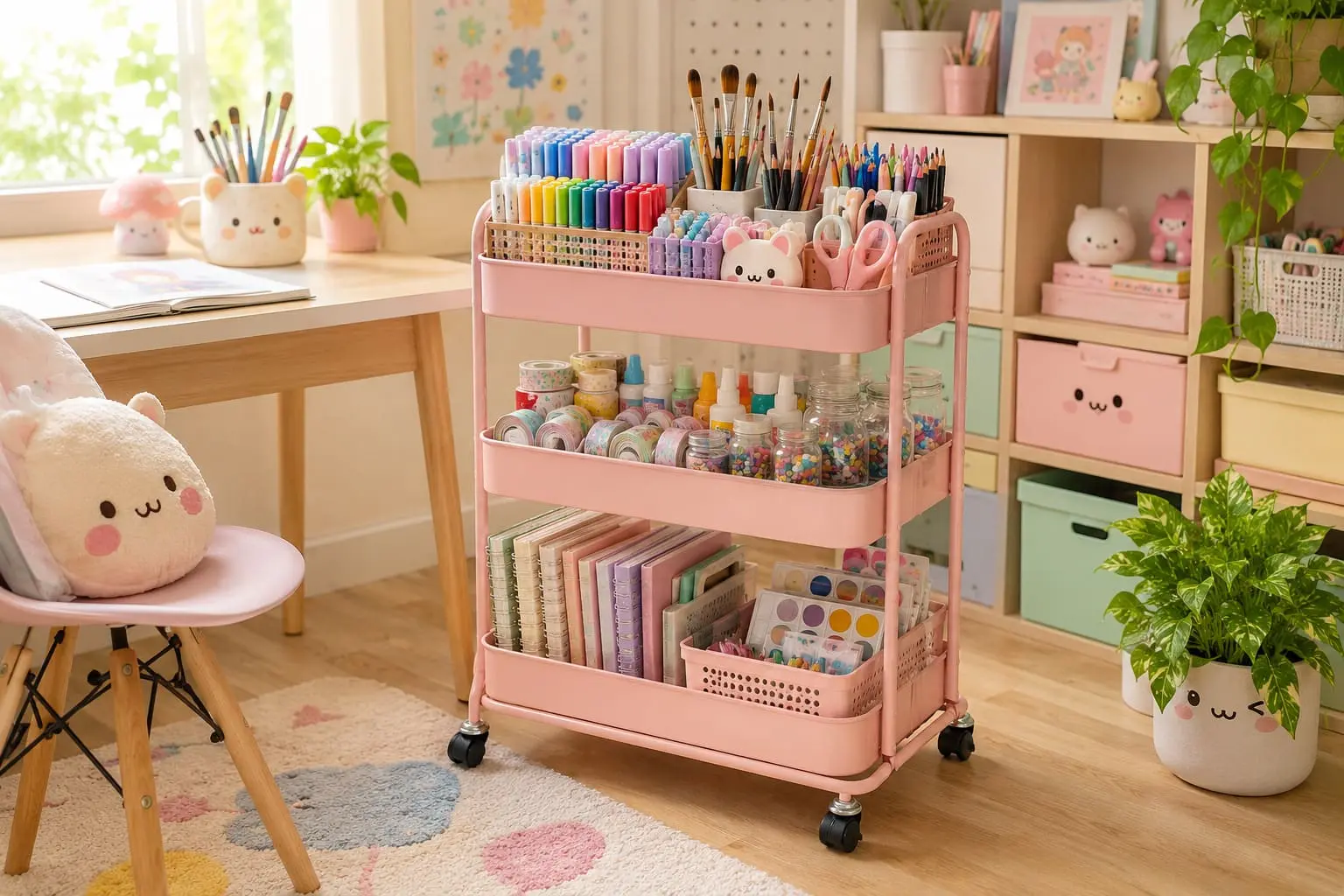
Best Rolling Art Carts and Craft Carts
Compare 10 rolling art cart and craft cart picks, from open 3-tier carts to drawer carts, foldable carts, worktop carts and wooden studio carts.
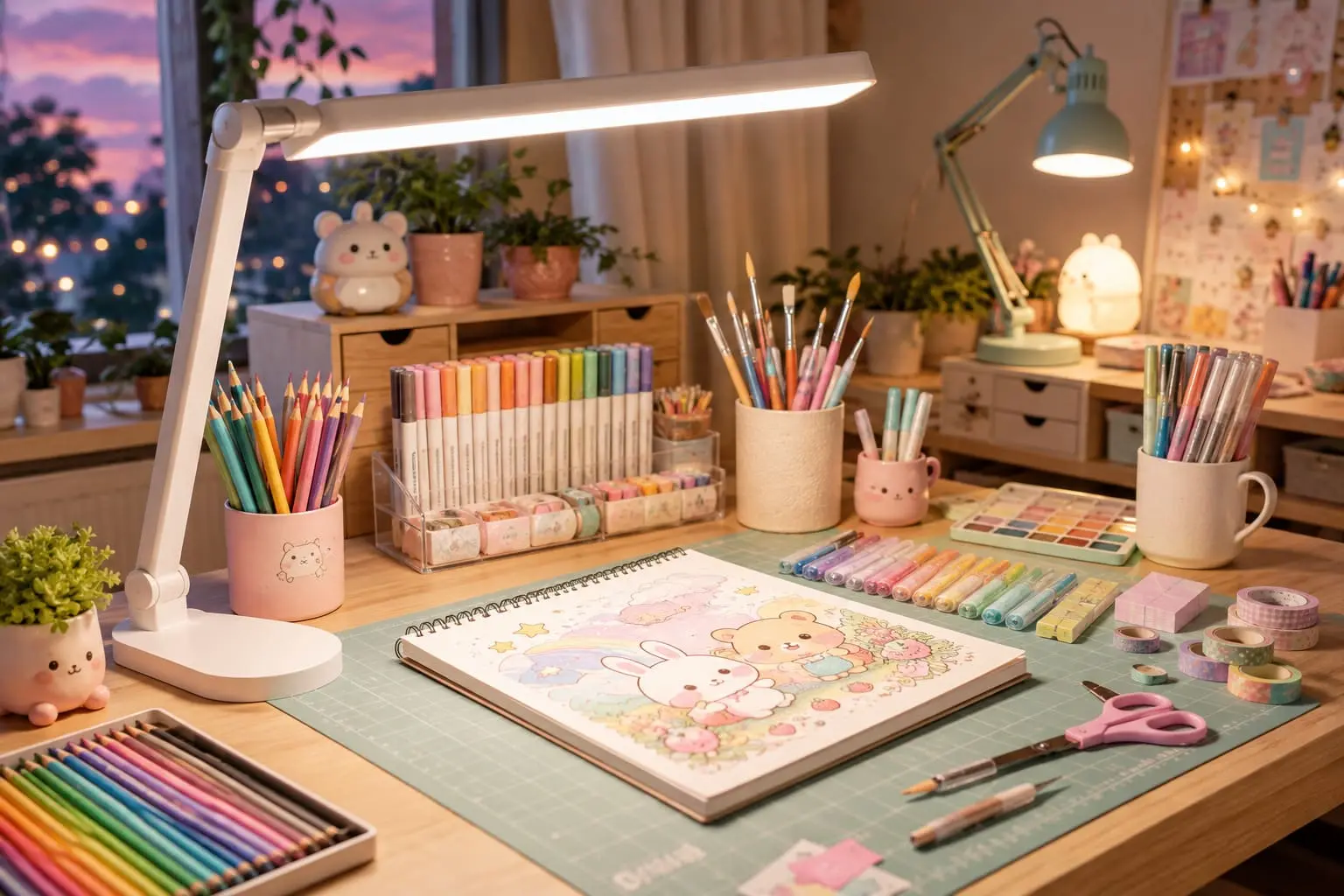
Best Desk Lamps for Drawing, Coloring & Crafts: 10 Bright Picks
The best desk lamps for drawing, coloring and crafts, from budget LEDs to bright wide task lamps. Compare CRI, brightness, coverage and controls.
Best Lap Desks for Coloring, Drawing & Journaling: 10 Comfortable Picks
The best lap desks for coloring, drawing and journaling, from cushioned flat tops to adjustable easels. Compare size, tilt, storage and support.


