Best Rolling Carts for Art & Craft Supplies: 10 Practical Picks. Compare 10 rolling carts for art and craft supplies, including 3-tier carts, drawer carts, foldable storage, worktops, and studio options.. Type: Buying guide. Category: Creative Spaces. Tags: rolling-carts, craft-storage, art-supply-storage, craft-room-organization, art-cart, utility-cart, creative-space, buying-guide, cluster-creative-desks-storage.

Buying guide

Best Rolling Carts for Art & Craft Supplies: 10 Practical Picks

Our recommendation

The best rolling cart for most art and craft rooms is the Pipishell 3 Tier Rolling Cart because its open metal baskets, handle, and four casters create a simple mobile station for frequently used supplies. Choose the DTK 3 Tier cart if you want a removable tabletop and side pockets, the TOOLF Foldable cart for a multipurpose room, the IRIS USA 6- or 10-drawer carts for small-supply sorting, the COSTWAY 15-drawer cart for a large collection, and the MEEDEN 5-Tier Beechwood cart for a permanent studio.

Quick picks

Top recommendations

  1. 1Pipishell 3 Tier Rolling Cart — Best overallA well-rounded three-tier metal cart with a steering handle, four casters, and a 66-pound stated maximum capacity
  2. 2Amazon Basics 3-Tier Rolling Utility Cart — Best simple metal cartA no-frills three-tier metal cart with recessed bins, pivoting casters, and a curved push handle
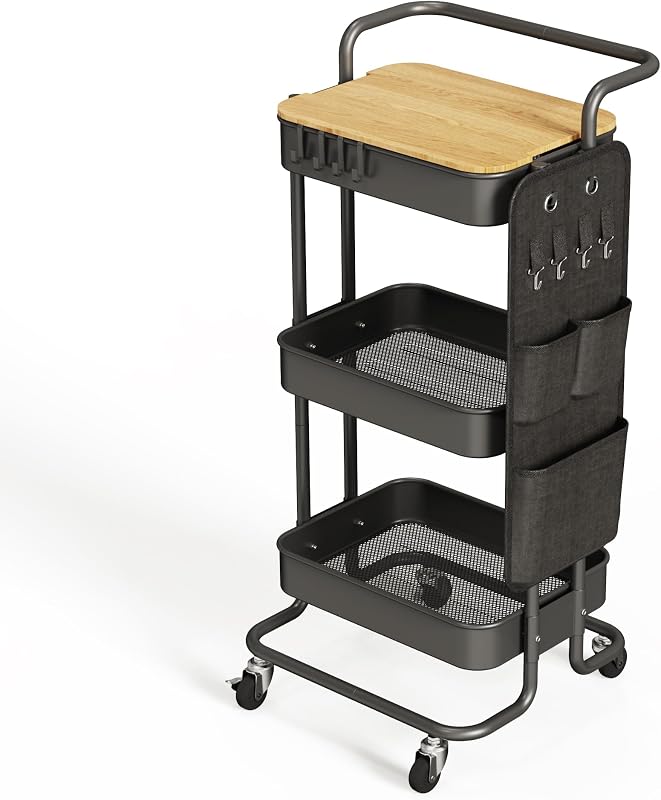
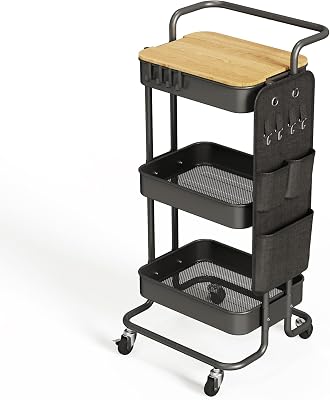
  3. 3DTK 3 Tier Metal Utility Rolling Cart with Table Top and Side Bags — Best with tabletopA three-tier metal cart that adds a removable top board, side pockets, and hooks for tools
  4. 4TOOLF 3 Tier Foldable Rolling Cart — Best foldableAn assembly-free metal cart with three round baskets that folds when you need the room back
  5. 5TOOLF 4 Tier Metal Rolling Cart — Best vertical capacityA four-tier metal cart with 132 pounds of stated total shelf capacity and lockable casters
  6. 6IRIS USA 6-Drawer Rolling Storage Cart with Organizer Top — Best compact drawer cartA six-drawer plastic cart that favors category-based organization over open-shelf visibility
  7. 7IRIS USA 10-Drawer Rolling Storage Cart — Best for small-supply sortingA tall ten-drawer tower for separating pens, vinyl scraps, stickers, tools, paper pieces, and project components
  8. 8SYKIARIOL 8-Drawer Rolling Storage Utility Cart — Best drawers with worktopAn eight-drawer cart that adds a wooden tabletop for a printer, paper cutter, tray, or current project
  9. 9COSTWAY 15 Drawer Rolling Storage Cart — Best large drawer cartA wide mobile organizer with five large drawers, ten small drawers, and a top surface
  10. 10MEEDEN 5-Tier Solid Beech Wood Art Supplies Storage Cart — Best premium studio cartA five-tier solid beechwood art cart with three drawers and a wider studio-oriented layout

Product comparison

ProductBest forWatch outPrice & shop
Pipishell 3 Tier Rolling Cart (opens Amazon in a new tab)Pipishell · 3-Tier Metal Utility Cart
Best overallResearch-based review
Most craft rooms that need a simple mobile station for frequently used suppliesOpen tiers favor visibility over fine sorting, so beads, stickers, small cutting tools, and loose accessories still benefit from cups or smaller bins inside the baskets
Amazon Basics 3-Tier Rolling Utility Cart (opens Amazon in a new tab)Amazon Basics · 3-Tier Rolling Utility Cart
Best simple metal cartResearch-based review
Artists who want straightforward recessed-bin storage without specialty accessoriesIts broad open-bin layout does not provide built-in separation for many small craft categories, and seller availability can change when Amazon does not show a featured offer
DTK 3 Tier Metal Utility Rolling Cart with Table Top and Side Bags (opens Amazon in a new tab)DTK · 3-Tier Cart with Removable Table Top
Best with tabletopResearch-based review
Crafters who want storage plus a small surface for an active projectThe top is useful as a staging surface but is still much smaller than a real desk, and the extra accessories add more pieces to organize
TOOLF 3 Tier Foldable Rolling Cart (opens Amazon in a new tab)TOOLF · 3-Tier Foldable Metal Cart
Best foldableResearch-based review
Multipurpose rooms and small homes where craft storage must disappear between sessionsIts roughly 11-inch square footprint and round baskets trade capacity for compactness, and rectangular paper pads do not use the basket shape as efficiently
TOOLF 4 Tier Metal Rolling Cart (opens Amazon in a new tab)TOOLF · 4-Tier Metal Utility Storage Cart
Best vertical capacityResearch-based review
Craft rooms that need an extra tier without a much wider footprintThe extra tier makes the cart taller and more visually dominant, which is less convenient beside low seating or under wall-mounted storage
IRIS USA 6-Drawer Rolling Storage Cart with Organizer Top (opens Amazon in a new tab)IRIS USA · 6-Drawer Rolling Storage Cart
Best compact drawer cartResearch-based review
Markers, stickers, tools, paper accessories, and other small supplies that need separationThe shallow drawers are excellent for small materials but are not designed for bulky yarn, tall paint bottles, or large three-dimensional tools
IRIS USA 10-Drawer Rolling Storage Cart (opens Amazon in a new tab)IRIS USA · 10-Drawer Rolling Storage Organizer
Best for small-supply sortingResearch-based review
Crafters who want many labeled categories in a narrow vertical footprintIts tall narrow proportions are not ideal for oversized paper, canvases, bulky bottles, or anything that needs a deep bin
SYKIARIOL 8-Drawer Rolling Storage Utility Cart (opens Amazon in a new tab)SYKIARIOL · 8-Drawer Cart with Wooden Tabletop
Best drawers with worktopResearch-based review
Scrapbooking, sewing, and mixed-media setups that need separated drawers plus a flat topYou lose the instant one-glance access of an open cart, and the mixed metal, wood, and plastic construction is more involved than a simple trolley
COSTWAY 15 Drawer Rolling Storage Cart (opens Amazon in a new tab)COSTWAY · 15-Drawer Mobile Storage Organizer
Best large drawer cartResearch-based review
Big craft collections that need extensive built-in sortingThe 25-inch-wide frame needs substantially more dedicated floor space than a narrow tower or three-tier cart
MEEDEN 5-Tier Solid Beech Wood Art Supplies Storage Cart (opens Amazon in a new tab)MEEDEN · 5-Tier Beechwood Cart with 3 Drawers
Best premium studio cartResearch-based review
Artists who want a furniture-style rolling taboret for a dedicated studioThe larger footprint and premium price make little sense for occasional crafters who mainly need a lightweight cart they can tuck into a corner

Selection and testing methodology

This is a research-based guide, not a hands-on ranking. We compared 10 rolling carts using current Amazon US product information checked on August 11, 2026, focusing on storage format, dimensions, number of tiers or drawers, materials, mobility, locking wheels where documented, stated load capacity where available, worktop or accessory features, and the practical fit for art and craft supplies. We also favored products with active Amazon listings and recent availability signals. KawaiiToons has not personally assembled, loaded, rolled, or durability-tested these exact carts, so we do not publish measured wheel smoothness, wobble scores, long-term drawer durability, real-world load tests, or assembly-time rankings.

Detailed product sections

Best overallResearch-based review

Pipishell 3 Tier Rolling Cart (opens Amazon in a new tab)

Pipishell · 3-Tier Metal Utility Cart

A well-rounded three-tier metal cart with a steering handle, four casters, and a 66-pound stated maximum capacity

Why it fits this guide

Pipishell is the easiest all-purpose recommendation because its three open tiers fit the way many people actually work: brushes, markers, paints, adhesives, cups, and current-project supplies can stay visible instead of disappearing into deep drawers. The 13 by 16.5 inch footprint is compact enough for a desk-side station, while the handle and swivel casters make it practical to move between a craft table and storage area.

Honest drawback

Open tiers favor visibility over fine sorting, so beads, stickers, small cutting tools, and loose accessories still benefit from cups or smaller bins inside the baskets

Best forMost craft rooms that need a simple mobile station for frequently used supplies

Pros

  • Open three-tier layout keeps active supplies visible
  • Four swivel casters and a handle make repositioning simple
  • 66-pound stated maximum capacity suits mixed everyday craft supplies

Cons

  • Needs smaller containers for tiny loose items
  • Open shelves provide less dust protection than drawers
Check price on Amazon (opens Amazon in a new tab)
Best simple metal cartResearch-based review

Amazon Basics 3-Tier Rolling Utility Cart (opens Amazon in a new tab)

Amazon Basics · 3-Tier Rolling Utility Cart

A no-frills three-tier metal cart with recessed bins, pivoting casters, and a curved push handle

Why it fits this guide

The Amazon Basics cart is a sensible choice when you want the familiar rolling-trolley format without extra drawers, pegboards, or fabric pockets. Its recessed mesh-bottom bins are useful for paint bottles, marker cups, paper tools, and cleaning supplies, while the curved handle gives you a defined place to steer the cart rather than pushing directly on a basket.

Honest drawback

Its broad open-bin layout does not provide built-in separation for many small craft categories, and seller availability can change when Amazon does not show a featured offer

Best forArtists who want straightforward recessed-bin storage without specialty accessories

Pros

  • Three recessed metal bins contain bottles and tools
  • Curved push handle improves steering
  • Simple metal format is easy to adapt with cups and bins

Cons

  • No built-in drawers or dividers
  • Seller availability can vary
Check price on Amazon (opens Amazon in a new tab)
Best with tabletopResearch-based review

DTK 3 Tier Metal Utility Rolling Cart with Table Top and Side Bags (opens Amazon in a new tab)

DTK · 3-Tier Cart with Removable Table Top

A three-tier metal cart that adds a removable top board, side pockets, and hooks for tools

Why it fits this guide

DTK turns the basic rolling cart into more of a mobile craft station. The removable top can act as a landing place for a sketchbook, cutting mat, palette, or tray, while the side storage bag and four hooks create quick-access spots for brushes, rulers, scissors, and other frequently reached-for tools.

Honest drawback

The top is useful as a staging surface but is still much smaller than a real desk, and the extra accessories add more pieces to organize

Best forCrafters who want storage plus a small surface for an active project

Pros

  • Removable top board adds a temporary work surface
  • Side pockets and hooks improve small-tool access
  • Two lockable swivel casters help keep it parked

Cons

  • More complex than a minimalist three-tier trolley
  • Tabletop is too small to replace a craft desk
Check price on Amazon (opens Amazon in a new tab)
Best foldableResearch-based review

TOOLF 3 Tier Foldable Rolling Cart (opens Amazon in a new tab)

TOOLF · 3-Tier Foldable Metal Cart

An assembly-free metal cart with three round baskets that folds when you need the room back

Why it fits this guide

The TOOLF foldable cart solves a different problem from conventional rolling storage: permanence. If the dining room becomes a craft room only on weekends, or you work from a small apartment where every square foot has multiple jobs, a cart that can fold down after supplies are packed away is more useful than another fixed shelving unit.

Honest drawback

Its roughly 11-inch square footprint and round baskets trade capacity for compactness, and rectangular paper pads do not use the basket shape as efficiently

Best forMultipurpose rooms and small homes where craft storage must disappear between sessions

Pros

  • Folding design suits temporary craft setups
  • No conventional screw-together assembly is required
  • Two lockable casters help stabilize the cart

Cons

  • Compact baskets hold less than full-size utility carts
  • Round baskets are awkward for large rectangular paper
Check price on Amazon (opens Amazon in a new tab)
Best vertical capacityResearch-based review

TOOLF 4 Tier Metal Rolling Cart (opens Amazon in a new tab)

TOOLF · 4-Tier Metal Utility Storage Cart

A four-tier metal cart with 132 pounds of stated total shelf capacity and lockable casters

Why it fits this guide

TOOLF's four-tier model is the practical choice when a normal three-tier cart is almost enough but you keep running out of one basket. The 37-inch height uses vertical space instead of making the cart dramatically wider, and the stated 33-pound-per-shelf capacity gives you room for denser supplies such as paint, tools, paper punches, or stacked containers.

Honest drawback

The extra tier makes the cart taller and more visually dominant, which is less convenient beside low seating or under wall-mounted storage

Best forCraft rooms that need an extra tier without a much wider footprint

Pros

  • Four tiers increase capacity without a dramatically wider base
  • Manufacturer states 33 pounds per shelf
  • Two lockable wheels help hold position

Cons

  • Taller than typical three-tier carts
  • Still needs inner containers for tiny supplies
Check price on Amazon (opens Amazon in a new tab)
Best compact drawer cartResearch-based review

IRIS USA 6-Drawer Rolling Storage Cart with Organizer Top (opens Amazon in a new tab)

IRIS USA · 6-Drawer Rolling Storage Cart

A six-drawer plastic cart that favors category-based organization over open-shelf visibility

Why it fits this guide

The IRIS 6-drawer cart is a better fit than an open trolley when your problem is not lack of capacity but lack of separation. Six shallow drawers let you give markers, pens, cutting tools, stickers, adhesives, embellishments, or project parts their own home, while removable wheels let the unit stay mobile or sit in a fixed location.

Honest drawback

The shallow drawers are excellent for small materials but are not designed for bulky yarn, tall paint bottles, or large three-dimensional tools

Best forMarkers, stickers, tools, paper accessories, and other small supplies that need separation

Pros

  • Six drawers create clear supply categories
  • Drawer stops help keep drawers from pulling completely free
  • Removable wheels support mobile or stationary use

Cons

  • Shallow drawers limit bulky items
  • Plastic frame is less rigid than a metal cart
Check price on Amazon (opens Amazon in a new tab)
Best for small-supply sortingResearch-based review

IRIS USA 10-Drawer Rolling Storage Cart (opens Amazon in a new tab)

IRIS USA · 10-Drawer Rolling Storage Organizer

A tall ten-drawer tower for separating pens, vinyl scraps, stickers, tools, paper pieces, and project components

Why it fits this guide

When you have many small categories, ten shallow drawers can be more useful than three big baskets. This IRIS tower is especially easy to imagine beside a journaling desk, Cricut station, sewing table, or kids' craft area where each drawer can be labeled by material, color family, project, or person.

Honest drawback

Its tall narrow proportions are not ideal for oversized paper, canvases, bulky bottles, or anything that needs a deep bin

Best forCrafters who want many labeled categories in a narrow vertical footprint

Pros

  • Ten drawers support detailed labeling and sorting
  • Clear drawers make contents easier to identify
  • Narrow footprint uses vertical space efficiently

Cons

  • Not suitable for many bulky materials
  • Heavier supplies should stay in lower drawers
Check price on Amazon (opens Amazon in a new tab)
Best drawers with worktopResearch-based review

SYKIARIOL 8-Drawer Rolling Storage Utility Cart (opens Amazon in a new tab)

SYKIARIOL · 8-Drawer Cart with Wooden Tabletop

An eight-drawer cart that adds a wooden tabletop for a printer, paper cutter, tray, or current project

Why it fits this guide

SYKIARIOL bridges the gap between a drawer tower and a tiny mobile workbench. Eight drawers provide more separation than an open utility cart, while the wooden top gives you somewhere to set a paper cutter, compact printer, basket, reference book, or in-progress materials without sacrificing a drawer.

Honest drawback

You lose the instant one-glance access of an open cart, and the mixed metal, wood, and plastic construction is more involved than a simple trolley

Best forScrapbooking, sewing, and mixed-media setups that need separated drawers plus a flat top

Pros

  • Eight drawers organize multiple supply categories
  • Wooden top adds a useful flat landing surface
  • Rolling frame keeps the unit mobile

Cons

  • Drawers slow access compared with open baskets
  • More components mean more assembly and upkeep
Check price on Amazon (opens Amazon in a new tab)
Best large drawer cartResearch-based review

COSTWAY 15 Drawer Rolling Storage Cart (opens Amazon in a new tab)
COSTWAY · 15-Drawer Mobile Storage Organizer

A wide mobile organizer with five large drawers, ten small drawers, and a top surface

Why it fits this guide

COSTWAY is the high-capacity drawer pick because its 15-drawer layout gives you two useful sizes instead of repeating one shallow drawer over and over. The ten smaller drawers suit pens, beads, stickers, punches, thread, paint tubes, and tools, while five larger drawers can take bulkier project materials.

Honest drawback

The 25-inch-wide frame needs substantially more dedicated floor space than a narrow tower or three-tier cart

Best forBig craft collections that need extensive built-in sorting

Pros

  • Fifteen drawers provide extensive built-in categorization
  • Two drawer sizes handle a wider range of supplies
  • Top surface keeps current tools within reach

Cons

  • Wider footprint is harder to fit beside a small desk
  • A 15-drawer system requires labels and maintenance to stay organized
Check price on Amazon (opens Amazon in a new tab)
Best premium studio cartResearch-based review

MEEDEN 5-Tier Solid Beech Wood Art Supplies Storage Cart (opens Amazon in a new tab)

MEEDEN · 5-Tier Beechwood Cart with 3 Drawers

A five-tier solid beechwood art cart with three drawers and a wider studio-oriented layout

Why it fits this guide

MEEDEN is the premium pick for a permanent creative space. Instead of looking like classroom or pantry storage, its beechwood construction and mixed drawer-and-shelf layout are closer to studio furniture. The wider top and open levels can support larger art materials, while the three drawers give brushes, pencils, palette knives, and smaller tools protected storage.

Honest drawback

The larger footprint and premium price make little sense for occasional crafters who mainly need a lightweight cart they can tuck into a corner

Best forArtists who want a furniture-style rolling taboret for a dedicated studio

Pros

  • Beechwood construction suits a dedicated studio
  • Five levels combine open storage and three drawers
  • Wider format accommodates larger art materials

Cons

  • Costs more than basic utility carts
  • Needs more floor space than compact metal or plastic carts
Check price on Amazon (opens Amazon in a new tab)

How to choose

  • Start with the way you use supplies. Open baskets are fastest for paint, marker cups, adhesives, sketchbooks, and current projects; drawers are better for small categories such as stickers, beads, pens, cutting tools, thread, and embellishments.
  • Measure the parking spot before buying. Rolling carts often look small in product photos, but handles, caster width, and tall four-tier or drawer-tower designs can make them harder to fit beside a desk than expected.
  • Put mobility second to organization. A cart only helps if the supplies inside have clear homes; use cups, bins, drawer labels, or project trays so moving the cart does not simply move clutter from one room to another.
  • Choose three tiers for a compact everyday station, four tiers when you need more vertical capacity, and drawer carts when the number of separate categories matters more than instant visibility.
  • Keep heavy materials low. Paint bottles, paper reams, punches, and tools are more stable on lower shelves or drawers, especially on taller carts.

Common mistakes

  • Buying the largest cart before measuring the space beside the desk, table, closet, or shelf where it will actually live.
  • Choosing open shelves for dozens of tiny loose supplies and then discovering that everything mixes together in the baskets.
  • Filling the top tier with the heaviest paint, paper, or tools instead of keeping weight lower on the cart.
  • Treating a small tabletop cart as a replacement for a proper cutting, painting, or crafting work surface.
  • Ignoring wheel locks and floor transitions when the cart needs to stay stable during use or move between rugs, tile, and hard flooring.

FAQ

What is the best rolling cart for art supplies?

For most home craft rooms, our top research pick is the Pipishell 3 Tier Rolling Cart because the open metal tiers make brushes, markers, paints, adhesives, cups, and current-project supplies easy to see and reach. If you have many small loose supplies, a drawer cart such as the IRIS USA 6-Drawer or 10-Drawer is usually easier to keep organized.

Are rolling carts good for craft supplies?

Yes. A rolling cart can turn unused floor space beside a desk or table into mobile storage, and it can move a set of supplies to wherever you are working. Open carts are especially useful for frequently used materials, while drawer carts are better for small categories that would become mixed in a large basket.

Is a 3-tier or 4-tier cart better for crafts?

A three-tier cart is usually easier to keep beside a desk and gives quick access to three broad categories. A four-tier cart makes better use of vertical space when the footprint is limited, but it is taller and can be less convenient beside a seated workspace. Choose based on your parking space and the height of the supplies you store.

Are drawers or open shelves better for art supplies?

Open shelves are better for supplies you reach for constantly, such as marker cups, paint bottles, sketchbooks, adhesives, and active-project bins. Drawers are better for pens, stickers, beads, thread, vinyl scraps, stamps, cutting tools, embellishments, and other small items that benefit from being separated and labeled.

How should I organize a rolling craft cart?

Put the supplies you use most often on the easiest-to-reach level, keep heavy items lower, and group small items in cups, bins, or labeled drawers. Organize by workflow rather than by what looks neat: for example, one tier for drawing tools, one for paper and current projects, and one for adhesives, cutting tools, or cleanup supplies.

What size rolling cart should I buy?

Measure the exact floor area where the cart will park, then compare that space with the listed product dimensions including the handle and wheels. Compact carts around 11 to 17 inches wide are easier to place beside a desk, while wide 15-drawer and wooden studio carts need more dedicated floor space.

Can I use a rolling cart for Cricut or scrapbooking supplies?

Yes, but drawer carts are often more practical than open baskets for small Cricut accessories, vinyl scraps, blades, weeding tools, stickers, stamps, and embellishments. A cart with a flat top can also hold a paper cutter, compact printer, project tray, or frequently used tool, provided you stay within the manufacturer's guidance.

What should go on the bottom shelf of a craft cart?

The bottom level is the best place for heavier or less frequently used items such as paint bottles, paper stacks, punches, bulk adhesive refills, tool boxes, or backup supplies. Keeping dense items low can also make a tall rolling cart feel more stable during movement.

Are rolling carts safe around children?

The cart itself is only part of the safety question. Keep sharp tools, solvents, hot tools, choking-size craft parts, and other age-inappropriate materials secured or out of reach, avoid top-heavy loading, use wheel locks when available, and supervise children around a loaded mobile cart.

Is a wooden art cart worth it?

A wooden cart such as the MEEDEN 5-Tier model makes the most sense in a dedicated studio where the cart will stay visible and you want furniture-style storage with drawers and wider shelves. For occasional crafts or a multipurpose room, a lighter metal or plastic cart is usually more economical and easier to move or store.

Final recommendation

For most craft rooms, start with the Pipishell 3 Tier Rolling Cart because the open basket layout is easy to adapt and keeps frequently used materials visible. The Amazon Basics 3-Tier is the simpler alternative, while the DTK 3 Tier is more useful when a removable tabletop and side pockets matter. Choose TOOLF's Foldable cart for temporary setups and its 4-Tier cart when vertical capacity is the priority. For small-supply organization, the IRIS USA 6-Drawer is the compact choice and the IRIS USA 10-Drawer gives you more labeled categories. SYKIARIOL's 8-Drawer cart adds a useful wooden top, COSTWAY's 15-Drawer cart is the better fit for a large collection, and MEEDEN's 5-Tier Beechwood cart is the premium option for a dedicated art studio. All recommendations remain research-based until KawaiiToons completes original assembly, loading, mobility, and durability testing.

Choosing the best rolling carts for art and craft supplies is less about finding the cart with the most shelves and more about matching storage to the way you actually create. Paint bottles, markers, brushes, scissors, paper, sticker sheets, washi tape, vinyl scraps, yarn, glue, punches, and half-finished projects all behave differently once they are placed on wheels.

A good cart can make a creative space feel dramatically easier to use because it brings a working set of supplies to the desk instead of forcing you to stand up and search through cabinets every few minutes. The wrong cart can simply become mobile clutter: three baskets of mixed materials that are technically organized because they are off the floor, but still difficult to find.

That is why this guide includes several different formats. Some people need a classic three-tier metal utility cart. Others will be happier with six, eight, ten, or fifteen drawers. A small apartment may benefit from a cart that folds away, while a dedicated studio can justify a wider wooden taboret with drawers and open shelves.

This guide is research-based. We checked current Amazon US product information for all 10 selections on August 11, 2026, but KawaiiToons has not personally assembled or long-term tested these exact carts yet. We therefore do not publish invented wheel-smoothness rankings, wobble scores, assembly times, measured load tests, or durability claims.

The short version: which rolling cart should you choose?

For most craft rooms, start with the Pipishell 3 Tier Rolling Cart. It uses the familiar open-basket format that works especially well for supplies you reach for constantly: marker cups, paint bottles, brushes, adhesives, sketchbooks, scissors, rulers, and current-project containers. Its listed dimensions are 13 inches deep by 16.5 inches wide by 33.8 inches high, and the Amazon listing states a 66-pound maximum capacity.

If you want an even simpler metal trolley, the Amazon Basics 3-Tier Rolling Utility Cart uses three recessed bins and a curved push handle. It is easy to adapt with pencil cups, small plastic bins, or project trays.

The DTK 3 Tier Metal Utility Rolling Cart is more useful when the cart needs to behave like a mini workstation. It adds a removable tabletop, side pockets, and hooks, so brushes, scissors, rulers, and other small tools can remain outside the main baskets.

For a small home or a room that has to change jobs during the day, the TOOLF 3 Tier Foldable Rolling Cart is the more unusual choice. Its roughly 11-inch-square footprint is compact, and the cart folds rather than becoming a permanent piece of furniture.

If a normal three-tier cart is almost enough but you keep running out of one shelf, choose the TOOLF 4 Tier Metal Rolling Cart. Its fourth level adds vertical storage while keeping the footprint relatively narrow.

For small items, drawers make more sense. The IRIS USA 6-Drawer Rolling Storage Cart is the compact pick, while the IRIS USA 10-Drawer Rolling Storage Cart gives you more individual categories. The SYKIARIOL 8-Drawer Cart adds a wooden top, and the COSTWAY 15 Drawer Rolling Storage Cart is the high-capacity option for a large mixed craft collection.

Finally, the MEEDEN 5-Tier Solid Beech Wood Art Supplies Storage Cart is the premium studio pick. It combines three drawers with multiple open levels in a furniture-style wood frame rather than a lightweight household trolley.

Why a rolling cart works so well for art and craft supplies

Most creative spaces have a distance problem.

Your tools may technically be organized, but the markers are in a desk drawer, paints are in a cabinet, paper is on a shelf, adhesives are in a box, and the scissors you want are somewhere else. Every small interruption adds friction. Eventually, the materials you use most often migrate onto the desk and stay there.

A rolling cart solves that problem by creating a mobile working zone. You can park it beside the desk while drawing, move it to the dining table for family crafts, roll it next to a window for painting, or return it to a corner when the session is finished.

The key is that mobility should support a clear system. A cart becomes much more useful when every shelf or drawer has a job.

For example, the top level can hold the supplies you touch during almost every session: pens, pencils, brushes, scissors, ruler, glue, and a small trash cup. The middle level can hold the active project, sketchbooks, paper, stickers, or paint. The bottom level can carry heavier or less frequently used supplies such as backup paint bottles, paper pads, punches, refills, or a tool box.

Drawer carts use the same principle at a finer scale. One drawer can hold fineliners, another paint pens, another stickers, another cutting tools, another adhesives, and another project pieces. The cart becomes a map of your workflow.

Open shelves or drawers: which is better for a craft cart?

The biggest decision is not metal versus plastic. It is open access versus separated storage.

Open three-tier carts

Open carts such as the Pipishell, Amazon Basics, DTK, and TOOLF models are excellent for supplies that already have some structure.

Marker sets can stand in cups. Paint bottles can line up in a basket. Brushes can sit in jars. Sketchbooks and small paper pads can lean against one side. A project bin can occupy an entire shelf.

The advantage is speed. You can glance at the cart and immediately see what you need.

The disadvantage is that open shelves are bad at automatically organizing dozens of small loose items. If you dump clips, beads, sticker flakes, washi samples, blades, nibs, erasers, charms, and thread into one basket, you still have a search problem.

The solution is to treat the cart as a frame and add smaller containers inside it.

Drawer carts

Drawer carts such as the IRIS, SYKIARIOL, and COSTWAY picks create categories for you.

This is particularly useful for journaling supplies, scrapbooking embellishments, Cricut accessories, sewing notions, stickers, paint tubes, stamps, ink pads, beads, jewelry-making components, and small hand tools.

The trade-off is visibility. When everything is behind a drawer front, the system depends on labels and memory. A ten-drawer tower without labels can become ten places to search.

Drawers also have fixed dimensions. A shallow drawer can be excellent for pens and sticker sheets but useless for a tall bottle or large yarn skein.

If your collection is mostly small and varied, choose drawers. If it is mostly larger and frequently used, choose open shelves.

Three tiers, four tiers, or a full drawer tower?

A three-tier cart is popular because it is easy to understand and easy to place beside a desk. Three broad zones are enough for many people: tools, active materials, and backup supplies.

A four-tier cart uses vertical space more aggressively. The TOOLF 4 Tier Metal Rolling Cart measures about 37 inches high, so the extra level adds capacity without requiring the footprint of a wide cabinet.

The drawback is access. A taller cart can feel awkward beside a low chair, and the highest or lowest shelf may be less comfortable depending on your setup.

Drawer towers go further. The IRIS 10-Drawer reaches a little over 41 inches high, but each level is shallow. Instead of four broad categories, you get ten narrow ones.

The right question is not “Which holds more?” It is “How many categories do I need, and what shape are the supplies in each category?”

How we chose these rolling craft carts

We started with a practical creative-space question: what organization problem does this cart solve better than the others?

That prevented the shortlist from becoming ten variations of the same three-tier trolley.

We compared current Amazon US listings across seven factors:

  1. Storage format. Open baskets, shallow drawers, mixed drawer sizes, worktops, and furniture-style shelves each serve different workflows.
  2. Footprint. Width and depth matter because carts usually live beside a desk, table, closet, or cabinet rather than in the middle of a room.
  3. Vertical capacity. Three tiers are compact; four tiers and tall drawer towers can store more categories without becoming much wider.
  4. Mobility. We looked for casters and locking wheels where the listing documented them.
  5. Materials. Metal, plastic, wood, and mixed-material designs change rigidity, weight, appearance, and the kinds of supplies a cart is best suited to.
  6. Special features. Foldability, a tabletop, side pockets, hooks, removable drawers, and multiple drawer sizes can materially change how useful a cart is.
  7. Visible drawbacks. Every recommendation includes the main compromise so the ranking is not based on features alone.

All 10 picks remain labeled research-based. We have not yet run controlled side-by-side tests for assembly, loaded rolling, caster performance, wobble, drawer flex, or long-term wear.

What to look for before buying a rolling cart for art supplies

Measure the parking spot, not the empty room

A cart rarely lives in the most open part of the room. It usually has to fit between a desk and wall, beside a cabinet, under a shelf, near a power outlet, or at the end of a table.

Measure that exact location.

The TOOLF Foldable Cart is unusually compact at roughly 11 by 11 inches, while the COSTWAY 15-Drawer Cart is about 25 inches wide. Both are rolling storage, but they solve very different space problems.

Also leave room for the wheels to turn. A cart that technically fits into a narrow gap may be frustrating if you have to drag it sideways every time you want to use it.

Match basket depth to the supplies

Deep open baskets are helpful for bottles, cups, jars, and containers because the raised sides reduce the chance of items falling while the cart moves.

But deeper is not always better. A deep basket full of tiny supplies becomes a digging bin.

If you choose an open cart, plan to use vertical cups for pens and brushes, small bins for loose tools, and project trays for flat materials.

Think about paper before buying

Paper is one of the easiest materials to forget when shopping for a craft cart.

A compact round cart may hold paint, scissors, pens, and glue perfectly but waste space around rectangular sketchbooks and 12-inch scrapbook paper. A shallow drawer may hold letter-size sheets but not a large pad. A wide wooden cart may be much better for canvases, boards, and oversized media.

Measure the paper, cutting mats, sketchbooks, and pads you use most often before choosing a cart.

Use the top shelf as a working shelf

The most accessible level should support your current session.

On an open cart, that usually means marker cups, brushes, scissors, adhesives, a ruler, and whatever medium you are using today. On a cart with a tabletop, it can mean an active tray, small paper cutter, reference book, or compact printer.

Avoid turning the top into long-term overflow storage. If every inch is occupied by backup supplies, you lose the main advantage of a mobile workstation.

Put heavy supplies lower

Paint bottles, paper stacks, punches, tools, clay, and bulk refills are better placed low.

This does two things. It keeps the densest supplies closer to the floor, and it makes the top levels easier to use for the lighter tools you reach for repeatedly.

This is especially important with tall carts such as a four-tier trolley or ten-drawer tower.

Check whether you need wheel locks

If the cart only moves occasionally and stays against a wall, basic casters may be enough.

If you plan to pull tools directly from the cart while painting, cutting, or crafting, wheel locks become more useful. The Pipishell, DTK, and TOOLF models in this guide include locking-caster designs according to their current listings.

Locks do not turn a small cart into a fixed workbench, but they can reduce unwanted movement while you reach into a shelf.

Common mistakes when organizing art supplies on a rolling cart

Using the cart as one giant junk drawer

A rolling cart is not an organization system by itself.

Three baskets labeled “craft stuff” will eventually become three mixed baskets. Give each level a purpose, then add containers inside it.

A simple setup might be:

  • Top: drawing and cutting tools
  • Middle: active project and paper
  • Bottom: paint, glue, refills, and heavier materials

That structure is more useful than organizing solely by what fits.

Buying drawers for supplies that are too bulky

Drawer carts look orderly, but the drawer dimensions decide what they can actually store.

The shallow IRIS drawers are a strong fit for pens, markers, stickers, paper accessories, tools, and embellishments. They are not the first choice for tall acrylic paint bottles, big yarn skeins, bulky hot-glue guns, or large containers.

Do not buy ten beautiful drawers and then discover your main supplies cannot stand or fit inside them.

Putting everything you own on one cart

Mobility gets worse as the cart becomes a permanent archive.

The best rolling cart is often a working collection, not your entire collection. Keep backups and rarely used supplies in cabinets or boxes, then load the cart with the materials you use weekly.

This makes the cart easier to move and keeps your most useful tools visible.

Ignoring the handle and wheel footprint

Product dimensions can focus your attention on the baskets, but handles and casters affect how the cart behaves in a real room.

A push handle can make steering easier, but it may also extend into a walkway. Caster wheels may need a little extra clearance to rotate.

Leave breathing room around the parking spot.

Treating a tabletop cart as a full desk

The DTK and SYKIARIOL carts have useful flat surfaces, but those surfaces are best understood as staging areas.

They are excellent for a tray, compact paper cutter, sketchbook, reference book, or current materials. They are not substitutes for a stable full-size desk when you need pressure, cutting space, or large-format work.

Best rolling carts for art and craft supplies

Pipishell 3 Tier Rolling Cart: best overall

The Pipishell is our top research pick because it gets the fundamentals right for a broad range of creative spaces.

Its three open metal baskets make sense for the materials that dominate everyday craft sessions: pens, marker cups, paint, brushes, glue, scissors, sketchbooks, rulers, and project bins. The current listing gives dimensions of 13 by 16.5 by 33.8 inches and a stated maximum capacity of 66 pounds.

That combination is large enough to be useful without turning into a full mobile cabinet.

The strongest reason to choose it is visibility. You can see what you have, move the cart where you are working, and adapt the baskets with whatever cups or small containers already fit your supplies.

The drawback is the same thing that makes it flexible: there is no built-in fine organization. If you own hundreds of tiny embellishments or many different small tools, a drawer cart is easier to label.

Amazon Basics 3-Tier Rolling Utility Cart: best simple metal cart

The Amazon Basics model is the straightforward alternative.

It uses three recessed metal bins with mesh bottoms, pivoting caster wheels, and a curved push handle. Its listed dimensions are about 13.9 inches deep by 18.4 inches wide by 31 inches high.

This is the cart to choose when you do not need a tabletop, drawers, pegboards, or fabric accessories. Add your own pen cups, small bins, and project containers, then use the cart as a simple mobile shelf.

The main caution is availability. Amazon’s current page can show the listing without a featured offer, so seller status should be rechecked before purchase.

DTK 3 Tier Rolling Cart with Table Top: best with tabletop

DTK adds more structure to the standard open cart.

The three metal trays are paired with a removable top board, side storage bag, and hooks. That is useful for a crafter who wants the cart beside the desk during a session rather than only using it for storage.

Brushes can go in the side pockets. Scissors or small tools can hang from hooks. The top can hold a reference book, project tray, palette, or compact paper cutter.

The current listing gives dimensions of roughly 17.3 by 18.3 by 37.3 inches and describes four swivel wheels with two lockable casters.

This is not the smallest cart in the guide, but it is one of the most workstation-like.

TOOLF 3 Tier Foldable Rolling Cart: best foldable

A folding cart only matters if you actually need to reclaim the space.

For people working in a dining room, bedroom, shared office, or small apartment, that can be a major advantage.

The TOOLF foldable model measures roughly 11.02 by 11.02 by 28.3 inches and uses three round baskets. The current listing describes a folding, assembly-free design with four casters, including two lockable wheels.

Its compact footprint is the reason to buy it and also the reason not to buy it. You give up the capacity and rectangular efficiency of a larger trolley.

If your craft kit is mainly pens, brushes, glue, small paint sets, notebooks, and a few active tools, that trade-off can be worthwhile.

TOOLF 4 Tier Metal Rolling Cart: best vertical capacity

When three levels are not enough, adding a fourth can be more efficient than buying a much wider cart.

The TOOLF four-tier model measures about 17.9 by 12.1 by 37 inches. The listing states a capacity of 33 pounds per shelf, or 132 pounds total.

For art supplies, the extra tier gives you a natural way to divide categories. You might use the top for daily tools, the second for drawing and journaling, the third for paint and adhesives, and the bottom for paper or heavier backup supplies.

At 37 inches high, it is more visible and less likely to disappear beside low furniture. Make sure that height works with your desk and seating position.

IRIS USA 6-Drawer Rolling Storage Cart: best compact drawer cart

The IRIS 6-drawer cart solves the small-supply problem.

Its six drawers are roughly 12.5 inches deep by 9.5 inches wide by 2.94 inches high, while the overall unit is about 14.25 by 12.05 by 24 to 26 inches depending on the measurement shown on the current Amazon page.

Those shallow drawers are useful for markers, pens, stickers, blades, rulers, paper tools, stamps, adhesives, embellishments, and project pieces.

The listing also describes built-in drawer stops and removable wheels.

Choose this over an open trolley when you regularly lose small items inside larger baskets.

IRIS USA 10-Drawer Rolling Storage Cart: best for small-supply sorting

The ten-drawer IRIS takes the same concept and pushes it vertically.

At roughly 14.25 by 12.05 by 41.81 inches, the footprint stays narrow while the number of categories increases.

That makes it particularly useful for journaling and paper crafts. Ten drawers can become pens, markers, stickers, washi tape, stamps, ink, cutting tools, adhesives, paper scraps, and active project pieces.

Clear drawers also help you see what is inside before pulling one open.

The trade-off is shape. This is a specialist for small and flat supplies, not a general cart for large paint bottles, canvases, or bulky tools.

SYKIARIOL 8-Drawer Rolling Storage Utility Cart: best drawers with worktop

SYKIARIOL offers a useful middle ground between a narrow drawer tower and a full craft station.

The current Amazon listing describes eight drawers, a wooden tabletop, and an overall size of about 15.55 by 12.6 by 31.18 inches. The manufacturer states that the top can support 33 pounds and each drawer 11 pounds.

For scrapbooking, sewing, classroom crafts, and mixed media, the format makes sense. The drawers separate supplies, while the top can hold a compact printer, paper cutter, current-project tray, or reference materials.

This is a better fit than an open trolley when visual neatness and category separation matter more than instant access.

COSTWAY 15 Drawer Rolling Storage Cart: best large drawer cart

Fifteen drawers can sound excessive until you have a large mixed craft collection.

The COSTWAY design combines five larger drawers with ten smaller drawers, so the storage system is not limited to one repeated shallow size. Its listed dimensions are approximately 14.5 inches deep by 25 inches wide by 34.5 inches high.

That width makes it the biggest commitment among the plastic drawer carts here, but it also gives you room to create a true mobile supply library.

Small drawers can hold beads, pens, stickers, thread, stamps, tools, and embellishments. Larger drawers can hold project materials, paint, paper packs, or bulkier accessories.

Choose it when organization by category is the priority and you have enough wall or desk-side space to dedicate to the cart.

MEEDEN 5-Tier Beechwood Art Supplies Storage Cart: best premium studio cart

The MEEDEN belongs in a different category from lightweight household trolleys.

It is a solid beechwood cart with five storage levels and three drawers, measuring roughly 17.5 inches deep by 26.98 inches wide by 30 inches high.

That wider format is useful for a painter or artist who wants a cart to stay in the studio permanently. Larger paper, boards, paint boxes, palettes, and containers have more room, while the drawers can protect brushes, pencils, palette knives, and small tools.

The beechwood construction also makes it look more like studio furniture than kitchen or classroom storage.

It is the premium pick because you are paying for that format and material. If the cart needs to fold away or move constantly between rooms, a lighter metal or plastic option is more practical.

Best rolling cart for a small craft room

Small spaces reward carts that solve one clear problem.

If you need open storage and want the smallest footprint in this guide, the TOOLF Foldable Cart is the obvious place to start. Its roughly 11-inch-square footprint is easier to fit into a corner than wider rectangular carts, and it can fold after the project is finished.

If you need drawers, the IRIS 6-Drawer Cart keeps the footprint narrow and the overall height relatively low. It can sit beside or near a desk without creating a 40-inch tower.

If you need more vertical storage and do not mind height, the IRIS 10-Drawer or TOOLF 4 Tier can store more categories without requiring the width of the COSTWAY 15-drawer cart.

The most important step is measuring the parking space first. In a small room, a cart that is two inches too wide can become a permanent obstacle.

Best rolling cart for Cricut, scrapbooking, and paper crafts

Paper crafts create many small categories.

Blades, weeding tools, scraper tools, pens, vinyl scraps, transfer tape, sticker paper, adhesive, rulers, stamps, ink pads, embellishments, and paper offcuts all benefit from separation.

That is why the IRIS 10-Drawer is one of the strongest choices for this workflow. Each drawer can become a labeled category.

The SYKIARIOL 8-Drawer is more useful if you also want a top surface for a compact printer, paper cutter, or current project.

For a larger collection, the COSTWAY 15-Drawer gives you two drawer sizes and more total categories.

Open carts still work, but they need more internal organizers to keep tiny accessories from mixing together.

Rolling carts for kids’ art supplies and family craft tables

A rolling cart can make family crafts easier because the supplies come to the activity instead of covering a permanent table.

For washable markers, crayons, colored pencils, paper, stickers, glue sticks, and coloring books, a simple open cart is easy for an adult to move and easy for children to see.

The organization system matters more than the brand. Use clear bins or cups, label shelves with simple categories, and keep the materials children use independently separate from anything that requires adult supervision.

Sharp scissors, craft knives, hot tools, solvents, small choking-size pieces, and other age-inappropriate items should not become easier to access simply because the cart has wheels.

Also avoid top-heavy loading. Put paper, paint refills, and other dense materials on lower levels, and use the wheel locks when the cart includes them.

Our final recommendation

The best rolling cart is the one that reduces friction in your actual creative routine.

For most people, our top research pick is the Pipishell 3 Tier Rolling Cart. It is simple, visible, mobile, and easy to customize with the bins and cups you already own.

Choose the Amazon Basics 3-Tier when you want an even more straightforward recessed-bin cart, or the DTK 3 Tier when a removable tabletop, pockets, and hooks would make the cart more useful during an active session.

Choose the TOOLF Foldable model when the room has to return to another use after crafting, and the TOOLF 4 Tier when you need more vertical capacity without jumping to a full drawer cabinet.

If your collection is dominated by small supplies, skip the open baskets. The IRIS 6-Drawer is the compact choice, the IRIS 10-Drawer creates more labeled categories, the SYKIARIOL 8-Drawer adds a useful top, and the COSTWAY 15-Drawer is better for a large mixed collection.

For a permanent studio where the cart can function as visible furniture, the MEEDEN 5-Tier Beechwood Art Supplies Storage Cart is the premium option.

The next step for this guide should be hands-on testing with the same representative craft kit in every cart. Once we have real assembly times, loaded wheel tests, drawer measurements, stability notes, and long-term use photos, we can replace research-based assumptions with original evidence and make the ranking more definitive.