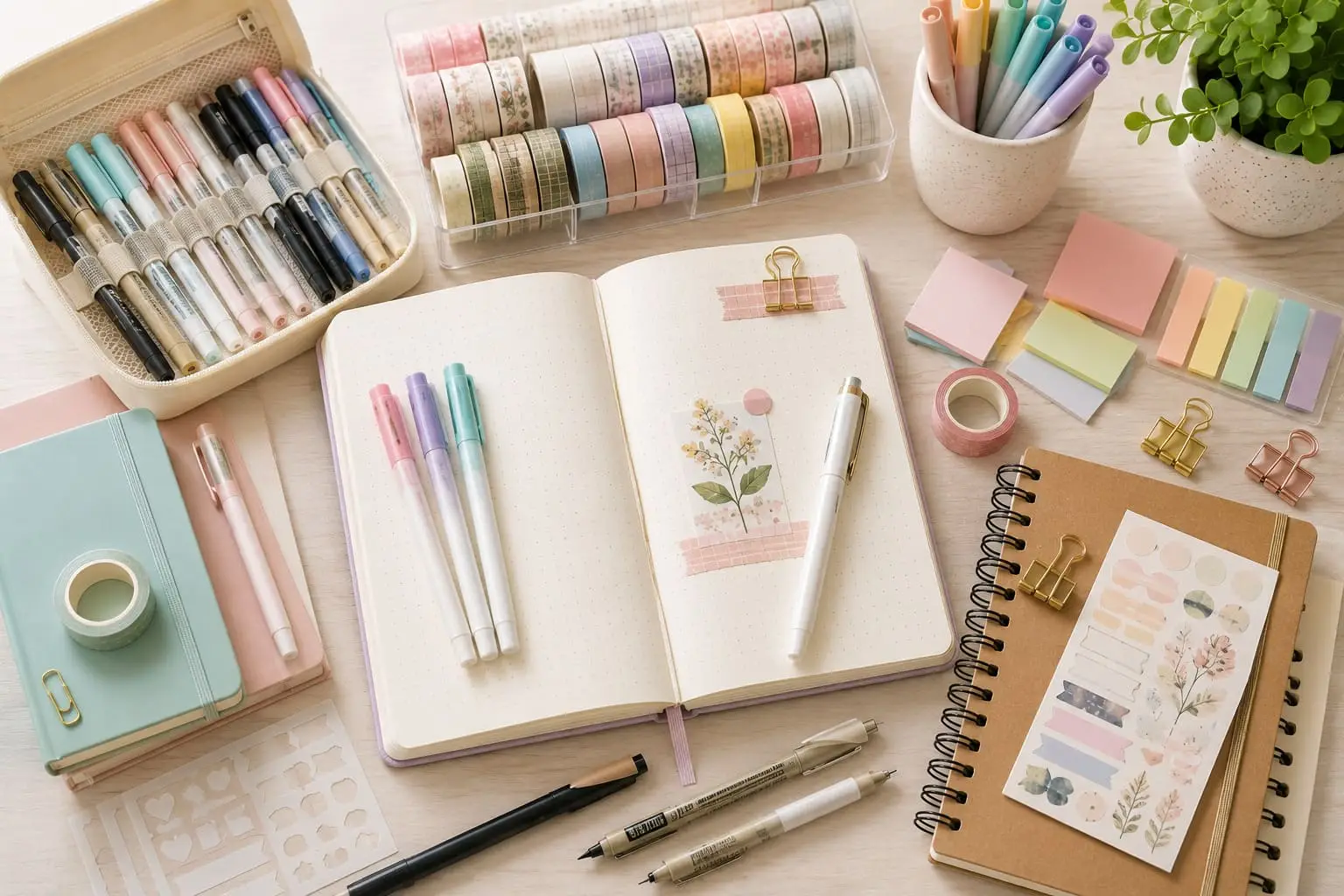
Best Journaling Supplies for Beginners: 10 Essentials to Start With. The best journaling supplies for beginners, from journals and pens to highlighters, washi tape, stencils and adhesive. Build a simple starter kit.. Type: Buying guide. Category: Journaling. Tags: journaling-stationery, beginner-journaling, bullet-journal-supplies, journals, fineliner-pens, highlighters, washi-tape, buying-guide, cluster-journaling-stationery.

Buying guide

Best Journaling Supplies for Beginners: 10 Essentials to Start With

Our recommendation

The best journaling supplies for beginners are a notebook you enjoy using, one dependable black pen, a pencil for planning, and a small amount of color. Our top research pick for the journal itself is the LEUCHTTURM1917 Medium A5 dotted hardcover because its numbered dotted pages, index, page markers and elastic closure provide useful structure without locking you into a preprinted system. Pair it with Sakura Pigma Micron fineliners for precise black lines, Zebra Mildliners for soft color coding and Crayola Super Tips for an affordable color palette. Tombow Fudenosuke brush pens are useful if you want hand-lettered headers, while Mr. Pen stencils and washi tape, Tombow MONO adhesive and Post-it Page Markers add optional layout, memory-keeping and navigation tools.

Quick picks

Top recommendations

  1. 1LEUCHTTURM1917 Hardcover Medium A5 Dotted Notebook — Best journal for beginnersA structured A5 dotted hardcover with numbered pages, an index and built-in navigation features that can grow with your journaling style
  2. 2SAKURA Pigma Micron Fineliner Pens 6-Pack — Best finelinersSix black Micron tip sizes give beginners a simple way to vary fine writing, outlines and bolder section dividers
  3. 3Zebra Pen MILDLINER Dual Tip Highlighters 15-Pack — Best highlightersA 15-color dual-tip highlighter set with a broad chisel end and fine bullet end for both emphasis and detail work
  4. 4Tombow 62038 Fudenosuke Brush Pen 2-Pack — Best brush pens for beginnersA compact two-pack containing both hard and soft Fudenosuke brush tips so you can learn which level of flexibility you prefer
  5. 5Crayola Washable Super Tips Markers 20-Count — Best budget color markersTwenty assorted washable markers with versatile tips that can create thicker or thinner lines for an inexpensive first color set
  6. 6uniball Kuru Toga Elite Mechanical Pencil Kit 0.5 mm — Best pencil for planning layoutsA refillable 0.5 mm mechanical pencil kit that makes it easy to plan a spread lightly and erase mistakes before committing with pen
  7. 7Mr. Pen Journal Stencils 12-Pack — Best journal stencilsTwelve reusable 4 x 7 inch templates that can speed up basic decorative and organizational elements in an A5-style journal
  8. 8Mr. Pen Washi Tape Set 21 Rolls Floral — Best washi tape starter setA 21-roll floral washi collection in assorted sizes for beginners who want easy decoration without needing drawing skills
  9. 9Tombow MONO Permanent Adhesive Applicator 62106 — Best adhesive for memory journalingA refillable dry tape runner that creates a quick permanent bond for paper and photo-based memory-keeping pages
  10. 10Post-it Page Markers 670-5AF 5-Pack — Best page markersFive colors of small writable repositionable markers that create temporary navigation without permanently altering the journal

Product comparison

ProductBest forWatch outPrice & shop
LEUCHTTURM1917 Hardcover Medium A5 Dotted Notebook (opens Amazon in a new tab)LEUCHTTURM1917 · Medium A5 Hardcover Dotted
Best journal for beginnersResearch-based review
Beginners who want one flexible notebook for writing, trackers, lists and bullet-journal layoutsIt is more expensive than a basic notebook, and its paper should still be swatched before using wet or repeatedly layered markers
SAKURA Pigma Micron Fineliner Pens 6-Pack (opens Amazon in a new tab)SAKURA · Pigma Micron 30062 Assorted Point Sizes
Best finelinersResearch-based review
Black writing, boxes, borders, trackers, icons and clean journal layoutsThe set is black-only and the finer tips should not be pressed hard into rough paper
Zebra Pen MILDLINER Dual Tip Highlighters 15-Pack (opens Amazon in a new tab)Zebra Pen · MILDLINER Dual Tip Assorted Colors 15-Pack
Best highlightersResearch-based review
Soft color coding, habit trackers, headers and understated page accentsFifteen colors are more than a minimalist beginner needs, and repeated layering can behave differently on different journal papers
Tombow 62038 Fudenosuke Brush Pen 2-Pack (opens Amazon in a new tab)Tombow · 62038 Fudenosuke Soft and Hard Tip 2-Pack
Best brush pens for beginnersResearch-based review
Simple brush-lettered headers, titles and calligraphy practiceBrush lettering takes practice and is unnecessary if you mainly want fast, plain daily entries
Crayola Washable Super Tips Markers 20-Count (opens Amazon in a new tab)Crayola · 588106 Super Tips 20-Count
Best budget color markersResearch-based review
Beginners who want affordable color for doodles, trackers, headers and simple letteringThe tips are less precise than technical fineliners, and the exact journal paper should be tested before a finished spread
uniball Kuru Toga Elite Mechanical Pencil Kit 0.5 mm (opens Amazon in a new tab)uniball · Kuru Toga Elite 0.5 mm Starter Kit
Best pencil for planning layoutsResearch-based review
Light guide lines, calendar grids, trackers and sketches before inkingA simple wooden pencil can perform the same planning job for much less money
Mr. Pen Journal Stencils 12-Pack (opens Amazon in a new tab)Mr. Pen · 4 x 7 Inch Reusable Journal Stencils 12-Pack
Best journal stencilsResearch-based review
Repeatable icons, shapes and layout details without drawing everything freehandPreset shapes can make pages feel template-driven, and not every stencil opening works equally well with every pen tip
Mr. Pen Washi Tape Set 21 Rolls Floral (opens Amazon in a new tab)Mr. Pen · WT21 21-Roll Assorted Floral Set
Best washi tape starter setResearch-based review
Fast borders, dividers, decoration and lightweight paper accentsTwenty-one rolls can be unnecessary for a minimalist journal, and tape adhesion can vary by paper surface and age
Tombow MONO Permanent Adhesive Applicator 62106 (opens Amazon in a new tab)Tombow · 62106 MONO Permanent Adhesive Applicator
Best adhesive for memory journalingResearch-based review
Attaching photos, tickets, paper ephemera and journaling cardsThe bond is permanent, so a crooked photo or ticket is harder to reposition after it has been pressed down
Post-it Page Markers 670-5AF 5-Pack (opens Amazon in a new tab)Post-it · 670-5AF Assorted Colors 5 Pads
Best page markersResearch-based review
Indexing collections, future logs, reference pages and entries that need follow-upToo many protruding paper tabs can become bent and make the journal edge feel cluttered

Selection and testing methodology

This is a research-based beginner buying guide, not a hands-on ranking. We compared 10 currently listed Amazon US journaling products using product information checked on August 11, 2026. We prioritized whether each item solves a distinct beginner need, the usefulness of the notebook or tool across more than one journaling style, documented tip or paper details where available, ease of starting with a small kit, and obvious trade-offs such as permanent adhesive, large color counts or paper compatibility. KawaiiToons has not personally tested these exact SKUs, so we do not publish invented bleed-through scores, ghosting measurements, dry-time tests, adhesive aging results, marker longevity or durability ratings. Availability, images and listing details should be rechecked before future republishing because Amazon catalog data can change.

Detailed product sections

Best journal for beginnersResearch-based review

LEUCHTTURM1917 Hardcover Medium A5 Dotted Notebook (opens Amazon in a new tab)

LEUCHTTURM1917 · Medium A5 Hardcover Dotted

A structured A5 dotted hardcover with numbered pages, an index and built-in navigation features that can grow with your journaling style

Why it fits this guide

The notebook is the one supply every journaling style has in common, and LEUCHTTURM1917 gives beginners useful structure without deciding what every page must become. The A5 dotted format can handle daily entries, habit trackers, lists, calendars and simple drawings, while numbered pages and a blank table of contents make it easier to find important sections later.

Honest drawback

It is more expensive than a basic notebook, and its paper should still be swatched before using wet or repeatedly layered markers

Best forBeginners who want one flexible notebook for writing, trackers, lists and bullet-journal layouts

Pros

  • A5 dotted layout works for writing, lists, trackers and hand-drawn spreads
  • Numbered pages and blank table of contents support easy indexing
  • Thread-bound hardcover includes page markers, an elastic closure and rear pocket

Cons

  • Higher upfront cost than a basic starter notebook
  • Marker compatibility still needs to be tested on the exact paper
Check price on Amazon (opens Amazon in a new tab)
Best finelinersResearch-based review

SAKURA Pigma Micron Fineliner Pens 6-Pack (opens Amazon in a new tab)

SAKURA · Pigma Micron 30062 Assorted Point Sizes

Six black Micron tip sizes give beginners a simple way to vary fine writing, outlines and bolder section dividers

Why it fits this guide

A good black pen is more useful than a huge decorative set when you are learning how you like to journal. This six-pack gives you multiple point sizes in the same pen family, so you can keep fine handwriting small, draw precise boxes, and use a slightly heavier line to separate headings or sections without changing your entire ink system.

Honest drawback

The set is black-only and the finer tips should not be pressed hard into rough paper

Best forBlack writing, boxes, borders, trackers, icons and clean journal layouts

Pros

  • Six assorted point sizes cover fine writing and stronger outlines
  • Archival Pigma ink is marketed as waterproof, quick-drying and pH neutral
  • Useful for journaling, drawing and precise planner layouts

Cons

  • Does not provide colored ink
  • Fine points reward a lighter hand and can be damaged by excess pressure
Check price on Amazon (opens Amazon in a new tab)
Best highlightersResearch-based review

Zebra Pen MILDLINER Dual Tip Highlighters 15-Pack (opens Amazon in a new tab)

Zebra Pen · MILDLINER Dual Tip Assorted Colors 15-Pack

A 15-color dual-tip highlighter set with a broad chisel end and fine bullet end for both emphasis and detail work

Why it fits this guide

Mildliners are useful for beginners who want color without turning every journal page into a full art project. The broad tip can highlight dates, headings and key lines, while the fine end can underline, color small tracker cells or add compact accents. The softer palette is also easier to reuse consistently across planning and reflective journaling.

Honest drawback

Fifteen colors are more than a minimalist beginner needs, and repeated layering can behave differently on different journal papers

Best forSoft color coding, habit trackers, headers and understated page accents

Pros

  • Dual tips combine broad highlighting with fine detail work
  • Fifteen assorted mild colors support flexible color coding
  • Useful across journals, planners, notes and lettering practice

Cons

  • Larger starter set costs more than choosing only a few colors
  • Paper should be swatched before repeated layering
Check price on Amazon (opens Amazon in a new tab)
Best brush pens for beginnersResearch-based review

Tombow 62038 Fudenosuke Brush Pen 2-Pack (opens Amazon in a new tab)

Tombow · 62038 Fudenosuke Soft and Hard Tip 2-Pack

A compact two-pack containing both hard and soft Fudenosuke brush tips so you can learn which level of flexibility you prefer

Why it fits this guide

Brush lettering is popular in decorative journals, but a beginner does not need a large brush-marker collection to try it. Tombow's two-pack includes both the harder and softer Fudenosuke tip, which gives you a practical side-by-side introduction to pressure-based thick and thin strokes before you invest in more colors or larger nibs.

Honest drawback

Brush lettering takes practice and is unnecessary if you mainly want fast, plain daily entries

Best forSimple brush-lettered headers, titles and calligraphy practice

Pros

  • Includes both hard-tip and soft-tip brush pens
  • Pressure can create extra-fine, fine or medium strokes
  • Small two-pen set keeps the learning commitment manageable

Cons

  • Consistent lettering requires practice
  • Black ink only and non-refillable
Check price on Amazon (opens Amazon in a new tab)
Best budget color markersResearch-based review

Crayola Washable Super Tips Markers 20-Count (opens Amazon in a new tab)

Crayola · 588106 Super Tips 20-Count

Twenty assorted washable markers with versatile tips that can create thicker or thinner lines for an inexpensive first color set

Why it fits this guide

Super Tips are a practical way to discover how much color you actually use before buying a specialist marker system. Their versatile tips can handle simple headings, doodles, tracker fills and basic lettering, while the 20-color assortment gives a beginner enough variety to develop a repeatable palette without starting with dozens of premium markers.

Honest drawback

The tips are less precise than technical fineliners, and the exact journal paper should be tested before a finished spread

Best forBeginners who want affordable color for doodles, trackers, headers and simple lettering

Pros

  • Twenty assorted colors provide a broad starter palette
  • Versatile marker tips are designed for thicker and thinner lines
  • Useful for writing, drawing and coloring beyond journaling

Cons

  • Less precise than a dedicated fineliner for tiny details
  • Marker-to-paper performance varies by notebook stock
Check price on Amazon (opens Amazon in a new tab)
Best pencil for planning layoutsResearch-based review

uniball Kuru Toga Elite Mechanical Pencil Kit 0.5 mm (opens Amazon in a new tab)

uniball · Kuru Toga Elite 0.5 mm Starter Kit

A refillable 0.5 mm mechanical pencil kit that makes it easy to plan a spread lightly and erase mistakes before committing with pen

Why it fits this guide

Beginners often feel pressure to make every line permanent on the first attempt. A fine mechanical pencil removes much of that friction: sketch a calendar, divide a page, test a title placement or draft a tracker, then erase the construction lines after inking. The Kuru Toga Elite is a more polished version of a basic tool and includes a rotating lead mechanism designed to keep the writing point consistent.

Honest drawback

A simple wooden pencil can perform the same planning job for much less money

Best forLight guide lines, calendar grids, trackers and sketches before inking

Pros

  • Fine 0.5 mm lead suits compact journal layouts and guide lines
  • Rotating lead mechanism is designed for a consistent point while writing
  • Refillable pencil with replaceable lead and eraser options

Cons

  • Costs more than the basic pencil many beginners already own
  • Small refills need to be stored carefully
Check price on Amazon (opens Amazon in a new tab)
Best journal stencilsResearch-based review

Mr. Pen Journal Stencils 12-Pack (opens Amazon in a new tab)

Mr. Pen · 4 x 7 Inch Reusable Journal Stencils 12-Pack

Twelve reusable 4 x 7 inch templates that can speed up basic decorative and organizational elements in an A5-style journal

Why it fits this guide

Stencils can reduce the perfection pressure that makes some beginners abandon decorative journaling. Instead of redrawing the same icon or shape every week, you can use a template as a quick guide and keep the page moving. This 12-pack is also reusable, so it adds variety without becoming another consumable supply you need to replace regularly.

Honest drawback

Preset shapes can make pages feel template-driven, and not every stencil opening works equally well with every pen tip

Best forRepeatable icons, shapes and layout details without drawing everything freehand

Pros

  • Twelve reusable templates provide multiple layout and decoration options
  • 4 x 7 inch size is designed to work conveniently with many A5 notebooks
  • Can also be used for scrapbooks, cards and other paper crafts

Cons

  • Less flexible than drawing your own shapes
  • Some openings may be awkward with very fine or broad pens
Check price on Amazon (opens Amazon in a new tab)
Best washi tape starter setResearch-based review

Mr. Pen Washi Tape Set 21 Rolls Floral (opens Amazon in a new tab)

Mr. Pen · WT21 21-Roll Assorted Floral Set

A 21-roll floral washi collection in assorted sizes for beginners who want easy decoration without needing drawing skills

Why it fits this guide

Washi tape is one of the simplest ways to make a journal page feel personal. It can divide sections, create a border, cover a small mistake, hold a lightweight note or add color to a plain spread in seconds. This set gives beginners multiple widths and patterns to experiment with before they know which decorative style they will keep using.

Honest drawback

Twenty-one rolls can be unnecessary for a minimalist journal, and tape adhesion can vary by paper surface and age

Best forFast borders, dividers, decoration and lightweight paper accents

Pros

  • Includes 21 rolls in assorted sizes
  • Floral patterns add quick decoration without drawing
  • Works across journals, planners, scrapbooks and paper crafts

Cons

  • Large pattern selection may be more than a minimalist needs
  • Adhesion and removability can vary on different paper finishes
Check price on Amazon (opens Amazon in a new tab)
Best adhesive for memory journalingResearch-based review

Tombow MONO Permanent Adhesive Applicator 62106 (opens Amazon in a new tab)

Tombow · 62106 MONO Permanent Adhesive Applicator

A refillable dry tape runner that creates a quick permanent bond for paper and photo-based memory-keeping pages

Why it fits this guide

If your journal includes receipts, ticket stubs, printed photos or small paper keepsakes, a tape runner is usually cleaner and faster than spreading liquid glue across a small page. Tombow describes this MONO adhesive as acid-free, photo-safe and refillable, which makes it a useful specialist addition for memory journaling rather than a required purchase for plain writing.

Honest drawback

The bond is permanent, so a crooked photo or ticket is harder to reposition after it has been pressed down

Best forAttaching photos, tickets, paper ephemera and journaling cards

Pros

  • Designed for clean bonding of paper, photos and cardstock
  • Acid-free and PAT-approved for photo-related projects
  • Refillable snap-in cartridge system

Cons

  • Permanent adhesive gives less room to fix placement mistakes
  • Refill cartridges add an ongoing consumable cost
Check price on Amazon (opens Amazon in a new tab)
Best page markersResearch-based review

Post-it Page Markers 670-5AF 5-Pack (opens Amazon in a new tab)

Post-it · 670-5AF Assorted Colors 5 Pads

Five colors of small writable repositionable markers that create temporary navigation without permanently altering the journal

Why it fits this guide

A journal becomes more useful when you can quickly return to the pages that matter. Post-it Page Markers let beginners flag a tracker, reading list, project page or future-log section without building a complicated indexing system first. Because the tabs are repositionable, you can change the navigation as the notebook evolves.

Honest drawback

Too many protruding paper tabs can become bent and make the journal edge feel cluttered

Best forIndexing collections, future logs, reference pages and entries that need follow-up

Pros

  • Five assorted colors are easy to spot along the page edge
  • Repositionable format suits temporary indexing and changing priorities
  • Writable markers can carry short section labels

Cons

  • Paper tabs are less durable than permanent plastic dividers
  • Overusing them can make the notebook visually cluttered
Check price on Amazon (opens Amazon in a new tab)

How to choose

  • Start with the journal and one black pen before buying decorative supplies. A notebook you will actually open and a pen that feels easy to use matter more than owning a large coordinated stationery collection.
  • Match the page ruling to the way you think. Dotted paper is flexible for writing, trackers and hand-drawn layouts, lined paper is easiest for long-form entries, and blank paper gives the most freedom for sketching and collage.
  • Add color slowly. A few highlighters or versatile markers are enough to learn which colors and visual system you naturally reuse before you commit to very large marker or pen sets.
  • Treat brush pens, stencils and washi tape as optional helpers rather than requirements. They are useful when lettering and decoration make you want to journal more, but they should not make each page feel like a design assignment.
  • Choose permanent adhesive only for items you genuinely want to keep in place. Tickets, photos and paper mementos are easier to add with a tape runner, but permanent placement leaves less room to correct a crooked piece later.

Common mistakes

  • Buying a complete aesthetic stationery haul before you know whether you prefer daily writing, bullet journaling, memory keeping, planning or art journaling.
  • Using a new marker across a finished spread before testing ghosting, bleed-through and feathering on the same notebook paper.
  • Spending so much time drawing elaborate weekly layouts that the setup becomes harder to maintain than the journaling habit itself.
  • Choosing a notebook only for the cover while ignoring size, ruling, page count and whether it feels comfortable to carry and open every day.
  • Assuming expensive tools will create consistency. A simple notebook and pen can be a complete journaling system if they are easy enough to use repeatedly.

FAQ

What journaling supplies does a beginner actually need?

A beginner only needs a notebook and a pen to start. A pencil is useful if you want to plan layouts before inking, and one small color set can help with headings or organization. Highlighters, brush pens, stencils, washi tape, adhesive and page tabs are optional additions that become useful only when they support the style of journaling you enjoy.

Is a dotted notebook best for beginner journaling?

Dotted paper is especially flexible because the dots can guide straight lines, boxes, trackers and simple layouts while remaining less visually dominant than a full grid. It is not automatically best for everyone. Lined paper is often easier for long-form reflective writing, while blank paper gives more freedom for sketching, collage and art journaling.

What is the best pen for a beginner journal?

Start with a dependable black pen that feels comfortable for your handwriting. Sakura Pigma Micron fineliners are a useful research pick when you also want to draw boxes, icons and fine layout lines because the six-pack includes multiple point sizes. If you mainly write paragraphs, the best pen may simply be the everyday gel or ballpoint you already enjoy using.

Do I need highlighters for journaling?

No. Highlighters are optional, but they can make color coding easy without requiring a full marker collection. Zebra Mildliners combine broad and fine tips, so the same tool can highlight dates, underline text and color small tracker sections. If color does not help you find information or enjoy the page, skip them.

Are brush pens necessary for bullet journaling?

Brush pens are not necessary for bullet journaling. They are mainly useful if you enjoy decorative headers, calligraphy or pressure-based lettering. A two-pen set such as Tombow Fudenosuke lets you experiment with a hard and soft brush tip before buying a larger collection, but ordinary handwriting works perfectly well for a functional journal.

Will markers bleed through journal paper?

It depends on the marker, ink load, number of layers and the exact paper. Manufacturer claims are not a substitute for testing your own notebook. Reserve a pen-test page near the back, make representative strokes and layered marks, then check the reverse side for ghosting, feathering or bleed-through before using the marker on an important spread.

What is washi tape used for in a journal?

Washi tape can create borders, separate sections, add a quick color theme, cover small mistakes or attach lightweight paper pieces. It is popular because it adds decoration without requiring drawing skills. Beginners should start with patterns they genuinely like rather than collecting large amounts of tape before they know how often they will use it.

Are journal stencils worth it for beginners?

Stencils are useful when repeated icons, shapes or small layout elements are slowing you down or making you anxious about drawing neatly. They are not required for functional journaling, and freehand shapes often become faster with practice. A reusable set makes the most sense when the templates solve a recurring layout need.

What adhesive should I use for memory journaling?

A dry tape runner is convenient for paper keepsakes because it applies adhesive without the wet drying stage of liquid glue. Tombow MONO Permanent Adhesive is a research pick for photos, paper and cardstock, but it creates a permanent bond. If you often reposition elements while designing a page, use a removable solution until you are confident about placement.

How much should I spend on beginner journaling supplies?

There is no required starter budget. The lowest-risk approach is to use a notebook and pen you already own, then buy one category only when a repeated need appears. A premium notebook may be worthwhile if it makes you enjoy writing every day, while decorative supplies are easier to add gradually after you learn whether you prefer writing, planning, memory keeping or art-focused pages.

Final recommendation

For most beginners, build the kit in layers. Start with the LEUCHTTURM1917 Medium A5 dotted hardcover as a structured all-purpose journal, Sakura Pigma Micron fineliners for precise black writing and layout lines, and a pencil such as the uniball Kuru Toga Elite for light planning before you commit with ink. Add Zebra Mildliners if color coding matters to you, or Crayola Super Tips if you want a broader budget color palette. Tombow Fudenosuke brush pens are the optional lettering upgrade. Mr. Pen stencils and washi tape make decoration easier, Tombow MONO Permanent Adhesive is useful for photos and paper keepsakes, and Post-it Page Markers make important collections easier to find. You do not need all 10 products on day one; the strongest beginner kit is the smallest one that supports the kind of journaling you will actually keep doing.

Choosing the best journaling supplies for beginners should make it easier to put words on a page, not turn a new habit into a shopping project. A journal can be as simple as a notebook and the pen already on your desk. Everything else—highlighters, brush pens, markers, stencils, washi tape, adhesive and tabs—should earn its place by making your particular style of journaling easier or more enjoyable.

That matters because “journaling” can mean very different things. One person may write three reflective pages every evening. Another may build a compact bullet journal around tasks, calendars and trackers. A memory journal might hold ticket stubs and photos, while a creative journal may mix lettering, doodles and color.

A beginner kit therefore works best when it is modular. Start with the core supplies, notice what you repeatedly wish you had, and add one category at a time. You will spend less, create less clutter and end up with tools that match the way you actually use your notebook.

This guide is research-based. We checked current Amazon US listing information for all 10 selections on August 11, 2026, but KawaiiToons has not personally tested these exact products yet. We therefore do not publish invented bleed-through rankings, measured dry times, paper-ghosting scores, adhesive longevity or durability ratings.

The short version: what journaling supplies should a beginner buy?

If you are starting from nothing, the first three purchases are straightforward: a journal, a black pen and a pencil.

Our top research pick for the notebook is the LEUCHTTURM1917 Medium A5 Dotted Hardcover. Dotted pages give you enough guidance to draw a straight line or tracker without making a reflective entry look like it was written on graph paper. Numbered pages and a blank table of contents also become useful once the journal grows beyond a few weeks.

For black ink, the SAKURA Pigma Micron 6-Pack gives you several line widths in one familiar pen family. You can use a finer tip for compact writing or tracker details and a heavier line for borders and section headings. If you like planning layouts before they become permanent, the uniball Kuru Toga Elite 0.5 mm is the pencil upgrade in this guide, though an ordinary pencil you already own is completely adequate.

Color is the next layer. Zebra MILDLINER Highlighters make sense if your main goal is highlighting and color coding, while Crayola Super Tips are a lower-cost way to get a broader marker palette for doodles, headings and simple lettering.

Everything after that is optional. Tombow Fudenosuke brush pens are for lettering practice. Mr. Pen Journal Stencils help with repeatable shapes. Mr. Pen Washi Tape adds instant decoration. Tombow MONO Permanent Adhesive is useful when you add photos or paper keepsakes, and Post-it Page Markers make frequently used pages easier to find.

You do not need to buy all 10 at once. The list is better understood as a menu of beginner-friendly functions than a mandatory shopping checklist.

Start with the journal: dotted, lined or blank?

The notebook matters more than the decorative tools because it determines the space you return to every day.

Dotted paper is the most flexible all-rounder

Dotted pages are popular for bullet journaling because they create a subtle grid without dominating the page. You can count dots to build a calendar, draw a box around a habit tracker, align a list or keep handwriting relatively straight. When you want to write a full paragraph, the dots fade into the background more easily than dark ruled lines.

That flexibility is why the LEUCHTTURM1917 Medium A5 Dotted Hardcover is our top journal pick. Its A5 size is compact enough for a desk, work bag or nightstand without giving up as much writing room as a pocket notebook. The numbered pages and table of contents are also practical once you begin mixing dated entries with undated collections such as books to read, gift ideas, trip notes or project pages.

Dotted paper is not a requirement. If you already know that journaling means long-form writing to you, a lined notebook can reduce friction because you never have to think about page design. If the journal is mostly for sketching, collage or free-form creativity, blank paper may feel less restrictive.

The best page style is the one that asks the least from you before you begin.

Do not choose a journal by paper weight alone

Paper weight is useful context, but it does not tell you exactly how every pen will behave. Ink formulation, tip width, pressure, repeated strokes and page coating all affect ghosting, feathering and bleed-through.

Even if a notebook is widely used for journaling, create a pen-test page. Put it near the back and test every new marker in the same way you expect to use it on a real spread. A single light stroke is not enough if your habit trackers usually receive two or three layers of color.

Choose one dependable black pen before collecting colors

A beginner often gets more value from one reliable black pen than from a giant rainbow pack.

Black ink handles the work that appears on almost every kind of journal page: dates, entries, lists, checkboxes, borders, labels, small icons and quick sketches. Once that foundation feels consistent, color becomes an addition rather than something you need to manage on every page.

The SAKURA Pigma Micron 6-Pack is useful because it gives you several tip sizes without changing the underlying pen family. Amazon’s current listing describes six black pens ranging from very fine points through a broader 08 size. That variety lets a beginner discover whether compact writing feels better with a fine line or whether a heavier outline makes sections easier to scan.

The practical rule is to use the lightest pressure that produces a clean line. Fine fineliners are precision tools, not carving tools. Pressing hard does not make a journal more polished; it simply increases the chance of damaging a fine tip or leaving a groove in the paper.

If you are a long-form writer rather than a layout builder, you may not need multiple point sizes. Your everyday gel pen or ballpoint can be a better starting choice if it already feels comfortable for a full page of handwriting.

Use a pencil when blank-page perfection slows you down

A pencil is not visually exciting, but it solves one of the most common beginner problems: the fear of putting the first permanent line in the wrong place.

Use pencil for the parts of a page where spacing matters. Mark the top and bottom of a calendar, sketch the rough width of columns, place a title, divide a habit tracker or plan where a photo will sit. Once the layout works, ink the parts you want to keep and erase the remaining guide lines after the ink is fully dry.

The uniball Kuru Toga Elite 0.5 mm is our more premium pencil pick because the fine lead suits compact journal layouts and its mechanism is designed to rotate the lead while you write. But this is also the easiest category to skip buying: if there is a working pencil in your drawer, use it first.

That is a useful mindset for the whole kit. Upgrade when a basic tool creates a repeated annoyance, not simply because a prettier version exists.

Highlighters or color markers: which should you add first?

Highlighters and color markers overlap, but they solve slightly different problems.

Choose highlighters for structure and color coding

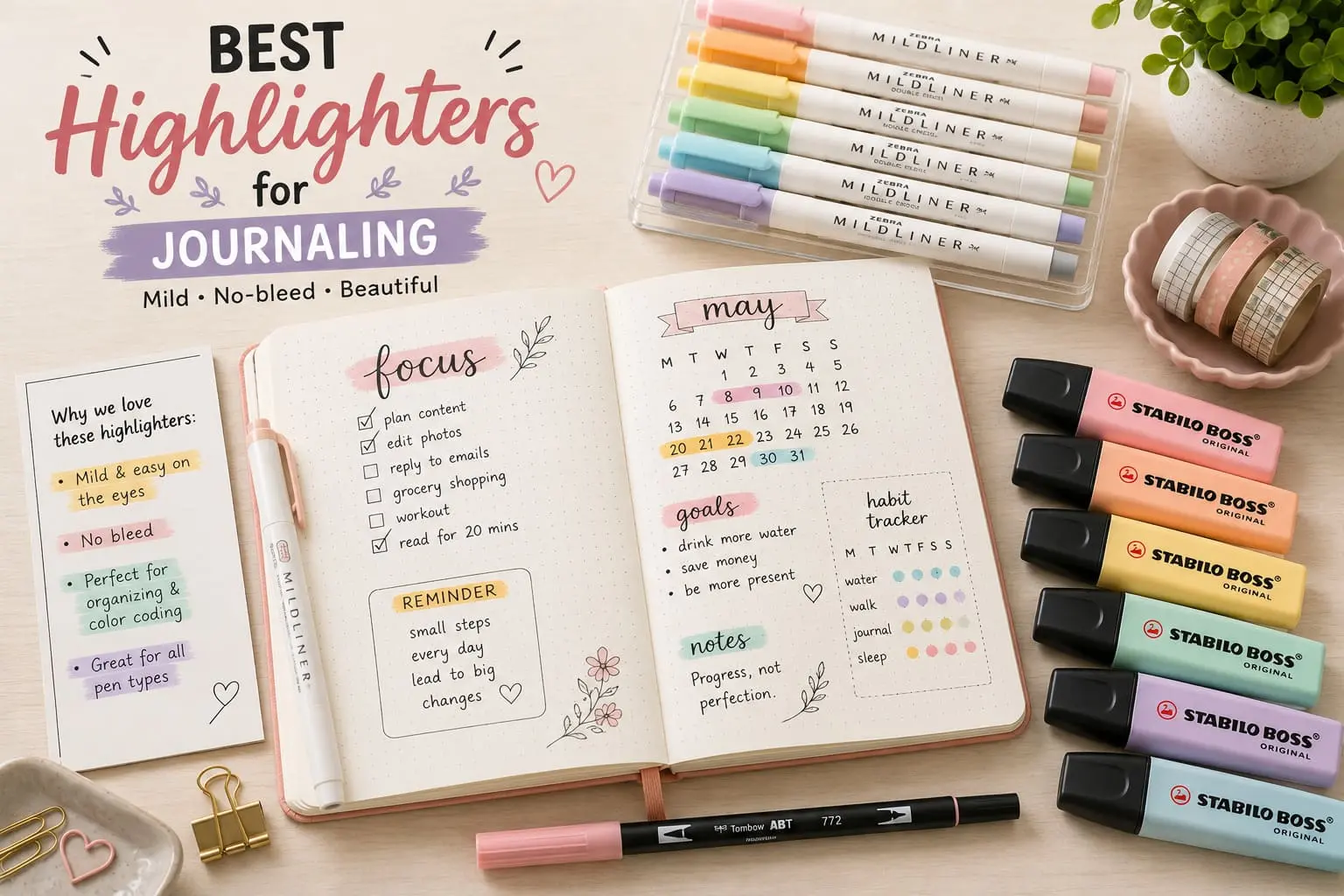
The Zebra MILDLINER 15-Pack is built around a dual-tip format. The broad chisel end can highlight a heading or date, while the fine bullet end is better for underlining, small tracker cells and compact accents.

That makes highlighters especially useful in a functional journal. You might assign one color to appointments, another to personal tasks and a third to items that need follow-up. A reflective journal can use color more subtly—perhaps one shade for a key insight or a line you want to revisit.

The important part is consistency. Color coding becomes helpful only when you remember what the colors mean. Five colors used repeatedly can be more effective than 30 colors chosen at random.

Choose versatile markers for doodles and broader creative use

Crayola Super Tips 20-Count gives you a different kind of flexibility. The markers are designed to create thicker or thinner strokes depending on how the tip is used, which makes them useful for simple titles, doodles, color fills and beginner lettering experiments.

They are also inexpensive enough to act as a discovery set. If you learn that you always reach for muted greens, warm browns and two blues, that information is more useful than buying a premium 100-marker set before you know your palette.

Whatever marker you choose, test it on the actual journal paper first. Do not rely on a general “no bleed” claim as a guarantee for every notebook, especially if you layer the same area repeatedly.

Brush pens are optional, not a beginner requirement

Social media can make brush-lettered headers look like part of the definition of bullet journaling. They are not.

A journal written entirely in normal handwriting is still a journal. In fact, plain handwriting is often easier to sustain because it removes the feeling that every daily entry needs a finished design.

If lettering itself sounds enjoyable, the Tombow Fudenosuke 62038 2-Pack is a sensible starting point. It includes both a hard and soft brush tip. The harder tip generally gives a beginner more resistance, while the softer tip offers more flexibility as pressure changes. Trying both teaches you something about your hand before you buy a larger collection.

Practice on separate paper first. Brush pens depend on pressure transitions, so expecting polished headers on the first journal page can turn a fun supply into unnecessary frustration.

Stencils can make layouts faster—if you use them as shortcuts

The Mr. Pen Journal Stencils 12-Pack is designed around reusable 4 x 7 inch templates. For a beginner, the value is not that every journal should look identical. It is that a stencil can make recurring shapes faster when you would otherwise redraw them from scratch.

That might mean a small weather icon, a banner, a decorative divider or another repeated element you genuinely use. A stencil is most helpful when it removes friction from a recurring task.

Avoid the opposite problem: building a spread around every shape simply because the stencil includes it. The journal should determine which tools you use, not the other way around.

If a hand-drawn circle is good enough for the way you use the page, it is good enough.

Washi tape is the easiest decorative supply to overbuy

Washi tape is beginner-friendly because it creates an immediate visual change. A strip can divide a page, frame a heading, hold down a lightweight note, cover a small mistake or create a theme without requiring illustration skills.

The Mr. Pen 21-Roll Floral Washi Tape Set gives you multiple widths and patterns to experiment with. That variety can be useful when you are still learning whether you prefer thin dividers, wider borders or small torn accents.

It can also create a new problem: storage. Decorative tape is easy to collect because each roll is inexpensive compared with a notebook, but dozens of rolls can sit unused once your personal style becomes clearer.

For beginners, treat washi as seasoning rather than the meal. Use enough to make the page inviting, then leave room for the thing you actually came to record.

Add adhesive only if your journal includes memories and paper keepsakes

A plain writing journal does not need glue. A memory journal often does.

Photos, ticket stubs, museum receipts, printed maps, packaging labels and small notes can turn an ordinary notebook into a record of a trip or season. A dry tape runner makes those pieces easier to attach without spreading liquid adhesive across the page.

The Tombow MONO Permanent Adhesive Applicator 62106 is included for that use case. Tombow describes the adhesive as permanent, acid-free, refillable and suitable for paper, photos and cardstock. That makes it more relevant to memory keepers than to someone who writes text-only entries.

The drawback is right in the name: permanent. Dry-fit a photo or ticket before applying adhesive. Check the edges, close the journal once to make sure the placement does not interfere with the binding, and only then press it down.

If you regularly change your mind while arranging pages, a repositionable option may suit the creative process better.

Page markers make an evolving journal easier to navigate

A table of contents is useful, but sometimes you want to find a page without looking up its number first.

Post-it Page Markers 670-5AF add a simple temporary index. Use one color for a current project, another for a recurring tracker or a third for the page you need at your next appointment. Because the markers are writable, a short label can carry more meaning than color alone.

They are particularly useful while a journal is still evolving. A permanent tab assumes that a section will remain important for the life of the notebook. A repositionable page marker can move as your focus changes.

Restraint matters here too. If every page has a tab, no tab stands out.

How we chose these beginner journaling supplies

We did not look for the 10 most elaborate stationery products. We started with a simpler question: what beginner problem does this item solve?

That produced 10 distinct roles rather than 10 competing notebooks or pen sets:

  1. A journal that can support multiple journaling styles.
  2. Black fineliners for writing and precise structure.
  3. Highlighters for low-effort color coding.
  4. Brush pens for optional lettering practice.
  5. Color markers for affordable creative variety.
  6. A pencil for reversible planning.
  7. Stencils for repeatable shapes and layout shortcuts.
  8. Washi tape for fast decoration.
  9. Permanent adhesive for memory keeping and paper ephemera.
  10. Page markers for temporary navigation.

We compared current Amazon US listing information checked on August 11, 2026, including the documented format or count, intended paper or creative uses, relevant tip or notebook features, and the most obvious compromise for a beginner.

The ranking remains research-based until KawaiiToons completes original testing. That distinction is important. We can report that a notebook has numbered pages or that a marker is sold with a dual tip from current product information. We cannot responsibly claim that one pen “feels smoother” or one marker “bleeds less” than another without testing them side by side on the same paper.

What to look for before buying journaling supplies

Choose a journal size you will actually carry or keep nearby

A large notebook gives you more room for art, elaborate weekly spreads and pasted memories. It also takes more desk space and can be less convenient to carry.

A small notebook is portable but can feel cramped if you write long paragraphs. A5 sits in the middle, which is one reason it is so common for general journaling. Do not treat the size as a rule; treat it as a clue about where and how you will use the journal.

Match the ruling to the activity

Use lined pages when your journal is mostly writing. Use dotted pages when you want a balance of writing and layout flexibility. Use blank pages when drawing, collage or visual freedom matters more than keeping text aligned.

If you are unsure, dotted paper is a versatile experiment because it can behave like a subtle grid when you need structure and like a nearly blank page when you do not.

Buy pen functions, not just pen counts

A 40-pen set may look like better value than six pens, but it is only better if you use the additional colors or tips.

Ask what the pen does. Does a fineliner give you a line width you cannot get from your everyday pen? Does a dual-tip highlighter replace two separate tools? Does a brush pen add a lettering effect you actually enjoy?

The best beginner collection often looks small because each tool has a clear job.

Keep decoration separate from organization

A highlighter can be decorative, but it can also encode information. A page marker can add color, but its main job is navigation. Washi tape can divide sections, but too much of it can reduce usable writing space.

When you know whether a supply is helping you find information, record information or simply enjoy the page, it becomes much easier to decide whether you need it.

Think about permanence before attaching anything

Memory journaling adds a physical design decision that ordinary writing does not: once a ticket or photo is attached, do you want it to move again?

Permanent adhesive is convenient when the layout is decided. Repositionable solutions are more forgiving while you are still arranging the page. Washi can sometimes hold lightweight pieces temporarily, but adhesion varies by paper and tape.

For anything sentimental, test the material combination before committing an irreplaceable original.

Common mistakes when building a first journaling kit

Buying the aesthetic before finding the habit

A coordinated stationery set can make you excited to begin. That is useful—until the supplies become the hobby and the journal remains empty.

Start with enough visual appeal to make the notebook inviting, but give yourself a short period of real use before buying more. Two weeks of actual pages will teach you more about your needs than an hour of browsing stationery collections.

Making every spread a design project

A layout that takes 45 minutes to prepare is fine if drawing layouts is the part you enjoy. It is a problem if you wanted a five-minute daily planning habit.

Your journal is allowed to contain plain pages. It is allowed to look inconsistent. It is allowed to shift from decorated weekly spreads to one-line entries during a busy month.

Consistency of use matters more than visual consistency.

Skipping the pen-test page

A marker that behaves well on one notebook can look completely different on another. Paper thickness is only one variable.

Test fine lines, normal writing, broad strokes and the number of layers you realistically use. Then look at the back of the page. A little show-through may be acceptable to you; actual bleed may not be.

The point is not to chase paper that shows absolutely nothing. It is to know what to expect before using a tool on an important entry.

Using permanent adhesive before arranging the whole page

When you are working with photos or ticket stubs, place every large item first. Make sure the journal still closes comfortably and that the fold or binding does not cross a thick stack of materials.

Only then apply permanent adhesive.

Treating mistakes as failed pages

A slightly crooked header, uneven box or crossed-out sentence does not make a page unusable. Journals are records of thought and time, not print-ready design files.

Pencil, washi and stencils can reduce certain mistakes, but they should not make you afraid to work without them.

Best supplies for bullet journaling beginners

Bullet journaling tends to use the widest range of supplies because it mixes planning, lists, collections and optional decoration.

For a clean functional setup, start with the LEUCHTTURM1917 dotted notebook, a Pigma Micron and any pencil. That is enough to build an index, future log, monthly pages, daily notes and custom collections.

Add Mildliners when color helps you scan the page. One color can mark events, another can flag deadlines and another can identify notes that need to be migrated. If you enjoy illustrated headers, the Fudenosuke two-pack adds brush lettering without requiring a large marker case.

Stencils are most useful when you repeat the same shapes. Page markers are most useful when a few active collections need faster access than an index provides.

The most effective bullet-journal kit is not the most decorative one. It is the kit that makes rapid logging and retrieval feel easier than your previous system.

Best supplies for reflective and daily journaling

Long-form reflective journaling needs less equipment.

A comfortable notebook and a pen you can use for several paragraphs without thinking about the tool are enough. The LEUCHTTURM1917 is flexible, but a lined notebook can be even simpler if you do not intend to draw layouts.

Color should serve the writing rather than interrupt it. A Mildliner can mark a sentence you want to revisit. A page marker can flag an entry for a future therapy session, project review or monthly reflection. A single strip of washi can separate months without creating a full decorative spread.

In this style of journaling, fewer supplies often make it easier to begin because there is nothing to set up before you write.

Best supplies for memory journaling and scrapbook-style pages

Memory journaling is where the accessory categories become more practical.

A Tombow MONO Permanent Adhesive can secure paper ephemera and photos. Washi tape can frame a ticket, add a date strip or hold a lightweight note. Crayola Super Tips can add color around a photo or fill a simple hand-drawn title. Pigma Microns are useful for captions and fine borders.

Be mindful of thickness. Tickets, layered paper, multiple tape strips and photos can make a notebook expand quickly. Leave more space around the spine, avoid stacking every thick element in the same part of the book, and consider whether a notebook with room to grow would suit a heavily collaged style better.

If the item is irreplaceable, photograph or scan it before attaching it permanently.

How much should a beginner journaling kit cost?

There is no minimum spend that makes a journal legitimate.

The cheapest complete kit is the notebook and pen you already own. If you want to buy new supplies, spend first on the part you touch every time you journal: the notebook and main writing pen. Those choices affect every page.

Then add tools only when a repeated need appears. If you keep wishing important pages were easier to find, buy tabs. If you paste something into the journal every week, an adhesive runner becomes useful. If you never letter headings, skip brush pens. If you use only three colors, you do not need a giant marker case.

This approach also prevents duplicate purchases. Once you know the exact tip width, paper style or color family you prefer, future upgrades become much more targeted.

A simple beginner journaling kit in three stages

You can build the supplies in three stages instead of one shopping trip.

Stage one: write. Choose a notebook, black pen and pencil. Use them long enough to learn whether your journal is primarily reflective, planning-focused, creative or memory-based.

Stage two: organize. Add a small amount of color and navigation only where it helps. Mildliners, a few markers or page tabs fit here.

Stage three: decorate or preserve. Add brush pens, stencils, washi or adhesive only when lettering, design or keepsakes become a regular part of the habit.

That order keeps the habit at the center. Supplies expand because the journal asks for them, not because a shopping list says you are missing something.

Our final recommendation

For most people starting their first dedicated journal, buy fewer things than you think you need.

Our top research pick for the foundation is the LEUCHTTURM1917 Medium A5 Dotted Hardcover because the dotted pages can adapt to writing and layouts, while numbered pages and an index help the notebook stay useful as it fills. Pair it with the SAKURA Pigma Micron 6-Pack if you want precise black lines and multiple tip sizes. Use a pencil—whether the Kuru Toga Elite or one you already own—to plan anything that makes you nervous to draw directly in ink.

For color, choose between two directions. Zebra MILDLINER is the better fit for highlighting and a controlled color-coding system. Crayola Super Tips is the better budget choice when you want a broader creative palette for doodles, headings and simple lettering.

Everything else should reflect your actual pages. Add Tombow Fudenosuke only if brush lettering is enjoyable. Add Mr. Pen stencils when repeated shapes save you time. Add washi tape when quick decoration keeps the journal inviting. Add Tombow MONO Permanent Adhesive when photos and paper memories become part of the record, and use Post-it Page Markers when important collections need faster navigation.

The goal is not to own a perfect stationery kit. It is to create a set of tools with so little friction that opening the journal becomes the easy part of your day.