
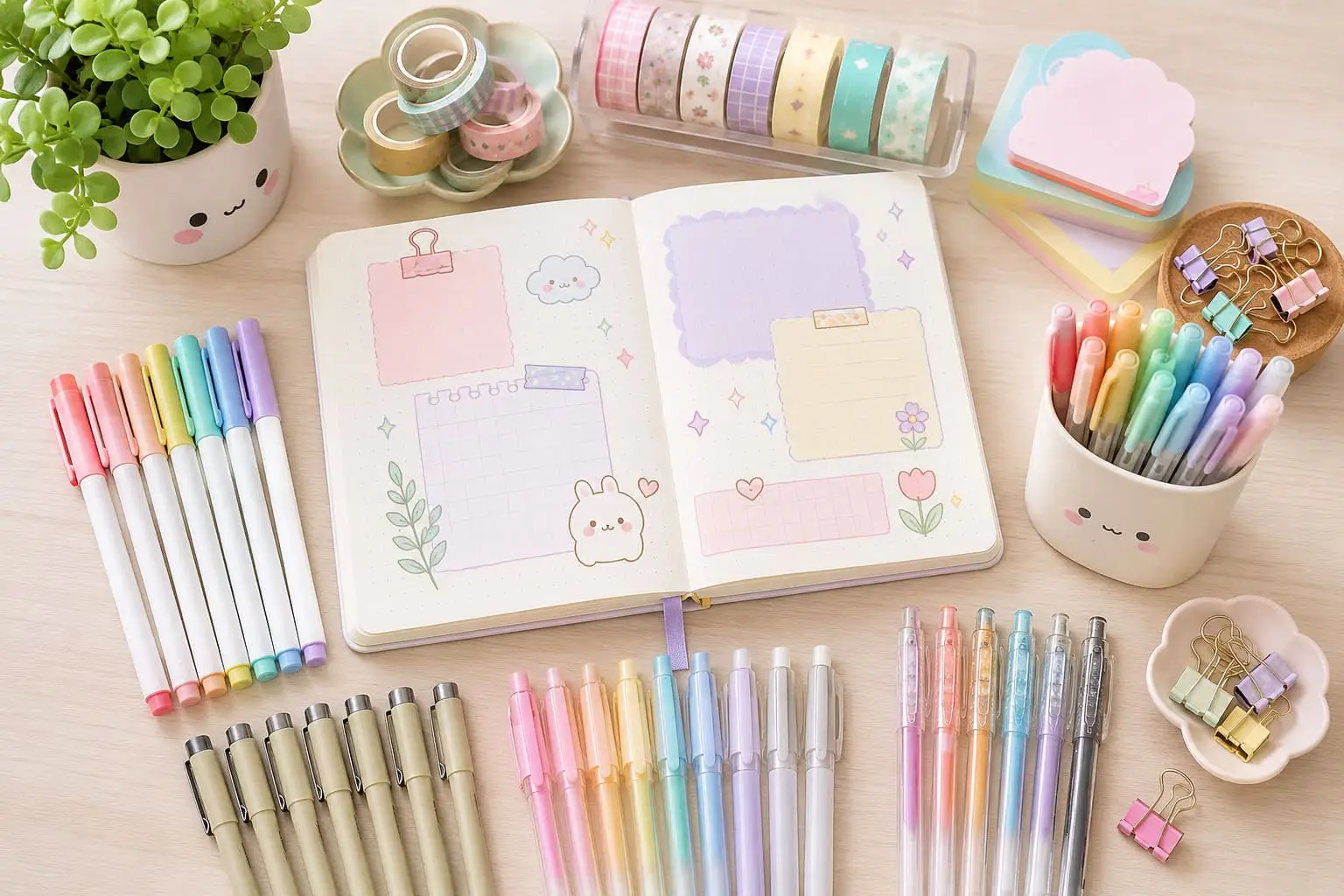
Quick picks
- Best no-bleed gel pickSharpie S-Gel 0.5mm Black Gel Pens, 12-Count (opens Amazon in a new tab)
- Best felt-tip optionPaper Mate Flair Felt Tip Pens 0.7mm, 12-Count (opens Amazon in a new tab)


Journaling pens compared by ink, tip size and bleed claims
Ink type, tip size, drying and bleed-through claims for all 10 pens, taken from the current Amazon US listings we checked. These are manufacturer or listing claims, not KawaiiToons paper tests.
| Pen | Ink type | Tip size | Dry time/smudge resistance | Bleed-through risk | Best for |
|---|---|---|---|---|---|
| Zebra Pen SARASA X20 | Gel (Rapid Dry Ink) | 0.5mm | Rapid Dry Ink designed to reduce smearing | No universal no-bleed claim; test thin paper | Daily writing and left-handed journaling |
| Pentel EnerGel RTX | Liquid gel | 0.5mm needle tip | Marketed as fast-drying | No zero-bleed guarantee; test thin paper | Smooth long-form writing |
| Sharpie S-Gel | Gel | 0.5mm | Listing states no-smear technology | Listing states no bleed; still test very thin paper | Black-ink journaling with an explicit no-bleed claim |
| Paper Mate Flair | Water-based felt tip | 0.7mm | Not stated in our research | Listing states it will not bleed through paper; broader line, so test thin paper | Colorful headings and trackers |
| Sakura Pigma Micron 6-Pack | Archival pigment ink (fineliner) | 0.20mm to 0.50mm (6 sizes) | Marketed as quick-drying | Listing states bleed-free | Archival layouts, labels and diagrams |
| PILOT Juice Up 04 | Gel | 0.4mm | Not stated in our research | No no-bleed claim in our research; finer line puts down less ink | Small handwriting and narrow planner grids |
| Zebra Pen SARASA Clip Vintage | Water-based pigment gel (acid-free, archival quality) | 0.5mm | Not stated in our research | No universal no-bleed claim; test thin paper | Muted color-coding and aesthetic spreads |
| PILOT G2 | Gel (refillable) | 0.7mm | Not stated in our research | No no-bleed claim; the wetter 0.7mm line can show through thin paper | Everyday color notes with a bolder line |
| Uni-Ball Signo 207 | Gel (Uni Super Ink) | 0.5mm | Not stated in our research | No explicit no-bleed claim; test thin paper | Durable black-ink records |
| STAEDTLER Triplus Fineliner | Fineliner (acid-free ink) | 0.3mm | Not stated in our research | No zero-bleed promise; test thin paper | Tiny trackers, legends and color coding |
“Not stated in our research” means we did not confirm that detail from the listing. Ghosting (seeing writing from the back of thin paper) can happen even when ink does not bleed through, so swatch a back page first.
Product comparison
| Product | Best for | Watch out | Price & shop |
|---|---|---|---|
| Zebra Pen SARASA X20 Retractable Gel Pen 0.5mm, 12-Pack (opens Amazon in a new tab) Best overallResearch-based review | Daily journal writers and left-handed users who want a fast-drying 0.5mm black gel pen | The selected 12-pack is black ink only, and the listing does not claim that the ink will never ghost or bleed through every journal paper | |
| Pentel EnerGel RTX 0.5mm Assorted Gel Pens, 5-Pack (opens Amazon in a new tab) Best smooth gel penResearch-based review | Writers who care most about a fluid feel but still want a precise 0.5mm line | Five colors are enough for basic color coding but much less flexible than a 10- or 20-color journaling set | Budget-friendlyCheck price on Amazon (opens Amazon in a new tab) |
| Sharpie S-Gel 0.5mm Black Gel Pens, 12-Count (opens Amazon in a new tab) Best no-bleed gel pickResearch-based review | Black-ink journaling when an explicit manufacturer no-bleed claim matters | The 12-count selection is black only, and even an explicit product claim should be tested on unusually thin or absorbent journal paper | Budget-friendlyCheck price on Amazon (opens Amazon in a new tab) |
| Paper Mate Flair Felt Tip Pens 0.7mm, 12-Count (opens Amazon in a new tab) Best felt-tip optionResearch-based review | Colorful headings, trackers and expressive journal layouts | The 0.7mm felt line is broader than the fine gel and technical pens here, so it is less precise inside tiny grids | Budget-friendlyCheck price on Amazon (opens Amazon in a new tab) |
| Sakura Pigma Micron Black Fineliner Pens, 6-Pack (opens Amazon in a new tab) Best archival finelinerResearch-based review | Permanent journal layouts, fine labels, diagrams, line art and multiple black line widths | This is a black-only technical pen set, and the finer tips are better with light pressure than heavy-handed writing | |
| PILOT Juice Up 04 0.4mm Black Gel Pens, 5-Count (opens Amazon in a new tab) Best ultra-fine gel penResearch-based review | Small handwriting, Hobonichi-style layouts and narrow planner grids | This selected listing is an imported black-ink pack, so price and seller availability can fluctuate more than mainstream US multipacks | |
| Zebra Pen SARASA Clip Vintage 0.5mm Gel Pens, 10-Pack (opens Amazon in a new tab) Best vintage colorsResearch-based review | Aesthetic journals and muted color-coding systems | The muted colors are not ideal if you want maximum contrast, and the exact listing does not make a universal bleed-through guarantee | |
| PILOT G2 0.7mm Assorted Gel Pens, 8-Count (opens Amazon in a new tab) Best refillable color setResearch-based review | General journaling, doodling and color-coded notes with a familiar 0.7mm gel feel | The wetter 0.7mm line can be more visible through thin paper and this SKU is not marketed with a universal no-bleed claim | |
| Uni-Ball Signo 207 0.5mm Black Gel Pens, 6-Pack (opens Amazon in a new tab) Best for durable black notesResearch-based review | Long-term journals, records and black-ink writing that benefits from Uni Super Ink | The selected pack is black only, and the security-oriented ink claim should not be confused with a guaranteed no-bleed result on every paper | Budget-friendlyCheck price on Amazon (opens Amazon in a new tab) |
| STAEDTLER Triplus Fineliner 0.3mm Assorted Pens, 20-Pack (opens Amazon in a new tab) Best for tiny planner detailsResearch-based review | Trackers, mini calendars, charts, legends and detailed color coding | The firmer fineliner tip feels different from a gel pen and the selected listing does not promise zero bleed-through on every paper |
Detailed product sections
Zebra Pen SARASA X20 Retractable Gel Pen 0.5mm, 12-Pack (opens Amazon in a new tab)
A fine-point everyday gel pen that prioritizes quick drying, controlled lines and comfortable long-form writing

Why it fits this guide
SARASA X20 earns the top spot because its 0.5mm point is fine enough for planners and compact handwriting while Zebra's Rapid Dry Ink is specifically designed to reduce smearing. That combination is more broadly useful for journaling than a specialty tip or oversized color set.
Honest drawback
The selected 12-pack is black ink only, and the listing does not claim that the ink will never ghost or bleed through every journal paper
Best forDaily journal writers and left-handed users who want a fast-drying 0.5mm black gel pen
Pros
- 0.5mm fine point suits compact handwriting and planners
- Rapid Dry Ink is designed to reduce smearing and smudging
- Soft latex-free grip and retractable body suit longer writing sessions
Cons
- Selected pack is black ink only
- Bleed-through still depends on the paper because this SKU is not marketed with a universal no-bleed guarantee
Pentel EnerGel RTX 0.5mm Assorted Gel Pens, 5-Pack (opens Amazon in a new tab)
A five-color 0.5mm needle-tip gel set built around a smooth, fast-drying liquid-gel writing feel

Why it fits this guide
EnerGel RTX is a strong journaling choice when the physical feel of writing matters as much as the finished page. The needle tip keeps the line controlled, while Pentel markets the ink for super-smooth and fast-drying performance.
Honest drawback
Five colors are enough for basic color coding but much less flexible than a 10- or 20-color journaling set
Best forWriters who care most about a fluid feel but still want a precise 0.5mm line
Pros
- 0.5mm needle tip gives precise journal lines
- Liquid gel ink is marketed for super-smooth, fast-drying writing
- Latex-free grip improves control during longer entries
Cons
- Only five colors in this selected set
- Fast-drying does not guarantee zero ghosting or bleed-through on every notebook paper
Sharpie S-Gel 0.5mm Black Gel Pens, 12-Count (opens Amazon in a new tab)
A 0.5mm black gel pen multipack marketed with no-smear, no-bleed technology and a comfortable rubber grip

Why it fits this guide
Sharpie S-Gel is one of the clearest matches to the no-bleed intent of this guide because the current Amazon listing explicitly uses 'no smear, no bleed' language. The 0.5mm point also keeps it practical for ordinary handwriting rather than only headings.
Honest drawback
The 12-count selection is black only, and even an explicit product claim should be tested on unusually thin or absorbent journal paper
Best forBlack-ink journaling when an explicit manufacturer no-bleed claim matters
Pros
- 0.5mm fine point keeps handwriting controlled
- Listing explicitly states no-smear, no-bleed technology
- Contoured rubber grip is designed for comfortable writing
Cons
- Selected pack contains only black ink
- Paper thickness and heavy retracing can still affect show-through in real journals
Paper Mate Flair Felt Tip Pens 0.7mm, 12-Count (opens Amazon in a new tab)
A 12-color 0.7mm felt-tip set whose water-based ink is specifically marketed not to bleed through paper

Why it fits this guide
Flair is the most useful non-gel option here for readers who want bold color without moving all the way to a marker. The medium felt tip works well for headers, calendar blocks and trackers, and the Amazon listing explicitly states that the water-based ink will not bleed through paper.
Honest drawback
The 0.7mm felt line is broader than the fine gel and technical pens here, so it is less precise inside tiny grids
Best forColorful headings, trackers and expressive journal layouts
Pros
- Twelve vivid colors work well for headings and color coding
- Listing states the water-based ink will not bleed through paper
- Point guard is designed to help prevent tip fraying
Cons
- 0.7mm felt line is less precise for tiny planner grids
- Show-through and bleed-through are different, so very thin paper should still be tested
Sakura Pigma Micron Black Fineliner Pens, 6-Pack (opens Amazon in a new tab)
Six black pigment fineliners from 0.20mm to 0.50mm with archival, waterproof, fade-resistant and bleed-free listing claims

Why it fits this guide
Pigma Micron is the strongest specialist choice for structured journals, illustrated notes and layouts you want to keep. Instead of one compromise line width, the six-pack spans very fine writing through stronger outlines while keeping the same black pigment ink family.
Honest drawback
This is a black-only technical pen set, and the finer tips are better with light pressure than heavy-handed writing
Best forPermanent journal layouts, fine labels, diagrams, line art and multiple black line widths
Pros
- Six point sizes cover tiny labels through stronger outlines
- Listing describes the ink as archival, waterproof, fade-resistant and bleed-free
- Quick-drying pigment ink is useful for structured journal layouts
Cons
- No color variety in this selected six-pack
- Fine technical tips reward lighter pressure than soft gel pens
PILOT Juice Up 04 0.4mm Black Gel Pens, 5-Count (opens Amazon in a new tab)
A 0.4mm retractable gel pen for compact writing where a conventional 0.7mm line feels too large

Why it fits this guide
Juice Up 04 solves a specific journaling problem: fitting readable writing into small spaces without switching to a technical fineliner. Its 0.4mm point gives more room inside trackers and compact planners, while the listing also highlights smooth writing, water resistance and lightfastness.
Honest drawback
This selected listing is an imported black-ink pack, so price and seller availability can fluctuate more than mainstream US multipacks
Best forSmall handwriting, Hobonichi-style layouts and narrow planner grids
Pros
- 0.4mm ultra-fine point suits compact handwriting
- Rubber grip adds control around small planner boxes
- Listing highlights smooth writing plus water resistance and lightfastness
Cons
- Selected pack is black only
- Imported listing can carry a higher per-pen cost than common US multipacks
Zebra Pen SARASA Clip Vintage 0.5mm Gel Pens, 10-Pack (opens Amazon in a new tab)
Ten coordinated 0.5mm gel colors with an intentionally subdued palette and archival-quality pigment-ink positioning

Why it fits this guide
Many journaling sets lean bright or neon; SARASA Clip Vintage is more useful when you want color without turning every page into a highlighter palette. The 0.5mm point remains practical for ordinary notes, and Zebra describes the pigment ink as acid-free, archival quality and water resistant.
Honest drawback
The muted colors are not ideal if you want maximum contrast, and the exact listing does not make a universal bleed-through guarantee
Best forAesthetic journals and muted color-coding systems
Pros
- Ten vintage colors suit understated journal themes
- 0.5mm point works for notes, planners and smaller boxes
- Water-based pigment ink is described as acid-free, archival quality and water resistant
Cons
- Muted colors are less suitable if you prefer bright high-contrast accents
- No universal no-bleed claim for all journal papers
PILOT G2 0.7mm Assorted Gel Pens, 8-Count (opens Amazon in a new tab)
Eight classic gel colors in a refillable 0.7mm format with a cushioned grip and widely familiar writing feel

Why it fits this guide
G2 remains practical for journaling because it is easy to understand: eight everyday colors, a comfortable grip and a refillable format. It is especially useful for writers who prefer a slightly bolder line than 0.4mm or 0.5mm pens.
Honest drawback
The wetter 0.7mm line can be more visible through thin paper and this SKU is not marketed with a universal no-bleed claim
Best forGeneral journaling, doodling and color-coded notes with a familiar 0.7mm gel feel
Pros
- Eight assorted colors cover notes, headings and simple color coding
- Contoured rubber grip supports longer journal entries
- Refillable design can reduce how often you replace the whole pen
Cons
- 0.7mm line uses more ink than ultra-fine options
- Listing does not promise zero bleed-through on every paper
Uni-Ball Signo 207 0.5mm Black Gel Pens, 6-Pack (opens Amazon in a new tab)
A 0.5mm black retractable gel pen with Uni Super Ink designed to become trapped in paper

Why it fits this guide
Signo 207 fits journals that are more record-keeping than decoration. The micro point keeps writing compact, the textured grip adds control, and the ink technology is positioned for permanence and resistance to document alteration.
Honest drawback
The selected pack is black only, and the security-oriented ink claim should not be confused with a guaranteed no-bleed result on every paper
Best forLong-term journals, records and black-ink writing that benefits from Uni Super Ink
Pros
- 0.5mm micro point is controlled enough for most journals
- Uni Super Ink is designed to bond into paper for durable writing
- Textured grip provides added writing control
Cons
- Selected pack contains only black ink
- No explicit universal no-bleed claim for this exact SKU
STAEDTLER Triplus Fineliner 0.3mm Assorted Pens, 20-Pack (opens Amazon in a new tab)
A 20-color 0.3mm fineliner set that prioritizes precision and palette variety over a soft gel-pen feel

Why it fits this guide
Triplus Fineliner is the choice when a journal page behaves more like a tiny dashboard. The 0.3mm line fits narrow boxes and legends, while 20 assorted colors make it easy to assign consistent colors to habits, subjects, projects or categories.
Honest drawback
The firmer fineliner tip feels different from a gel pen and the selected listing does not promise zero bleed-through on every paper
Best forTrackers, mini calendars, charts, legends and detailed color coding
Pros
- 0.3mm line is excellent for tiny trackers and compact layouts
- Twenty colors give broad color-coding flexibility
- Selected listing identifies acid-free ink
Cons
- Fineliner feel is firmer than a liquid gel pen
- Very thin journal paper should still be swatch-tested before full-page use
Related guides
Best Bullet Journal Notebooks: 10 Picks for Beginners & Creative Planning
The best bullet journal notebooks for beginners and creative planning. Compare paper weight, page count, dot grids, binding, and setup features.
Best Journaling Supplies for Beginners: 10 Essentials to Start With
The best journaling supplies for beginners, from journals and pens to highlighters, washi tape, stencils and adhesive. Build a simple starter kit.
Best Washi Tape for Journaling: 10 Cute & Versatile Sets
The best washi tape for journaling, from kawaii animals and pastel florals to grid, vintage, skinny, and foil sets. Compare roll count, width, length, and style.
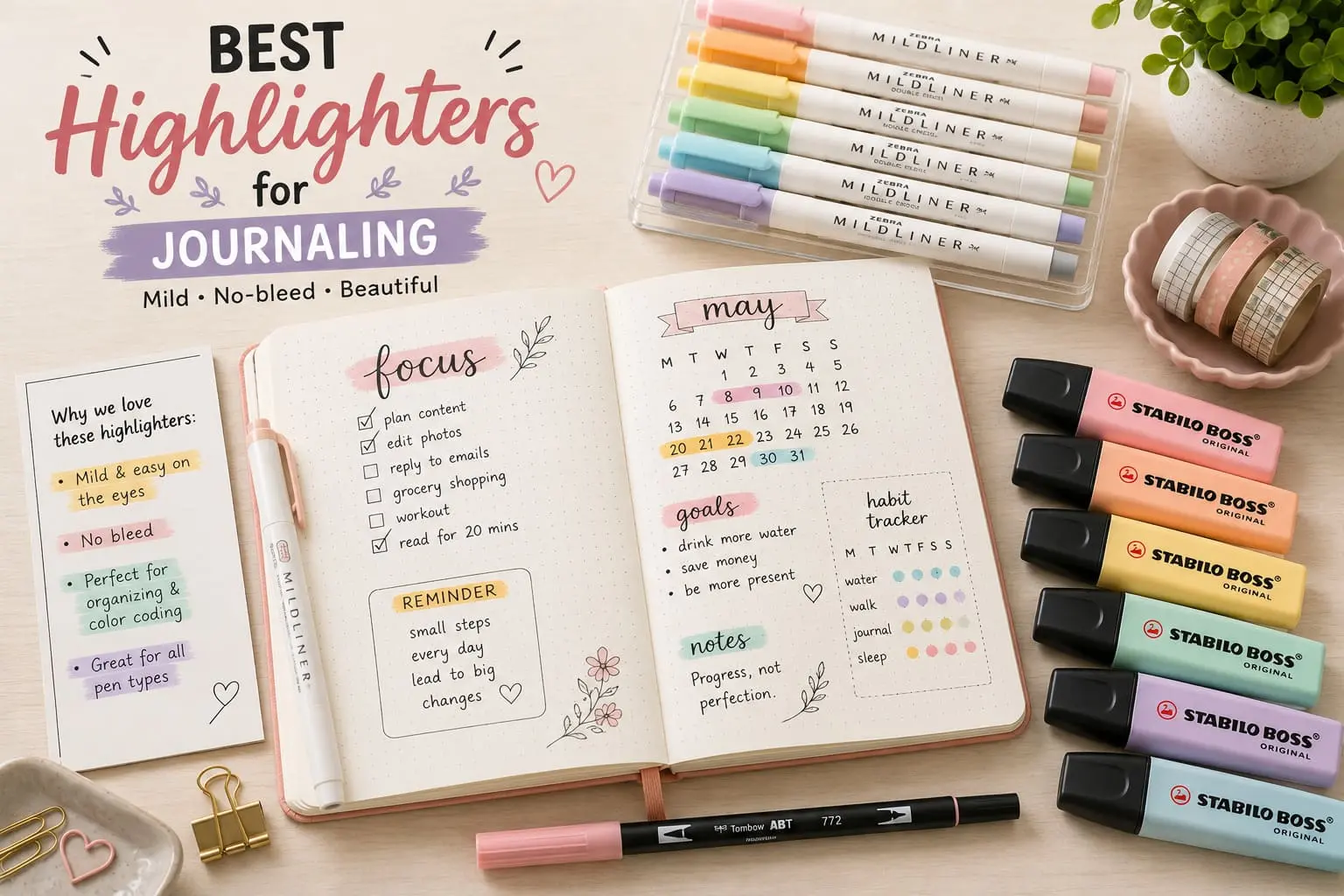
Best Highlighters for Journaling: 10 Mild, No-Bleed Picks
The best highlighters for journaling, from mild pastel markers to no-bleed gel picks. Compare tips, colors, erasability, and thin-paper use.


