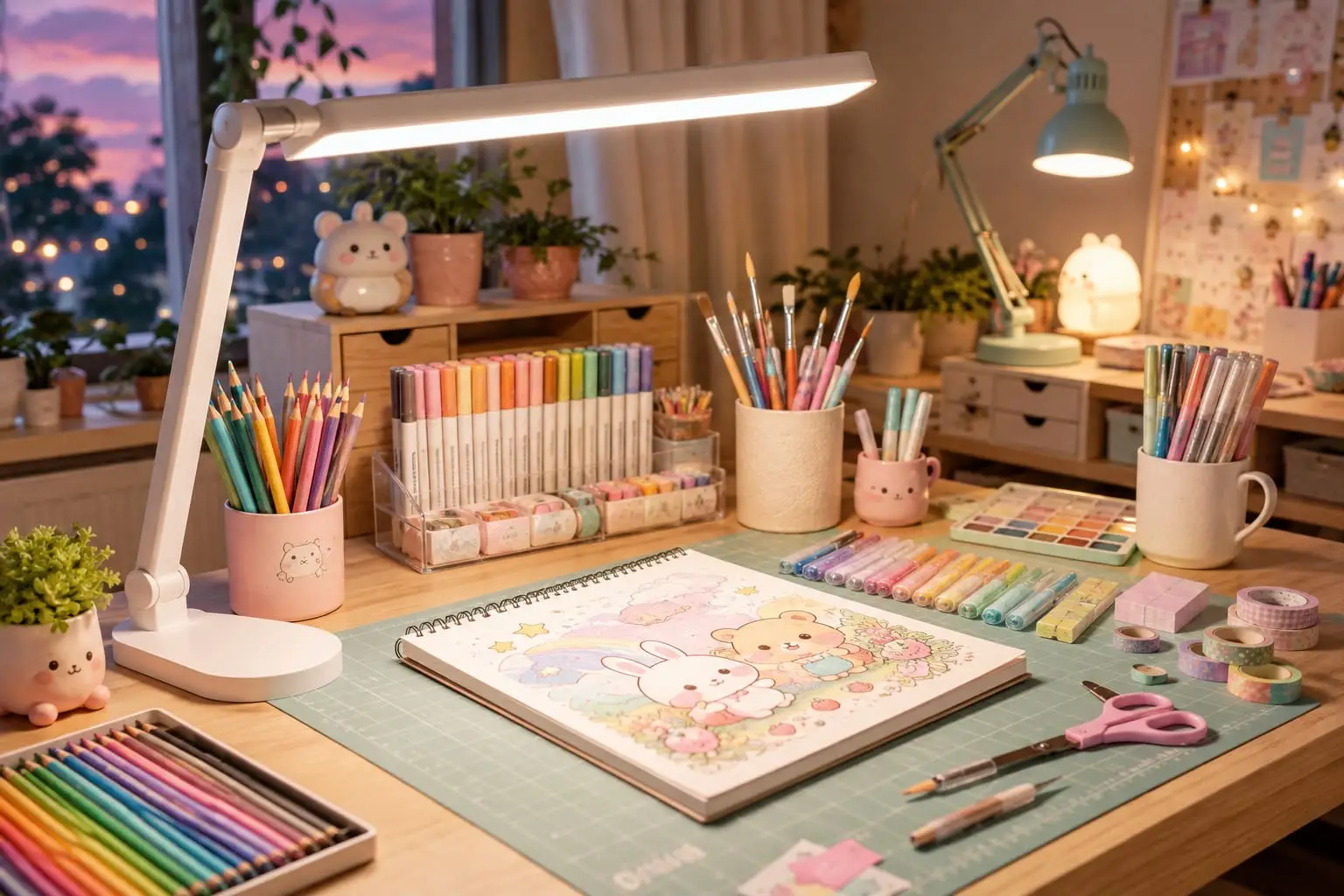
Best Desk Lamps for Drawing, Coloring & Crafts: 10 Bright Picks. The best desk lamps for drawing, coloring and crafts, from budget LEDs to bright wide task lamps. Compare CRI, brightness, coverage and controls.. Type: Buying guide. Category: Creative Spaces. Tags: desk-lamps, drawing-desk, craft-room, art-studio-lighting, led-desk-lamps, task-lighting, coloring-supplies, buying-guide, cluster-creative-desks-storage.

Buying guide

Best Desk Lamps for Drawing, Coloring & Crafts: 10 Bright Picks

Our recommendation

The best desk lamp for drawing and crafts should light the whole working area without harsh glare or awkward hand shadows. Our top research pick is the Neatfi XL 2,200 Lumens LED Desk Lamp because its 23-inch head and strong output suit large drawing boards and craft tables. For color-sensitive illustration, the Daylight Company Lumi and Honeywell HWT-H01 stand out with listed CRI 95+ lighting, while the SKYLEO 31.5-inch lamp is the value pick for wide adjustable coverage. Lepro is the budget choice for a compact desk, and the SANDROY VOLT 4-head lamp is the specialist pick for extra-wide workspaces.

Quick picks

Top recommendations

  1. 1Neatfi XL 2,200 Lumens 24W LED Desk Lamp — Best overallA 2,200-lumen clamp lamp with a 23-inch head built to light a wide drawing or craft surface
  2. 2Daylight Company Lumi Task Lamp — Best for serious art and color workA long-reach 95+ CRI task lamp designed for detailed creative work and accurate-looking color
  3. 3Honeywell HWT-H01 LED Desk Lamp — Best compact high-CRI lampA foldable base lamp with CRI 95+ full-spectrum lighting and stepless brightness control
  4. 4BenQ e-Reading Desk Lamp — Best premium smart lampAn ultrawide premium desk lamp with adjustable color tone, brightness and automatic dimming
  5. 5SANDROY VOLT CRI95+ 4-Head LED Desk Lamp — Best for extra-wide craft tablesA 24W four-head clamp lamp with CRI 95+ and very wide adjustable coverage
  6. 6SKYLEO 31.5-Inch LED Desk Lamp — Best value wide lampA 31.5-inch 12W desk light with five color modes and eleven brightness levels
  7. 7Micomlan 24W Architect Desk Lamp — Best multi-angle lampA 24W three-bar architect lamp with seven rotatable joints and auto-dimming controls
  8. 8Airlonv 24W Architect Desk Lamp with Clamp — Best remote-control clamp lampA 24W clamp lamp with remote control, stepless dimming, stepless color temperature and memory
  9. 9Daylight Company Slimline 3 Table Lamp — Best slim task lightA long slim LED task lamp with 1,065 lumens, four brightness levels and flexible positioning
  10. 10Lepro 9.5W 800lm LED Desk Lamp — Best budget tabletop lampAn 800-lumen base lamp with five color modes and five brightness levels

Product comparison

ProductBest forWatch outPrice & shop
Neatfi XL 2,200 Lumens 24W LED Desk Lamp (opens Amazon in a new tab)Neatfi · XL 2,200 Lumens 24W, 23-Inch Shade
Best overallResearch-based review
Artists and crafters who need very bright, broad coverage across a large deskThe fixed 6500K daylight color is less adaptable than lamps that let you move from warm to neutral to cool light.
Daylight Company Lumi Task Lamp (opens Amazon in a new tab)Daylight Company · Lumi Task Lamp
Best for serious art and color workResearch-based review
Illustrators, model makers and detail crafters who care about high color renderingIt is a premium, clamp-style task lamp, so it costs more and is less portable than a compact base lamp.
Honeywell HWT-H01 LED Desk Lamp (opens Amazon in a new tab)Honeywell · HWT-H01 Sunturalux
Best compact high-CRI lampResearch-based review
Colorists and journalers working at smaller desksThe compact head cannot spread light across a large craft table as evenly as the wide-bar lamps in this guide.
BenQ e-Reading Desk Lamp (opens Amazon in a new tab)BenQ · e-Reading Desk Lamp
Best premium smart lampResearch-based review
Creative desks that also double as study, reading and computer workstationsIt is expensive compared with straightforward craft lamps, and much of the premium goes toward convenience and design rather than raw brightness alone.
SANDROY VOLT CRI95+ 4-Head LED Desk Lamp (opens Amazon in a new tab)SANDROY VOLT · 24W 4-Head CRI95+ Desk Lamp
Best for extra-wide craft tablesResearch-based review
Large tables, drafting setups and multi-project craft stationsFour heads and a clamp arm are visually and physically oversized for a small writing desk.
SKYLEO 31.5-Inch LED Desk Lamp (opens Amazon in a new tab)SKYLEO · 31.5-Inch 12W Desk Lamp
Best value wide lampResearch-based review
Crafters who want a very wide light bar with lots of adjustmentIts large arm format works best on a dedicated workstation and is less convenient to carry between rooms.
Micomlan 24W Architect Desk Lamp (opens Amazon in a new tab)Micomlan · 24W Architect Desk Lamp with Atmosphere Lighting
Best multi-angle lampResearch-based review
Projects that benefit from lighting coming from several adjustable directionsThe many joints make it more complicated and visually busier than a simple slim task lamp.
Airlonv 24W Architect Desk Lamp with Clamp (opens Amazon in a new tab)Airlonv · 24W Architect Desk Lamp with Remote
Best remote-control clamp lampResearch-based review
Fixed home studios where you want fine brightness and color-temperature control from your seatClamp-only mounting limits where you can use it, especially on very thick, glass or rounded-edge tables.
Daylight Company Slimline 3 Table Lamp (opens Amazon in a new tab)Daylight Company · U35108 Slimline 3
Best slim task lightResearch-based review
Sewing, sketching and crafts where you want broad light without a bulky lamp headIts listed 80 CRI is less impressive for color-critical art than the 90+ and 95+ CRI lamps here.
Lepro 9.5W 800lm LED Desk Lamp (opens Amazon in a new tab)Lepro · 9.5W 800lm Metal Desk Light
Best budget tabletop lampResearch-based review
Beginners, students and casual colorists with compact desksThe smaller light head and 800-lumen output are better for a compact work area than a large cutting mat or drafting table.

Selection and testing methodology

This is a research-based guide, not a hands-on lamp test. We compared 10 active Amazon US desk-lamp listings checked on August 11, 2026, focusing on brightness where documented, width and coverage, color rendering index (CRI), color-temperature control, dimming range, mounting style, adjustability, and the practical fit for drawing, coloring, sewing, paper crafts, model making, and other detailed desk work. KawaiiToons has not personally measured lux, flicker, glare, heat, shadowing, electrical safety, long-session eye comfort, or color accuracy for these exact units, so we do not publish invented test scores or claim that one lamp will prevent eye strain. Amazon availability and listing details can change after the check date.

Detailed product sections

Best overallResearch-based review

Neatfi XL 2,200 Lumens 24W LED Desk Lamp (opens Amazon in a new tab)

Neatfi · XL 2,200 Lumens 24W, 23-Inch Shade

A 2,200-lumen clamp lamp with a 23-inch head built to light a wide drawing or craft surface

Why it fits this guide

Neatfi earns the top research spot because its combination of strong 2,200-lumen output, a 23-inch shade and a long adjustable arm directly solves the main lighting problem on a creative desk: illuminating more of the page or work surface without putting a bulky base in the middle of your supplies.

Honest drawback

The fixed 6500K daylight color is less adaptable than lamps that let you move from warm to neutral to cool light.

Best forArtists and crafters who need very bright, broad coverage across a large desk

Pros

  • 2,200-lumen output is suited to large task areas
  • Wide 23-inch shade helps illuminate more of a drawing or craft surface
  • Adjustable clamp arm saves desktop space

Cons

  • Fixed 6500K light color offers less mood flexibility
  • Larger arm-and-clamp design is more substantial than a compact table lamp
Check price on Amazon (opens Amazon in a new tab)
Best for serious art and color workResearch-based review

Daylight Company Lumi Task Lamp (opens Amazon in a new tab)

Daylight Company · Lumi Task Lamp

A long-reach 95+ CRI task lamp designed for detailed creative work and accurate-looking color

Why it fits this guide

The Lumi is the strongest specialist choice when color judgment matters more than maximum features. Its 95+ CRI specification and long articulated reach make it easier to position bright task light over a sketchbook, painting area or model without relying on ordinary room lighting.

Honest drawback

It is a premium, clamp-style task lamp, so it costs more and is less portable than a compact base lamp.

Best forIllustrators, model makers and detail crafters who care about high color rendering

Pros

  • 95+ CRI is a strong specification for judging colors and subtle tones
  • Long articulated reach helps position light over drawings and craft work
  • Designed for concentrated task lighting rather than decorative ambience

Cons

  • Premium pricing compared with general office lamps
  • Clamp-and-arm format is less portable than a small tabletop model
Check price on Amazon (opens Amazon in a new tab)
Best compact high-CRI lampResearch-based review

Honeywell HWT-H01 LED Desk Lamp (opens Amazon in a new tab)

Honeywell · HWT-H01 Sunturalux

A foldable base lamp with CRI 95+ full-spectrum lighting and stepless brightness control

Why it fits this guide

Honeywell stands out because CRI 95+ is unusual in a compact desk lamp at this level. That makes it attractive for colored pencil, marker, watercolor and journaling work when you want colors to look more natural but do not need an oversized clamp arm.

Honest drawback

The compact head cannot spread light across a large craft table as evenly as the wide-bar lamps in this guide.

Best forColorists and journalers working at smaller desks

Pros

  • CRI 95+ is well suited to color-focused creative work
  • Stepless brightness and three listed color temperatures add flexibility
  • Foldable base design is easy to reposition

Cons

  • Smaller coverage than wide architect-style lamps
  • Base uses some desktop space
Check price on Amazon (opens Amazon in a new tab)
Best premium smart lampResearch-based review

BenQ e-Reading Desk Lamp (opens Amazon in a new tab)

BenQ · e-Reading Desk Lamp

An ultrawide premium desk lamp with adjustable color tone, brightness and automatic dimming

Why it fits this guide

BenQ is the most polished all-purpose desk lamp here. Its curved wide head, manual color tuning and smart dimming features suit a workspace that changes from drawing to reading to computer work throughout the day.

Honest drawback

It is expensive compared with straightforward craft lamps, and much of the premium goes toward convenience and design rather than raw brightness alone.

Best forCreative desks that also double as study, reading and computer workstations

Pros

  • Wide curved lighting head is designed to cover a broad desktop area
  • Brightness and color tone can be adjusted for different tasks
  • Auto-dimming mode adds convenience for changing ambient light

Cons

  • Costs much more than basic LED desk lamps
  • Large premium design may be excessive for a small or rarely used craft desk
Check price on Amazon (opens Amazon in a new tab)
Best for extra-wide craft tablesResearch-based review

SANDROY VOLT CRI95+ 4-Head LED Desk Lamp (opens Amazon in a new tab)

SANDROY VOLT · 24W 4-Head CRI95+ Desk Lamp

A 24W four-head clamp lamp with CRI 95+ and very wide adjustable coverage

Why it fits this guide

SANDROY VOLT combines two specifications creative workspaces rarely get at the same time: a high listed CRI and a multi-head layout that can spread light across an unusually wide area. That makes it useful for paper crafts, large drawings, cutting mats and projects where your hands move around the table.

Honest drawback

Four heads and a clamp arm are visually and physically oversized for a small writing desk.

Best forLarge tables, drafting setups and multi-project craft stations

Pros

  • CRI 95+ supports color-sensitive drawing and craft work
  • Four-head design spreads light over an unusually wide area
  • Stepless dimming, color-temperature control and remote operation add flexibility

Cons

  • Large multi-head design can feel bulky on a small desk
  • Clamp mounting requires a compatible work surface
Check price on Amazon (opens Amazon in a new tab)
Best value wide lampResearch-based review

SKYLEO 31.5-Inch LED Desk Lamp (opens Amazon in a new tab)

SKYLEO · 31.5-Inch 12W Desk Lamp

A 31.5-inch 12W desk light with five color modes and eleven brightness levels

Why it fits this guide

SKYLEO offers a lot of functional range without moving into specialist artist-lamp pricing. The long head helps cover a broad desk, while five color modes and eleven brightness settings make it easier to tune the light for line drawing, coloring, cutting or general desk work.

Honest drawback

Its large arm format works best on a dedicated workstation and is less convenient to carry between rooms.

Best forCrafters who want a very wide light bar with lots of adjustment

Pros

  • 31.5-inch light head covers a broad desk area
  • Five color modes and eleven brightness levels offer flexible setup
  • Memory and timer functions are useful for repeated desk sessions

Cons

  • Large format is less portable
  • Clamp or arm placement needs enough desk-edge clearance
Check price on Amazon (opens Amazon in a new tab)
Best multi-angle lampResearch-based review

Micomlan 24W Architect Desk Lamp (opens Amazon in a new tab)

Micomlan · 24W Architect Desk Lamp with Atmosphere Lighting

A 24W three-bar architect lamp with seven rotatable joints and auto-dimming controls

Why it fits this guide

Micomlan is useful when a single straight light bar creates awkward shadows around tools, models or raised craft materials. Three light bars and seven joints let you change the geometry of the light around the work rather than only tilting one head.

Honest drawback

The many joints make it more complicated and visually busier than a simple slim task lamp.

Best forProjects that benefit from lighting coming from several adjustable directions

Pros

  • Three light bars can spread illumination across a wide workspace
  • Seven rotatable joints allow detailed positioning
  • Auto dimming and stepless controls support different tasks

Cons

  • More complex arm structure than basic desk lamps
  • Clamp design is less convenient if you often rearrange your workspace
Check price on Amazon (opens Amazon in a new tab)
Best remote-control clamp lampResearch-based review

Airlonv 24W Architect Desk Lamp with Clamp (opens Amazon in a new tab)

Airlonv · 24W Architect Desk Lamp with Remote

A 24W clamp lamp with remote control, stepless dimming, stepless color temperature and memory

Why it fits this guide

Airlonv is a practical fit for a large home desk because you can tune brightness and color temperature without repeatedly reaching for controls on the lamp itself. The 24W format and wide lamp structure are intended for workstation-scale coverage.

Honest drawback

Clamp-only mounting limits where you can use it, especially on very thick, glass or rounded-edge tables.

Best forFixed home studios where you want fine brightness and color-temperature control from your seat

Pros

  • 24W output is designed for bright workstation lighting
  • Stepless brightness and color temperature provide fine control
  • Remote control and memory function reduce repeated setup

Cons

  • Requires a compatible desk edge for clamping
  • Large overhead-style lamp is less portable than a base lamp
Check price on Amazon (opens Amazon in a new tab)
Best slim task lightResearch-based review

Daylight Company Slimline 3 Table Lamp (opens Amazon in a new tab)

Daylight Company · U35108 Slimline 3

A long slim LED task lamp with 1,065 lumens, four brightness levels and flexible positioning

Why it fits this guide

The Slimline 3 is designed around a narrow profile rather than a giant multi-panel head. Its 1,065-lumen output and four brightness levels make it useful for detailed crafts while keeping the visual footprint over the desk relatively clean.

Honest drawback

Its listed 80 CRI is less impressive for color-critical art than the 90+ and 95+ CRI lamps here.

Best forSewing, sketching and crafts where you want broad light without a bulky lamp head

Pros

  • 1,065-lumen output and four brightness levels suit detailed tasks
  • Long slim head spreads light across a wider work area
  • Flexible joints make it easy to reposition over crafts or sketchbooks

Cons

  • 80 CRI is not the strongest choice for color-critical work
  • Premium cost despite lacking adjustable color temperature
Check price on Amazon (opens Amazon in a new tab)
Best budget tabletop lampResearch-based review

Lepro 9.5W 800lm LED Desk Lamp (opens Amazon in a new tab)

Lepro · 9.5W 800lm Metal Desk Light

An 800-lumen base lamp with five color modes and five brightness levels

Why it fits this guide

Lepro is the easiest low-cost entry point in this shortlist. It does not cover a huge craft table, but its 25 light combinations give beginners a useful amount of control for sketchbooks, coloring books, journaling and small desktop projects.

Honest drawback

The smaller light head and 800-lumen output are better for a compact work area than a large cutting mat or drafting table.

Best forBeginners, students and casual colorists with compact desks

Pros

  • Five color modes and five brightness levels
  • 800-lumen output is useful for compact desks and sketchbooks
  • Tabletop base is easier to move than a permanently clamped lamp

Cons

  • Less coverage than 20W-plus wide-bar lamps
  • Base occupies some usable desk surface
Check price on Amazon (opens Amazon in a new tab)

How to choose

  • Choose coverage before chasing the highest lumen number. A long light head or multi-bar design can illuminate a large cutting mat or drawing board more evenly than a smaller lamp with similar output.
  • Prioritize higher CRI when you need to judge colored pencils, markers, paint, fabric, thread, or paper tones accurately. CRI 90+ is a useful target for creative work, while 95+ is especially appealing for color-sensitive tasks.
  • Use adjustable color temperature for a multipurpose desk. Cooler light can feel crisp for line work and cutting, while neutral or warmer settings can be more comfortable for evening journaling or reading.
  • Choose a clamp lamp when you want to preserve desk space and need long reach. Choose a base lamp when portability and easy repositioning matter more than maximum coverage.
  • Position the lamp to the opposite side of your drawing hand when possible. Right-handed artists often reduce hand shadows by lighting from the left, and left-handed artists from the right.

Common mistakes

  • Buying only by lumens and ignoring how wide the illuminated area actually is.
  • Assuming every daylight-colored lamp has high color accuracy; color temperature and CRI describe different characteristics.
  • Mounting the lamp directly behind your drawing hand and creating a moving shadow across the page.
  • Choosing a clamp lamp before checking desk-edge thickness, shape, clearance, and whether the surface can safely accept clamp pressure.
  • Using maximum brightness all evening even when a lower setting would provide enough task visibility in the room.

FAQ

What is the best desk lamp for drawing?

For a large drawing surface, our top research pick is the Neatfi XL 2,200 Lumens LED Desk Lamp because the 23-inch head and strong task-light output are designed for broad coverage. If accurate-looking color matters more than maximum brightness, the Daylight Company Lumi is the stronger specialist choice because its listing specifies CRI 95+.

How many lumens should a desk lamp have for drawing and crafts?

There is no single lumen target that guarantees good task lighting because distance, beam spread, shade design and ambient room light all affect what reaches the page. In this guide, compact lamps around 800 lumens suit smaller desks, while wide task lamps above 1,000 or 2,000 lumens are aimed at larger work areas. Coverage and positioning matter as much as the headline lumen number.

What CRI is best for drawing and coloring?

For creative work involving color, CRI 90 or higher is a useful specification to look for, and CRI 95+ is especially attractive when you compare subtle pencil, paint, fabric or paper colors. The Daylight Company Lumi, Honeywell HWT-H01 and SANDROY VOLT lamp in this guide list CRI 95+ performance. We have not independently measured their color rendering.

Is 6500K good for drawing?

6500K is a cool daylight-style color temperature that can make line work and small details look crisp, especially in a bright studio. It is not automatically the most comfortable setting for every person or every time of day. If your desk serves several purposes, a lamp with adjustable color temperature gives you more flexibility than a fixed 6500K model.

Are clamp desk lamps better for crafts?

Clamp lamps are excellent for crafts when desk space is limited because the mount stays at the edge and the arm can reach over cutting mats, sewing projects or drawings. The trade-off is compatibility: the desk edge must be thick, flat and strong enough for the clamp. A base lamp is easier to move and can work on desks without a usable edge.

How do I stop my hand from casting a shadow while drawing?

Move the light so it approaches the page from the side opposite your drawing hand. A right-handed artist will often get fewer hand shadows with the lamp on the left, while a left-handed artist can try lighting from the right. Wide heads and multi-bar lamps can also reduce the intensity of a single hard shadow.

Is a high-CRI lamp important for coloring books?

It is useful when you want colored pencils, markers and printed colors to look closer to their natural appearance under the lamp. High CRI does not make you a better colorist, but it can reduce the visual distortion that lower-quality light sometimes introduces. If you mainly color for relaxation, adjustable brightness and comfortable positioning may matter just as much.

Do I need a lamp with adjustable color temperature?

Not necessarily. A fixed daylight lamp can work very well on a dedicated art desk. Adjustable color temperature is more valuable when the same desk is used for daytime drawing, evening journaling, reading and computer work because you can change the character of the light without swapping lamps.

Can a desk lamp reduce eye strain?

Good task lighting can make details easier to see and reduce the need to work in a dim environment, but we do not treat 'eye-caring' marketing language as a medical claim. Comfort depends on brightness, glare, flicker, positioning, room lighting, working distance and individual sensitivity. If you have persistent eye discomfort, seek advice from a qualified eye-care professional.

What is the best budget desk lamp for crafts?

The Lepro 9.5W 800lm LED Desk Lamp is our budget research pick because it combines a movable tabletop base with five color modes and five brightness levels. It is better suited to a sketchbook, coloring book or small craft area than to an oversized cutting mat.

Final recommendation

For a large creative workspace, our top research pick is the Neatfi XL 2,200 Lumens LED Desk Lamp because its wide 23-inch light head, strong output and adjustable clamp arm are directly suited to drawing boards and craft tables. Choose the Daylight Company Lumi when 95+ CRI and long-reach professional task lighting matter most, or the Honeywell HWT-H01 when you want high-CRI light in a smaller movable base lamp. BenQ is the premium multipurpose choice, SKYLEO is the value pick for wide coverage with many brightness and color settings, and Lepro is the straightforward budget option. For very large workstations, SANDROY VOLT and Micomlan use multi-head designs to spread or redirect light around bigger projects. These rankings remain research-based until KawaiiToons completes side-by-side measurements and original photography.

Choosing the best desk lamps for drawing, coloring and crafts is less about finding the lamp with the biggest number on the box and more about putting enough useful light across the entire area where your hands are working.

A sketchbook needs even illumination across the page. A coloring setup benefits from light that lets you distinguish similar pencil and marker shades. Paper crafts and sewing need enough coverage to see cut lines, edges and small details. Model making adds another challenge: raised objects can cast shadows that a single narrow lamp cannot always reach around.

That is why this guide includes several different lamp formats. There are wide clamp lamps for large desks, high-CRI task lamps for color-sensitive work, multi-head designs for spreading light around bigger projects, and compact base lamps for smaller spaces.

This guide is research-based. We checked current Amazon US listings on August 11, 2026, but KawaiiToons has not yet put these exact lamps through a controlled side-by-side test. We therefore do not claim measured lux at the desk, verified flicker performance, medical eye-comfort benefits, or independently confirmed color accuracy.

The short version: which desk lamp should you choose?

For a large creative workspace, start with the Neatfi XL 2,200 Lumens LED Desk Lamp. Its appeal is straightforward: a 23-inch light head and strong listed output are designed to spread bright task light over more of a desk than a typical compact reading lamp. If you work on large sketch pads, cutting mats or craft projects, coverage is often more useful than extra charging ports or decorative features.

If color rendering matters most, look at the Daylight Company Lumi Task Lamp or Honeywell HWT-H01. Both list CRI 95+ lighting. The Lumi is the larger specialist task lamp with a long articulated reach, while the Honeywell is the easier choice for a compact desk because it uses a foldable base rather than a long clamp arm.

The BenQ e-Reading Desk Lamp is the premium multipurpose option. It is more expensive, but it combines wide coverage, adjustable color tone, brightness control and automatic dimming in a polished lamp that can move between art, reading and computer work.

For value, the SKYLEO 31.5-Inch LED Desk Lamp gives you an unusually long light bar plus five color modes and eleven brightness levels. If you only need a smaller lamp for a coloring book, journal or sketchbook, the Lepro 9.5W 800lm Desk Lamp is the budget pick.

At the other end of the size spectrum, SANDROY VOLT and Micomlan use multiple light sections to spread illumination across extra-wide work surfaces or around three-dimensional craft projects.

Why desk lighting matters for drawing and crafts

Creative desk work often asks your eyes to distinguish small differences for long periods. You may be following a faint pencil construction line, matching two similar marker colors, trimming a paper edge, threading a needle, painting a miniature detail or deciding whether a shaded area is actually darker or simply sitting in a shadow.

Room lighting can be enough for casual work, but it is often positioned too far away to give the desk consistent illumination. A ceiling light behind you can also throw your head and shoulders onto the page.

A dedicated task lamp gives you three things you can control more easily: direction, intensity and distance.

Direction matters because your hand can block the light. Intensity matters because a dim workspace makes detail harder to see. Distance matters because a lamp that is bright at the LED can still produce mediocre illumination if the head is too far from the page or pointed away from the working area.

For large creative desks, a fourth factor becomes important: coverage. One bright hotspot in the center of a cutting mat is less useful if the corners of the project remain dim.

Brightness: lumens are useful, but not enough

Lumens describe the total visible light output of a source, but they do not tell you exactly how much light will land on your drawing.

The Neatfi XL is listed at 2,200 lumens, the Daylight Slimline 3 at 1,065 lumens, and the Lepro at 800 lumens. Those numbers help explain the broad category each lamp occupies, but they are not a complete ranking.

A long, well-positioned light bar can spread its output across a big work surface. A smaller lamp may concentrate light into a narrower area and still feel bright over a notebook. Distance changes everything: move the light head farther away and the page receives less illumination.

For that reason, we would choose by workspace size first.

If you use an A5 journal or small coloring book, a compact 800-lumen lamp can be enough. If you regularly work across a large sketch pad, cutting mat or sewing table, the wide 20W- to 24W-style clamp lamps in this guide are more naturally suited to the job.

When KawaiiToons tests these lamps hands-on, illuminance in lux at the actual work surface will be more informative than simply repeating lumen claims.

CRI and why colorists should care

CRI stands for Color Rendering Index. In simple terms, it describes how naturally colors appear under a light source compared with a reference source.

For general office work, CRI may not be the first specification you look at. For coloring, illustration, painting, fabric selection and craft materials, it becomes much more relevant.

Three products here make particularly strong listed CRI claims:

  • Daylight Company Lumi Task Lamp: 95+ CRI
  • Honeywell HWT-H01: CRI 95+
  • SANDROY VOLT 4-Head Desk Lamp: CRI 95+

The Airlonv and other architect-style lamps focus more heavily on output, coverage and adjustable controls in their current Amazon presentation.

A higher CRI does not mean a lamp is automatically brighter, more comfortable or better in every situation. It also does not replace a properly color-managed workflow for professional art reproduction. What it can do is make the lamp a more sensible candidate when you care about distinguishing subtle art-supply colors at the desk.

For casual coloring, do not feel that CRI 95+ is mandatory. A lamp that is easy to position, bright enough and comfortable to use may be the better purchase.

Color temperature: warm, neutral or daylight?

Color temperature is measured in Kelvin and describes whether the light appears warmer or cooler.

A lamp around 2700K to 3000K looks warmer and more amber. Around 4000K feels more neutral. Around 5500K to 6500K looks cooler and closer to a crisp daylight style.

The Neatfi pick in this guide uses a fixed 6500K daylight color. That makes sense on a dedicated task desk where you want a bright, cool working environment.

Other lamps give you more choice. The Honeywell HWT-H01 lists multiple color temperatures, while SKYLEO, BenQ, Airlonv and several multi-head architect lamps let you tune the color mode or temperature.

Adjustability is useful when the same desk serves several jobs. You may prefer a cool setting while cutting or drawing in the afternoon, then move toward neutral or warm light for journaling in the evening.

Do not confuse color temperature with CRI. A 6500K lamp can have modest or excellent color rendering; the Kelvin number alone does not tell you how accurately colors will appear.

Wide light bars versus standard desk lamps

The most obvious design difference in this shortlist is head width.

Traditional desk lamps direct light from one relatively compact head. They are easy to move, and they work well over a notebook-sized area.

Modern architect-style lamps use long horizontal bars, multiple bars, or several adjustable heads. Their goal is to reduce the dark zones at the sides of a wide workstation.

The SKYLEO 31.5-inch model pushes this idea furthest among the single-bar options in this guide. Neatfi uses a 23-inch shade. SANDROY VOLT uses four heads, and Micomlan uses three light bars with multiple joints.

For a drawing or craft desk, wide coverage can make the workspace feel more consistent. You can move a ruler, cutting mat, palette or reference sheet around without constantly swinging the lamp.

The trade-off is size. A wide lamp works best when it has a permanent home.

Clamp lamp or base lamp?

A clamp lamp attaches to the desk edge. A base lamp stands on the work surface.

For artists and crafters with a fixed workstation, clamps are extremely practical because they preserve usable desktop area. The arm can start at the edge, rise above supplies and reach into the center of the workspace.

They also have downsides. A desk may be too thick, too thin, rounded, glass-topped or arranged against a wall in a way that makes clamping awkward. A clamp can leave pressure marks on delicate surfaces if it is not used correctly.

Base lamps such as the Honeywell HWT-H01 and Lepro are easier to move. You can shift them from a drawing desk to a side table, or rotate the whole lamp when you change projects.

The base itself occupies space, though. On a crowded art desk, that footprint competes with pencil cups, paint water, paper and storage trays.

How to position a desk lamp for drawing

Before buying a brighter lamp, check where your current lamp sits.

If you draw with your right hand and the lamp is also on the right, your hand and forearm may block the light as you move across the page. Try moving the lamp to the left so the light travels toward the drawing before your hand can interrupt it.

Left-handed artists can try the opposite setup.

The exact position depends on the lamp, page angle and your posture, but the principle is useful: put the main light source on the opposite side of the hand doing the detailed work.

A wide overhead-style bar can reduce the severity of shadows because the light is coming from a broader area. Multi-head lamps give you another option: angle separate sections so one shadow is partially filled by light from another direction.

For glossy markers or coated paper, adjust the angle to reduce reflected glare rather than pointing the lamp straight into the page.

How we chose these desk lamps

We did not rank the lamps by Amazon star rating or by the largest lumen claim.

Instead, we asked how each product fits a real creative desk.

We compared:

  1. Coverage. How wide is the lamp head, and is the design built for a notebook or a large workstation?
  2. Brightness. We recorded lumen, wattage or lux information when the current Amazon listing documented it.
  3. Color rendering. Higher listed CRI received extra consideration for coloring, illustration and material selection.
  4. Color-temperature control. We favored adjustability when a lamp was positioned as a multipurpose desk choice.
  5. Mounting. Clamp lamps save space; base lamps are easier to move.
  6. Arm and head adjustability. A creative desk often needs light to move around the project rather than stay at one angle.
  7. Practical trade-offs. Every recommendation includes the main compromise, whether that is fixed color temperature, a bulky arm, lower CRI or smaller coverage.

All rankings remain research-based until we complete original testing.

What to look for before buying a desk lamp for art

Start with the size of your working area

Measure the surface you actually use, not the entire desk.

A small notebook setup might only need a focused pool of light. A 24 x 36-inch cutting mat benefits from a much wider light source. If you work across two monitors plus a drawing area, look at long light bars or multi-head designs.

This is the reason a product like the SKYLEO 31.5-inch lamp can be more useful than a stylish compact lamp even if both are bright.

Check CRI if you work with color

Colored pencils, markers, paint swatches, fabric and thread can look different under poor lighting.

If that matters to your projects, prioritize a lamp that documents CRI rather than relying only on terms such as “daylight” or “eye-caring.”

The Daylight Company Lumi, Honeywell HWT-H01 and SANDROY VOLT are the strongest documented high-CRI options in this shortlist.

Make sure the lamp can reach the center of the desk

A clamp lamp saves surface space only if its arm actually reaches the place you work.

Check the arm length, joint range and where the clamp will attach. On a deep desk, a short arm mounted at the back edge may leave the light too far from the page.

Decide whether color tuning matters

If the lamp will stay on a dedicated craft bench, fixed cool daylight may be fine.

If it will also be used for reading, journaling, studying or computer work, adjustable color temperature is more useful. BenQ, SKYLEO, Airlonv, Honeywell and several of the multi-head models give you more flexibility than a fixed-color task lamp.

Do not ignore the controls

A lamp with dozens of theoretical settings is annoying if you have to cycle through them every time.

Memory functions can help. Remote controls are useful on large overhead-style lamps where the physical buttons may be out of easy reach. Touch controls are convenient on a compact base lamp.

Best desk lamps for coloring books

Coloring books usually do not require the same coverage as a large drafting table, but good color rendering and comfortable positioning are useful.

For a compact desk, the Honeywell HWT-H01 is the most interesting research pick because it combines a movable base with listed CRI 95+ lighting.

If you color on a larger table with several pencil cases, marker trays and an open A4 or square coloring book, a wider lamp like the SKYLEO can spread light across the book and surrounding supplies.

The Lepro is the simpler budget option. Its 800-lumen output, five color modes and five brightness settings are enough to make it a practical starter lamp for a small coloring or journaling station.

Best desk lamps for drawing and illustration

Drawing places more emphasis on shadow control and line visibility.

For big sketch pads, Neatfi is our top research pick because the broad 23-inch head is designed around coverage. For more color-sensitive illustration, the Daylight Company Lumi is the specialist option with 95+ CRI.

If your drawing desk is also a computer workstation, the BenQ e-Reading Lamp is more versatile. Its wide head and adjustable lighting are built for changing desk activities rather than one fixed task.

Artists working on models, mixed media or raised surfaces may prefer Micomlan because its multiple bars can be angled around the project.

Best desk lamps for sewing and crafts

Crafting can take up more physical space than drawing.

A cutting mat, fabric, ruler, glue tools and loose components may spread across much of the desk. Wide-bar lamps make sense here because you are not always staring at the same point.

The SANDROY VOLT 4-Head Lamp is the extra-wide specialist pick because its multiple heads can spread light across a large area. The Airlonv 24W Architect Lamp is a more conventional wide clamp choice with remote control and stepless adjustment. The Daylight Slimline 3 is appealing when you want a narrow professional-looking bar for sewing or detailed crafts without a complex multi-head structure.

Common mistakes when setting up craft lighting

Pointing the lamp straight down without checking glare

A perfectly vertical light head may produce reflections on glossy paper, marker ink, plastic rulers or coated craft surfaces.

Tilt the lamp until the work is evenly visible without a distracting bright reflection.

Working with one bright task lamp in a completely dark room

A strong local lamp can create a large contrast between the page and the surrounding room. You may find the setup more comfortable with some ambient room light rather than treating the desk lamp as the only light source.

Putting storage directly under the light path

Tall pencil cups, marker racks and organizers can cast their own shadows across the work area.

Keep tall storage slightly behind or to the side of the main working surface.

Assuming “daylight” means accurate color

Daylight is usually a color-temperature description. It does not guarantee a high CRI.

If you care about color accuracy, check for a documented CRI specification.

Ignoring desk-edge compatibility

Before buying a clamp lamp, measure the edge thickness and look underneath the desk for crossbars, drawers or cable trays that might block the clamp.

Our final recommendation

For most large drawing and craft desks, the Neatfi XL 2,200 Lumens LED Desk Lamp is our top research pick. Its wide 23-inch light head and strong task-light output address the two things creative workspaces often need most: brightness and coverage.

For more serious color-focused work, choose the Daylight Company Lumi Task Lamp for its 95+ CRI specification and long articulated reach. If you want high-CRI lighting without a large clamp arm, the Honeywell HWT-H01 is the compact alternative.

The BenQ e-Reading Desk Lamp is the premium choice for a desk that shifts between creative work, reading and computer use. SKYLEO is the value pick for a very wide light bar with many settings, while Lepro is the budget recommendation for a small desk.

If your projects regularly cover a large cutting mat or three-dimensional craft area, look at SANDROY VOLT, Micomlan or Airlonv instead. Their wider and multi-section designs make more sense when one narrow pool of light is not enough.

The most important next step for KawaiiToons is original testing. A controlled comparison should measure lux across the same work surface, photograph identical art swatches under fixed camera settings, check shadow patterns from both drawing-hand positions, and record how stable each arm and clamp remains after repeated adjustments. Until then, these recommendations are based on documented specifications and current product information rather than hands-on performance.