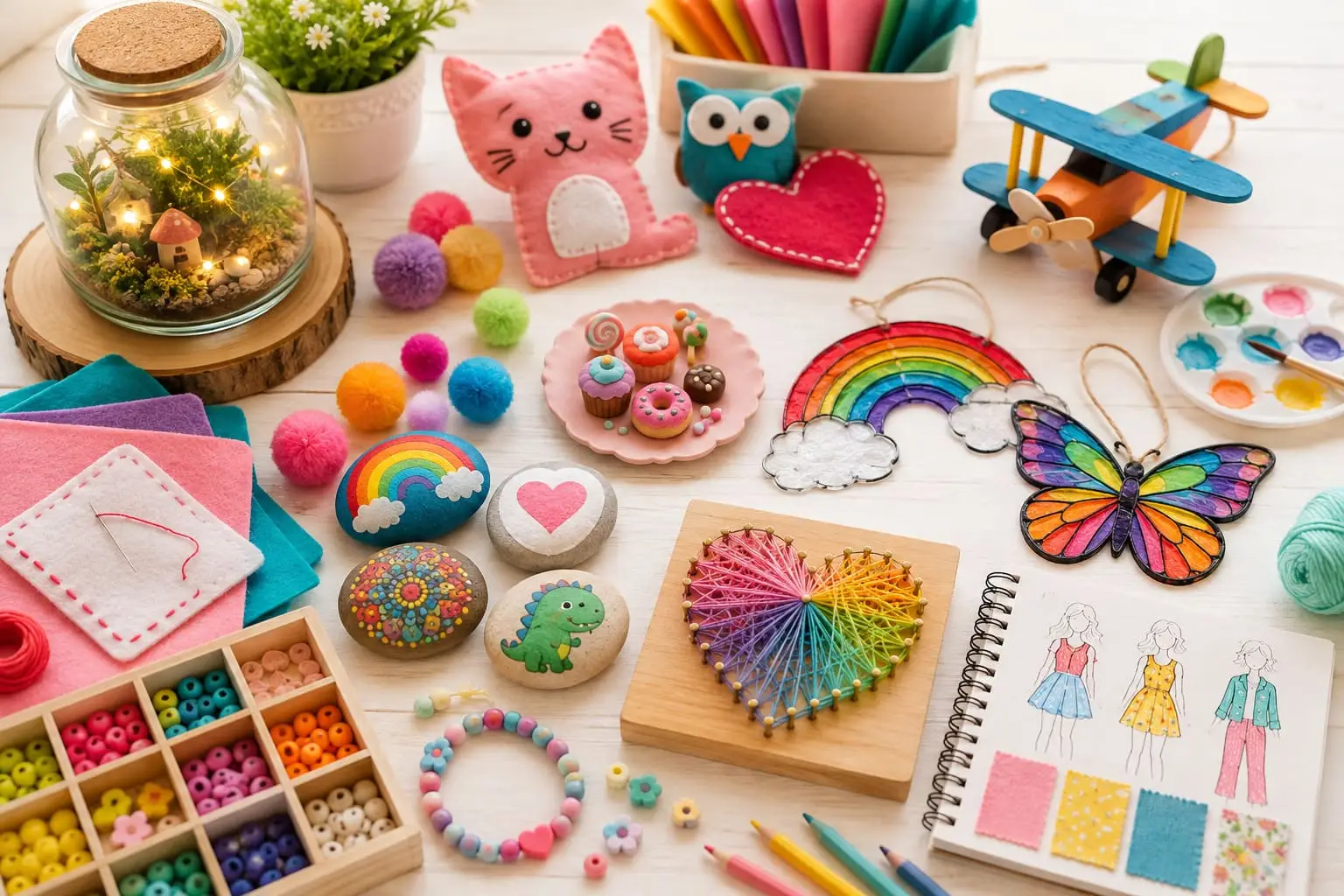
Best Craft Kits for Kids: 12 Creative Screen-Free Picks. The best craft kits for kids, from preschool pom-pom art to sewing, painting, clay, jewelry and terrariums. Compare ages, mess and skill level.. Type: Buying guide. Category: Crafts & Activities. Tags: craft-kits, kids-crafts, screen-free-activities, arts-and-crafts, gifts-for-kids, rainy-day-activities, creative-play, buying-guide, cluster-crafts-activities.

Buying guide

Best Craft Kits for Kids: 12 Creative Screen-Free Picks

Our recommendation

The best craft kit for a child is one that matches both age and the kind of making they already enjoy. Our top research pick is the Creativity for Kids Grow 'N Glow Terrarium because it combines decorating, planting and an ongoing project after the first craft session. For preschoolers, Pom Pom Pictures: Animals is the simplest starting point; for ages 7+ who want to learn a reusable skill, Craft-Tastic Let's Learn to Sew is the stronger beginner sewing option. Older kids who want more involved projects can move toward Klutz Sew Mini Treats, Designed by You Fashion Studio or Klutz String Art.

Quick picks

Top recommendations

  1. 1Creativity for Kids Grow 'N Glow Terrarium Kit — Best overallA decorate-and-grow terrarium kit that turns one craft session into an ongoing plant-care project
  2. 2Creativity for Kids Pom Pom Pictures: Animals — Best for preschoolersA straightforward animal-picture activity that uses colorful pom-poms instead of a long sequence of painting or assembly steps
  3. 3Craft-Tastic Let's Learn to Sew — Best beginner sewing kitA beginner-focused sewing kit built around guided instruction rather than expecting a child to figure out needlework from loose supplies
  4. 4Made By Me Create Your Own Window Art — Best suncatcher kitA multi-project window-art set with suncatchers and materials for making bright decorative pieces
  5. 5Melissa & Doug Decorate-Your-Own Wooden Plane Craft Kit — Best wooden craftA compact wooden-plane project that combines simple assembly, paint and stickers
  6. 6NATIONAL GEOGRAPHIC Mega Arts and Crafts Kit for Kids — Best variety packA mixed-media set that combines mosaic, marbling and air-dry clay projects
  7. 7Klutz Sew Mini Treats — Best sewing kit for older kidsA pattern-and-materials kit for sewing more than 18 miniature felt food plushies
  8. 8Creativity for Kids Hide & Seek Rock Painting Kit — Best painting kitA ten-rock painting set with colorful paint and design transfers for decorating, displaying or hiding outdoors
  9. 9Make It Real Swift Clicks Deluxe Bracelet Studio — Best bracelet-making kitA bead-loaded bracelet studio designed to speed up repetitive threading and support more than 30 bracelets
  10. 10Klutz Mini Clay World Candy Cart Craft Kit — Best clay kitA themed clay-modeling kit centered on building a miniature candy-cart world
  11. 11Creativity for Kids Designed by You Fashion Studio — Best fashion design kitA fashion studio that combines sketching, fabric experimentation and sewing-oriented activities
  12. 12Klutz String Art Book Kit — Best string art kitA guided string-art kit with multiple techniques and patterns for making decorative designs

Product comparison

ProductBest forWatch outPrice & shop
Creativity for Kids Grow 'N Glow Terrarium Kit (opens Amazon in a new tab)Creativity for Kids · Grow 'N Glow Terrarium Kit
Best overallResearch-based review
Kids ages 6+ who like nature, decorating and projects that continue after craft timeIt uses real soil, seeds and water, so it is not the lowest-mess choice and children have to wait for the growing stage
Creativity for Kids Pom Pom Pictures: Animals (opens Amazon in a new tab)Creativity for Kids · Pom Pom Pictures: Animals
Best for preschoolersResearch-based review
Ages 3+ who need a simple, tactile first craft kitSmall pom-poms require supervision, and the predesigned animal pictures are less open-ended than blank-canvas art
Craft-Tastic Let's Learn to Sew (opens Amazon in a new tab)Craft-Tastic · Let's Learn to Sew
Best beginner sewing kitResearch-based review
Ages 7+ who want a structured introduction to sewingNeedles, threading and knots can require adult help, especially during the first few sessions
Made By Me Create Your Own Window Art (opens Amazon in a new tab)Made By Me · Create Your Own Window Art
Best suncatcher kitResearch-based review
Ages 6+ who enjoy colorful painting projects they can displayWindow paint can drip or smear before it dries, so a protected work area is still useful
Melissa & Doug Decorate-Your-Own Wooden Plane Craft Kit (opens Amazon in a new tab)Melissa & Doug · Decorate-Your-Own Wooden Plane 9518
Best wooden craftResearch-based review
Ages 4+ who like building, painting and then playing with what they madeIt is only one small project, so it will not occupy as many sessions as a large mixed-media box
NATIONAL GEOGRAPHIC Mega Arts and Crafts Kit for Kids (opens Amazon in a new tab)NATIONAL GEOGRAPHIC · Mega Arts and Crafts Kit
Best variety packResearch-based review
Ages 8-12 who want to try several craft techniques instead of oneThe variety also means more materials to organize, more cleanup and some projects that need drying time
Klutz Sew Mini Treats (opens Amazon in a new tab)Klutz · Sew Mini Treats
Best sewing kit for older kidsResearch-based review
Ages 10+ who want small hand-sewn projects with lots of personalityIt uses real needles and requires scissors, so it is better for patient older kids than younger beginners
Creativity for Kids Hide & Seek Rock Painting Kit (opens Amazon in a new tab)Creativity for Kids · Hide & Seek Rock Painting Kit
Best painting kitResearch-based review
Ages 6+ who like paint projects with an outdoor follow-up activityNatural curved surfaces are less forgiving than paper, and paint cleanup is still part of the activity
Make It Real Swift Clicks Deluxe Bracelet Studio (opens Amazon in a new tab)Make It Real · Swift Clicks Deluxe Bracelet Studio
Best bracelet-making kitResearch-based review
Ages 8+ who want to make lots of personalized jewelrySmall beads need careful storage, and the dedicated studio is less useful for non-jewelry crafts
Klutz Mini Clay World Candy Cart Craft Kit (opens Amazon in a new tab)Klutz · Mini Clay World Candy Cart
Best clay kitResearch-based review
Ages 8+ who like miniatures, pretend food and detailed modelingMiniature pieces can be fiddly and are less satisfying for children who prefer large, fast projects
Creativity for Kids Designed by You Fashion Studio (opens Amazon in a new tab)Creativity for Kids · Designed by You Fashion Studio
Best fashion design kitResearch-based review
Ages 9+ who want a deeper design project rather than a quick craftThe broader design process takes more workspace, patience and skill than a compact paint-or-pom-pom project
Klutz String Art Book Kit (opens Amazon in a new tab)Klutz · String Art: Turn String and Pins into Works of Art
Best string art kitResearch-based review
Older kids and tweens who like precise, pattern-based craftsPins require careful handling, and wrapping detailed patterns can feel repetitive for children who prefer loose, expressive art

Selection and testing methodology

This is a research-based guide, not a hands-on ranking. We compared 12 current craft-kit listings checked on August 18, 2026, focusing on age guidance, activity type, project complexity, setup and cleanup, supervision needs, how much creative choice the child gets, and whether the finished project has display, play or repeat-use value. No kit here has been personally tested by KawaiiToons yet, so we do not publish invented durability scores, mess scores, completion times, live prices or star ratings. Recommendations remain labeled research-based until original testing evidence is added.

Detailed product sections

Best overallResearch-based review

Creativity for Kids Grow 'N Glow Terrarium Kit (opens Amazon in a new tab)

Creativity for Kids · Grow 'N Glow Terrarium Kit

A decorate-and-grow terrarium kit that turns one craft session into an ongoing plant-care project

Why it fits this guide

The mix of decorating, planting and later watching the terrarium grow gives this kit more staying power than a one-and-done craft while still keeping the activity concrete and approachable.

Honest drawback

It uses real soil, seeds and water, so it is not the lowest-mess choice and children have to wait for the growing stage

Best forKids ages 6+ who like nature, decorating and projects that continue after craft time

Pros

  • Combines decorating with a simple growing activity
  • Includes the core planting and decorative materials
  • The finished project stays interactive after the first session

Cons

  • Needs watering, light and patience
  • Soil makes it messier than paper-based crafts
Check price on Amazon (opens Amazon in a new tab)
Best for preschoolersResearch-based review

Creativity for Kids Pom Pom Pictures: Animals (opens Amazon in a new tab)

Creativity for Kids · Pom Pom Pictures: Animals

A straightforward animal-picture activity that uses colorful pom-poms instead of a long sequence of painting or assembly steps

Why it fits this guide

Preschool craft kits work best when the process is easy to understand and the child can see progress quickly. The push-in pom-pom format keeps the activity tactile without demanding sewing, detailed painting or miniature assembly.

Honest drawback

Small pom-poms require supervision, and the predesigned animal pictures are less open-ended than blank-canvas art

Best forAges 3+ who need a simple, tactile first craft kit

Pros

  • Simple format for younger children
  • Provides tactile fine-motor practice
  • Requires relatively little setup

Cons

  • Small pieces need supervision
  • More guided than free-form art
Check price on Amazon (opens Amazon in a new tab)
Best beginner sewing kitResearch-based review

Craft-Tastic Let's Learn to Sew (opens Amazon in a new tab)

Craft-Tastic · Let's Learn to Sew

A beginner-focused sewing kit built around guided instruction rather than expecting a child to figure out needlework from loose supplies

Why it fits this guide

This is the stronger starting point in the shortlist for a child who specifically wants to learn sewing because the kit is positioned around beginner skills, included supplies and easy-to-follow instruction.

Honest drawback

Needles, threading and knots can require adult help, especially during the first few sessions

Best forAges 7+ who want a structured introduction to sewing

Pros

  • Designed for first-time sewing
  • Includes guided instructions and supplies
  • Introduces a skill that can be reused beyond the kit

Cons

  • Needle handling requires care
  • Can feel slow for kids who prefer instant results
Check price on Amazon (opens Amazon in a new tab)
Best suncatcher kitResearch-based review

Made By Me Create Your Own Window Art (opens Amazon in a new tab)

Made By Me · Create Your Own Window Art

A multi-project window-art set with suncatchers and materials for making bright decorative pieces

Why it fits this guide

The appeal is the immediate purpose of the craft: make something colorful, let it dry and put it on display. Multiple pieces also give siblings or repeat craft sessions more to work with than a single ornament.

Honest drawback

Window paint can drip or smear before it dries, so a protected work area is still useful

Best forAges 6+ who enjoy colorful painting projects they can display

Pros

  • Includes multiple displayable projects
  • Bright finished pieces work well on windows
  • Offers both shaped and customizable art options

Cons

  • Paint needs drying time
  • Liquid paint can be messy
Check price on Amazon (opens Amazon in a new tab)
Best wooden craftResearch-based review

Melissa & Doug Decorate-Your-Own Wooden Plane Craft Kit (opens Amazon in a new tab)

Melissa & Doug · Decorate-Your-Own Wooden Plane 9518

A compact wooden-plane project that combines simple assembly, paint and stickers

Why it fits this guide

This is a good bridge between a craft and a toy. Children are not only decorating a flat picture; they assemble and personalize an object that can become part of imaginative play afterward.

Honest drawback

It is only one small project, so it will not occupy as many sessions as a large mixed-media box

Best forAges 4+ who like building, painting and then playing with what they made

Pros

  • Mixes simple assembly and decoration
  • Finished project has play value
  • Includes the main decorating supplies

Cons

  • Only one main project
  • Paint and glue need drying time
Check price on Amazon (opens Amazon in a new tab)
Best variety packResearch-based review

NATIONAL GEOGRAPHIC Mega Arts and Crafts Kit for Kids (opens Amazon in a new tab)

NATIONAL GEOGRAPHIC · Mega Arts and Crafts Kit

A mixed-media set that combines mosaic, marbling and air-dry clay projects

Why it fits this guide

A child who gets bored repeating the same technique gets three clearly different kinds of making here. That gives the box more range for weekends, school breaks or siblings with different interests.

Honest drawback

The variety also means more materials to organize, more cleanup and some projects that need drying time

Best forAges 8-12 who want to try several craft techniques instead of one

Pros

  • Three distinct craft styles
  • Useful for multiple sessions
  • Includes both flat and three-dimensional projects

Cons

  • More setup and cleanup
  • Clay and marbling can be messy
Check price on Amazon (opens Amazon in a new tab)
Best sewing kit for older kidsResearch-based review

Klutz Sew Mini Treats (opens Amazon in a new tab)

Klutz · Sew Mini Treats

A pattern-and-materials kit for sewing more than 18 miniature felt food plushies

Why it fits this guide

The tiny food theme keeps repetitive sewing practice playful, while the included patterns and instruction book provide more structure than buying felt and embroidery floss separately.

Honest drawback

It uses real needles and requires scissors, so it is better for patient older kids than younger beginners

Best forAges 10+ who want small hand-sewn projects with lots of personality

Pros

  • More than 18 project ideas
  • Teaches practical hand-sewing skills
  • Finished mini plushies can be customized

Cons

  • Requires needles and scissors
  • Projects take time and patience
Check price on Amazon (opens Amazon in a new tab)
Best painting kitResearch-based review

Creativity for Kids Hide & Seek Rock Painting Kit (opens Amazon in a new tab)

Creativity for Kids · Hide & Seek Rock Painting Kit

A ten-rock painting set with colorful paint and design transfers for decorating, displaying or hiding outdoors

Why it fits this guide

Rock painting is easy to understand but still leaves room for children to vary colors and motifs. The hide-and-seek idea can also extend the activity beyond the table once the rocks are finished.

Honest drawback

Natural curved surfaces are less forgiving than paper, and paint cleanup is still part of the activity

Best forAges 6+ who like paint projects with an outdoor follow-up activity

Pros

  • Ten separate rock projects
  • Transfers can help beginners decorate
  • Finished crafts can become an outdoor activity

Cons

  • Curved rocks make fine details harder
  • Paint requires cleanup
Check price on Amazon (opens Amazon in a new tab)
Best bracelet-making kitResearch-based review

Make It Real Swift Clicks Deluxe Bracelet Studio (opens Amazon in a new tab)

Make It Real · Swift Clicks Deluxe Bracelet Studio

A bead-loaded bracelet studio designed to speed up repetitive threading and support more than 30 bracelets

Why it fits this guide

For a child whose main interest is friendship bracelets rather than general crafts, the dedicated system and large assortment of heishi and alphabet beads create a focused, repeatable activity with giftable results.

Honest drawback

Small beads need careful storage, and the dedicated studio is less useful for non-jewelry crafts

Best forAges 8+ who want to make lots of personalized jewelry

Pros

  • Designed for more than 30 bracelets
  • Includes alphabet and colorful heishi beads
  • Dedicated system reduces manual bead threading

Cons

  • Many small pieces
  • Specialized mainly for bracelet making
Check price on Amazon (opens Amazon in a new tab)
Best clay kitResearch-based review

Klutz Mini Clay World Candy Cart Craft Kit (opens Amazon in a new tab)

Klutz · Mini Clay World Candy Cart

A themed clay-modeling kit centered on building a miniature candy-cart world

Why it fits this guide

Rather than handing a child a block of clay with no direction, this kit gives the modeling session a clear miniature-world goal. It should appeal most to kids who enjoy tiny details and displayable scenes.

Honest drawback

Miniature pieces can be fiddly and are less satisfying for children who prefer large, fast projects

Best forAges 8+ who like miniatures, pretend food and detailed modeling

Pros

  • Clear miniature-world theme
  • Combines sculpting and scene building
  • Creates a displayable finished project

Cons

  • Small details require patience
  • Clay needs a clean work surface
Check price on Amazon (opens Amazon in a new tab)
Best fashion design kitResearch-based review

Creativity for Kids Designed by You Fashion Studio (opens Amazon in a new tab)

Creativity for Kids · Designed by You Fashion Studio

A fashion studio that combines sketching, fabric experimentation and sewing-oriented activities

Why it fits this guide

This is one of the more open-ended options in the shortlist. Instead of decorating one predetermined object, kids can work through the design process from an outfit idea to fabric-based creation.

Honest drawback

The broader design process takes more workspace, patience and skill than a compact paint-or-pom-pom project

Best forAges 9+ who want a deeper design project rather than a quick craft

Pros

  • Encourages original design ideas
  • Combines drawing and fabric crafts
  • Offers longer project depth for tweens

Cons

  • Higher learning curve
  • Needs more room to organize materials
Check price on Amazon (opens Amazon in a new tab)
Best string art kitResearch-based review

Klutz String Art Book Kit (opens Amazon in a new tab)

Klutz · String Art: Turn String and Pins into Works of Art

A guided string-art kit with multiple techniques and patterns for making decorative designs

Why it fits this guide

String art rewards patience and careful repetition, making this a good change of pace for older kids who have outgrown simple sticker crafts but still want clear patterns to follow.

Honest drawback

Pins require careful handling, and wrapping detailed patterns can feel repetitive for children who prefer loose, expressive art

Best forOlder kids and tweens who like precise, pattern-based crafts

Pros

  • Several patterns and techniques
  • Display-friendly finished projects
  • Well suited to methodical crafters

Cons

  • Pins require supervision
  • Detailed wrapping can be slow
Check price on Amazon (opens Amazon in a new tab)

How to choose

  • Start with age guidance, then consider the child's actual fine-motor ability, patience and experience. Two children the same age can have very different reactions to sewing, tiny beads or detailed string art.
  • Match the craft to an existing interest. A child who loves miniatures may stay engaged with clay or sewing longer than with a generic supply box, while a nature-focused child may prefer a terrarium or rock-painting project.
  • Decide whether you want one clear project or several sessions. Single-project kits can feel satisfying and manageable; multi-project boxes give more total craft time but also create more supplies to organize.
  • Check the mess profile before buying. Pom-pom and string projects are relatively contained, while paint, soil, marbling and clay benefit from a protected surface and cleanup plan.
  • Treat needles, pins and small beads as supervision decisions, not just age-label decisions. Choose a simpler medium when an adult cannot stay nearby.
  • Look for enough structure to prevent frustration without removing every creative decision. The best kids' craft kits give a clear starting point but still allow choices in color, layout, decoration or design.

Common mistakes

  • Buying a kit only because the age on the box matches, without considering whether the child enjoys careful, repetitive work or prefers faster creative play.
  • Choosing a huge mixed craft box for a beginner who would be happier with one clearly explained project and an obvious finished result.
  • Underestimating drying time, cleanup or workspace for paint, glue, marbling, clay, soil and other hands-on materials.
  • Giving a needle, pin or small-bead kit without planning appropriate adult supervision and storage.
  • Assuming every kit can be reused indefinitely when many rely on consumable materials such as beads, felt, paint, clay or seeds.
  • Focusing on the number of pieces in the box instead of asking whether those pieces support projects the child will actually want to finish.

FAQ

What are the best craft kits for kids?

The best craft kits for kids match the child's age, interests and patience level rather than simply offering the most pieces. In this research-based shortlist, the Creativity for Kids Grow 'N Glow Terrarium is our top all-around pick, Pom Pom Pictures: Animals is the easiest preschool option, Craft-Tastic Let's Learn to Sew is the beginner sewing pick, and the NATIONAL GEOGRAPHIC Mega Arts and Crafts Kit is the best fit when you want several different craft techniques in one box.

What are good craft kits for kids ages 3 to 5?

For ages 3 to 5, look for short projects with large, easy-to-handle materials and relatively few steps. Pom Pom Pictures: Animals is the clearest preschool choice in this guide. The Melissa & Doug wooden plane starts at age 4 and adds simple assembly and painting, but it is a better fit when an adult can help with glue, paint and setup.

What are good craft kits for kids ages 6 to 8?

Ages 6 to 8 can usually handle more sequential projects while still benefiting from a clear finished goal. Grow 'N Glow Terrarium, Made By Me Window Art and Hide & Seek Rock Painting all fit this range, while Craft-Tastic Let's Learn to Sew is aimed at ages 7+ for children ready to try needlework.

What are good craft kits for kids ages 9 to 12?

Older children and tweens can move toward projects that reward patience and technique. Designed by You Fashion Studio starts at age 9, while Klutz Sew Mini Treats and Klutz String Art are better suited to older kids who are comfortable with detailed, repetitive handwork. Bracelet making and miniature clay projects also give this age group more room for personalization.

Are craft kits good screen-free activities for kids?

Yes. A physical craft kit can give a child a clear hands-on activity that does not require a phone, tablet or game console. The strongest screen-free choices are the ones that match the child's interests closely enough to hold attention, whether that means painting, sewing, planting, jewelry, clay or design.

How do I choose a low-mess craft kit?

Avoid liquid paint, loose soil, marbling and large amounts of wet clay when cleanup is the priority. Guided pom-pom crafts, some sewing projects and string-art kits keep most materials relatively contained, although needles, pins and small pieces introduce their own supervision requirements.

Are kids' craft kits good gifts?

Craft kits can make useful gifts because they provide both an activity and a finished result. For gifting, choose a kit with a clear age range and an interest-specific theme. A terrarium suits a nature-focused child, bracelet supplies suit a jewelry fan, and a fashion studio makes more sense for a tween who already sketches clothes.

Should I choose one big craft box or a project-specific kit?

Project-specific kits are usually easier for beginners because the goal and instructions are clear. Bigger mixed-media boxes are better when a child already enjoys crafts and wants variety across multiple sessions. The NATIONAL GEOGRAPHIC set in this guide is an example of the latter, while the wooden plane, terrarium and window-art kits provide more defined outcomes.

Final recommendation

For the broadest mix of making and staying power, the Creativity for Kids Grow 'N Glow Terrarium is our top research pick because children decorate, plant and then continue interacting with the finished project. For a younger preschooler, choose a short, tactile activity such as Pom Pom Pictures: Animals. For a child ready to learn a lasting skill, Craft-Tastic Let's Learn to Sew is the better beginner sewing choice, while Klutz Sew Mini Treats gives older kids more project depth. Choose the NATIONAL GEOGRAPHIC Mega Arts and Crafts Kit when variety matters most, and move toward Fashion Studio or String Art for patient tweens who want a more involved challenge. We have not personally tested these kits, so adult supervision, mess level and real completion difficulty should be confirmed through original use before publishing comparative performance claims.

Choosing the best craft kits for kids is less about finding the box with the most pieces and more about finding a project a child will actually want to finish. A preschooler who loves touching and sorting materials needs something very different from a ten-year-old who is ready to sew tiny felt treats, wrap string around pins, or sketch a fashion collection.

For this guide, we looked for creative screen-free picks with distinct reasons to buy them. That means you will find a simple pom-pom activity for preschoolers, paint and wooden crafts for younger children, a terrarium that keeps growing after craft time, beginner sewing, bracelet making, clay modeling, mixed-media projects, fashion design and string art for older kids.

This guide is research-based. KawaiiToons has not personally tested these kits yet, so we are not publishing invented completion times, mess scores, durability ratings or claims about how long each kit will hold a particular child’s attention. Product information and active Amazon listings were checked on August 18, 2026, and every recommendation remains labeled research-based until we add original testing evidence.

The short version: which craft kit should you choose?

If you want one broadly appealing place to start, our top research pick is the Creativity for Kids Grow ’N Glow Terrarium Kit. It combines decorating with planting, so the craft does not end when the table is cleaned up. A child can return to the terrarium to water it and watch the plants develop.

For a preschooler, keep the number of steps low. Creativity for Kids Pom Pom Pictures: Animals is the simplest option in this shortlist because the child works with colorful tactile pieces and a guided picture rather than paint, needles or complicated assembly.

For a child around ages 6 to 8, look at interests. Made By Me Create Your Own Window Art suits kids who love color and displayable projects. Hide & Seek Rock Painting adds an outdoor element after the painting is finished. Craft-Tastic Let’s Learn to Sew is better when a seven-year-old or older child actively wants to learn sewing and an adult can help when needed.

For older kids and tweens, project depth becomes more important. Klutz Sew Mini Treats, Designed by You Fashion Studio and Klutz String Art all reward patience and careful handwork. Swift Clicks Deluxe Bracelet Studio makes more sense for a child who wants repeatable jewelry projects, while Klutz Mini Clay World Candy Cart is the more imaginative choice for kids who love tiny food and miniature scenes.

If you do not know which medium will stick, the NATIONAL GEOGRAPHIC Mega Arts and Crafts Kit is the variety pick because it combines mosaic, marbling and air-dry clay rather than committing the child to one technique.

Why age labels are only the starting point

The age range on a craft kit matters, especially when the box contains needles, pins, small beads or other small components. But age alone cannot tell you whether a child will enjoy the activity.

One eight-year-old may happily spend an afternoon sorting tiny beads and repeating the same bracelet pattern. Another may lose patience after five minutes but happily paint rocks or mold clay for an hour. A ten-year-old who has sewn before may find a beginner project easy, while another child of the same age may still need help threading a needle or tying a knot.

Use the manufacturer’s age guidance as the minimum filter, then consider three practical questions:

  • Does the child enjoy detailed work or prefer fast, bold projects?
  • Can an adult help with sharp tools, messy materials or tricky setup?
  • Will the finished object appeal to the child enough to motivate the process?

That last question is easy to overlook. Children often tolerate more challenging steps when they care about the outcome. A child who loves plush toys may work patiently through a felt sewing project, while a child who loves jewelry may show the same persistence with hundreds of beads.

One-project kits vs. multi-project craft kits

A bigger box is not automatically a better craft kit.

Choose a one-project kit when clarity matters

A defined project has a beginning, middle and obvious end. The Melissa & Doug Decorate-Your-Own Wooden Plane is a good example: assemble a small wooden object, paint it, add stickers and finish with something tangible.

That kind of structure is especially useful for younger children or occasional crafters. They do not have to decide what to make from a giant pile of supplies before they can start.

The Grow ’N Glow Terrarium is similarly clear even though the project continues after assembly. The child knows the goal — build and decorate a little planted world — and the growing stage gives the finished craft an extra reason to revisit it.

Choose a multi-project kit when repeat use matters

Older kids and enthusiastic crafters may get more value from a kit that supports several finished pieces. Klutz Sew Mini Treats includes patterns and materials for more than 18 miniature projects. Swift Clicks Deluxe Bracelet Studio is designed around making more than 30 bracelets. Made By Me Window Art supplies multiple suncatchers and window-art activities.

The trade-off is organization. More projects usually mean more components, more leftovers and more opportunities for tiny pieces to disappear. A storage tray or resealable container can matter almost as much as the craft itself.

Choose a mixed-media box when the child is still exploring

The NATIONAL GEOGRAPHIC Mega Arts and Crafts Kit takes a different approach by offering several craft types. This is useful when you know a child likes making things but do not yet know whether mosaic, marbling or clay will become the favorite.

The downside is that a mixed-media kit asks you to manage several workflows. Clay and marbling do not have the same cleanup needs, and different projects may need different drying or workspace arrangements.

How much mess can you realistically handle?

The best kids’ craft kit is not the one that looks most impressive online if you dread opening it at home.

Lower-mess choices

Guided pom-pom crafts are among the easier setups in this list. Sewing and string art also keep most of their materials relatively contained, although they replace paint cleanup with supervision around needles or pins.

Bracelet making can be clean in the sense that nothing is wet, but thousands of small beads create a different kind of mess. A dropped bead tray on carpet can turn a calm activity into a scavenger hunt.

Medium-mess choices

Window art and wooden-plane painting use liquid paint but have defined work areas. A washable mat, old newspaper or reusable table cover makes these projects easier to manage.

Rock painting sits in the same category. The project itself is simple, but paint on a rounded surface can reach fingers and tables more easily than paint on a flat sheet.

Higher-mess choices

Terrariums involve soil and water. Air-dry clay leaves residue. Marbling can involve liquid color and a wider setup. None of these are reasons to avoid the kits, but they are reasons to prepare the surface before opening the box.

For many families, a slightly messier project is worth it when the child is deeply engaged. The key is choosing that mess intentionally rather than discovering it halfway through the activity.

How we chose these craft kits

We started with one question: what would make a craft kit genuinely useful for a child rather than simply impressive in the box?

We compared 12 current product listings across six factors:

  1. Age fit. We kept manufacturer age guidance visible and paid extra attention to needles, pins, beads and other small components.
  2. Activity type. The shortlist deliberately spans painting, sewing, planting, jewelry, clay, mixed media, fashion design, suncatchers, wooden crafts, pom-poms and string art.
  3. Project clarity. Younger kids generally benefit from an obvious goal, while older kids can make better use of open-ended design choices.
  4. Setup and cleanup. A no-liquid craft solves a different household problem from a clay, soil or paint project.
  5. Staying power. We looked at whether the kit produces one object, several projects, a reusable skill or an ongoing activity.
  6. Visible drawbacks. Every recommendation keeps its main limitation alongside the reason to buy it.

All 12 entries are currently labeled research-based. We have not yet timed real sessions, watched children use the instructions, compared missing or leftover materials, or measured how much adult assistance each project actually requires.

Our 12 best craft kits for kids

1. Creativity for Kids Grow ’N Glow Terrarium Kit — Best overall

The Grow ’N Glow Terrarium is our top research pick because it combines two kinds of engagement: making something now and caring for it afterward. Children decorate the container and build the little scene, then add the planting materials and wait for the real growing stage.

That makes the kit particularly appealing for kids who enjoy nature, tiny worlds or projects that change over time. It also gives parents an easy follow-up activity — watering and checking growth — without opening another craft box.

The limitation is obvious: real soil, seeds and water are less tidy than stickers or felt. It is also a poor match for a child who wants an instant finished result. Choose it when the waiting is part of the appeal.

Best for: Ages 6+ who like nature, decorating and ongoing projects.

2. Creativity for Kids Pom Pom Pictures: Animals — Best for preschoolers

Preschool craft kits work better when a child can understand the basic action almost immediately. Pom Pom Pictures: Animals uses a straightforward push-in format with colorful pom-poms and guided animal pictures, avoiding the extra coordination required by sewing or detailed painting.

The tactile pieces also give small hands something concrete to pick up, place and press. That makes it a useful rainy-day activity for a three- to five-year-old who wants to “make something” but is not ready for a long sequence of instructions.

It is not the most open-ended kit in this guide, and small pom-poms still need close supervision. For a first craft kit, however, the simplicity is a feature rather than a weakness.

Best for: Ages 3+ who need a short, tactile activity with few steps.

3. Craft-Tastic Let’s Learn to Sew — Best beginner sewing kit

If a child is specifically asking to learn sewing, Craft-Tastic Let’s Learn to Sew is a more focused starting point than handing over loose felt, thread and a needle. The kit is positioned around beginner instruction and included supplies, which gives a new sewer a clearer path from first stitch to finished project.

Sewing is also different from many craft kits because the skill can outlast the consumables in the box. Learning to thread, stitch and finish a simple piece can transfer to later felt crafts, mending or embroidery.

The trade-off is that sewing requires patience. A seven-year-old may still need help threading a needle, making knots or recovering from a mistake. It is best when an adult can be nearby during early attempts.

Best for: Ages 7+ who want to learn a reusable hand-sewing skill.

4. Made By Me Create Your Own Window Art — Best suncatcher kit

Made By Me Create Your Own Window Art has a simple payoff: the child makes something colorful and then gets to put it on display. The set includes multiple suncatcher projects plus materials for custom window art, which gives it more repeat value than a one-ornament kit.

This is a good fit for kids who enjoy choosing colors but do not necessarily want an open-ended blank canvas. The shaped pieces provide enough structure to get started, while the customizable element leaves room for original designs.

Because the medium is liquid paint, expect drying time and protect the work surface. A child who gets frustrated waiting to display a finished craft may prefer a dry-material kit.

Best for: Ages 6+ who love bright color and displayable window crafts.

5. Melissa & Doug Decorate-Your-Own Wooden Plane — Best wooden craft

The Melissa & Doug Decorate-Your-Own Wooden Plane combines a small amount of assembly with painting and stickers. That gives younger kids a sense that they are building an object rather than simply coloring a flat page.

The finished plane also has play value. A child can paint it as carefully or as freely as they like, let it dry and then add it to a shelf or imaginative-play setup.

This is intentionally a small project. It will not provide the hours of repeat crafting you get from a large sewing or bracelet kit. For a younger child who benefits from a clear finish line, that can be an advantage.

Best for: Ages 4+ who enjoy a short build, paint and play project.

6. NATIONAL GEOGRAPHIC Mega Arts and Crafts Kit — Best variety pack

Some kids love crafting but do not want to repeat one medium. The NATIONAL GEOGRAPHIC Mega Arts and Crafts Kit is designed around that problem, combining mosaic, paint marbling and air-dry clay activities in one package.

The range makes it useful for a school break or a child who is still discovering which kinds of art projects feel most satisfying. It can also work better than buying three separate kits if the goal is exploration rather than specialization.

More variety brings more cleanup. Clay, marbling and mosaic materials need different setups, and some projects cannot be packed away the second the creative part is finished. Choose it when you want breadth and have room to manage several media.

Best for: Ages 8-12 who want several different craft techniques in one box.

7. Klutz Sew Mini Treats — Best sewing kit for older kids

Klutz Sew Mini Treats turns basic sewing practice into miniature felt food. The kit includes a 48-page instruction book, patterns, felt, embroidery floss, pre-cut facial details, needles and filling materials for more than 18 projects.

That project count matters because sewing improves through repetition. Instead of learning one stitch for one finished object, kids can use the same core skills across a series of increasingly familiar little designs.

This is not a preschool sewing substitute. Real needles are included, scissors are required, and tiny plush projects reward patience. It is a better fit for older children and tweens who are excited enough by the mini-food theme to enjoy the process.

Best for: Ages 10+ who want lots of small hand-sewn projects.

8. Creativity for Kids Hide & Seek Rock Painting — Best painting kit

Rock painting has a low barrier to entry: choose a rock, choose a design and start adding color. The Hide & Seek Rock Painting Kit includes ten rocks, multiple paint colors and decorative transfers, giving children several chances to experiment rather than asking them to get one project “right.”

The transfers are especially useful for children who like the idea of decorated rocks but are nervous about drawing directly onto an uneven surface. Afterward, the finished pieces can be displayed, gifted or used for an outdoor hide-and-find activity.

Curved rocks are less forgiving than paper, and the paint still requires cleanup. But for kids who would rather paint an object than a picture, this is one of the most approachable options here.

Best for: Ages 6+ who like painting and outdoor follow-up activities.

9. Make It Real Swift Clicks Deluxe Bracelet Studio — Best bracelet-making kit

For a child who wants to make friendship bracelets again and again, the Swift Clicks Deluxe Bracelet Studio is more specialized than a generic bead box. The system is designed to reduce repetitive hand-threading and comes with a large assortment of heishi and alphabet beads for more than 30 bracelets.

That repeatability is the main reason to choose it. A bracelet can be made for a friend, sibling, school event or new color combination, and alphabet beads make personalization easy.

The downside is the number of tiny pieces. This is not the kit to open beside a toddler or over deep carpet without a plan for storage. It also makes little sense for a child who only has a passing interest in jewelry.

Best for: Ages 8+ who want a repeatable, personalized jewelry craft.

10. Klutz Mini Clay World Candy Cart — Best clay kit

The Klutz Mini Clay World Candy Cart gives modeling clay a clear destination: build a tiny candy-themed world. That structure can be helpful for children who like clay but freeze when the instruction is simply “make anything.”

Miniature food also invites detail. Kids can focus on shapes, colors and tiny decorative elements, then bring the pieces together into a scene that feels more like a small world than a loose collection of sculptures.

That same scale is the drawback. The project is likely to appeal more to a patient miniatures fan than a child who wants to make large shapes quickly. A clean table and somewhere safe to keep tiny pieces are useful.

Best for: Ages 8+ who love miniatures, clay and detailed pretend-food projects.

11. Creativity for Kids Designed by You Fashion Studio — Best fashion design kit

Designed by You Fashion Studio is one of the more ambitious picks in this guide. It combines fashion sketching, fabric experimentation and sewing-oriented activities, giving older kids a way to think through a design instead of only decorating a pre-shaped object.

That makes it a strong fit for a tween who already draws outfits, watches how clothes are constructed or likes choosing fabrics and accessories. The creative decisions are broader than in a fixed-pattern craft.

It also requires more patience and table space. This is not a ten-minute rainy-day activity. Choose it when the child wants a project they can return to and is old enough to manage a more involved design process.

Best for: Ages 9+ who want a deeper fashion and fabric-design activity.

12. Klutz String Art Book Kit — Best string art kit

Klutz String Art suits older kids who enjoy following a pattern, working carefully and seeing a design emerge from repetition. The kit teaches multiple approaches to arranging string around pins and includes several decorative motifs to work through.

Compared with painting or clay, string art is controlled and methodical. That can be relaxing for one child and tedious for another, so personality matters more here than simply checking the age on the box.

Pins also require careful handling. For a patient older child or tween who enjoys geometry, patterns and displayable room decor, however, string art adds a very different kind of screen-free craft to the mix.

Best for: Older kids and tweens who like precise, pattern-based projects.

What to look for before buying a craft kit for kids

Start with what the child already makes

Buying “educational” or “creative” supplies does not guarantee they will be used. Look at what the child already chooses during free time.

A kid who draws outfits may genuinely want Fashion Studio. A child who builds tiny worlds may prefer clay or a terrarium. A child who makes bracelets from any available string is giving you a strong hint that a jewelry kit will get used.

Use the kit to deepen an existing interest when possible.

Check whether adult help is part of the plan

Some of the most rewarding kits in this guide are not the most independent.

Needles and pins need careful handling. Younger children may need help with glue, knots or setup. Soil, marbling and liquid paint are much easier when an adult prepares the table first.

If the goal is an activity a child can start with minimal assistance while you are busy nearby, choose a simpler medium and fewer steps.

Think about the finish line

Kids respond differently to delayed results.

A painted plane or pom-pom picture gives a visible finish relatively quickly. Sewing, string art and fashion design involve more repetition before the result comes together. A terrarium has a finished decorated stage but then asks the child to wait for growth.

Match the project length to the child’s patience rather than assuming a longer kit is better value.

Look beyond the piece count

“Hundreds of pieces” can mean lots of creative choice, or it can mean hundreds of tiny items to sort and lose.

The number that matters is the number of meaningful projects and how well the included materials support them. A small kit with clear instructions and a motivating result can be more useful than a giant tub of supplies with no obvious starting point.

Decide whether the result should be displayed, played with or given away

Finished crafts have different kinds of value.

Window art, string art and fashion designs lean toward display. A wooden plane can move into pretend play. Bracelets and mini plush treats can become gifts. A terrarium stays interactive because it needs care.

Thinking about the afterlife of the project can make it easier to choose between two otherwise similar kits.

Common mistakes when buying arts and crafts kits for kids

Buying for the age on the box instead of the child

Age guidance is important for safety and complexity, but it does not predict interest. A methodical seven-year-old may love beginner sewing; another may prefer fast painting projects for several more years.

Choosing the biggest box first

Large mixed kits look generous, but beginners can be overwhelmed by too many options. A focused kit with a clear objective is often a better first success.

Forgetting about drying and cleanup

Paint, glue, clay, soil and marbling do not end when the creative step is finished. Check where projects can dry and how the table will be protected before craft time starts.

Treating needles, pins and beads like ordinary supplies

These materials can make excellent projects for older children, but they change the supervision and storage requirements. Keep the craft environment in mind, especially when younger siblings are nearby.

Expecting every project to be independent

Even a correctly age-labeled kit may include a knot, assembly step or tricky instruction that benefits from adult help. A few minutes of setup support can be the difference between a child feeling capable and giving up.

Best craft kits for preschoolers

For preschoolers, we would prioritize simple actions, obvious progress and limited setup.

Pom Pom Pictures: Animals is the cleanest fit in this shortlist for that stage. It gives younger children a tactile placement activity without requiring them to control a paintbrush on tiny lines or understand several assembly steps.

The Melissa & Doug wooden plane starts at age 4 and is a better option when the child specifically enjoys paint and building. It asks more from the child and adult — glue, paint and drying — but the toy-like result can be especially motivating.

At this age, the goal does not need to be a perfectly polished craft. A kit is doing its job when the child can participate meaningfully and feels ownership over the finished result.

Best craft kits for kids ages 6 to 8

This is the range where the choices expand quickly.

The Grow ’N Glow Terrarium suits children who like nature and care routines. Window Art works for color-focused kids who want something to display. Rock Painting is flexible and easy to understand while still leaving room for personal designs.

At age 7+, Craft-Tastic Let’s Learn to Sew adds a different kind of challenge. It is less about decorating and more about building a skill, so it is best for a child who has already shown interest in sewing, embroidery or fabric crafts.

For eight-year-olds ready for more complexity, the NATIONAL GEOGRAPHIC Mega Arts and Crafts Kit, Swift Clicks Bracelet Studio and Mini Clay World Candy Cart open up more detailed multi-step projects.

Best craft kits for kids ages 9 to 12

Older kids often want craft projects that do not feel like simplified preschool art.

Designed by You Fashion Studio gives a fashion-interested tween more room to make design decisions. Klutz Sew Mini Treats combines structured instructions with a large series of small projects, while Klutz String Art rewards a child who likes precision and patterns.

This age group can also make better use of repeatable systems such as bracelet making because they are more able to plan color combinations, create gifts and manage small supplies.

The best craft kit for an older child should still feel fun first. Skill-building is valuable, but a kit that looks like homework will struggle to compete with other activities.

Why craft kits can work well as screen-free gifts

A craft kit gives a child something to do, not only something to own. That makes it especially useful for birthdays, holidays, travel downtime, rainy weekends or school breaks.

The most giftable kits also communicate their purpose quickly. A terrarium says “grow a tiny garden.” A bracelet studio says “make jewelry.” A sewing kit shows the mini plushies the child can create. The recipient can imagine the finished result before opening every component.

For gift buyers, the safest approach is to choose by interest first and age second. If you know the child loves animals but not sewing, an age-perfect sewing kit is still the wrong gift. If the child already fills notebooks with clothing sketches, a fashion kit has a much better chance of becoming a real project instead of shelf clutter.

Our final recommendation

If you are unsure where to start, pick the kit that offers a clear project without closing off every creative decision.

Our top research choice is the Creativity for Kids Grow ’N Glow Terrarium Kit because it combines decorating and planting with an ongoing reason to revisit the finished project. For preschoolers, Pom Pom Pictures: Animals is the simpler and more age-appropriate first craft. For kids ready to learn sewing, Craft-Tastic Let’s Learn to Sew provides a clearer beginner path than a box of loose fabric supplies.

Choose NATIONAL GEOGRAPHIC Mega Arts and Crafts when you want variety, Swift Clicks when bracelet making is already the child’s thing, and Made By Me Window Art or Hide & Seek Rock Painting when painting is the main attraction.

For older kids, move toward Klutz Sew Mini Treats, Designed by You Fashion Studio or Klutz String Art when the child is ready for a slower, more detailed project.

The next step for this guide should be original KawaiiToons testing across age groups. Once we have real setup times, photos, child-assistance notes, cleanup observations and finished-project durability, we can replace research-based assumptions with first-hand evidence and make the rankings more definitive.