
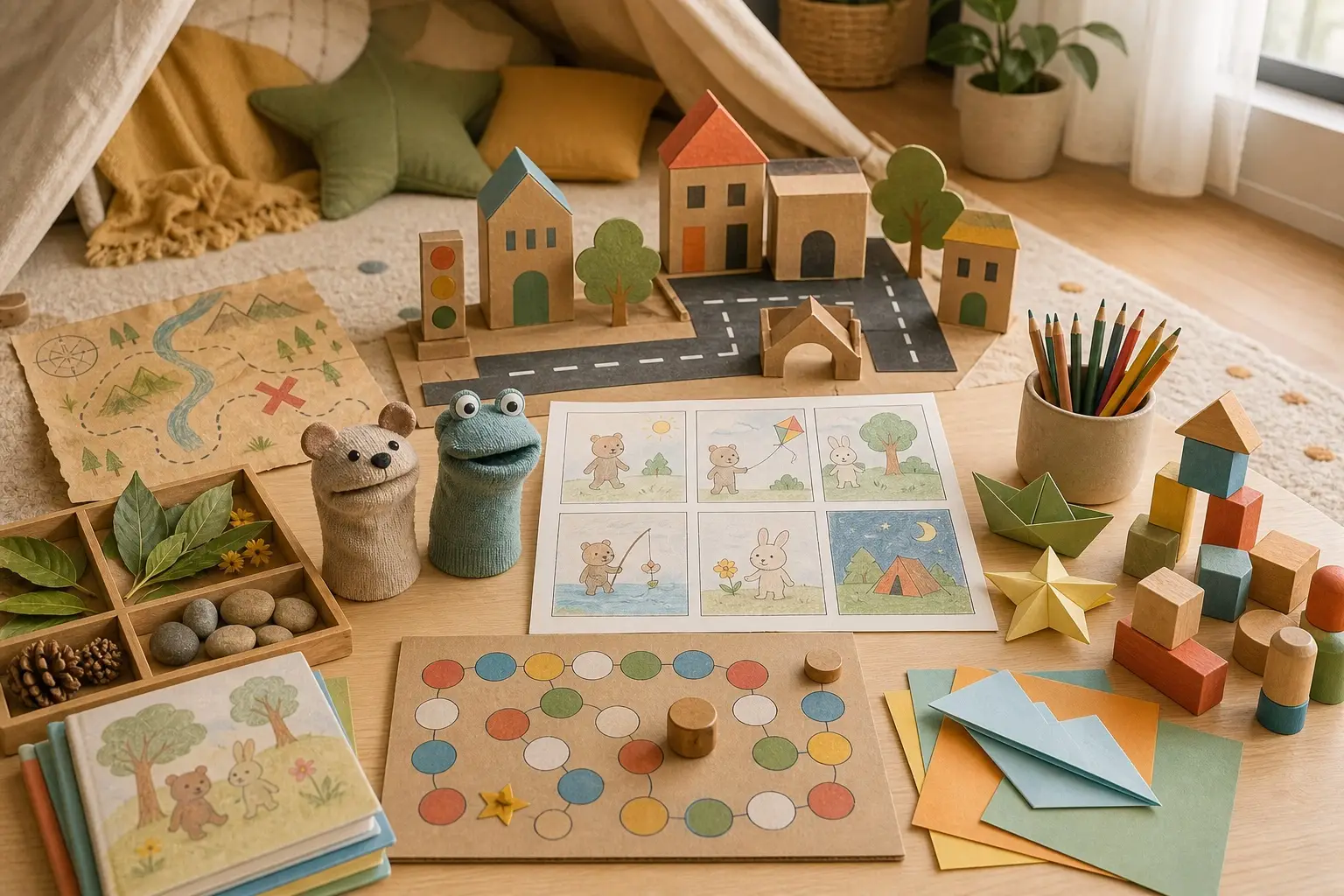
Screen-free time works best when it creates room for something appealing, not when it is framed only as the absence of a device. A child may want to move, make, sort, pretend, read, talk or simply be quiet. This guide offers all six, using materials that are already common in many homes and substitutions when they are not.
The age groups are broad starting points rather than developmental tests. A six-year-old may love the toddler color hunt; a tween may happily build a blanket fort; a preschooler may need an adult to simplify an activity listed for their band. The CDC’s developmental milestone guidance describes milestones across play, learning, language, behavior and movement, but children reach individual skills on different timelines. Choose for the child’s abilities, interests and sensory preferences—not the number on the heading.
These are research-informed ideas, not results from timed family testing. None promises a particular developmental outcome, and no activity needs to hold attention for a set number of minutes to count.
Before you choose: make offline time easier to start
The American Academy of Pediatrics’ current digital-media guidance for families recommends making room for sleep, exercise, reading, play, homework and family time, including shared screen-free times and places. That is a more useful goal than treating every screen as bad or every offline minute as automatically enriching. A video call with a grandparent and an hour of restless scrolling are not the same experience; neither are an imposed worksheet and child-led play.
Play can be active, social, imaginative or quiet. The AAP’s overview of the power of play encourages physical, outdoor and pretend play, and emphasizes the value of interaction between children and caregivers or peers. You do not have to direct the entire session. Often the most useful adult role is to make the first step obvious, stay nearby and let the child take the idea somewhere unexpected.
Use the one-tray rule
Put the whole activity on one tray, towel, basket or clear patch of floor. Offer only the materials needed for that idea. A tray with paper, four crayons and tape is easier to begin—and easier to reset—than an open cupboard full of choices.
If the child does not engage, change one variable: make it bigger, make it cooperative, add a story or move it outside. If that still does not work, stop. An unused idea is not a failure and boredom does not always need immediate fixing.
Check safety for the actual child
Follow the current age and warning labels on toys and materials. The U.S. Consumer Product Safety Commission advises choosing toys that match a child’s abilities and keeping toys with small parts away from children younger than three. Use that youngest-child standard when siblings share a space. Keep button batteries, loose magnets, balloons, medications and cleaning products out of activity supplies entirely.
Use child-labeled art materials, and remember that “non-toxic” does not mean edible. An adult should handle craft knives, staplers, hot tools and tough cardboard. Supervise water play continuously, keep climbing routes low and stable, clear tripping hazards, and stop any movement game that becomes unsafe for the room.
Ages 2–3: big movements and simple choices
At this age, use large objects, short instructions and repeatable actions. Stay close enough to help immediately, especially around water, climbing, cords, art materials or anything a child may mouth.
1. Cushion trail
Lay two or three firm cushions on a rug with a small gap between them and invite the child to step from “island” to “island.” Hold a hand if needed. Add a destination such as delivering a stuffed animal to the sofa.
Keep everything at floor level and remove cushions that slide or tip. If stepping is not comfortable, make the trail a route for toy animals or cars instead.
2. Laundry-basket delivery
Put a few lightweight towels or soft toys in a laundry basket and name a delivery point across the room. The child can carry one item at a time, push an empty lightweight basket on a clear floor or sort deliveries by room.
Do not let a child climb into a basket or push another child inside it. A paper bag or small open box works for a lighter version.
3. One-color hunt
Choose one broad color and look for three large, safe objects that match. Leave everything where it belongs and point instead of collecting breakable or heavy items. Then let the child choose the next color.
If color matching is frustrating, hunt for “soft,” “round” or “something we wear” instead. The activity is noticing and talking, not checking whether every answer is technically perfect.
4. Painter’s-tape roads
Make two or three wide roads on the floor with low-tack painter’s tape, then move large toy vehicles, blocks or walking feet along the route. Add a parking box or a masking-tape bridge over a sheet of blue paper.
Test tape on the surface first and remove it after play. Skip small vehicles for children who mouth toys, and use paper roads on a table if tape could damage the floor.
5. Cardboard-box doorway
Open both ends of a large clean box so it becomes a short tunnel or doorway, then let the child crawl through, knock before entering or deliver a toy to the other side. An adult should remove staples and cut every opening.
Keep the box on the floor, watch for torn edges and stop when the cardboard softens or collapses. A blanket draped across two chairs with an adult nearby creates a roomier alternative.
6. Water painting on cardboard
Set a piece of plain cardboard on a towel and offer a small cup of water with a wide paintbrush or clean kitchen brush. The dark strokes appear, then slowly disappear as they dry, so the surface can be used again.
Use only a shallow amount of water and supervise continuously. This is for painting the cardboard, not drinking or splashing; move the activity outdoors if wet floors would be slippery.
7. Sponge transfer
Place two shallow bowls on a towel, with a little water in one. The child dips a clean sponge, carries it to the empty bowl and squeezes. Start with the bowls close together and model one slow transfer.
Stay within arm’s reach and empty both bowls immediately afterward. A dry version uses rolled socks moved between baskets with both hands.
8. Scarf freeze dance
Wave a lightweight scarf while humming, clapping or playing rhythm on your knees. When the sound stops, everyone freezes. Let the child decide whether the next round is fast, slow, high or low.
Use a short scarf, never wrap it around a body part and put it away after play. If sudden stops are upsetting, use “slow motion” instead of freezing.
9. Animal walk parade
Choose two familiar animals and copy their movements across a clear floor: waddle like a duck, stretch like a cat or take heavy elephant steps. Add animal sounds only if the household can enjoy the noise.
Avoid jumps on slippery surfaces or movements that strain wrists and knees. A seated version uses faces, sounds and arm movements.
10. Sock matching
Put four or five clean, clearly different adult socks in a basket and find the partners together. The child can place each pair in a line, carry it to the drawer or toss it into another basket nearby.
Ignore perfect folding. The satisfying finish is finding a partner for each sock. Count the pairs only if the child wants to.
11. Picture-book conversation
Choose a familiar book and look through the pictures without needing to read every word. Ask concrete questions such as “Where is the dog?” or “What do you think they will eat?” Then follow whatever detail the child notices.
Repeating the same book is welcome; familiarity makes it easier for a child to point, predict and join in. Stop when turning pages becomes more interesting than the story.
12. Big-paper mural
Tape a large sheet of paper or the blank inside of a paper grocery bag to the floor and offer two or three washable crayons. Draw roads, loops, family marks or one enormous creature together.
Use child-labeled tools, protect the floor and keep caps or broken pieces out of reach. If a large blank surface feels intimidating, start with one circle and invite the child to add “rain,” “fur” or “wheels.”
If you are choosing tools for this age, our guide to chunky crayons for toddlers compares shape, washability claims and age labels, and the dot markers for toddlers and preschoolers guide covers a stamping-style alternative.
Ages 4–5: pretend worlds and short missions
Preschoolers often enjoy a clear role or story. Give the activity a beginning—“The café is opening”—but leave the middle flexible. Adult cutting and setup can make ordinary cardboard much easier to use.
13. Shape safari
Draw or name a circle, rectangle and triangle, then hunt for examples around one room. A plate might be a circle; a door might be a rectangle; a folded paper roof might make a triangle.
Photographic proof is unnecessary. Point, sketch or place one tally mark for each find. If shape names are new, hunt for only one shape at a time.
14. Blanket-fort library
Drape a blanket over a sturdy table or across chair backs that cannot tip, add floor cushions and bring in three books. Let the child choose a “fort librarian” job such as arranging the books or making admission tickets.
Keep airflow open, avoid lamps and heaters, and do not stack furniture. A reading picnic under the table gives the same change of scene with almost no construction.
15. Pretend café
Use paper circles for plates, blocks for food and scrap paper for a menu. Take turns being the customer, cook and server. The order can be delightfully impossible: cloud soup and a triangle sandwich are allowed.
Keep real breakables and hot kitchen items out of the setup. If writing a menu slows the play, draw three simple pictures or let the customer order from imagination.
16. Cardboard-tube creature
An adult cuts a clean cardboard tube if needed; the child adds a face, paper ears and crayon patterns. Ask where the creature lives and what it eats, then build a tiny habitat from a shoebox.
Use tape or a glue stick rather than a hot-glue gun. Skip loose eyes and other small decorations when younger siblings could reach them; drawn features work just as well.
17. Paper-bag puppet
Turn a clean lunch bag into a character with paper shapes and drawn details. Slide a hand inside and ask the puppet one easy question: “What is your favorite sound?” A second plain bag can become its friend.
The puppet does not need elaborate decoration before play begins. If the child dislikes wearing it, stand it over a cup or use it as a story character on the table.
18. Three-object story basket
Place three large familiar objects in a basket—a spoon, scarf and toy animal, for example. Pull them out one at a time and make a story that includes each. Let the child change any plot point.
Use household objects that are safe to handle and too large to swallow. For a quieter version, arrange the objects as a scene and draw what might happen next.
19. Picture treasure trail
Draw three simple clues that lead from one safe place to another: a shoe, a table and a pillow. Place the next clue at each location and finish with a book, snack served by an adult or invitation to choose the next game.
Keep every clue on the same floor and away from storage areas, stairs and doors leading outside. The “treasure” can be an experience; no prize is required.
20. Window weather station
Look outside and choose a symbol for today’s weather. Draw a sun, cloud, raindrop or moving leaf on a small card, then notice one detail: bright, windy, wet, cool or warm.
Repeat on several days and line up the cards. This is observation, not a forecast, so conflicting answers are fine—weather can change and different windows show different clues.
21. Nature sorting tray
Collect a few safe fallen leaves, smooth stones or seed pods with an adult, then sort them by color, texture, size or a category the child invents. Return outdoor items afterward where appropriate.
Avoid unknown berries, mushrooms, irritating plants, sharp shells and anything contaminated by animals or chemicals. Wash hands after handling outdoor finds. Indoors, substitute blocks, fabric scraps or paper shapes.
22. Tape balance path
Place one straight painter’s-tape line on the floor and walk heel-to-toe beside or along it. Add a curve, a pause circle or a spot where the walker turns around.
There is no need to stay exactly on the line. Keep the route away from furniture corners and stairs, and use a wide paper path for a child who benefits from more space.
23. Sink-or-float predictions
Fill a stable basin with a shallow amount of water and choose three washable objects—perhaps a plastic cup, metal spoon and large block. Predict, test one item and talk about what happened without turning the prediction into a score.
Supervise continuously, keep electrical items away and empty the basin as soon as the activity ends. Do not use batteries, magnets or objects that can break, rust or release small parts.
24. Paper-chain pattern
An adult precuts wide paper strips. The child chooses two colors and helps arrange an alternating pattern before an adult or capable child links them with tape or a glue stick.
Hang the chain where it cannot be pulled around the neck, or keep it as a table decoration. If linking is difficult, line up the strips as a flat road pattern instead.
Ages 6–8: projects with a visible finish
Children in early elementary years can often hold a short sequence in mind, but a project is still easier when the finish is concrete: six comic boxes, five clues or one game board. Help with setup, then step back from decisions that do not affect safety. If a child would rather start from a boxed project, our craft kits for kids ages 6–8 include age and adult-help notes.
25. Six-panel comic
Fold a sheet into six boxes and draw a character in the first one. Decide on a small problem—lost snack, surprising sound, mixed-up backpack—and show what happens next. Speech bubbles can use words, symbols or scribbles.
Six panels create a natural stopping point. If drawing feels hard, use stick figures or make one character from a repeated shape. Plain paper and a pencil are enough, though our guide to drawing supplies for kids compares simple sets if you want to build a basket.
26. Household scavenger hunt
Write or draw five things to find without moving them: something striped, something older than the child, something that opens, something soft and something that makes a quiet sound. Walk together and check each clue.
Exclude private storage, medication, tools and breakables. For siblings, make the hunt cooperative and ask them to agree on one example per clue.
27. Cardboard town
Use small clean boxes as buildings and strips of scrap cardboard as roads. Add a park, bridge, bus stop or home for an imaginary animal. The town can be built in stages and stored on a flattened box base.
An adult removes staples and handles thick-cardboard cuts. Draw windows and doors instead of cutting them when the structure is already working.
28. Secret-code note
Match six simple symbols to common letters or assign a tiny drawing to each word in a short message. Write a note such as “MEET AT THE FORT,” include the key and ask someone at home to decode it.
Keep the first code short enough to solve. Older children can make a symbol alphabet; younger writers can encode only their name or a three-word clue.
29. Obstacle-course architect
Ask the child to design a route on paper before building it from safe floor-level actions: step over a tape line, circle a cushion, crawl under a table and toss a rolled sock into a basket.
An adult approves every station, clears the floor and removes climbing on furniture. The designer can time the course only if competition stays friendly; accuracy, silliness or teamwork can be the goal instead.
30. Paper-airplane comparison
Fold two simple paper airplanes, changing one feature such as wider wings or an added paper clip only if the child is old enough to handle it safely. Predict how each will fly, then launch one at a time in a clear hallway.
Aim away from faces, pets, fans and breakables. Call it a comparison rather than a scientific test unless conditions are deliberately controlled; surprising flights are part of the fun.
31. Sock-puppet scene
Use clean socks over hands and draw a three-part story plan: who arrives, what goes wrong and how it ends. Perform behind the sofa or at the edge of a table.
The socks can stay undecorated. If adding features, use securely attached paper or washable fabric-safe materials appropriate for the child; avoid pins, buttons and loose eyes.
32. Homemade board game
Draw a path of 20 large spaces on cardboard. Add a start, finish and a few simple actions such as “move forward one” or “make an animal sound.” Use large blocks as playing pieces and a handmade spinner or shuffled number cards.
Play once before decorating heavily. Revise rules that make one person wait too long or cannot be explained in a sentence.
33. Recipe helper
Choose one ordinary kitchen job: wash produce, tear lettuce, measure a dry ingredient into a separate bowl or arrange sandwich fillings. Read the step aloud and let the child complete that defined part.
An adult manages knives, heat, appliances, raw ingredients and allergy decisions. Wash hands and surfaces, and keep the job small enough that the meal does not depend on perfect execution.
34. Postcard from home
Fold cardstock or thick paper into a postcard, draw something seen that day and write one or two sentences to a relative, friend or future self. An adult can address and mail it later.
The child does not need a holiday to send a postcard. A picture of breakfast, the view from a window or a joke from the morning makes a genuine record.
35. Texture-rubbing collection
Place ordinary paper over a safe textured surface and rub gently with the side of an unwrapped crayon. Try a leaf, corrugated cardboard, textured placemat or coin secured by an adult, then label favorite patterns.
Stay away from walls, fragile finishes and dirty outdoor surfaces. Test first, and use only objects that remain stable under the paper.
36. Read and act one scene
Choose a short moment from a familiar book and act it with household props. One scarf might become a cape, river or picnic blanket; a chair might become a boat without being climbed.
The performance can last one minute and does not need an audience. Let the child rewrite the ending or narrate while toys play the characters.
37. One-page mini-zine
Fold a sheet into sections and fill each with one small contribution: a cover, drawing, list, joke, tiny comic and recommendation. Keep it as a single folded page rather than cutting a slit if an adult is not available.
Choose a narrow theme—cats, favorite snacks, made-up planets or “things in my room”—so the blank sections feel like prompts rather than homework.
Ages 9–12: ownership, design and useful challenges
Tweens are more likely to engage when the activity respects their taste and produces something they chose. Offer a brief, not a craft script: “Could you design a game we can actually play tonight?” Participation can include planning, documenting or teaching rather than only making. For a tween who wants a craft that feels more like a hobby, see our craft kits for tweens ages 9–12.
38. Family trivia cards
Write questions that household members can answer without embarrassment: favorite snacks, places visited, pet habits, family sayings or events from last month. Put answers on the back and run a cooperative round.
Let anyone skip a question and avoid private, medical or conflict-related topics. The best cards spark stories rather than prove who remembers correctly.
39. Room redesign on paper
Sketch the room from above, mark doors and windows, then cut simple paper shapes for movable furniture. Try two layouts without moving anything heavy. Add a reading corner, art-supply zone or clearer walking path.
Treat the plan as a proposal. An adult decides what can safely move, and tall furniture still needs appropriate anchoring; the paper exercise is valuable even if the real room stays unchanged.
40. Chain-reaction build
Use blocks, cardboard tubes and folded-card ramps to move one lightweight object into another. Begin with only three actions, make one change at a time and sketch the successful sequence afterward.
Keep the build on the floor, use soft or lightweight pieces and exclude flames, glass, batteries, magnets and projectiles. Protect pets and younger siblings from the setup.
41. Blind-contour gallery
Choose a household object, place the pencil on paper and draw its outline slowly while looking mostly at the object rather than the page. Do not erase. Make three drawings and display the wonderfully strange results together.
This works because accuracy is not the point. Add a one-line museum label describing what each drawing captures well.
42. Neighborhood field guide
From a window, yard or supervised walk, record five recurring sights: tree shapes, birds, building details, clouds or street patterns. Draw each and note where or when it appeared. Use broad descriptions when the exact species or name is unknown.
Observe from public or permitted spaces, respect neighbors’ privacy and never touch unknown plants or animals. The guide can grow over several weeks.
43. No-cook snack brief
An adult offers a small set of approved ingredients, and the child designs a snack that includes two textures or three colors. Write a name and short serving description before making it together.
An adult handles allergy checks, food safety, knives and portion decisions. Avoid turning nutrition into a moral rating; the challenge is combining and describing ingredients safely.
44. Teach a five-minute class
Choose a skill the child already knows—folding a paper shape, drawing an eye, organizing trading cards, doing a dance step or explaining game rules. Plan three steps and teach one willing person.
The learner should ask questions kindly and the teacher may restart. Recording is unnecessary; a handwritten instruction card can preserve the lesson.
45. Paper-tower challenge
Use a limited supply such as ten sheets of scrap paper and 30 centimeters of painter’s tape to build the tallest freestanding tower possible on a table or floor. Fold, roll and test different supports.
Measure only if it adds fun. Keep chairs and bodies out of the height attempt, and recycle or save usable paper afterward.
46. Creative-prompt deck
Cut scrap paper into 12 cards. On four, write characters; on four, places; on four, problems. Shuffle one from each pile and use the combination for a drawing, story or spoken scene.
Specific prompts are more useful than grand ones: “a sleepy robot,” “inside a greenhouse” and “the door disappeared” give the imagination something to push against.
47. Cardboard weaving
An adult or capable tween cuts evenly spaced notches along two ends of sturdy cardboard. Wrap thick yarn vertically as the warp, then weave paper strips, ribbon offcuts or more yarn over and under.
Keep lengths manageable and put yarn away after use, especially around younger children and pets. A flat paper-weaving version avoids loose yarn entirely. Children who enjoy working with yarn or floss may also like beginner crochet kits for kids and tweens or friendship bracelet kits, both compared by age guidance and adult-help needs.
48. Household mini museum
Choose five ordinary objects around a theme—old kitchen tools, favorite stones, tiny artworks or family souvenirs. Arrange them on a shelf or table and write a label for each: what it is, where it came from and why it belongs.
Ask permission before handling keepsakes and leave valuable or fragile objects in place. A museum can feature copies, drawings or written descriptions instead.
49. Board-game remix
Take a familiar non-collectible game and change one rule: a cooperative win condition, a new movement card or a short optional challenge. Write the change clearly, play one round and decide whether to keep, revise or discard it.
Preserve the original pieces and rules. The goal is learning what a rule does to the experience, not declaring the first version better.
50. Evening observation journal
Sit by a window, on a balcony with an adult or in a safe outdoor spot for ten quiet minutes. Record five things noticed through words, sketches, tally marks or a color palette: changing light, sounds, cloud movement or neighborhood routines.
There is no requirement to feel calm or grateful. “The traffic was loud” is a valid observation. Over several entries, the journal becomes a record of ordinary change.
Choose by energy, not only by age
Age narrows the safety and complexity range, but energy often determines whether an idea works today.
| What the child seems to need | Low-setup starting points | Why they fit |
|---|---|---|
| Big movement | Animal walk, cushion trail, tape path or approved obstacle course | Uses the floor and begins with one action |
| Quiet recovery | Picture-book conversation, mini-zine, contour drawing or observation journal | Can be done seated without a performance goal |
| Connection | Pretend café, puppet scene, family trivia or five-minute class | Gives two people clear roles |
| Independence | Cardboard town, comic, field guide or prompt deck | Has a visible structure but leaves decisions open |
| Sensory simplicity | Sock matching, paper folding, large-block building or drawing | Avoids wet, sticky or noisy materials |
| A useful job | Laundry delivery, recipe helper, postcard or room plan | Contributes to home life without pretending chores are always play |
For a fast transition away from a device, do not announce a 50-item program. Name one invitation: “I’m putting tape down for a road,” “Could you make three trivia cards?” or “I need a museum curator.” Begin the first step, then allow the child to join, watch, change the plan or decline.
Build a reusable screen-free shelf
You do not need 50 activity bins. One shelf or lidded box can support most of this guide:
- plain and colored paper;
- a small set of child-labeled washable drawing tools;
- painter’s tape and a glue stick;
- clean cardboard and paper bags;
- two scarves or fabric scraps;
- a few books, blocks and large safe household objects; and
- one tray or basket that defines the work area.
Keep scissors, string, small parts and adult tools in separate storage. Refill the shelf with scrap paper and cardboard rather than adding novelty for its own sake. A familiar material becomes new when the invitation changes: cardboard can be a road today, a puppet stage tomorrow and a loom next week.
When choosing the drawing tools themselves, our guide to washable markers for kids compares tip styles and realistic cleanup claims, and the broader coloring supplies for kids guide covers crayons, pencils and paint sticks.
If the weather is keeping everyone inside, our easy rainy day crafts for kids add 25 more paper, cardboard and recyclable-material projects. For activities that fit a plane, car or restaurant table, use the more compact screen-free travel activity guide. If a child specifically wants a contained project rather than an open-ended prompt, the low-mess craft kit guide explains researched options and their cleanup trade-offs. For a wider overview by age and skill level, compare our best craft kits for kids, or try air-dry clay kits for a sculpting project with a drying step.
The useful measure is not how many activities you complete or how long a child stays offline. It is whether the idea makes the next part of the day easier to enter: a little movement, a shared joke, a finished page, a useful job or a few minutes of absorbed play.


