
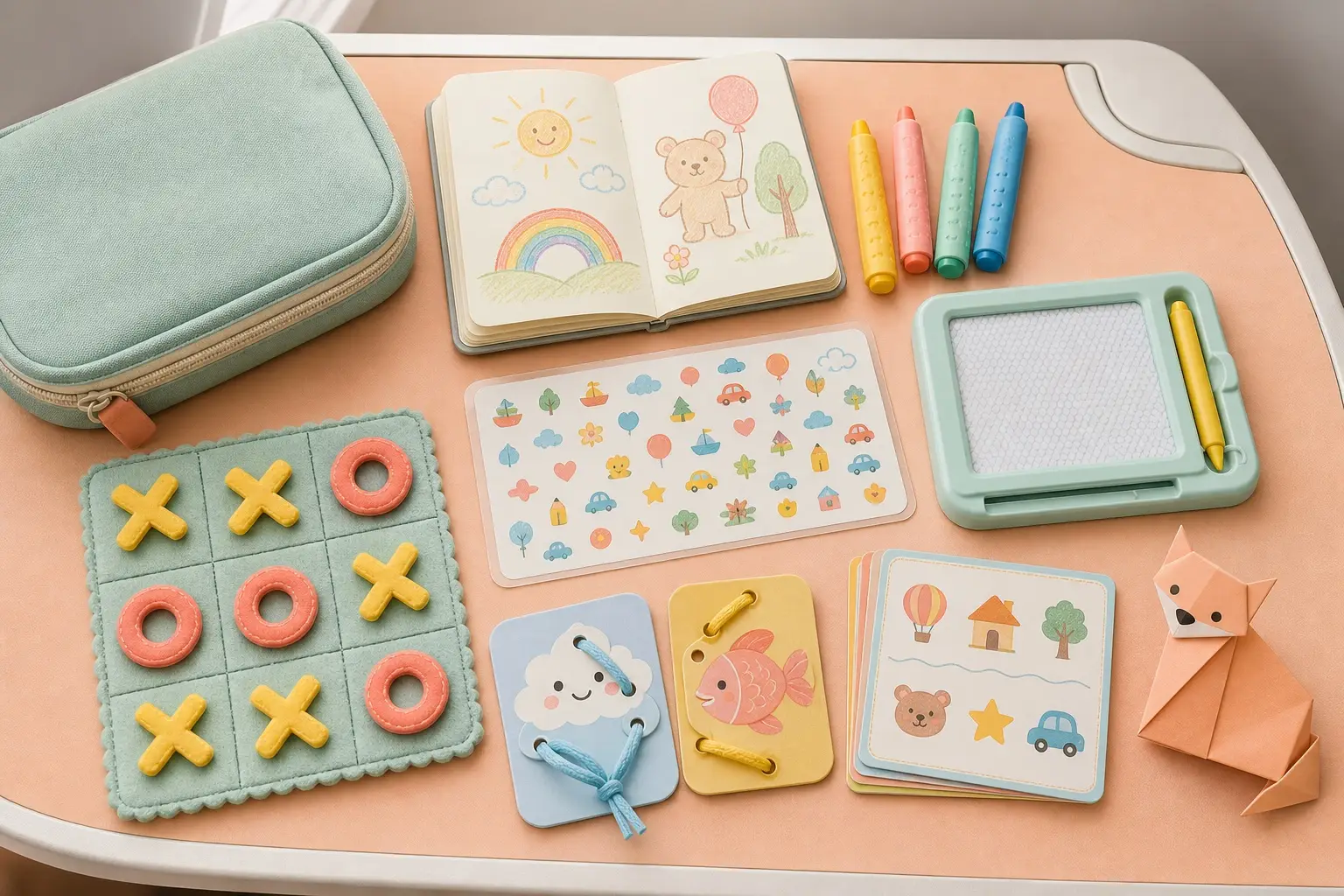
A screen-free travel activity does not have to occupy an entire flight or make every restaurant wait peaceful to be useful. Ten focused minutes can bridge the gap between ordering and eating, help a child settle after takeoff or turn an unremarkable stretch of highway into a shared game.
The most reliable ideas have four things in common: they fit in the child’s space, begin with one clear prompt, pause without a complicated cleanup and do not depend on a parent performing constant entertainment. This guide includes spoken games, paper activities and a few reusable tactile options so you can choose for the child, the journey and the energy available that day.
These are research-informed activity ideas, not claims from timed family testing. Adapt them to the child’s age, abilities, sensory preferences and current travel rules. For a larger menu of ideas at home, see our 50 screen-free activities for kids.
Start with travel safety, then choose the activity
An activity should work around the restraint, not require a child to leave it. The Federal Aviation Administration’s turbulence guidance advises passengers to keep seat belts buckled while seated and says the safest place for a child under two is in a government-approved child seat or device. The FAA’s travel guidance for children strongly urges using an approved child restraint system or other approved device for the whole flight.
For road trips, the National Highway Traffic Safety Administration says everyone should be buckled in an age- and size-appropriate car seat, booster seat or seat belt, and children under 13 should ride correctly buckled in the back seat. Choose activities the child can reach without leaning out of position. The driver should never retrieve crayons, judge a drawing or turn around to run a game; let another passenger help or wait for a safe stop.
Age labels matter more in a cramped space where dropped pieces are difficult to recover. The U.S. Consumer Product Safety Commission advises following package age guidance and keeping toys with small parts away from children younger than three. Remember the youngest traveler or sibling who could pick up a dropped piece, not only the child using the activity.
At a restaurant, separate making from eating. Clear the table and wash hands before food; the Centers for Disease Control and Prevention recommends handwashing before and after eating. Keep hand sanitizer with an adult and supervise young children if it is used.
A simple travel-activity packing system
Build a small selection rather than a giant entertainment bag:
- One no-supply game: useful during queues, turbulence, a traffic delay or any moment when bags need to stay closed.
- One paper activity: a thin notebook plus two or three twist-up crayons or washable markers is enough.
- One reusable tactile activity: choose a one-piece or large-piece option that returns to its pouch quickly.
- One reset envelope: use it for completed pages, sticker backings and any paper scraps until a bin is available.
Offer one activity at a time. A bag with 15 visible choices can become a sorting project; two hidden alternatives preserve novelty and make it easier to notice what the child actually wants.
No-supply travel games
These four ideas are the lightest to pack because they live in your head. They also work well for children who feel uncomfortable looking down in a moving car.
1. Color-and-shape I Spy
Best for: cars, airport gates, planes before bags come out and restaurant waits.
Choose a clue based on something genuinely visible: “I spy something round and blue” or “I spy something soft with stripes.” Let the child ask questions or make one guess at a time, then switch clue-giver.
For a younger child, name only a color or broad category. For an older child, combine two or three properties, such as material, function and location. Avoid asking a child to twist around in a car seat; clues should point ahead or toward the side the child can comfortably see.
2. Alphabet hunt
Best for: road trips, terminal signs and restaurant menus before ordering.
Find letters in order on signs, license plates, menus, safety cards or objects around you. The child can say the letter rather than touch anything. Skip difficult letters and return to them later, or look for the first letters of family names instead of completing the whole alphabet.
Preschoolers can hunt only for the letters in their own name. Older children can add a rule: each example must come from a new word, or the next letter has to appear farther away than the previous one.
3. Category countdown
Best for: any place where quiet conversation is appropriate.
Pick a category and try to name five things in it: five animals with tails, five foods that crunch, five things found at an airport or five characters you could draw later. Take turns and allow repeats if a younger child is learning the game.
The countdown gives the activity an ending, which is helpful when attention is short. Make it cooperative rather than using elimination; the goal is to reach five together, not to trap someone with an impossible answer.
4. Three-word story chain
Best for: planes, cars and longer restaurant waits with siblings or adults.
One person begins a story with three words—“A sleepy dragon…”—and each person adds exactly three more. Keep building until someone gives the story a natural ending. If counting words interrupts the fun, use one sentence per turn instead.
Give a reluctant storyteller two choices: “Did the dragon find a sandwich or a suitcase?” A clear choice is easier than inventing the entire next scene. Keep voices at conversation level and pause immediately for announcements, instructions or food service.
Paper-and-pencil activities
Precut and prepare paper at home. During travel, choose capped or twist-up drawing tools that will not create shavings, and pack only a few colors at once. Our guide to mess-free coloring supplies for travel compares options for planes, restaurants and road trips by cleanup and portability.
5. Six-square travel bingo
Best for: cars, trains, airport windows and a walk through the terminal.
Divide a small sheet into six large boxes and draw one simple thing to find in each: a bridge, cloud, suitcase, red vehicle, animal and number. The child circles or colors a box when the item appears. Use pictures instead of words for early readers.
Six squares finish faster than a full bingo card and leave room for bold marks. Make the page specific to the route without promising sights you may not encounter; broad clues such as “something taller than a house” are more flexible than a particular landmark.
6. Finish the squiggle
Best for: restaurant tables, plane trays and children who freeze at a blank page.
Before the trip, draw several loose loops, zigzags and partial shapes on separate pages. The child turns each line into something—a zigzag becomes a crown, mountains or monster teeth; a loop becomes a face, planet or bowl.
There is no correct answer. If two people use identical starting squiggles, compare how differently they finish them without ranking which drawing is better. One small notebook keeps all versions contained.
7. One-line drawing relay
Best for: restaurant waits, gate areas and plane trays shared with an adult.
One person draws a single line or shape, then passes the page. The next person adds one line. Continue until everyone agrees the picture is complete, then give the creature, machine or place a name.
In a car, only seated passengers should pass the notebook, and only if they can do so without unbuckling or reaching across the vehicle. A clipboard is unnecessary if the notebook has a firm cover.
8. Spot-and-sketch postcard
Best for: a flight window after takeoff, a rest stop, a scenic train ride or a restaurant near the destination.
Fold a sheet into quarters or use small index-card-size paper. Ask the child to sketch one thing noticed on the trip: wing shapes, cloud layers, a funny road sign, a building, a meal or a pattern on the wall. On the back, an adult can write the place and date.
The aim is noticing, not accurate drawing. Keep the postcard as a trip record or give it to someone at the destination. Do not ask a child to move around the cabin or vehicle to find a better view.
9. Tiny travel journal
Best for: the final minutes of a travel segment or quiet time after arrival.
Use one page per day with three prompts: “I saw…,” “I felt…” and “Tomorrow I hope….” A child can draw the answers, dictate them to an adult or write only a few words. Add a simple weather symbol and one favorite color from the day.
A fixed page limit keeps the journal from feeling like homework. This is also a gentle way to record an uncomfortable day without forcing it to sound positive; “I felt tired” is a complete and useful entry.
10. Design an imaginary menu or vehicle
Best for: restaurants, long gate waits and children who like inventing systems.
At a restaurant, draw an imaginary menu with three foods, a house special and a dessert for an animal. On a plane or road trip, design a vehicle with a sleeping nook, snack drawer, cloud catcher or other impossible feature.
Use your own notebook rather than drawing on a real menu, placemat, safety card or seat-back material. Older children can add symbols, a map or instructions; younger children can dictate features while an adult labels the picture.
11. Folded-paper character
Best for: a stable restaurant table, gate table or smooth plane tray during calm cruise.
Pack two or three square sheets cut at home. Make one very simple fold—a triangle, pocket or accordion—then add a face and turn it into an animal, puppet or passenger. The folds do not need to match formal origami instructions.
Avoid scissors and glue during the trip. If the table is moving or the child becomes frustrated by precise creases, flatten the paper and turn it into an ordinary drawing instead. Store the finished character in the reset envelope so it does not become litter.
Reusable tactile activities
Reusable does not automatically mean travel-friendly. Check the activity’s current age label, count its components and reject anything with many tiny pieces, a loud mechanism, long loose cords or a container that spills when opened.
12. Reusable doodle tablet
Best for: almost any travel context, especially when loose crayons are awkward.
Choose a non-electronic drawing surface with a stylus that stores securely or remains attached by a short manufacturer-designed tether. Take turns giving small prompts: draw a pet with three ears, a map from the seat to an imaginary castle or four objects that start with the same sound.
Clear the surface only after asking; some children care deeply about preserving a drawing until someone has seen it. The activity should sit on the child’s lap without interfering with the seat belt or tray latch.
13. Large-piece felt tic-tac-toe
Best for: restaurant tables, airport gates and calm parts of a flight.
Use a soft board with large, easy-to-count pieces that cannot be mistaken for food. Put unused pieces in the pouch rather than spreading all of them across the table. Play best-of-three, then ask the child to invent a new placement pattern or use the pieces for simple sorting.
This is not suitable for a child who still mouths objects unless the product is explicitly intended for that age and the pieces meet its safety requirements. Put the game away before meals and whenever turbulence begins.
14. Lacing card with a short secured cord
Best for: quiet waits and older preschool or elementary-age children who already enjoy threading.
Choose a sturdy card with widely spaced holes and a short cord designed for the activity. Start the first hole, then invite the child to lace around the edge, make a crisscross pattern or use only every second hole.
Follow the manufacturer’s age guidance and supervise continuously. The cord should stay with the card, not become jewelry or wrap around the child, seat or tray. Skip lacing entirely for children who mouth cords or find repetitive hand movements uncomfortable.
15. Sticker-scene envelope
Best for: restaurants, gate areas and plane trays when the child can manage peel-and-place work.
Pack one background sheet, one small sticker sheet and an envelope. Give the scene a prompt: build a park for nocturnal animals, make an airport for clouds or create a café on the moon. Stickers belong only on the family’s paper, never on windows, trays, furniture or dishes.
The envelope does two jobs: it stores the unfinished scene and catches the backing paper. Choose large stickers for younger children and follow choking-hazard labels. A reusable sticker set may offer more repeat play, but only if its pieces stay attached or are large enough for the child’s age.
Which activity fits this moment?
Use the setting and the child’s current state to narrow the list:
| Situation | Start here | Why it fits |
|---|---|---|
| Bags must stay closed | I Spy, alphabet hunt or category countdown | No setup and no loose pieces |
| Child feels queasy when looking down | Spoken games using the view ahead or to the side | Avoids sustained close-up work |
| Restaurant food is coming soon | Finish one squiggle or make a quick imaginary menu | Easy to stop and clear |
| Plane ride is calm with a tray available | Tiny journal, doodle tablet or sticker scene | Contained within one surface |
| Child wants repeated hand movement | Lacing card or felt game | Tactile and predictable |
| Siblings want to play together | Story chain, drawing relay or cooperative bingo | Turns waiting into a shared task |
| Adult attention is limited | Doodle tablet, tiny journal or prepared squiggles | The prompt is built into the activity |
If the child refuses the carefully packed activity, that is information rather than a packing failure. Offer one alternative, switch to a spoken game or allow quiet observation. Travel already asks children to process unfamiliar sounds, movement, rules and transitions; constant occupation is not required.
Make the same small kit work three ways
A notebook, three twist-up crayons and one reusable surface can cover most of this list. On the plane, draw squiggles and make a tiny arrival journal. In the car, use the notebook only at a safe stop if looking down causes discomfort, and play I Spy while moving. At the restaurant, design a menu, then close the pouch before food arrives.
Before the return journey, discard backing paper, replace used pages and check that every reusable piece is present. Keep the successful activities, remove the ignored ones and add only one new prompt. That small reset is more useful than buying a completely different bag for every trip. For older children who sketch seriously, our guide to portable drawing kits for travel compares pencils, pads and storage cases.
For ready-contained options, our low-mess craft kit guide explains the cleanup and small-part trade-offs of several researched kits. If you are building a basic paper-and-color pouch from supplies already at home, compare formats in our coloring supplies for kids and drawing supplies for kids guides. For stay-at-home making with ordinary materials, see these easy rainy day crafts for kids.


