Quick picks
- Best overall for ages 12+The Woobles Pierre the Penguin Crochet Kit (opens Amazon in a new tab)
- Best adult-and-child duo projectDisney Winnie the Pooh and Piglet Crochet Kit (opens Amazon in a new tab)
- Best compact Woobles startThe Woobles Kiki the Chick Crochet Kit (opens Amazon in a new tab)


Product comparison
| Product | Best for | Watch out | Price & shop |
|---|---|---|---|
| The Woobles Pierre the Penguin Crochet Kit (opens Amazon in a new tab) Best overall for ages 12+Research-based review | Complete beginners age 12+ who want the gentlest guided start | The system depends on online video access and the official age recommendation begins at 12, so it is not our default choice for a younger child. | |
| Original Squishmallows Omar the Bear Crochet Kit (opens Amazon in a new tab) Best for ages 8+Research-based review | Ages 8+ who want a recognizable plush project with pre-started loops | We have not compared the tutorials hands-on, and the single project still requires stitch counting, tension and final assembly that may need adult coaching. | |
| Disney Winnie the Pooh and Piglet Crochet Kit (opens Amazon in a new tab) Best adult-and-child duo projectResearch-based review | Ages 6+ Pooh fans who will work through a printed pattern with an adult | The age label starts at six, but the full amigurumi patterns are not pre-started and should not be mistaken for independent six-year-old projects. | |
| Disney Lilo & Stitch Stitch and Scrump Crochet Kit (opens Amazon in a new tab) Best ambitious licensed duoResearch-based review | Ages 6+ Stitch fans with patient adult help and a longer attention span | Two figures, multiple colors and sewn details make this one of the most ambitious options here despite its age 6+ listing guidance. | |
| The Woobles Kiki the Chick Crochet Kit (opens Amazon in a new tab) Best compact Woobles startResearch-based review | Ages 12+ who prefer a visually simple chick to a penguin | Small scale can make counting and handling details fiddly, and the project still requires online instruction access. | |
| The Woobles Jojo the Bunny Crochet Kit (opens Amazon in a new tab) Best bunny for ages 12+Research-based review | First-time crocheters age 12+ who are most motivated by a bunny | Sewing ears and limbs can become harder than crocheting the body, so the cute silhouette is not proof of effortless finishing. | |
| The Woobles Felix the Fox Crochet Kit (opens Amazon in a new tab) Best first color-change projectResearch-based review | Ages 12+ ready to move from basic rounds into color changes | The Beginner+ label matters; several colors and attached parts make Felix less forgiving than Pierre, Kiki or Jojo for a nervous first session. | |
| The Woobles Fred the Dinosaur Crochet Kit (opens Amazon in a new tab) Best dinosaur kit for ages 12+Research-based review | Dinosaur fans age 12+ who accept Beginner Plus shaping and assembly | Spikes, limbs and a tail create repeated small finishing tasks, so Fred is better for persistence than for the fewest possible steps. | |
| The Woobles Bjørn the Narwhal Crochet Kit (opens Amazon in a new tab) Best for joining practiceResearch-based review | Ages 12+ ready to practice color changes and attaching separate pieces | Those same learning goals make it a poor choice for someone who has not yet completed a basic crochet shape. | |
| The Woobles Harry Potter Crochet Kit (opens Amazon in a new tab) Best fandom pickResearch-based review | Ages 12+ Harry Potter fans who will persist through Beginner Plus details | The licensed design adds detail and complexity, and it should not replace a true Beginner kit solely because the recipient likes the character. |
Detailed product sections
The Woobles Pierre the Penguin Crochet Kit (opens Amazon in a new tab)
A pre-started piece, easy-to-see yarn and handed video paths make Pierre the clearest first Woobles choice

Why it fits this guide
The manufacturer identifies Pierre as its easiest place to start. The project begins past the opening-round hurdle, then teaches the main stitch through short video steps with separate right- and left-handed views.
Honest drawback
The system depends on online video access and the official age recommendation begins at 12, so it is not our default choice for a younger child.
Specifications
- Exact Amazon US ASIN and direct product image checked August 25, 2026
- Manufacturer recommendation begins at age 12
- Pre-started piece, Easy Peasy yarn, 4 mm hook, eyes, stuffing, needle and stitch markers
Best forComplete beginners age 12+ who want the gentlest guided start
Pros
- Simplest starting design in the Woobles line
- Right- and left-handed video tutorials
- Complete materials in one kit
Cons
- Requires screen and internet access
- Not manufacturer-recommended below age 12
Original Squishmallows Omar the Bear Crochet Kit (opens Amazon in a new tab)
Three starter loops and step-by-step support create a more age-appropriate bridge for an elementary-age beginner

Why it fits this guide
Omar is the only recommendation here with an age floor of eight and an explicit pre-started format. That combination is more realistic for a younger beginner than handing over a full printed amigurumi pattern with no first round prepared.
Honest drawback
We have not compared the tutorials hands-on, and the single project still requires stitch counting, tension and final assembly that may need adult coaching.
Specifications
- Exact Amazon US listing showed an in-stock offer and the matching ASIN on review
- Manufacturer listing guidance begins at age 8
- Hook, plastic needle, four yarn bundles, eyes, stuffing, three starter loops and project guide
Best forAges 8+ who want a recognizable plush project with pre-started loops
Pros
- Lower age floor than the Woobles kits
- Pre-started loops reduce initial setup
- Familiar finished character may sustain interest
Cons
- One project only
- Video quality and child independence remain untested
Disney Winnie the Pooh and Piglet Crochet Kit (opens Amazon in a new tab)
Six yarn colors and a complete tool set make both Pooh and Piglet without relying on a tutorial app

Why it fits this guide
This box offers two finished characters and keeps the main instructions on paper. It is appealing when the adult also wants to learn or already crochets and can translate stitch language in real time.
Honest drawback
The age label starts at six, but the full amigurumi patterns are not pre-started and should not be mistaken for independent six-year-old projects.
Specifications
- Exact Amazon US ASIN had a current in-stock offer when checked August 25, 2026
- Package and retailer age guidance begins at 6
- Six yarn colors, black thread, felt sticker, adhesive gems, hook, plastic needle, stuffing and instructions
Best forAges 6+ Pooh fans who will work through a printed pattern with an adult
Pros
- Two characters in one box
- Printed instructions support a screen-free session
- Core supplies are included
Cons
- No pre-started piece
- Younger listed ages need close adult partnership
Disney Lilo & Stitch Stitch and Scrump Crochet Kit (opens Amazon in a new tab)
Nine yarn colors and two patterns turn the first purchase into a substantial Stitch and Scrump project

Why it fits this guide
A strongly preferred character can keep a beginner returning after a difficult round. The box includes the materials for both figures, and printed instructions avoid an account or tutorial-app dependency.
Honest drawback
Two figures, multiple colors and sewn details make this one of the most ambitious options here despite its age 6+ listing guidance.
Specifications
- Exact Amazon US ASIN and matching direct image checked August 25, 2026
- Listing guidance begins at age 6
- Nine yarn colors, six felt stickers, hook, plastic needle, stuffing and printed instructions
Best forAges 6+ Stitch fans with patient adult help and a longer attention span
Pros
- Makes two displayable characters
- Printed pattern keeps the core activity offline
- Hook and finishing materials are included
Cons
- No pre-started round
- Many colors and attachments increase difficulty
The Woobles Kiki the Chick Crochet Kit (opens Amazon in a new tab)
Kiki uses the same pre-started Beginner system in a small, one-color-dominant character

Why it fits this guide
Kiki offers the full Woobles teaching setup without moving into Beginner+ color-change goals. The compact design can feel less visually busy when a maker wants one clear body shape and a short supply list.
Honest drawback
Small scale can make counting and handling details fiddly, and the project still requires online instruction access.
Specifications
- Exact Amazon US ASIN, offer evidence and direct product image checked August 25, 2026
- Manufacturer recommendation begins at age 12
- Pre-started piece, Easy Peasy yarn, 4 mm hook, eyes, stuffing, needle and stitch markers
Best forAges 12+ who prefer a visually simple chick to a penguin
Pros
- Beginner skill label
- Simple character silhouette
- Separate right- and left-handed lessons
Cons
- Small parts can be fiddly
- Screen access is required
The Woobles Jojo the Bunny Crochet Kit (opens Amazon in a new tab)
Jojo keeps the true Beginner label while adding satisfying ears and limbs to the guided round body

Why it fits this guide
Character preference matters when learning requires repeated practice. Jojo retains the pre-started piece and paced teaching that make the system approachable while producing a recognizable bunny rather than a generic sampler.
Honest drawback
Sewing ears and limbs can become harder than crocheting the body, so the cute silhouette is not proof of effortless finishing.
Specifications
- Exact Amazon US ASIN and direct product image checked August 25, 2026
- Manufacturer recommendation begins at age 12
- Pre-started piece, yarn, ergonomic hook, eyes, stuffing, needle and stitch markers
Best forFirst-time crocheters age 12+ who are most motivated by a bunny
Pros
- Beginner rather than Beginner+ level
- Full guided teaching system
- Complete project supplies
Cons
- Separate pieces add sewing work
- Online video access is central
The Woobles Felix the Fox Crochet Kit (opens Amazon in a new tab)
Felix layers a new color-change skill onto the pre-started Beginner Plus teaching system

Why it fits this guide
Felix makes sense after a basic sampler or simple round character because the fox markings give color changes a clear purpose. The official videos still separate right- and left-handed demonstrations.
Honest drawback
The Beginner+ label matters; several colors and attached parts make Felix less forgiving than Pierre, Kiki or Jojo for a nervous first session.
Specifications
- Exact Amazon US ASIN had current Amazon-market sales evidence in the June 2026 report reviewed August 25
- Manufacturer recommendation begins at age 12 and skill level is Beginner+
- Pre-started piece, three yarn colors, 4 mm hook, eyes, stuffing, needle and stitch markers
Best forAges 12+ ready to move from basic rounds into color changes
Pros
- Teaches a useful next skill
- Pre-starting preserves an accessible entry
- Complete guided kit
Cons
- Not the calmest first crochet project
- Multiple sewn details increase finishing work
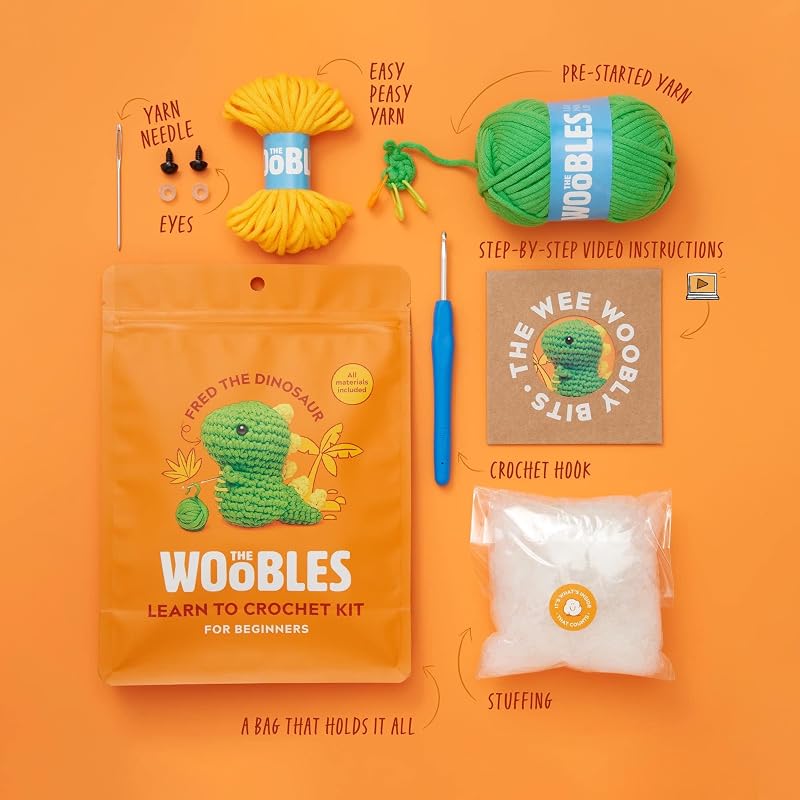
The Woobles Fred the Dinosaur Crochet Kit (opens Amazon in a new tab)
Fred turns the Woobles teaching system into a character with a tail, limbs and textured back details
Why it fits this guide
A dinosaur can be the difference between abandoning a practice swatch and returning to finish the next round. Fred includes the same visible-yarn and video supports while adding more three-dimensional assembly.
Honest drawback
Spikes, limbs and a tail create repeated small finishing tasks, so Fred is better for persistence than for the fewest possible steps.
Specifications
- Exact Amazon US ASIN had current August 2026 offer evidence and matching direct image
- Manufacturer recommendation begins at age 12 and skill level is Beginner+
- Pre-started piece, Easy Peasy yarn, 4 mm hook, eyes, stuffing, needle and stitch markers
Best forDinosaur fans age 12+ who accept Beginner Plus shaping and assembly
Pros
- Strong theme for dinosaur fans
- Guided shaping beyond a plain round body
- Complete materials and tools
Cons
- Multiple small pieces need assembly
- Beginner+ is harder than the simplest picks
The Woobles Bjørn the Narwhal Crochet Kit (opens Amazon in a new tab)
Bjørn deliberately adds a contrasting belly, horn, fins and tail to the guided foundation

Why it fits this guide
Bjørn has a clearer skill-progression role than simply offering another animal. The manufacturer positions the project around changing colors and joining pieces, useful goals after a maker can maintain a basic round.
Honest drawback
Those same learning goals make it a poor choice for someone who has not yet completed a basic crochet shape.
Specifications
- Exact Amazon US ASIN had current July 2026 market activity in the report reviewed August 25
- Manufacturer recommendation begins at age 12 and skill level is Beginner+
- Pre-started piece, multicolor yarn, 4 mm hook, eyes, stuffing, needle and stitch markers
Best forAges 12+ ready to practice color changes and attaching separate pieces
Pros
- Clear second-project skill progression
- Right- and left-handed videos
- All required project materials included
Cons
- Too many new steps for the gentlest first start
- Several attachments require sewing
The Woobles Harry Potter Crochet Kit (opens Amazon in a new tab)
A licensed character, custom hook and pre-started video course make a motivating but detailed guided project

Why it fits this guide
Motivation can justify a slightly harder project for a patient older tween. Harry keeps the pre-started Woobles structure while the recognizable hair, glasses and outfit make the finished result feel specific.
Honest drawback
The licensed design adds detail and complexity, and it should not replace a true Beginner kit solely because the recipient likes the character.
Specifications
- Exact Amazon US ASIN had current August 2026 Amazon offer evidence and matching direct image
- Manufacturer kids guidance begins at age 12 and the project is Beginner+
- Pre-started piece, Easy Peasy yarn, custom 4 mm hook, eyes, stuffing, needle and stitch markers
Best forAges 12+ Harry Potter fans who will persist through Beginner Plus details
Pros
- Officially licensed design
- Pre-started guided teaching path
- Complete tools and materials
Cons
- Character details raise the difficulty
- Requires online video access
Related guides
Best Craft Kits for Kids Ages 6–8
The best craft kits for kids ages 6–8, with 10 realistic projects including foil art, rock painting, weaving, sewing, gardening and more, plus age and adult-help notes.
Best Craft Kits for Tweens Ages 9–12
The best craft kits for tweens ages 9–12, from pottery and sewing to jewelry, crochet, string art and clay. Compare age fit, mess, skill level and finished projects.
Best Low-Mess Craft Kits for Kids
Ten low-mess craft kits for kids, from foil and sticker art to water reveal, weaving and supervised sewing, with honest cleanup and age notes for parents.
Best Friendship Bracelet Kits for Kids & Tweens: 10 Easy Starter Sets
Ten friendship bracelet kits for kids and tweens, compared by age guidance, technique, strand control, project count, small parts and adult-help needs.


