Buying guide
Best Calligraphy Pens for Beginners
- Written byYumi Ang
- Published

Our recommendation
For modern brush calligraphy, our first research pick is the Tombow Fudenosuke hard/soft two-pack: start with the firmer pen for small practice strokes, then compare the softer tip. Choose the Pilot Parallel 2.4 mm instead if you want broad-edge lettering such as italic or blackletter. Tombow Dual Brush Primary suits larger colored lettering; the Beginner Lettering Set bundles several tools for exploring styles. Buy one starting option and smooth paper before collecting more pens.
Quick picks
- First pick for small brush letteringTombow 62038 Fudenosuke Brush Pen 2-Pack (opens Amazon in a new tab)
Tombow · 62038 Fudenosuke Soft and Hard Tip 2-Pack
- For broad-edge scriptsPilot Parallel Calligraphy Pen Set, 2.4 mm (opens Amazon in a new tab)
Pilot · 90051, 2.4 mm nib
- For larger colored letteringTombow Dual Brush Pens, Primary Palette (opens Amazon in a new tab)
Tombow · Primary Palette 10-Pack
Top recommendations
- 1Tombow 62038 Fudenosuke Brush Pen 2-Pack — First pick for small brush letteringTwo black brush pens let you compare a firm tip with a softer one.
- 2Pilot Parallel Calligraphy Pen Set, 2.4 mm — For broad-edge scriptsA refillable 2.4 mm parallel-plate pen for angle-based thick and thin strokes.
- 3Tombow Dual Brush Pens, Primary Palette — For larger colored letteringTen water-based colors with a flexible brush end and a fine end.
- 4Tombow Beginner Lettering Set — For a bundled introductionA starter assortment with small and large brush tools, a pencil, eraser and guide.
Product comparison
| Product | Best for | Watch out | Price & shop |
|---|---|---|---|
| Tombow 62038 Fudenosuke Brush Pen 2-Pack (opens Amazon in a new tab)Tombow · 62038 Fudenosuke Soft and Hard Tip 2-Pack First pick for small brush letteringResearch-based review | Compact modern calligraphy and journal headers | This exact set is black only and non-refillable. It is not the choice for large colorful lettering or a broad-edge alphabet. | Budget-friendlyNot a live priceCheck price on Amazon (opens Amazon in a new tab) |
| Pilot Parallel Calligraphy Pen Set, 2.4 mm (opens Amazon in a new tab)Pilot · 90051, 2.4 mm nib For broad-edge scriptsResearch-based review | Learning italic or blackletter with a cartridge-fed nib | It requires a different stroke technique from brush lettering. The rigid broad edge does not become wider when you press harder, and paper compatibility still needs checking. | |
| Tombow Dual Brush Pens, Primary Palette (opens Amazon in a new tab)Tombow · Primary Palette 10-Pack For larger colored letteringResearch-based review | Roomy practice sheets, decorative words and card designs | A larger flexible tip asks for more space and pressure control than the small Fudenosuke. Ten colors are unnecessary if you only want to learn black-ink letterforms. | PremiumNot a live priceCheck price on Amazon (opens Amazon in a new tab) |
| Tombow Beginner Lettering Set (opens Amazon in a new tab)Tombow · 56190 Lettering Basics / Beginner Lettering Set For a bundled introductionResearch-based review | Someone exploring brush lettering and drawn lettering together | Paper is not included, and this is not a broad-edge cartridge-pen kit. Some tools may go unused if you only want one small black brush pen. |
Selection and testing methodology
This is a research-based buying guide. On October 12, 2026, we compared manufacturer information with the exact Amazon.com variants, active US purchase options and matching product images. Selection considers lettering style, tip scale and flexibility, documented ink and contents, refill options, paper needs and unnecessary duplication. We have not physically tested these products and do not claim comparative smoothness, measured drying times, tip lifespan or smudge-proof performance. Suitability recommendations are editorial judgments, not laboratory results. Sellers and stock can change.
Detailed product sections
Tombow 62038 Fudenosuke Brush Pen 2-Pack (opens Amazon in a new tab)
Tombow · 62038 Fudenosuke Soft and Hard Tip 2-Pack
Two black brush pens let you compare a firm tip with a softer one.
Why it fits this guide
The small-scale format is a focused way to learn pressure changes without starting with a large color collection. Use the harder pen first when you want more resistance, then repeat the same exercise with the soft tip to find your preference. Both are flexible brush tools; hard does not mean a rigid chisel nib.
Honest drawback
This exact set is black only and non-refillable. It is not the choice for large colorful lettering or a broad-edge alphabet.
Specifications
- Model 62038
- One hard-tip and one soft-tip pen
- Water-based pigmented black ink
- Non-refillable
Best forCompact modern calligraphy and journal headers
Pros
- Two flexibilities in one compact set
- No separate ink bottle needed
Cons
- Black ink only
- Pressure control still takes practice
Pilot Parallel Calligraphy Pen Set, 2.4 mm (opens Amazon in a new tab)
Pilot · 90051, 2.4 mm nib
A refillable 2.4 mm parallel-plate pen for angle-based thick and thin strokes.
Why it fits this guide
Choose this when your example alphabet uses a broad edge rather than a flexible brush. Pilot's two-plate nib supplies ink from cartridges, so you can concentrate on nib angle without repeatedly dipping. The selected 90051 package includes black and red cartridges. Start with one ink color and the included instructions; color-mixing experiments can wait.
Honest drawback
It requires a different stroke technique from brush lettering. The rigid broad edge does not become wider when you press harder, and paper compatibility still needs checking.
Specifications
- Model 90051
- 2.4 mm parallel-plate nib
- Black and red ink cartridges included
- Refillable with compatible cartridges
Best forLearning italic or blackletter with a cartridge-fed nib
Pros
- Cartridge-fed broad-edge format
- A defined nib width for repeatable practice
Cons
- Not a flexible brush pen
- Refills and cleaning add ongoing care
Tombow Dual Brush Pens, Primary Palette (opens Amazon in a new tab)
Tombow · Primary Palette 10-Pack
Ten water-based colors with a flexible brush end and a fine end.
Why it fits this guide
This is the color option for a beginner who wants to work at a larger scale. The fine end can add outlines and details while the brush end makes pressure-varied strokes. Primary includes ten colors, including black; the maker states that a colorless blender is not included. Leave plenty of room around each letter rather than squeezing it into small notebook ruling.
Honest drawback
A larger flexible tip asks for more space and pressure control than the small Fudenosuke. Ten colors are unnecessary if you only want to learn black-ink letterforms.
Specifications
- Primary 10-color set
- Flexible brush and fine tips
- Water-based blendable ink
- Colorless blender not included
Best forRoomy practice sheets, decorative words and card designs
Pros
- Color and detail tools in the same marker
- Useful for larger lettering compositions
Cons
- Needs larger practice lettering
- Smooth paper remains important
Tombow Beginner Lettering Set (opens Amazon in a new tab)
Tombow · 56190 Lettering Basics / Beginner Lettering Set
A starter assortment with small and large brush tools, a pencil, eraser and guide.
Why it fits this guide
The 56190 set brings two Dual Brush Pens, a Fudenosuke pen, a MONO Twin permanent marker, drawing pencil and eraser together with introductory guidance. It makes sense when you want to sketch a composition, try brush strokes and explore faux calligraphy in the same session. It is an alternative to the separate brush purchases above, rather than a fourth item to add to them.
Honest drawback
Paper is not included, and this is not a broad-edge cartridge-pen kit. Some tools may go unused if you only want one small black brush pen.
Specifications
- Model 56190
- Two Dual Brush Pens and one Fudenosuke
- MONO Twin permanent marker, pencil and eraser
- Introductory pamphlet
Best forSomeone exploring brush lettering and drawn lettering together
Pros
- Several lettering approaches in one package
- Includes tools for planning before inking
Cons
- Overlaps separate brush purchases
- Smooth practice paper needed separately
How to choose
- Choose a script first — flowing modern brush lettering or a broad-edge style such as italic or blackletter.
- Match the pen to the scale of your worksheet. Small brush tips suit compact exercises; large tips need more room.
- Start with a firmer brush when you want more resistance to pressure changes, then try a softer tip if you prefer lighter pressure.
- Reserve part of your budget for smooth paper, and try the exact ink-and-paper combination before lettering a finished card or journal page.
- Check what is already included in a kit before buying separate pens, and verify the exact nib width or set name at checkout.
Common mistakes
- Buying a brush pen for a broad-edge alphabet, or trying to make a rigid chisel nib flex under pressure.
- Using a large brush on a tiny alphabet worksheet and blaming the pen when letters feel crowded.
- Starting on rough drawing paper or pressing harder to compensate for an awkward grip.
- Buying all four options even though the beginner kit overlaps the separate brush pens.
- Assuming water-based ink means washable, waterproof or guaranteed not to smear on every paper.
Brush pen or chisel calligraphy pen — choose the style first
A package labeled “calligraphy” can contain tools that work in very different ways. Look at an alphabet you want to learn before shopping. Flowing script with tapered strokes points toward a flexible brush. Letterforms built from flat-edged strokes point toward a broad-edge pen.
| Your goal | How the tool varies the line | A useful starting choice |
|---|---|---|
| Small modern calligraphy or journal headers | Pressure bends a flexible brush tip | Fudenosuke hard/soft pair |
| Larger colored words and card designs | A larger brush makes pressure-varied strokes | Dual Brush Primary |
| Italic or blackletter practice | Broad-edge angle and stroke direction change width | Parallel 2.4 mm |
| Exploring brush lettering and drawn lettering | A mixture of brush, pencil and fixed-tip techniques | Beginner Lettering Set |
Broad-edge calligraphy does not require a flexible nib. Conversely, a brush pen is not a shortcut to every historical script. The Parallel has a metal parallel-plate edge rather than a felt chisel-marker tip, but it serves the broad-edge choice in this comparison. Follow instructions written for that tool and alphabet.
Hand lettering can also mean drawing letters: sketch the shape, refine the outline and fill it in. For faux calligraphy, write with an ordinary pen and deliberately add thickness to selected strokes. You can explore that approach with supplies you already own before deciding whether pressure-based brush work interests you.
This guide belongs to our journaling and stationery collection. For a complete notebook setup, see beginner journaling supplies; for everyday writing rather than decorative letterforms, see pens for journaling.
Small versus large brush tips
Match the scale of the letters, not just the page size. A large sheet can hold small handwriting, while a small card can feature one oversized word.
Small brushes give you room to practice compact curves and transitions. They are useful when the finished goal is a date, label or modest journal heading. Large brushes need larger letterforms so the thick strokes do not close the spaces inside the letters. Enlarging the exercise is often a more useful response to crowded lettering than buying another pen.
Choose a worksheet intended for your brush size. If the printed example is much narrower than the marks your tip makes, stop trying to fit it precisely. Find a larger version or practice the same movement on separate guidelines. A worksheet should guide proportion; it should not force an incompatible pen into tiny spaces.
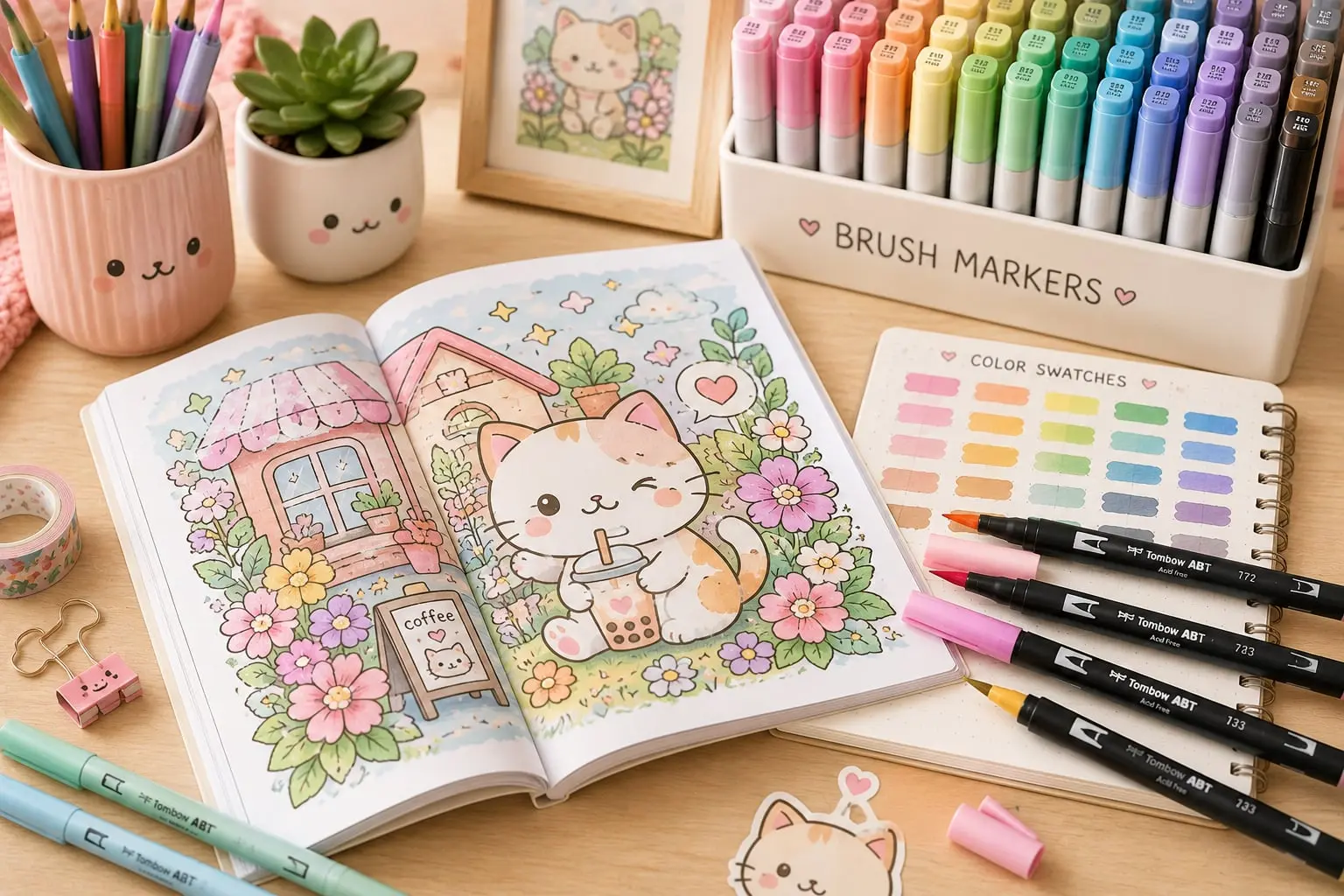
The colored set above can serve both lettering and other drawing activities. If your main goal is filling coloring-book areas, our brush-marker guide addresses that separate decision.
Firm versus flexible tips for a first brush pen
Firmness and size are separate choices. A small pen can have a softer tip, and a large brush can still vary in resistance. “Hard tip” on a Fudenosuke means a firmer flexible brush, not a ballpoint or metal nib.
A firmer brush is a reasonable starting point if small pressure changes tend to make your strokes too wide. A softer one may suit you if you naturally use a light touch and want the brush to respond more readily. Neither removes the need to practice transitions.
Try both pens in the Fudenosuke pack on the same suitable paper, with the same exercise. Look for the tool that lets you control the stroke without gripping tightly or forcing the tip. This is a way to discover your preference, not a claim that we measured either pen’s effort or performance.
Ink terminology deserves the same care. The Fudenosuke uses water-based pigment ink; the Dual Brush range uses water-based blendable ink. Those descriptions do not make the two inks interchangeable, establish a universal drying time, or guarantee that either behaves well on every notebook.
Calligraphy kits and practice paper
The smallest complete setup is one appropriate pen, suitable paper and instructions for that technique. Add a pencil and eraser if planning the placement helps you begin. A kit is useful when you want its additional functions; it is unnecessary when those tools are already in your drawer.
The beginner kit is an alternative route into the brush options here. Its permanent marker is a separate tool with a different ink system, so check its paper and handling guidance too. Do not assume every item in one kit can be used exactly like the brush pen.
For a practice pad, prioritize a smooth surface and enough room for your intended lettering. A pad that lies comfortably on the desk is useful; a textured drawing sketchbook can be the wrong match even when it has thick pages. Choose blank paper with a guideline sheet underneath when it is translucent enough, or smooth printed ruling if that is easier to see.
Do not buy a dedicated pad solely because its cover says “calligraphy.” Check whether the maker intends it for brush pens, fountain-style ink, dip pens or another medium. These can place different demands on paper. The right pad is the one that supports the chosen pen, not every possible lettering tool.
Paper that protects brush tips
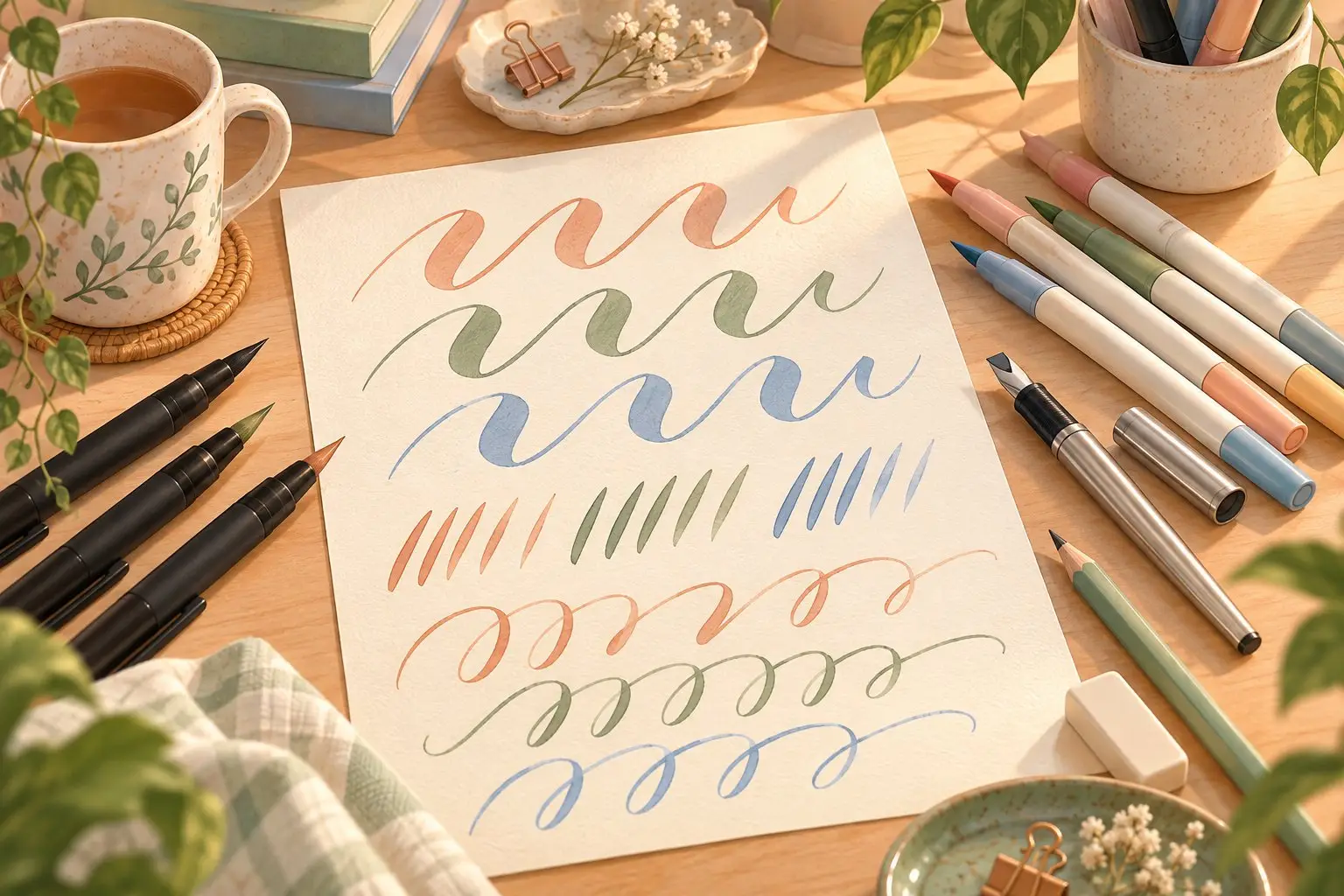
Tombow recommends smooth, non-textured paper for its brush tools. Rough surfaces can catch or wear a tip; excess pressure and an awkward angle can also make practice harder. The featured image is an original conceptual illustration, so its decorative paper texture is not a recommendation for a textured practice surface.
Before using a new paper for a finished piece, make a small trial:
- Draw a light line and a wider stroke with your normal lettering pressure.
- Add an overlapping stroke if that is part of your design.
- Let the ink dry before touching or erasing nearby pencil marks.
- Inspect the edge for feathering and the reverse for bleed-through or visible show-through.
Ghosting means you can see a mark through the sheet; bleed-through means ink has reached the reverse. Decide what matters for your project. Show-through may be acceptable on a one-sided practice sheet but distracting in a two-sided journal.
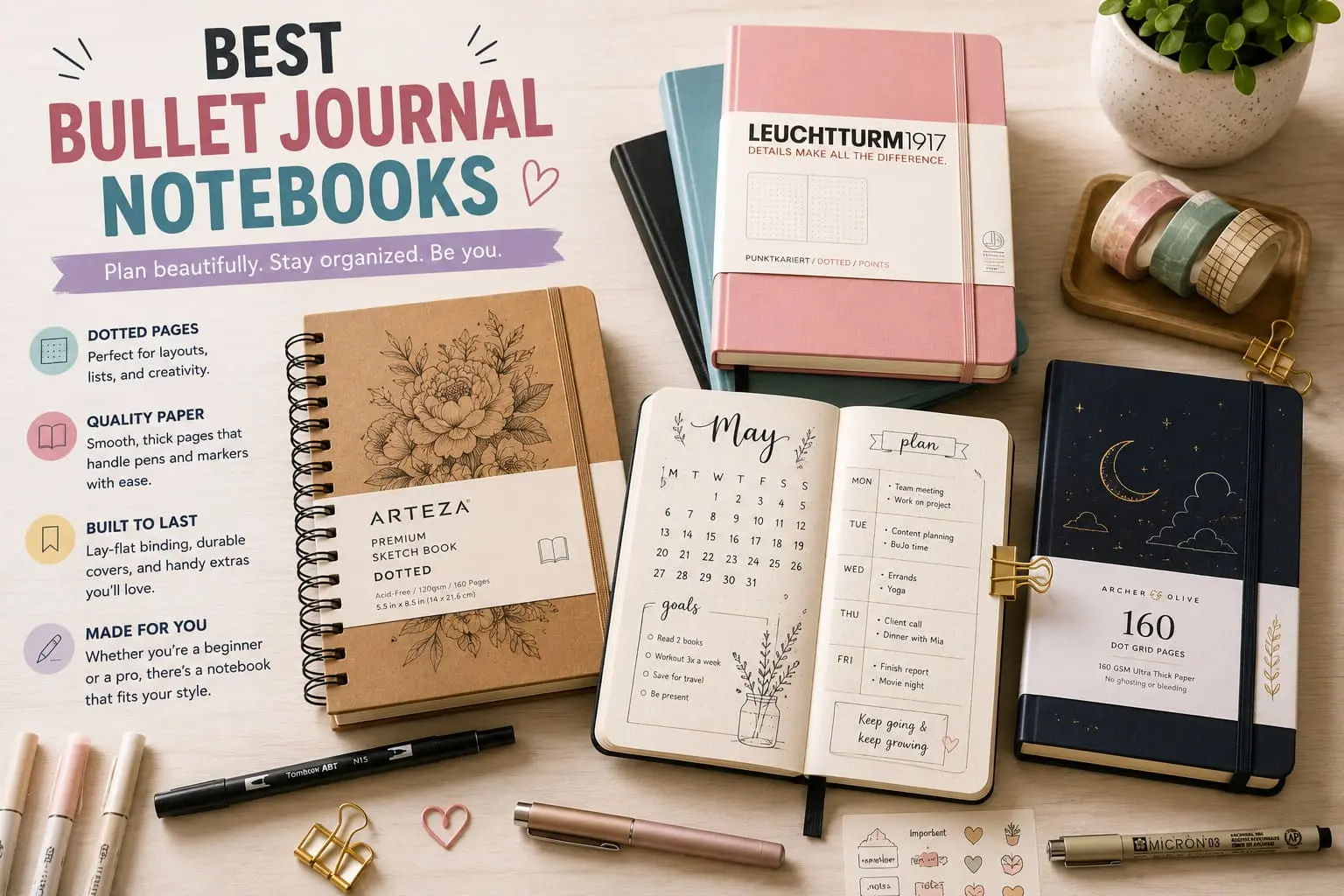
Our bullet journal notebook guide can help with ruling and binding choices, but a notebook’s weight or dotted layout is not proof of brush-ink compatibility. Keep practice on separate suitable sheets until you know how the finished notebook behaves.
Start practicing before collecting more pens
For brush lettering, use this short first session as an exercise rather than a speed challenge:
- Draw simple guidelines in pencil. Leave enough height and width for the brush you chose.
- Practice separate thin upstrokes and wider downstrokes. Hold the brush at a comfortable angle rather than pushing it vertically into the paper. Apply controlled pressure; do not crush the tip.
- Join a few strokes into curves. Lift the pen when you need to reset instead of trying to write the whole alphabet like ordinary cursive.
- Choose one short word. Sketch its placement, then work through the strokes slowly.
- Keep one observation. Note whether the next session needs larger letters, lighter pressure or different paper. Change one thing at a time.
Use Tombow’s lettering worksheets for exercises matched to Fudenosuke or Dual Brush tools. These are the maker’s resources, not KawaiiToons originals. Follow their printing and usage instructions and choose suitable smooth paper.
For the Parallel, use Pilot’s broad-edge instruction guide. Keep pressure even and practice the nib angle your chosen script requires; the brush-pressure exercise above is not the same technique. Use compatible cartridges and follow the supplied cleaning directions. Keep specialized dip-pen inks out of a cartridge pen unless the manufacturer explicitly approves them.
Left-handed calligraphy is a technique question
Left-handed beginners can use both brush and broad-edge tools. Start by adjusting the page position so you can see the stroke and keep your hand away from wet ink. Try a comfortable slant rather than forcing your wrist to imitate a right-handed demonstration.
Tombow’s left-handed lettering guidance discusses paper angle, brush angle and pressure. A small firm brush can be a practical starting point. It does not eliminate smearing; paper, wet ink and hand position still matter.
If a broad edge catches or leaves an incomplete line, check the contact and orientation against instructions for that script. Do not respond by pressing harder. A lesson or worksheet that demonstrates left-handed positioning can be more useful than a different color set.
Sources and the limits of these picks
Product descriptions draw on Tombow’s Fudenosuke information, Dual Brush Primary specifications, Lettering Basics Set contents and Pilot’s Parallel Pen information. Exact Amazon.com listings were checked for the recommended US variants and their purchase options; availability is a snapshot, not a promise of stock or delivery.
We have not used these exact products for this guide. Recommendations explain which documented tool format fits a beginner’s goal. They do not rank physical writing feel, quantify fraying, establish archival permanence or certify a pen as best for every left-handed writer. Start with one tool and let practice show you what you need next.
FAQ
What is the easiest calligraphy pen for beginners?
For small modern brush lettering, a firm Fudenosuke is a sensible first research pick because its small flexible tip offers more resistance than a large soft brush. The two-pack lets you compare the softer version too. If you want italic or blackletter, choose a broad-edge tool such as the Pilot Parallel instead. The easiest tool is the one that matches your alphabet and worksheet scale.
Are brush pens good for calligraphy?
Yes, for styles that use pressure changes to create thick and thin strokes, including modern brush calligraphy. They are not interchangeable with broad-edge pens, which vary line width through nib angle and stroke direction. Ordinary lettering can also be drawn with a pencil or fixed-width pen, then thickened by hand. Choose the technique before buying a set.
What paper should I use with brush pens?
Start with smooth, non-textured paper intended for the pen. Tombow recommends smooth art papers for Fudenosuke and smooth, non-textured paper for Dual Brush Pens. Rough surfaces can be harder on brush tips. Try a few representative strokes on the exact sheet and check for feathering and bleed-through; thickness alone does not establish compatibility.
Can left-handed people use calligraphy pens?
Yes. Experiment with the page angle and a comfortable hand position that keeps your hand away from wet ink. A small firm brush is a useful starting option, but no pen here is guaranteed smudge-proof. For a broad-edge pen, work on keeping the nib in contact with the page at the angle your script requires. Left-handed technique guidance can be more useful than buying a larger set.
Do I need a calligraphy kit or just pens?
One suitable pen, smooth paper and a practice guide are enough to begin. A pencil and eraser are useful for planning. Buy a kit when its included tools and instruction save you separate purchases; skip it if you already have those items. The Tombow starter kit overlaps the separate brush options and still needs paper.
Final recommendation
Start with the Fudenosuke two-pack and smooth practice paper for small modern calligraphy. Pick the Parallel 2.4 mm for broad-edge scripts. Choose the Dual Brush color set only when large colored lettering is the goal, or choose the beginner kit when its extra tools are useful. Practice a few basic strokes before buying more colors or nib sizes.
Related guides

Best Brush Markers for Coloring Books: 10 Picks for Shading & Blending
Find the best brush markers for coloring books, including water-based and alcohol picks for shading, blending, fine details, and bold fills.
Best Bullet Journal Notebooks: 10 Picks for Beginners & Creative Planning
The best bullet journal notebooks for beginners and creative planning. Compare paper weight, page count, dot grids, binding, and setup features.
Best Journaling Supplies for Beginners: 10 Essentials to Start With
The best journaling supplies for beginners, from journals and pens to highlighters, washi tape, stencils and adhesive. Build a simple starter kit.
Best Pens for Journaling: 10 Smooth, No-Bleed Picks
Best pens for journaling compared: quick-dry gel pens, no-bleed felt tips and archival fineliners, with picks for left-handed writers and thin paper.