
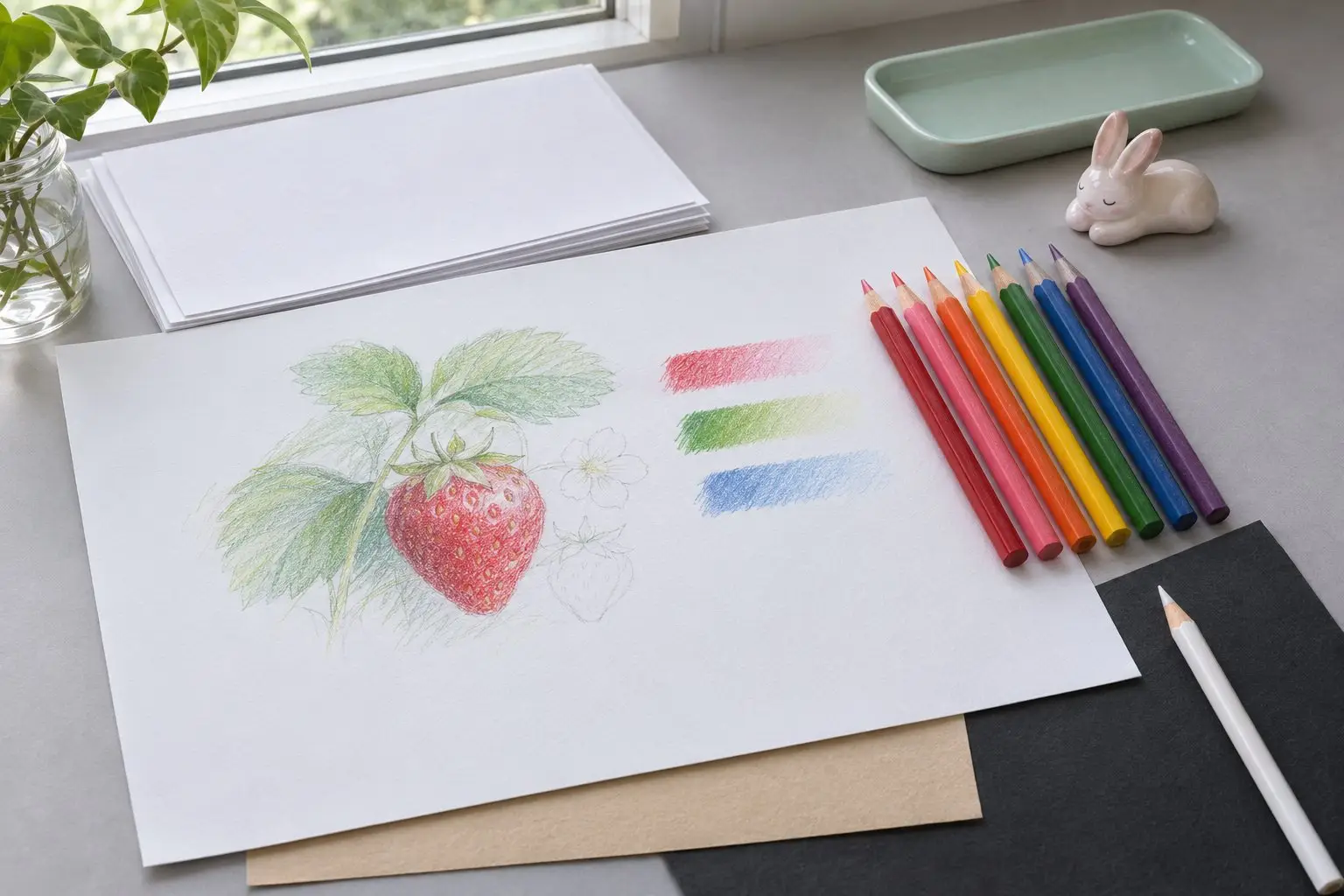
Quick answer
Choose the surface first, then compare weight, sheet size and count.
- Best for beginners: Strathmore 400 Colored Pencil offers a medium-tooth surface without starting on sanded paper.
- Best smooth option: Canson XL Bristol Smooth suits crisp outlines and small details.
- Best sanded option: UART 600 is for artists who specifically want an abrasive ground.
Choose by use case
If you wantLearning light layers on white paper

Strathmore 400 Series Colored Pencil Pad, 9 x 12, 30 Sheets
Best for beginnersResearch-based reviewA dedicated colored-pencil pad with a medium-tooth surface and 30 sheets.
If you wantDry shading on a substantial white support

Strathmore 300 Series Bristol Vellum Pad, 9 x 12, 20 Sheets
Best stiff vellum sheetResearch-based reviewTwenty sheets of 270 gsm Bristol with the vellum finish rather than smooth.
If you wantSmall motifs, clean outlines and controlled detail

Canson XL Bristol Smooth 9x12
Best smooth optionResearch-based reviewA bright-white 260 gsm Bristol pad for artists who prefer less surface texture.
If you wantDeveloped drawings on a non-sanded cotton ground

Legion Stonehenge White Pad, 9 x 12, 15 Sheets
Best cotton-paper optionResearch-based reviewA 15-sheet pad of 250 gsm, 100% cotton Stonehenge White.
If you wantDeliberately exploring an abrasive layering surface

UART Premium Sanded Pastel Paper, 600 Grade, 9 x 12, 10 Sheets
Best sanded optionResearch-based reviewA beige 600-grade sanded ground for a different approach to building colored pencil.
If you wantPlacing highlights and shadows around a middle tone

Strathmore 400 Series Toned Tan Sketch Pad 9 x 12
Best toned-paper starterResearch-based reviewA 50-sheet tan sketch pad for working with light and dark pencils.
If you wantBright highlights and opaque pencil marks

Strathmore 400 Series Artagain Coal Black Pad, 9 x 12, 24 Sheets
Best black-paper optionResearch-based reviewA medium-surface black pad for drawings that use the dark ground as part of the image.
Seven paper choices at a glance
Each recommended edition is 9 x 12 inches; the surfaces and weights are deliberately different.
| Paper | Surface / ground | Maker weight | Sheets | Choose it for |
|---|---|---|---|---|
| Strathmore 400 Colored Pencil | Medium tooth; white | 163 gsm | 30 | Starting dry pencil layers |
| Strathmore 300 Bristol Vellum | Vellum tooth; white | 270 gsm | 20 | A stiff drawing sheet |
| Canson XL Bristol Smooth | Smooth; bright white | 260 gsm | 25 | Crisp details and outlines |
| Stonehenge White | Cotton drawing paper; white | 250 gsm | 15 | Developed drawings on cotton |
| UART 600 | Fine abrasive; beige | Not compared by gsm | 10 | A sanded layering surface |
| Strathmore 400 Toned Tan | Medium tooth; tan | 118 gsm | 50 | Light-and-dark value studies |
| Strathmore Artagain Coal Black | Medium surface; black | 160 gsm | 24 | Bright marks on a dark ground |
Exact listings and manufacturer specifications checked November 23, 2026. Gsm describes mass per area, not a tested layer count or thickness. UART is compared by its stated grit rather than an unconfirmed weight.
Product comparison
| Product | Best for | Watch out | Price & shop |
|---|---|---|---|
| Strathmore 400 Series Colored Pencil Pad, 9 x 12, 30 Sheets (opens Amazon in a new tab) Best for beginnersResearch-based review | Best for beginners | At 163 gsm, it is lighter than the Bristol and Stonehenge choices. It is a dry-drawing recommendation; neither its weight nor the product name establishes suitability for a wet wash. | |
| Strathmore 300 Series Bristol Vellum Pad, 9 x 12, 20 Sheets (opens Amazon in a new tab) Best stiff vellum sheetResearch-based review | Best stiff vellum sheet | You get fewer sheets than the beginner pad, and extra weight does not promise extra layers. The Amazon page may put purchase offers behind See All Buying Options; confirm that the chosen offer is the 342-109 vellum pad. | |
| Canson XL Bristol Smooth 9x12 (opens Amazon in a new tab) Best smooth optionResearch-based review | Best smooth option | Choose it for the finish rather than a promise of maximum layering. If you want visible grain or a strongly gripping ground, start with one of the medium-tooth papers instead. | |
| Legion Stonehenge White Pad, 9 x 12, 15 Sheets (opens Amazon in a new tab) Best cotton-paper optionResearch-based review | Best cotton-paper option | Only 15 sheets are included. Cotton content does not guarantee your particular pencil technique will work better, and this White edition should not be confused with Warm White, Aqua watercolor or lightweight Stonehenge. | |
| UART Premium Sanded Pastel Paper, 600 Grade, 9 x 12, 10 Sheets (opens Amazon in a new tab) Best sanded optionResearch-based review | Best sanded option | The abrasive surface can wear a pencil point faster, and the 10-sheet pad leaves less room for casual experiments. The exact Amazon listing carries a California Proposition 65 cancer warning; read its current labeling before purchase. This is not presented as a children's paper kit. | |
| Strathmore 400 Series Toned Tan Sketch Pad 9 x 12 (opens Amazon in a new tab) Best toned-paper starterResearch-based review | Best toned-paper starter | At 118 gsm it is the lightest paper here, and the tan ground affects exposed highlights and pale colors. Choose the 400 Toned Sketch edition rather than assuming the thicker Toned Mixed Media paper is the same product. | |
| Strathmore 400 Series Artagain Coal Black Pad, 9 x 12, 24 Sheets (opens Amazon in a new tab) Best black-paper optionResearch-based review | Best black-paper option | Not every colored pencil will show strongly on black. Test the actual shades you own before planning a large drawing; extra pressure is not a reliable substitute for sufficient opacity. |
How we chose
- Compared 7 research-based picks from current product listings.
- Product listings checked on November 23, 2026.
- A useful distinction between medium-tooth drawing paper, vellum and smooth Bristol, cotton paper, sanded paper, tan and black grounds.
- Maker-supported media suitability, weight where available, acid-free statements, exact sheet size and count.
- Hands-on testing: none — all picks are research-based
- Product listings checked
- Hands-on testing
- None of the 7 picks — all are research-based
- Labels explained
- How we test and label products
We compared manufacturer-stated surfaces, intended media, weights, pad sizes and contents, and reviewed the matching Amazon.com detail pages for purchase offers and exact product imagery. The seven choices cover different drawing needs. We have not drawn on, erased, burnished, wetted or measured these papers, and we did not count how many pencil layers they accept.
What we compared
- A useful distinction between medium-tooth drawing paper, vellum and smooth Bristol, cotton paper, sanded paper, tan and black grounds.
- Maker-supported media suitability, weight where available, acid-free statements, exact sheet size and count.
- Exact edition and variant match on Amazon.com, including surface finish and paper color.
- Practical tradeoffs for beginners, detail work and layering without treating marketing claims as measured results.
What we did not test
- Actual layer capacity, eraser resistance, burnishing behavior, pencil consumption or color appearance.
- Solvent compatibility, wet-media performance, printer feeding, aging or comparative value at live prices.
Testing status by pick
- Strathmore 400 Series Colored Pencil Pad, 9 x 12, 30 SheetsResearch-based review
- Strathmore 300 Series Bristol Vellum Pad, 9 x 12, 20 SheetsResearch-based review
- Canson XL Bristol Smooth 9x12Research-based review
- Legion Stonehenge White Pad, 9 x 12, 15 SheetsResearch-based review
- UART Premium Sanded Pastel Paper, 600 Grade, 9 x 12, 10 SheetsResearch-based review
- Strathmore 400 Series Toned Tan Sketch Pad 9 x 12Research-based review
- Strathmore 400 Series Artagain Coal Black Pad, 9 x 12, 24 SheetsResearch-based review
Sources
- Colored-pencil paper selection and surface guidance — Strathmore Artist Papers
- 400 Series Colored Pencil paper and exact pad sizes — Strathmore Artist Papers
- 300 Series Bristol finishes and 342-109 pad — Strathmore Artist Papers
- XL Bristol US surface and weight specifications — Canson
- Stonehenge White cotton content, weight and pad formats — Legion Paper
- Sanded-paper formats and grades — UART
- Toned Sketch paper weight and tan pad contents — Strathmore Artist Papers
- Artagain paper and Coal Black pad contents — Strathmore Artist Papers
Product details and drawbacks
Strathmore 400 Series Colored Pencil Pad, 9 x 12, 30 Sheets (opens Amazon in a new tab)
A dedicated colored-pencil pad with a medium-tooth surface and 30 sheets.

Why it fits this guide
The maker specifies a vellum surface for building color, making this a straightforward place to learn before choosing a specialist ground. Its wire-bound 9 x 12 edition has micro-perforated sheets, useful when you want to remove a finished drawing.
Honest drawback
At 163 gsm, it is lighter than the Bristol and Stonehenge choices. It is a dry-drawing recommendation; neither its weight nor the product name establishes suitability for a wet wash.
Specifications
- 477-9; 9 x 12 inches; 30 sheets
- 163 gsm; medium surface; acid-free per maker
- Wire binding; micro-perforated sheets
Best forLearning light layers on white paper
Pros
- Surface specifically intended for colored pencil
- Removable sheets for finished studies
Cons
- Less substantial than the Bristol options
- Layer capacity not independently tested
Strathmore 300 Series Bristol Vellum Pad, 9 x 12, 20 Sheets (opens Amazon in a new tab)
Twenty sheets of 270 gsm Bristol with the vellum finish rather than smooth.

Why it fits this guide
This is the option to choose when a stiff sheet and a textured drawing surface both matter. The exact 342-109 edition has vellum tooth; check the finish rather than ordering by the yellow cover alone.
Honest drawback
You get fewer sheets than the beginner pad, and extra weight does not promise extra layers. The Amazon page may put purchase offers behind See All Buying Options; confirm that the chosen offer is the 342-109 vellum pad.
Specifications
- 342-109; 9 x 12 inches; 20 sheets
- 270 gsm; vellum finish
- Tape-bound pad
Best forDry shading on a substantial white support
Pros
- Stiff support for a finished drawing
- Finish intended for dry pencil media
Cons
- Fewer sheets than the dedicated pencil pad
- Smooth and vellum editions are easy to confuse
Canson XL Bristol Smooth 9x12 (opens Amazon in a new tab)
A bright-white 260 gsm Bristol pad for artists who prefer less surface texture.

Why it fits this guide
The smooth ground makes this a useful counterpoint to the toothier pads, especially when precise outlines are central to your drawing. Canson lists colored pencil among its intended media, so a smooth surface is a valid stylistic choice.
Honest drawback
Choose it for the finish rather than a promise of maximum layering. If you want visible grain or a strongly gripping ground, start with one of the medium-tooth papers instead.
Specifications
- 9 x 12 inches; 25 sheets
- 260 gsm; smooth; bright white
- Acid-free per maker
Best forSmall motifs, clean outlines and controlled detail
Pros
- Substantial smooth drawing sheet
- Useful for pencil with pen-and-ink outlines
Cons
- Less textured than the vellum choices
- No hands-on comparison of blending or erasing
Legion Stonehenge White Pad, 9 x 12, 15 Sheets (opens Amazon in a new tab)
A 15-sheet pad of 250 gsm, 100% cotton Stonehenge White.

Why it fits this guide
Legion explicitly identifies colored pencil as a use for this cotton drawing paper. Choose it when cotton content and a substantial sheet are your priorities, while keeping an ordinary drawing-paper approach rather than moving to an abrasive coating.
Honest drawback
Only 15 sheets are included. Cotton content does not guarantee your particular pencil technique will work better, and this White edition should not be confused with Warm White, Aqua watercolor or lightweight Stonehenge.
Specifications
- L21-STP250WH912; 9 x 12 inches; 15 sheets
- 250 gsm; 100% cotton; White edition
- Acid-free and neutral pH per maker
Best forDeveloped drawings on a non-sanded cotton ground
Pros
- Documented cotton composition
- Maker supports colored-pencil use
Cons
- Smaller sheet count
- Several different Stonehenge paper families share the name
UART Premium Sanded Pastel Paper, 600 Grade, 9 x 12, 10 Sheets (opens Amazon in a new tab)
A beige 600-grade sanded ground for a different approach to building colored pencil.

Why it fits this guide
UART identifies its paper for colored-pencil work and positions 600 grade toward detail. Consider this specialist option when ordinary paper feels too slick for the technique you want to explore, while allowing time to learn how your pencils respond.
Honest drawback
The abrasive surface can wear a pencil point faster, and the 10-sheet pad leaves less room for casual experiments. The exact Amazon listing carries a California Proposition 65 cancer warning; read its current labeling before purchase. This is not presented as a children's paper kit.
Specifications
- 600 grade; beige; 9 x 12 inches
- 10-sheet pad; sanded surface
Best forDeliberately exploring an abrasive layering surface
Pros
- Distinct abrasive ground
- Fine-grade option for deliberate detail work
Cons
- Different handling from ordinary paper
- Listing warning and smaller pad require consideration
Strathmore 400 Series Toned Tan Sketch Pad 9 x 12 (opens Amazon in a new tab)
A 50-sheet tan sketch pad for working with light and dark pencils.

Why it fits this guide
The tan ground supplies a middle value, so a white pencil can add light while darker colors establish shadows. This is a useful change of exercise for someone who already has white paper and wants to explore how the background participates in a drawing.
Honest drawback
At 118 gsm it is the lightest paper here, and the tan ground affects exposed highlights and pale colors. Choose the 400 Toned Sketch edition rather than assuming the thicker Toned Mixed Media paper is the same product.
Specifications
- 412-9; 9 x 12 inches; 50 sheets
- 118 gsm; medium surface; tan
- Acid-free per maker
Best forPlacing highlights and shadows around a middle tone
Pros
- Middle-value ground for highlight studies
- 50 sheets for repeated practice
Cons
- Lighter support than the other recommendations
- Does not preserve a white-paper color appearance
Strathmore 400 Series Artagain Coal Black Pad, 9 x 12, 24 Sheets (opens Amazon in a new tab)
A medium-surface black pad for drawings that use the dark ground as part of the image.

Why it fits this guide
Artagain is a drawing-paper option the maker lists for colored pencil. Use the Coal Black edition when you want to leave much of the background untouched and build light marks outward from it, such as a white flower study or a small night scene.
Honest drawback
Not every colored pencil will show strongly on black. Test the actual shades you own before planning a large drawing; extra pressure is not a reliable substitute for sufficient opacity.
Specifications
- 445-109; 9 x 12 inches; 24 sheets
- 160 gsm; medium surface; Coal Black
- Glue bound; acid-free per maker
Best forBright highlights and opaque pencil marks
Pros
- A true dark ground for light marks
- Removable sheets for individual drawings
Cons
- Pencil opacity becomes especially important
- Dark paper changes the drawing process
Corrections
Spotted an error or outdated detail? Read how we handle corrections.
Related guides
Best Coloring Books for Colored Pencils: Paper That Layers Well
Six research-based coloring books for colored pencils, compared by paper tooth, page format, binding, artwork detail and room for layered shading.
How to Blend Colored Pencils Smoothly
Learn how to blend colored pencils with light layers, burnishing and blender pencils, plus solvent precautions, coloring-book tips and fixes for grainy color.
How to Use Alcohol Markers (Beginner Guide)
Learn how to use alcohol markers with the right paper, simple blending and layering steps, fixes for streaks and bleed-through, and a first practice project.
Best Colored Pencil Blenders and Burnishers for Smoother Shading
Compare 8 colorless blender pencils, burnishers, pens and liquids for smoother colored-pencil gradients, softer edges and polished final layers.
Best Coloring Books for Teens: Creative Picks That Aren’t Childish
Six research-based coloring books for teens, compared by theme, detail level, page format, paper disclosure and fit for pencils, pens or markers.
Best Crayons for Toddlers: Washable, Jumbo and Easy-Grip Picks
Eight research-based toddler crayons compared by current age guidance, chunky shape, washability claims, rolling, palette and honest safety limits.


Latest guides
Gift Ideas for People Who Love Coloring
Thoughtful gift ideas for adults who love coloring, from marker sets and coloring books to lap desks, lamps and storage, sorted by budget and style.
Best Fountain Pens for Beginners
Compare beginner-friendly fountain pens for journaling and everyday writing, with tips on nib sizes, cartridges vs converters, ink and paper.
Best Cute Pens and Kawaii Gel Pens
Cute and kawaii pens for notes and journals, from a bunny gel pen to pastel and multi-color pens, with clear ink, tip-size and refill comparisons.
Best Travel Watercolor Sets and Pocket Palettes
Compare travel watercolor sets and pocket palettes for sketching on the go, with tips on pan count, water brushes, size and travel sketchbooks.
Best Watercolor Brush Pens and Watercolor Markers
Compare watercolor brush pens and markers that blend with water, with tips on paper, water brushes and using them safely in your coloring books.
Best Watercolor Paints and Sets for Beginners
Compare beginner watercolor paint sets, from student pan sets to artist-grade starters, with advice on pans vs tubes, brushes, paper and what to buy first.


