
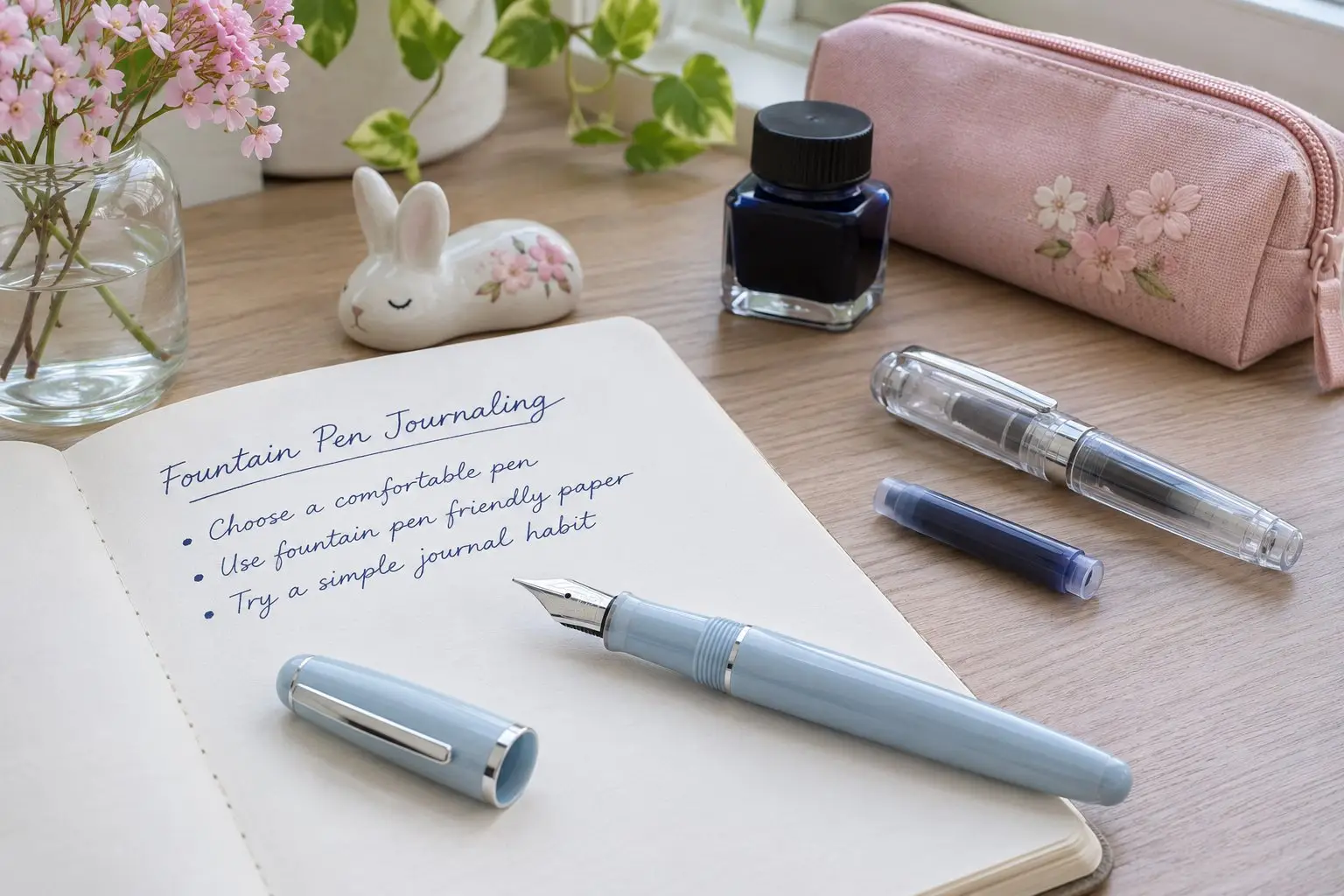
Quick answer
A first fountain pen should fit your handwriting and be straightforward to refill. A cartridge is enough to begin.
- Best for learning nib orientation: Pilot Kakuno Fine adds a visible smiley-face guide.
- Best simple budget starter: Platinum Preppy Crystal Fine has a clear body and Slip & Seal cap.
- Best metal-body journal option: Pilot Metropolitan Fine pairs a brass barrel with a conventional appearance.
Choose by use case
If you wantA first fountain pen for compact everyday journal writing

Pilot Kakuno Fountain Pen, White Body and Soft Blue Cap, Fine
Best for learning nib orientationResearch-based reviewA white-and-soft-blue Fine nib pen with a smiley face that shows the writing side.
If you wantTrying refillable fountain-pen writing with a clear, straightforward pen

Platinum Preppy Crystal Fountain Pen, Fine 03
Best simple budget starterResearch-based reviewA transparent Preppy with a Fine 03 steel nib and a cap designed to limit drying.
If you wantJournalers who prefer a conventional black pen with a brass barrel

Pilot Metropolitan Classic Fountain Pen, Black, Fine
Best metal-body journal optionResearch-based reviewA Fine nib Metropolitan with a black brass barrel and stainless steel accents.
If you wantLarger journal writing when a guided grip feels natural

LAMY Safari Fountain Pen, Aquasky, Medium
Best shaped-grip medium optionResearch-based reviewAn aquasky Safari with a Medium steel nib, shaped grip and ink-level window.
If you wantWriters who want a full-size starter with compatible standard cartridges

Kaweco Perkeo Fountain Pen, All Black, Fine
Best standard-cartridge optionResearch-based reviewA faceted All Black Perkeo with a Fine nib and guided grip.
Compare the exact starter pens
Nib letters describe grades, not a universal measured line width. These are five different pen families, each sold here as one pen.
| Pen / selected nib | Body / grip | Cap | Cartridge route | Bottled-ink decision |
|---|---|---|---|---|
| Pilot Kakuno / Fine | White resin; soft blue cap; shaped grip | Pull-off | Pilot fountain-pen cartridges | CON-40 or CON-70N per Pilot; sold separately |
| Preppy Crystal / Fine 03 | Transparent PC resin; round grip | Snap; Slip & Seal | Platinum fountain-pen cartridges | Compatible Platinum converter; sold separately |
| Metropolitan 91111 / Fine | Black brass barrel; round grip | Pull-off | Pilot IC-100 family in exact branded listing | Pilot-compatible converter; exact included type not confirmed |
| Safari aquasky / Medium | Plastic; shaped grip and ink window | Pull-off | LAMY T 10; blue cartridge included | LAMY Z 28; sold separately |
| Perkeo All Black / Fine | Faceted plastic; shaped grip | Pull-off | Kaweco or compatible standard cartridges | Suitable standard converter; sold separately |
Editions and purchase offers checked November 25, 2026. Confirm the nib and seller package before ordering. Compatibility does not establish that a converter is included. Start with a cartridge if you want to postpone buying bottled ink.
Product comparison
| Product | Best for | Watch out | Price & shop |
|---|---|---|---|
| Pilot Kakuno Fountain Pen, White Body and Soft Blue Cap, Fine (opens Amazon in a new tab) Best for learning nib orientationResearch-based review | Best for learning nib orientation | The shaped grip may feel restrictive if you rotate your pen, and there is no conventional pocket clip. A Fine label does not guarantee smoothness or a particular line width on your paper. | |
| Platinum Preppy Crystal Fountain Pen, Fine 03 (opens Amazon in a new tab) Best simple budget starterResearch-based review | Best simple budget starter | The basic plastic body is a different proposition from a metal pen, and a separately purchased converter adds to the total outlay. We do not treat the maker's cap claim as a reason to neglect cleaning or storage. | |
| Pilot Metropolitan Classic Fountain Pen, Black, Fine (opens Amazon in a new tab) Best metal-body journal optionResearch-based review | Best metal-body journal option | A metal barrel is a preference, not proof of comfort during a long entry. The branded listing's converter table is inconsistent, so we do not promise a specific included converter or recommend a part based on that table. Confirm the seller's package before buying for bottled ink. | |
| LAMY Safari Fountain Pen, Aquasky, Medium (opens Amazon in a new tab) Best shaped-grip medium optionResearch-based review | Best shaped-grip medium option | Try the grip before choosing it if you hold a pen at an unusual rotation. The linked edition is Medium, not Fine or the separate LH nib, and may be less suitable for tiny planner boxes. | |
| Kaweco Perkeo Fountain Pen, All Black, Fine (opens Amazon in a new tab) Best standard-cartridge optionResearch-based review | Best standard-cartridge option | The grip is shaped rather than round, and a clip is not part of the pictured pen. Standard-cartridge compatibility does not establish that every converter or cartridge length fits. Check the part and barrel clearance before buying extras. |
How we chose
- Compared 5 research-based picks from current product listings.
- Product listings checked on November 25, 2026.
- Five distinct refillable fountain-pen families with identifiable nibs and current Amazon.com purchase offers.
- Clear cartridge compatibility and a distinction between optional converters and included supplies.
- Hands-on testing: none — all picks are research-based
- Product listings checked
- Hands-on testing
- None of the 5 picks — all are research-based
- Labels explained
- How we test and label products
We manually reviewed five exact Amazon.com detail pages, selected nib and body variants, active purchase offers and matching main images. Manufacturer product pages, catalogs and care instructions support the material, nib, filling and maintenance facts. We compared the first-fill decision, cartridge family, cap, grip and suitability for journal writing. We have not handled these pens or measured their performance.
What we compared
- Five distinct refillable fountain-pen families with identifiable nibs and current Amazon.com purchase offers.
- Clear cartridge compatibility and a distinction between optional converters and included supplies.
- Different grip and body choices for learning, ordinary journal entries and larger handwriting.
- A removable cap and documented refill route rather than an unexplained decorative pen set.
- Manufacturer-supported facts without borrowed testing claims or universal no-bleed promises.
What we did not test
- Smoothness, nib alignment, ink flow, starting reliability, cap sealing duration or long-term durability.
- Line width, ink capacity, drying time, paper-specific feathering, ghosting or bleed-through.
- Grip comfort, fatigue, left-handed performance or suitability for any particular child.
Testing status by pick
- Pilot Kakuno Fountain Pen, White Body and Soft Blue Cap, FineResearch-based review
- Platinum Preppy Crystal Fountain Pen, Fine 03Research-based review
- Pilot Metropolitan Classic Fountain Pen, Black, FineResearch-based review
- LAMY Safari Fountain Pen, Aquasky, MediumResearch-based review
- Kaweco Perkeo Fountain Pen, All Black, FineResearch-based review
Sources
- Kakuno use, first cartridge, nib orientation and compatible converters — Pilot
- Pilot MR Metropolitan materials and Kakuno design — Pilot Corporation of America
- MR fountain pen and CON-B filling demonstration — Pilot Pen Australia
- Preppy Crystal PSQC-400 nib and body specifications — Platinum Pen
- Preppy family and Slip & Seal cap — Platinum Pen
- Platinum cartridge, converter and care instructions linked from Preppy — Platinum Pen
- Safari aquasky, steel nib, blue T 10 cartridge and Z 28 converter — LAMY
- Nib choice, ink changes and plain-water cleaning — LAMY
- Perkeo All Black design, F and M choices, cartridge and converter route — Kaweco
Product details and drawbacks
Pilot Kakuno Fountain Pen, White Body and Soft Blue Cap, Fine (opens Amazon in a new tab)
A white-and-soft-blue Fine nib pen with a smiley face that shows the writing side.

Why it fits this guide
The visible face gives a beginner a simple orientation cue. Pilot's instructions start with a cartridge and identify optional converters for later, so there is no need to begin by buying an ink bottle. The soft blue cap also suits a pastel stationery kit without novelty packaging.
Honest drawback
The shaped grip may feel restrictive if you rotate your pen, and there is no conventional pocket clip. A Fine label does not guarantee smoothness or a particular line width on your paper.
Specifications
- FKA-1SR-SLF; Fine nib
- White body and soft blue cap; pull-off cap
- Pilot cartridges; CON-40 or CON-70N separately
Best forA first fountain pen for compact everyday journal writing
Pros
- Visible nib-orientation cue
- Cartridge start with a documented converter route
Cons
- No conventional pocket clip
- Guided grip will not suit every hold
Platinum Preppy Crystal Fountain Pen, Fine 03 (opens Amazon in a new tab)
A transparent Preppy with a Fine 03 steel nib and a cap designed to limit drying.

Why it fits this guide
The clear body makes the cartridge visible, and Platinum identifies the Crystal's Fine nib and PC resin construction. Its Slip & Seal cap is a useful design feature for someone learning a new writing routine, although we have not tested its sealing performance.
Honest drawback
The basic plastic body is a different proposition from a metal pen, and a separately purchased converter adds to the total outlay. We do not treat the maker's cap claim as a reason to neglect cleaning or storage.
Specifications
- PSQC-400 Crystal; Fine 03 stainless steel nib
- Transparent PC resin body
- Snap cap with Slip & Seal; Platinum cartridge system
Best forTrying refillable fountain-pen writing with a clear, straightforward pen
Pros
- Simple visible cartridge setup
- Sealing-cap design documented by Platinum
Cons
- Basic plastic construction
- Optional converter is an additional purchase
Pilot Metropolitan Classic Fountain Pen, Black, Fine (opens Amazon in a new tab)
A Fine nib Metropolitan with a black brass barrel and stainless steel accents.

Why it fits this guide
Choose this for the material and understated shape rather than a promise that spending more improves your handwriting. The exact 91111 listing identifies the Fine nib and black ink, while Pilot's US brochure documents the Metropolitan's brass construction and refillable design.
Honest drawback
A metal barrel is a preference, not proof of comfort during a long entry. The branded listing's converter table is inconsistent, so we do not promise a specific included converter or recommend a part based on that table. Confirm the seller's package before buying for bottled ink.
Specifications
- 91111; black Classic Design; Fine nib
- Brass barrel; stainless steel accents and nib
- Pull-off cap; refillable Pilot ink system
Best forJournalers who prefer a conventional black pen with a brass barrel
Pros
- Brass body with a restrained appearance
- Identifiable US model and nib
Cons
- Metal-body comfort not physically assessed
- Exact included converter type not confirmed
LAMY Safari Fountain Pen, Aquasky, Medium (opens Amazon in a new tab)
An aquasky Safari with a Medium steel nib, shaped grip and ink-level window.

Why it fits this guide
This selected edition offers a Medium alternative to the Fine nibs elsewhere in the guide. LAMY documents a blue T 10 cartridge and optional Z 28 converter. The viewing window and wire clip add everyday utility alongside the pastel blue body.
Honest drawback
Try the grip before choosing it if you hold a pen at an unusual rotation. The linked edition is Medium, not Fine or the separate LH nib, and may be less suitable for tiny planner boxes.
Specifications
- Aquasky; Medium polished steel nib
- Plastic body; shaped grip; ink window; pull-off cap
- One blue LAMY T 10 cartridge; Z 28 converter optional
Best forLarger journal writing when a guided grip feels natural
Pros
- Visible ink window and wire clip
- Named cartridge and converter system
Cons
- Grip shape is personal
- Selected Medium edition is not the dedicated left-handed nib
Kaweco Perkeo Fountain Pen, All Black, Fine (opens Amazon in a new tab)
A faceted All Black Perkeo with a Fine nib and guided grip.

Why it fits this guide
Kaweco's branded product description specifies its own and compatible standard cartridges, while the maker offers suitable standard converters separately. This gives it a different refill proposition from the other brands here. The All Black finish is a quiet option for an everyday notebook.
Honest drawback
The grip is shaped rather than round, and a clip is not part of the pictured pen. Standard-cartridge compatibility does not establish that every converter or cartridge length fits. Check the part and barrel clearance before buying extras.
Specifications
- All Black; Fine nib
- Plastic body; faceted barrel and cap; pull-off cap
- Ink cartridge included; suitable standard converter separate
Best forWriters who want a full-size starter with compatible standard cartridges
Pros
- Maker-documented standard refill route
- Full-size body for desk writing
Cons
- No fitted clip in this edition
- Shaped grip and accessory fit need consideration
Corrections
Spotted an error or outdated detail? Read how we handle corrections.
Related guides
Best Bullet Journal Notebooks: 10 Picks for Beginners & Creative Planning
The best bullet journal notebooks for beginners and creative planning. Compare paper weight, page count, dot grids, binding, and setup features.
Best Calligraphy Pens for Beginners
Compare the best calligraphy pens for beginners, from soft and firm brush pens to chisel-tip sets, with tips on tip size, paper and practice.
Best Journals for Beginners: 10 Easy Notebooks to Start Journaling
The best journals for beginners, from simple lined notebooks to guided and dot-grid picks. Compare paper, layout, size, and ease of use.
Best Pens for Journaling: 10 Smooth, No-Bleed Picks
Best pens for journaling compared: quick-dry gel pens, no-bleed felt tips and archival fineliners, with picks for left-handed writers and thin paper.
What Is a Junk Journal? A Beginner's Guide to Starting One
What a junk journal is, how it differs from scrapbooking and bullet journaling, and a simple step-by-step way to start your first one today.
Best Cute Pens and Kawaii Gel Pens
Cute and kawaii pens for notes and journals, from a bunny gel pen to pastel and multi-color pens, with clear ink, tip-size and refill comparisons.


Latest guides
Gift Ideas for People Who Love Coloring
Thoughtful gift ideas for adults who love coloring, from marker sets and coloring books to lap desks, lamps and storage, sorted by budget and style.
Best Cute Pens and Kawaii Gel Pens
Cute and kawaii pens for notes and journals, from a bunny gel pen to pastel and multi-color pens, with clear ink, tip-size and refill comparisons.
Best Paper for Colored Pencils
Find the best paper for colored pencils, comparing tooth, weight and surface for layering and blending, with picks for beginners and detail art.
Best Travel Watercolor Sets and Pocket Palettes
Compare travel watercolor sets and pocket palettes for sketching on the go, with tips on pan count, water brushes, size and travel sketchbooks.
Best Watercolor Brush Pens and Watercolor Markers
Compare watercolor brush pens and markers that blend with water, with tips on paper, water brushes and using them safely in your coloring books.
Best Watercolor Paints and Sets for Beginners
Compare beginner watercolor paint sets, from student pan sets to artist-grade starters, with advice on pans vs tubes, brushes, paper and what to buy first.


