
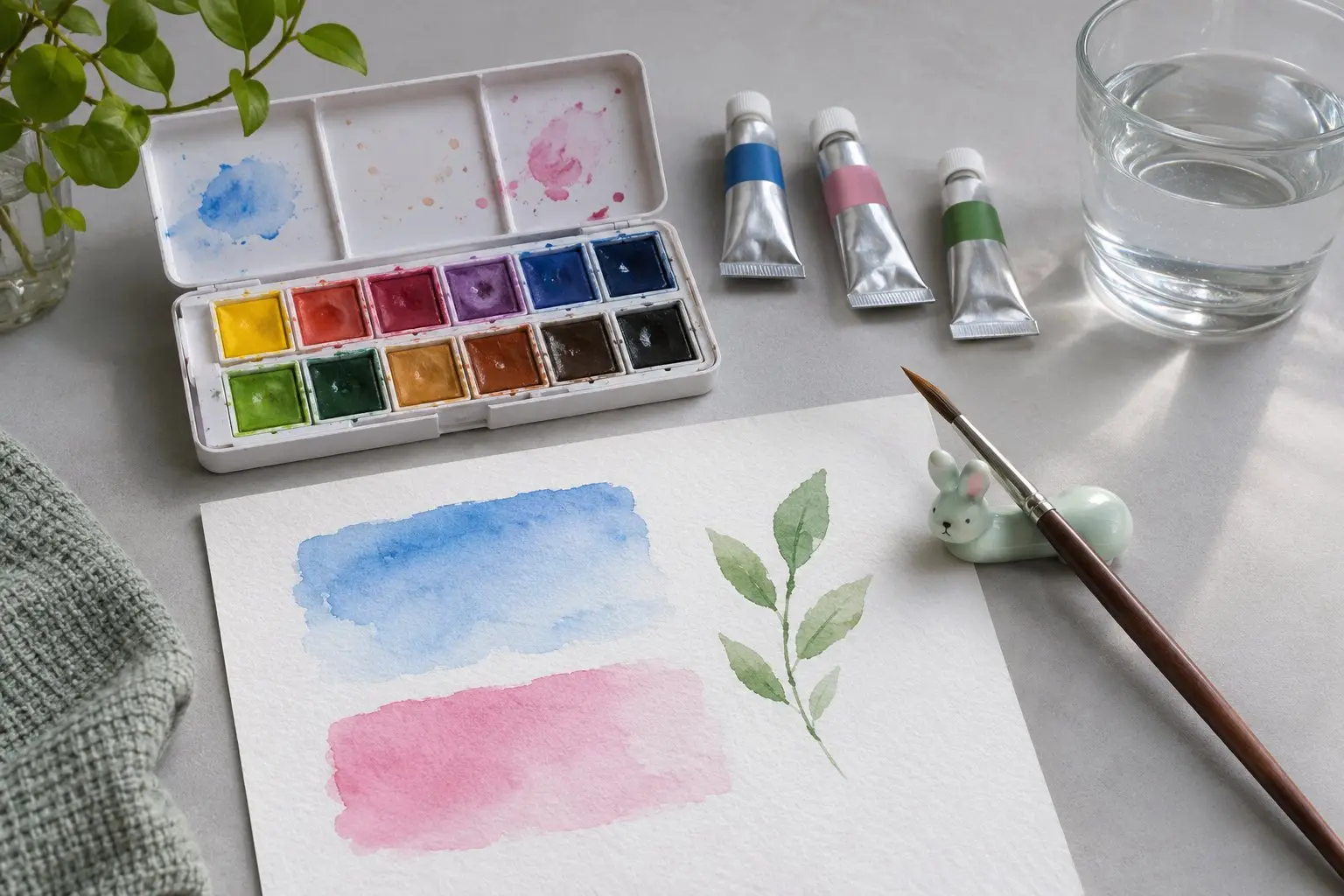
Quick answer
Choose the paint format you will use, then leave room in your budget for paper.
- Best first pan set: Cotman Sketchers’ Pocket Set keeps the starting palette to 12 colors.
- Best with a water brush: Sakura Koi 24 combines ready-made colors with a refillable water brush.
- Best step-up mixing set: Daniel Smith Essentials provides six small tubes for learning mixtures.
Choose by use case
If you wantBeginners who want a small, conventional starting palette

Winsor & Newton Cotman Sketchers’ Pocket Set, 12 Half Pans
Best first pan setResearch-based reviewTwelve half pans and a travel brush make the first setup straightforward.
If you wantCasual painters who want more ready-made colors

Sakura Koi Pocket Field Sketch Kit, 24 Colors
Best with a water brushResearch-based reviewA 24-color student set with a water brush, sponge and mixing palette.
If you wantBeginners setting up a desk palette

Van Gogh Watercolor General Selection, 10 × 10 ml Tubes
Best starter tube setResearch-based reviewTen 10 ml tubes give you paint to portion onto a separate palette.
If you wantLearners following a color-mixing course

DANIEL SMITH Essentials Watercolor Set, 6 × 5 ml Tubes
Best step-up mixing setResearch-based reviewSix artist-grade tubes put color mixing at the center of practice.
If you wantBeginners who enjoy decorative painting and larger pans

Kuretake Gansai Tambi, Standard 24 Colors
Best for cards and illustrationResearch-based reviewTwenty-four large gansai pans offer a different working style for illustration.
What comes in each watercolor set?
Compare the exact editions below; a bigger piece count can include accessories rather than extra paints.
| Set | Paint format | Included working tools | Add separately |
|---|---|---|---|
| Cotman Sketchers’ Pocket | 12 half pans | Travel brush; lid mixing area | Watercolor paper; rinse water |
| Sakura Koi 24 | 24 watercolor cakes | Water brush; sponge; mixing palette | Watercolor paper; water |
| Van Gogh General Selection | 10 tubes, 10 ml each | Paint-only set | Paper; brush; palette; water |
| Daniel Smith Essentials | 6 tubes, 5 ml each | Paint-only set | Paper; brush; palette; water |
| Gansai Tambi standard 24 | 24 large rectangular pans | Mixing sheet; blank color chart | Paper; brush; water |
Contents reflect the manufacturer information and exact Amazon.com editions checked November 20, 2026. Packaging can change; confirm the selected variant before ordering. No set here includes watercolor paper.
Product comparison
| Product | Best for | Watch out | Price & shop |
|---|---|---|---|
| Winsor & Newton Cotman Sketchers’ Pocket Set, 12 Half Pans (opens Amazon in a new tab) Best first pan setResearch-based review | Best first pan set | The small pans and pocket brush favor small work. Plan on a larger brush and mixing surface if you want broad backgrounds. | |
| Sakura Koi Pocket Field Sketch Kit, 24 Colors (opens Amazon in a new tab) Best with a water brushResearch-based review | Best with a water brush | The water brush is convenient, but squeezing its reservoir adds another control to learn. A regular brush and rinse cup may feel clearer for exercises that compare wet and damp strokes. | |
| Van Gogh Watercolor General Selection, 10 × 10 ml Tubes (opens Amazon in a new tab) Best starter tube setResearch-based review | Best starter tube set | This is paint only. A brush, palette and paper are separate purchases, and it is easy to squeeze out more paint than a small exercise needs. | |
| DANIEL SMITH Essentials Watercolor Set, 6 × 5 ml Tubes (opens Amazon in a new tab) Best step-up mixing setResearch-based review | Best step-up mixing set | You must mix the secondary and earth-like colors yourself. It is a less direct route to a finished little picture than a box of ready-made hues, and no working tools are included. | |
| Kuretake Gansai Tambi, Standard 24 Colors (opens Amazon in a new tab) Best for cards and illustrationResearch-based review | Best for cards and illustration | It is a different paint system from the conventional watercolor palettes used in many lessons. Choose it for its own style, and check your class requirements before using it as a direct substitute. |
How we chose
- Compared 5 research-based picks from current product listings.
- Product listings checked on November 20, 2026.
- A useful first-palette role, with pan, tube, water-brush and illustration options rather than repeated color-count variants.
- Exact paint count and tube capacity, included tools, and the supplies still needed for a first session.
- Hands-on testing: none — all picks are research-based
- Product listings checked
- Hands-on testing
- None of the 5 picks — all are research-based
- Labels explained
- How we test and label products
We compared manufacturer descriptions and exact set contents, then reviewed each corresponding Amazon.com detail page for an active purchase option and matching product image. These five recommendations are research-based; we did not paint with, swatch or physically inspect the sets.
What we compared
- A useful first-palette role, with pan, tube, water-brush and illustration options rather than repeated color-count variants.
- Exact paint count and tube capacity, included tools, and the supplies still needed for a first session.
- Manufacturer information on grade and working style; pigment documentation where available, without inventing permanence ratings.
What we did not test
- Activation speed, color strength, brush quality, staining, lifting, paper performance and long-term fading.
Testing status by pick
- Winsor & Newton Cotman Sketchers’ Pocket Set, 12 Half PansResearch-based review
- Sakura Koi Pocket Field Sketch Kit, 24 ColorsResearch-based review
- Van Gogh Watercolor General Selection, 10 × 10 ml TubesResearch-based review
- DANIEL SMITH Essentials Watercolor Set, 6 × 5 ml TubesResearch-based review
- Kuretake Gansai Tambi, Standard 24 ColorsResearch-based review
Sources
- Cotman Sketchers’ Pocket Set contents — Winsor & Newton
- Koi Field Sketch Kit grade and format — Sakura of America
- Van Gogh ten-tube General Selection contents — Royal Talens
- Essentials six-color mixing set — DANIEL SMITH
- Standard Gansai Tambi 24-color set — Kuretake
- Gansai working properties and pigment-chart resource — Kuretake
- Cold-press watercolor paper format — Strathmore Artist Papers
Product details and drawbacks
Winsor & Newton Cotman Sketchers’ Pocket Set, 12 Half Pans (opens Amazon in a new tab)
Twelve half pans and a travel brush make the first setup straightforward.

Why it fits this guide
Winsor & Newton lists 12 Cotman colors and a travel brush in this compact box. The lid provides a mixing area. It is a practical starting point when you want to learn washes without choosing individual paints first.
Honest drawback
The small pans and pocket brush favor small work. Plan on a larger brush and mixing surface if you want broad backgrounds.
Specifications
- 12 Cotman half pans
- Travel brush and integrated mixing area
- Sketchers’ Pocket Set, formerly Pocket Box
Best forBeginners who want a small, conventional starting palette
Pros
- A manageable first color selection
- Brush and mixing area included
Cons
- No paper included
- Compact tools are less suited to large washes
Sakura Koi Pocket Field Sketch Kit, 24 Colors (opens Amazon in a new tab)
A 24-color student set with a water brush, sponge and mixing palette.

Why it fits this guide
Sakura identifies Koi as student-grade half-pan watercolor. This exact standard 24-color kit includes a refillable water brush, sponge and palette, so there are fewer loose tools to gather for a small sketch. Choose this edition rather than the similarly named metallic and fluorescent Creative Art Colors set.
Honest drawback
The water brush is convenient, but squeezing its reservoir adds another control to learn. A regular brush and rinse cup may feel clearer for exercises that compare wet and damp strokes.
Specifications
- 24 standard watercolor cakes
- Water brush, sponge and mixing palette
- XNCW-24N edition
Best forCasual painters who want more ready-made colors
Pros
- More ready-made colors for small illustrations
- Water-holding brush included
Cons
- No watercolor paper
- Reservoir flow takes practice
Van Gogh Watercolor General Selection, 10 × 10 ml Tubes (opens Amazon in a new tab)
Ten 10 ml tubes give you paint to portion onto a separate palette.

Why it fits this guide
Royal Talens lists this exact General Selection as ten 10 ml tubes, including primary colors, Burnt Sienna and Payne’s Grey. It offers a route into tube painting with useful premixed earth and dark colors. The maker describes Van Gogh as a range for student and artist use.
Honest drawback
This is paint only. A brush, palette and paper are separate purchases, and it is easy to squeeze out more paint than a small exercise needs.
Specifications
- 10 tubes of 10 ml each
- General Selection, model 20820110
- No brush or paper included
Best forBeginners setting up a desk palette
Pros
- Portion paint for a larger mixing puddle
- Includes an earth color and a ready-made dark
Cons
- Requires a separate mixing palette
- More setup than a self-contained pan box
DANIEL SMITH Essentials Watercolor Set, 6 × 5 ml Tubes (opens Amazon in a new tab)
Six artist-grade tubes put color mixing at the center of practice.

Why it fits this guide
Daniel Smith selected three warm and three cool primary colors for this six-tube Essentials set. That structure gives you a clear way to compare mixtures rather than reaching for another premixed green or violet. Pick it when you want to learn the behavior of a small palette.
Honest drawback
You must mix the secondary and earth-like colors yourself. It is a less direct route to a finished little picture than a box of ready-made hues, and no working tools are included.
Specifications
- 6 tubes of 5 ml each
- Warm and cool primary-color selections
- Essentials edition, not PrimaTek
Best forLearners following a color-mixing course
Pros
- A focused palette for mixing exercises
- Small tubes limit the initial range commitment
Cons
- No ready-made greens or earth colors
- Brush, paper and palette sold separately
Kuretake Gansai Tambi, Standard 24 Colors (opens Amazon in a new tab)
Twenty-four large gansai pans offer a different working style for illustration.

Why it fits this guide
Kuretake describes gansai as Japanese pan watercolor and explains that its paint can be used more opaquely or diluted for transparency. The large rectangular pans make room for larger brushes. This is an appealing format for little cards, leaves and character illustrations.
Honest drawback
It is a different paint system from the conventional watercolor palettes used in many lessons. Choose it for its own style, and check your class requirements before using it as a direct substitute.
Specifications
- 24 standard colors, MC20/24V
- Large rectangular pans
- Mixing sheet and blank color chart; no brush or paper
Best forBeginners who enjoy decorative painting and larger pans
Pros
- Large pans accommodate larger brushes
- Broad ready-made color selection
Cons
- Box takes more desk space than a pocket palette
- Not the default match for every transparent-watercolor lesson
Corrections
Spotted an error or outdated detail? Read how we handle corrections.
Related guides
Best Portable Drawing Kits for Travel: 10 Compact Sketching Sets
The best portable drawing kits for travel, from graphite tins to mixed-media cases. Compare pencils, pads, storage, portability, and travel trade-offs.
Blending Stumps and Tortillons: How to Use Them (and Which to Buy)
Learn what blending stumps and tortillons are, how to use and clean them for graphite and charcoal shading, and which beginner-friendly sets to buy first.
Best Charcoal Pencils for Drawing: 10 Picks for Beginners & Shading
The best charcoal pencils for drawing and shading, compared for beginners, portraits, soft gradients, white highlights, woodless coverage and value.
Best Charcoal Sticks for Drawing: Vine, Willow and Compressed Picks
Compare four research-based vine, willow and compressed charcoal picks for gesture drawing, value studies, varied line widths and deep dark accents.
Best Colored Pencils for Drawing and Sketching
Compare six current colored-pencil sets for drawing and sketching by core feel, point control, palette size, paper fit, storage and lightfastness.
Best Drawing Books for Beginners
The best drawing books for beginners, from fundamentals and sketching to kawaii and cartoon styles, with tips on choosing the right book for you.


Latest guides
Gift Ideas for People Who Love Coloring
Thoughtful gift ideas for adults who love coloring, from marker sets and coloring books to lap desks, lamps and storage, sorted by budget and style.
Best Fountain Pens for Beginners
Compare beginner-friendly fountain pens for journaling and everyday writing, with tips on nib sizes, cartridges vs converters, ink and paper.
Best Cute Pens and Kawaii Gel Pens
Cute and kawaii pens for notes and journals, from a bunny gel pen to pastel and multi-color pens, with clear ink, tip-size and refill comparisons.
Best Paper for Colored Pencils
Find the best paper for colored pencils, comparing tooth, weight and surface for layering and blending, with picks for beginners and detail art.
Best Travel Watercolor Sets and Pocket Palettes
Compare travel watercolor sets and pocket palettes for sketching on the go, with tips on pan count, water brushes, size and travel sketchbooks.
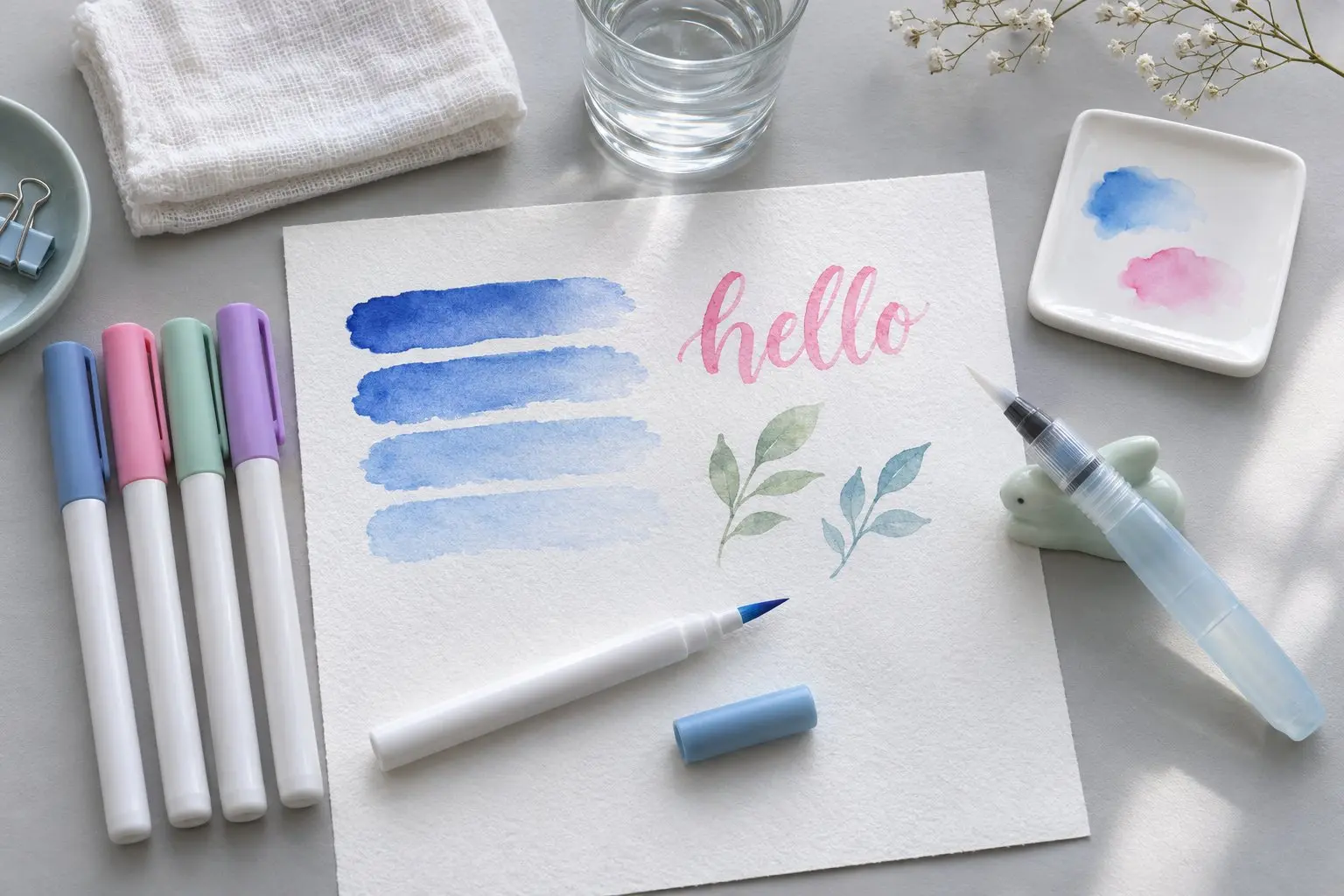
Best Watercolor Brush Pens and Watercolor Markers
Compare watercolor brush pens and markers that blend with water, with tips on paper, water brushes and using them safely in your coloring books.


