
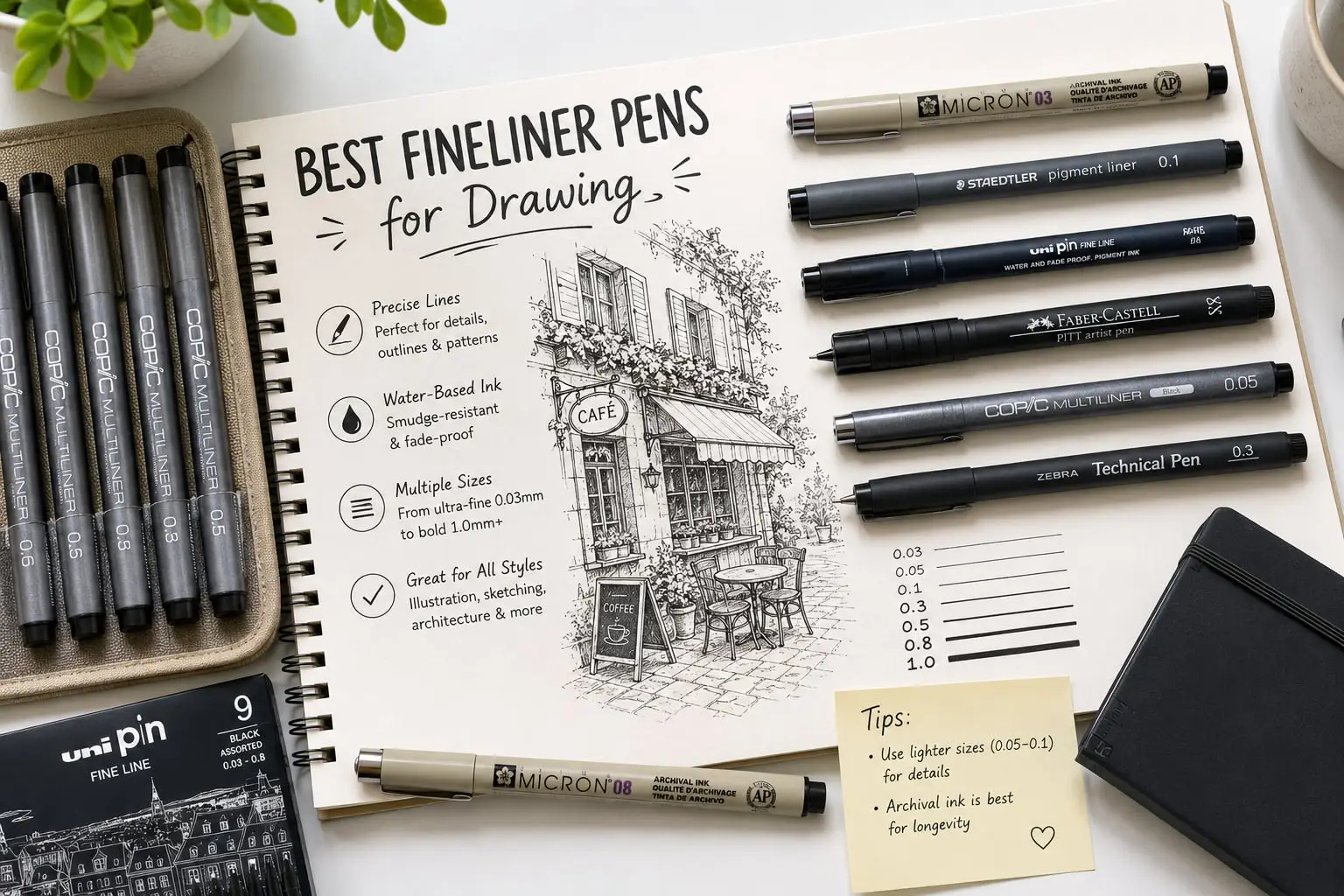
Quick picks
- Best for technical line workSTAEDTLER Pigment Liner 6-Pen Set (opens Amazon in a new tab)
- Best for hatching & stipplingPentel Arts Pointliner 5-Pen Set (opens Amazon in a new tab)
- Best with alcohol markersCopic Multiliner B-2 9-Piece Black Set (opens Amazon in a new tab)


Fineliner pens compared by tip size and ink
Tip sizes, ink type and water-resistance claims for all 10 sets, taken from the current Amazon US listings and manufacturer descriptions we checked. These are listing claims, not KawaiiToons test results.
| Pen | Tip sizes | Ink type | Waterproof/archival | Best for |
|---|---|---|---|---|
| SAKURA Pigma Micron 6-Pen Black Set | 0.20, 0.25, 0.30, 0.35, 0.45 and 0.50 mm (6 pens) | Pigma pigment ink, black | Waterproof, fade resistant, archival | Everyday line art, manga, illustration and journaling |
| STAEDTLER Pigment Liner 6-Pen Set | 0.05 mm to 0.8 mm (6 sizes), metal-clad tips | Pigment ink, black | Waterproof, lightfast | Technical line work with rulers and templates |
| Uni Pin Fineliner 6-Pen Black Set | 0.05 mm to 0.8 mm (6 sizes), metal-clad tips | Black ink (type not stated in our research) | Water resistant, lightfast | Ultra-fine detail, maps and cross-sections |
| Pentel Arts Pointliner 5-Pen Set | 0.05, 0.1, 0.3, 0.5 and 0.8 mm | Pigment-style drawing ink, black | Waterproof; marketed for watercolor washes once dry | Cross-hatching and stippling |
| Copic Multiliner B-2 9-Piece Black Set | 7 fixed widths from 0.03 mm to 1.0 mm, plus small and medium brush tips | Water-based pigment ink, black | Alcohol-marker resistant (waterproof claim not stated in our research) | Inking before coloring with alcohol markers |
| Tombow MONO Drawing Pen 3-Pack | 01, 03 and 05 | Water-based pigment ink, black | Not stated in our research | Beginner sketching with three simple sizes |
| Faber-Castell Pitt Artist Pen 4-Pen Black Set | XS, S, F and M | Pigmented India ink, black | Water resistant, highly fade resistant | India-ink sketching and studies |
| Ohuhu Fineliner Micro Drawing Pens 8-Pack | 7 fixed sizes from 0.2 mm to 1.0 mm, plus a brush tip | Pigment ink, black | Waterproof, fade resistant | Budget multi-tip set for learning line weight |
| Shuttle Art 18-Pack Micro-line Pens | 7 black from 0.15 mm to 0.5 mm, plus 11 colors at 0.3 mm | Not stated in our research | Not stated in our research | Black and colored line work in one set |
| ARTEZA Inkonic Fineliners 24-Color Set | 0.4 mm (all 24 colors) | Not stated in our research | Not stated in our research | Colored line art, doodling and sketchbook accents |
“Not stated in our research” means we did not confirm that detail from the listing. Let ink dry fully and test your own paper before applying watercolor or markers over finished line art.
Product comparison
| Product | Best for | Watch out | Price & shop |
|---|---|---|---|
| SAKURA Pigma Micron 6-Pen Black Set (opens Amazon in a new tab) Best overallResearch-based review | Line artists who want a proven black pigment fineliner set with six useful point sizes | It is black-only and stops at a 0.50 mm fixed point, so you will need another tool for expressive brush strokes or broad fills | |
| STAEDTLER Pigment Liner 6-Pen Set (opens Amazon in a new tab) Best for technical line workResearch-based review | Artists using rulers, templates, diagrams or highly controlled architectural-style lines | The technical nibs are excellent for controlled lines but less expressive than a brush nib for gesture or tapered strokes | |
| Uni Pin Fineliner 6-Pen Black Set (opens Amazon in a new tab) Best ultra-fine rangeResearch-based review | Detail-heavy sketches, maps, cross-sections and artists who need a true 0.05 mm option | It is another focused black technical set, so there is no brush nib or colored ink for more expressive work | |
| Pentel Arts Pointliner 5-Pen Set (opens Amazon in a new tab) Best for hatching & stipplingResearch-based review | Pen-and-ink sketchers who build value with cross-hatching, stippling and layered line texture | The set has fewer tip choices than some competitors and does not include a brush nib | Budget-friendlyCheck price on Amazon (opens Amazon in a new tab) |
| Copic Multiliner B-2 9-Piece Black Set (opens Amazon in a new tab) Best with alcohol markersResearch-based review | Illustrators who ink first and then color with Copic or other alcohol markers | The broader tool range comes at a higher price than basic black fineliner packs, so it makes most sense if you will use the brush tips or alcohol-marker compatibility | |
| Tombow MONO Drawing Pen 3-Pack (opens Amazon in a new tab) Best compact starter setResearch-based review | Beginners who want three useful black drawing tips without buying a large set | Three sizes are easy to learn but provide much less line-weight range than six- to nine-piece sets | Budget-friendlyCheck price on Amazon (opens Amazon in a new tab) |
| Faber-Castell Pitt Artist Pen 4-Pen Black Set (opens Amazon in a new tab) Best India ink setResearch-based review | Sketchers who prefer pigmented India ink and a compact four-tip drawing wallet | The four-tip selection is less granular than larger technical sets, especially if you need many closely spaced fine widths | |
| Ohuhu Fineliner Micro Drawing Pens 8-Pack (opens Amazon in a new tab) Best budget multi-tip setResearch-based review | Beginners who want to experiment with many black widths plus a brush nib | The feature list is strong for the price, but we have not independently tested long-term nib durability or ink consistency against the established technical-pen brands | Budget-friendlyCheck price on Amazon (opens Amazon in a new tab) |
| Shuttle Art 18-Pack Micro-line Pens (opens Amazon in a new tab) Best black + color comboResearch-based review | Sketchers who want variable black line sizes and colored fineliners in the same pouch | All of the colored pens use the same 0.3 mm point, so line-width variation is limited to the black pens | Budget-friendlyCheck price on Amazon (opens Amazon in a new tab) |
| ARTEZA Inkonic Fineliners 24-Color Set (opens Amazon in a new tab) Best colored finelinersResearch-based review | Colored line art, doodling, sketchbook accents and artists who value palette size over varied nib widths | Every pen uses the same 0.4 mm tip, so you will need another set when you want varied line weights or ultra-fine black details |
Detailed product sections
SAKURA Pigma Micron 6-Pen Black Set (opens Amazon in a new tab)
A six-size archival black set that covers fine details, contour lines and everyday ink drawing without unnecessary extras

Why it fits this guide
Pigma Micron is the safest all-round research pick because the Amazon set spans 0.20 mm to 0.50 mm, uses waterproof and fade-resistant pigment ink, and is explicitly positioned for illustration, manga, journaling and technical work.
Honest drawback
It is black-only and stops at a 0.50 mm fixed point, so you will need another tool for expressive brush strokes or broad fills
Best forLine artists who want a proven black pigment fineliner set with six useful point sizes
Pros
- Six point sizes cover fine detail through stronger outlines
- Waterproof, fade-resistant Pigma pigment ink
- Widely useful for line art, manga, illustration and journaling
Cons
- No brush tip in this six-pen set
- No color variety
STAEDTLER Pigment Liner 6-Pen Set (opens Amazon in a new tab)
A metal-tipped six-pen set from 0.05 mm to 0.8 mm with waterproof, lightfast pigment ink

Why it fits this guide
STAEDTLER stands out when precision against a straightedge matters. The long metal-clad tips are designed for rulers and templates, while the six-size range starts at an ultra-fine 0.05 mm and reaches 0.8 mm for stronger contours.
Honest drawback
The technical nibs are excellent for controlled lines but less expressive than a brush nib for gesture or tapered strokes
Best forArtists using rulers, templates, diagrams or highly controlled architectural-style lines
Pros
- 0.05 mm to 0.8 mm size range
- Metal-clad tips suit rulers and stencils
- Waterproof, lightfast black pigment ink
Cons
- No brush tip
- Black-only set
Uni Pin Fineliner 6-Pen Black Set (opens Amazon in a new tab)
Six black technical fineliners from 0.05 mm to 0.8 mm with water-resistant, lightfast ink

Why it fits this guide
Uni Pin is a strong alternative to STAEDTLER for artists who prioritize very fine technical marks. Its six sizes give a practical progression for hairlines, hatching, construction detail and heavier outlines, and the metal-clad tips work well with guides.
Honest drawback
It is another focused black technical set, so there is no brush nib or colored ink for more expressive work
Best forDetail-heavy sketches, maps, cross-sections and artists who need a true 0.05 mm option
Pros
- Starts at a very fine 0.05 mm
- Six sizes extend to 0.8 mm
- Water-resistant, lightfast ink and metal-clad tips
Cons
- No brush tip
- No color variety
Pentel Arts Pointliner 5-Pen Set (opens Amazon in a new tab)
A five-size black drawing set built around clean lines, stippling and cross-hatching

Why it fits this guide
Pentel specifically positions Pointliner for shading techniques such as cross-hatching and stippling. The five sizes from 0.05 mm to 0.8 mm cover fine texture through heavier contours, and the waterproof ink is intended to integrate with watercolor washes.
Honest drawback
The set has fewer tip choices than some competitors and does not include a brush nib
Best forPen-and-ink sketchers who build value with cross-hatching, stippling and layered line texture
Pros
- Five practical sizes from 0.05 mm to 0.8 mm
- Designed for cross-hatching and stippling
- Waterproof ink can be paired with watercolor washes
Cons
- Only five fixed tips
- No brush nib or color
Copic Multiliner B-2 9-Piece Black Set (opens Amazon in a new tab)
Seven fixed fineliner sizes plus small and medium brush tips using alcohol-resistant pigment ink

Why it fits this guide
Copic Multiliner B-2 is the most versatile inking package here for marker illustrators. It combines widths from 0.03 mm to 1.0 mm with two brush tips, and Copic describes the water-based pigment ink as alcohol-resistant for use with its markers.
Honest drawback
The broader tool range comes at a higher price than basic black fineliner packs, so it makes most sense if you will use the brush tips or alcohol-marker compatibility
Best forIllustrators who ink first and then color with Copic or other alcohol markers
Pros
- Seven fixed widths from 0.03 mm to 1.0 mm
- Includes small and medium brush tips
- Alcohol-resistant pigment ink suits marker workflows
Cons
- Premium price relative to simple sets
- Black-only package
Tombow MONO Drawing Pen 3-Pack (opens Amazon in a new tab)
A simple 01, 03 and 05 trio for outlines, details, hatching and small filled areas

Why it fits this guide
Tombow keeps the decision simple. The three MONO Drawing Pens cover the core jobs most beginners need—fine details, ordinary outlines and slightly heavier line work—without the duplication or storage of a larger technical set.
Honest drawback
Three sizes are easy to learn but provide much less line-weight range than six- to nine-piece sets
Best forBeginners who want three useful black drawing tips without buying a large set
Pros
- Compact 3-pen format
- Water-based pigment ink
- Durable nib design intended for steady ink flow
Cons
- Only three line sizes
- No brush or colored tips
Faber-Castell Pitt Artist Pen 4-Pen Black Set (opens Amazon in a new tab)
Four black Pitt Artist Pens with XS, S, F and M tips for sketching, studying and inking

Why it fits this guide
Faber-Castell's Pitt Artist Pen set is the specialist choice for artists who like pigmented India ink. The four assorted tips cover everyday sketching and illustration, while the ink is marketed for high fade resistance and water resistance.
Honest drawback
The four-tip selection is less granular than larger technical sets, especially if you need many closely spaced fine widths
Best forSketchers who prefer pigmented India ink and a compact four-tip drawing wallet
Pros
- Pigmented India ink
- Four assorted XS, S, F and M tips
- Water-resistant and highly fade-resistant ink
Cons
- Only four tip choices
- Black-only set
Ohuhu Fineliner Micro Drawing Pens 8-Pack (opens Amazon in a new tab)
Eight black drawing pens spanning 0.2 mm to 1.0 mm plus a brush tip at an accessible entry point

Why it fits this guide
Ohuhu packs a lot of line-weight experimentation into one set. Seven fixed sizes cover fine details through bold outlines, while the included brush nib introduces variable-width strokes without buying a second pen family.
Honest drawback
The feature list is strong for the price, but we have not independently tested long-term nib durability or ink consistency against the established technical-pen brands
Best forBeginners who want to experiment with many black widths plus a brush nib
Pros
- Seven fixed line sizes plus a brush tip
- Waterproof, fade-resistant pigment ink
- Broad range for beginners learning line weight
Cons
- Black-only set
- Long-term nib durability remains unverified by us
Shuttle Art 18-Pack Micro-line Pens (opens Amazon in a new tab)
Eleven 0.3 mm colored pens plus seven black fineliners from 0.15 mm to 0.5 mm

Why it fits this guide
Shuttle Art fills a useful gap between technical black sets and colorful journaling fineliners. The black pens give multiple drawing widths, while the 11 colored 0.3 mm pens let you add colored contours, annotation and sketchbook accents without a separate purchase.
Honest drawback
All of the colored pens use the same 0.3 mm point, so line-width variation is limited to the black pens
Best forSketchers who want variable black line sizes and colored fineliners in the same pouch
Pros
- Combines black and colored fineliners
- Seven black sizes from 0.15 mm to 0.5 mm
- Eleven colored 0.3 mm pens for accents
Cons
- Colored pens have only one line size
- Less specialized than a dedicated technical set
ARTEZA Inkonic Fineliners 24-Color Set (opens Amazon in a new tab)
A 24-color set with consistent 0.4 mm tips and numbered barrels

Why it fits this guide
ARTEZA is the most straightforward color-first choice in this shortlist. Twenty-four shades give much more palette range than the black technical sets, while the consistent 0.4 mm point keeps outlines and small details predictable across colors.
Honest drawback
Every pen uses the same 0.4 mm tip, so you will need another set when you want varied line weights or ultra-fine black details
Best forColored line art, doodling, sketchbook accents and artists who value palette size over varied nib widths
Pros
- Twenty-four assorted colors
- Consistent 0.4 mm fine point
- Numbered barrels simplify color organization
Cons
- No assorted line widths
- Not a replacement for a technical black fineliner set
Related guides
Best Charcoal Pencils for Drawing: 10 Picks for Beginners & Shading
The best charcoal pencils for drawing and shading, compared for beginners, portraits, soft gradients, white highlights, woodless coverage and value.
Best Sketchbooks for Pencil Drawing: 10 Picks for Sketching & Shading
Compare 10 of the best sketchbooks for pencil drawing, from budget spiral pads to premium heavyweight and toned paper picks for shading.
Best Drawing Kits for Beginners: 10 Starter Sets That Are Actually Useful
The best drawing kits for beginners, with useful graphite, charcoal, blending and sketching tools instead of filler. Compare 10 practical starter sets.
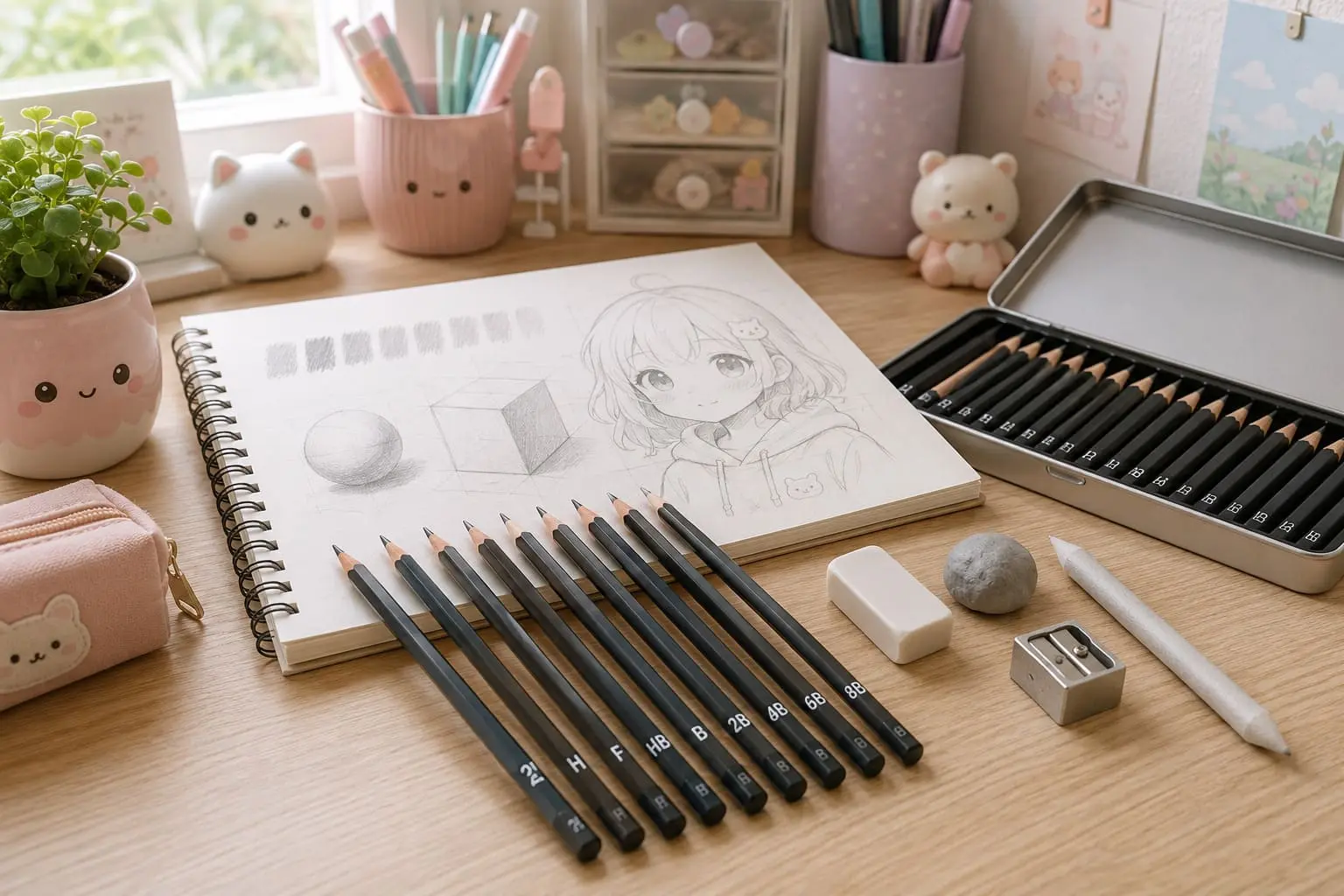
Best Drawing Pencils for Beginners: 10 Sets for Sketching & Shading
Compare the best drawing pencils for beginners for sketching and shading, including graphite grades, starter tools, accessories, and practical trade-offs.


