
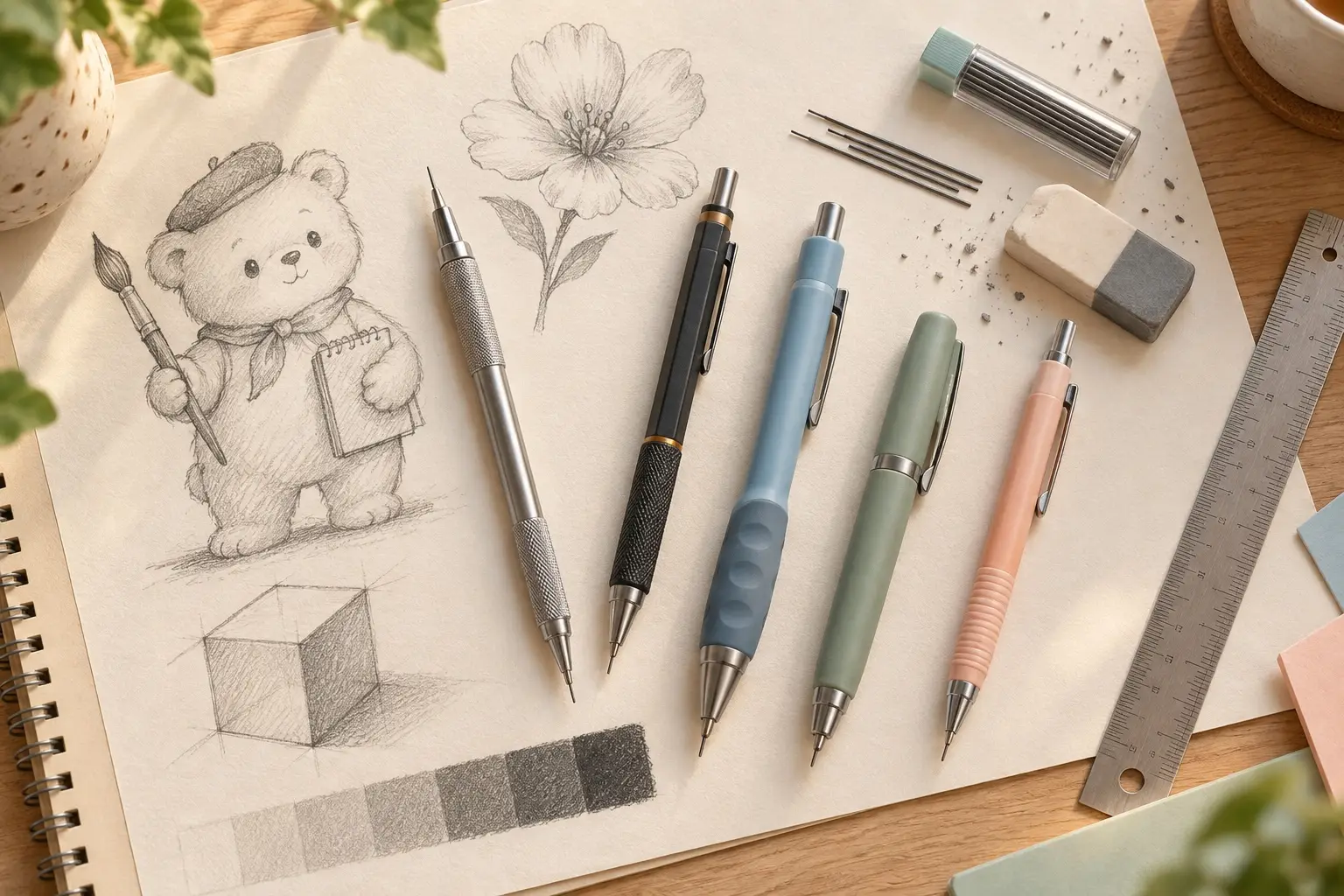
Quick answer
0.5 mm suits most sketching; match sleeve and grip to how you work.
- Best overall: Pentel GraphGear 1000 0.5 mm — retracting drafting sleeve, textured grip and lead-grade indicator.
- Best budget drafting pencil: Pentel GraphGear 500.
- Best for ultra-fine detail: Pentel Orenz Nero 0.3 mm (Zebra DelGuard if leads keep snapping).
Choose by use case
If you wantAn all-round drafting pencil for most sketching

Pentel GraphGear 1000 Mechanical Pencil 0.5 mm
Best overallResearch-based reviewRetracting sleeve, textured grip and lead-grade indicator in one 0.5 mm tool.
If you wantA simpler budget drafting pencil

Pentel Arts GraphGear 500 Drafting Pencil 0.5 mm
Best budget drafting pencilResearch-based reviewKeeps the drafting sleeve format without the GraphGear 1000 feature set.
If you wantUltra-fine detail work

Pentel Orenz Nero Mechanical Pencil 0.3 mm, Black
Best for ultra-fine detailResearch-based review0.3 mm is the specialist pick when tiny lines matter most.
If you wantLead that keeps snapping under pressure

Zebra DelGuard Mechanical Pencils 0.5 mm, Assorted 3-Pack
Best lead protectionResearch-based reviewBreak-protection mechanism is the main reason to choose DelGuard.
If you wantA full-metal desk pencil

rOtring 600 Mechanical Pencil 0.5 mm, Black
Best full-metal desk pencilResearch-based reviewDense metal body for stationary desk drawing rather than pocket carry.
Product comparison
| Product | Best for | Watch out | Price & shop |
|---|---|---|---|
| Pentel GraphGear 1000 Mechanical Pencil 0.5 mm (opens Amazon in a new tab) Best overallResearch-based review | Best overall | The metal construction and textured grip may feel more substantial than artists who prefer a light plastic pencil want, and we have not tested its balance or grip over a long drawing session | |
| Pentel Arts GraphGear 500 Drafting Pencil 0.5 mm (opens Amazon in a new tab) Best budget drafting pencilResearch-based review | Best budget drafting pencil | The fixed sleeve stays exposed, so it needs deliberate storage and is less convenient in a loose everyday-carry pouch | Budget-friendlyCheck price on Amazon (opens Amazon in a new tab) |
| rOtring 600 Mechanical Pencil 0.5 mm, Black (opens Amazon in a new tab) Best full-metal desk pencilResearch-based review | Best full-metal desk pencil | Its fixed sleeve does not retract, and premium metal construction is unnecessary for an occasional sketcher who mainly wants a refillable pencil | |
| Pentel Orenz Nero Mechanical Pencil 0.3 mm, Black (opens Amazon in a new tab) Best for ultra-fine detailResearch-based review | Best for ultra-fine detail | The sleeve-contact feel and ultra-fine lead are specialized, and we have not tested whether this automatic system suits a particular drawing angle or paper texture | |
| uniball Kuru Toga Elite Mechanical Pencil Kit 0.5 mm (opens Amazon in a new tab) Best rotating pointResearch-based review | Best rotating point | The rotation system is most relevant to repeated short strokes and offers less benefit during long, continuous shading motions | |
| Zebra DelGuard Mechanical Pencils 0.5 mm, Assorted 3-Pack (opens Amazon in a new tab) Best lead protectionResearch-based review | Best lead protection | The three-pack is unnecessary if one pencil is enough, and no mechanism can guarantee that overextended or mismatched lead will never snap | |
| Tombow MONO Graph Shaker Mechanical Pencil 0.5 mm, Blue (opens Amazon in a new tab) Best built-in eraserResearch-based review | Best built-in eraser | The fixed guide pipe still needs protection, and artists whose drawing motion triggers unwanted advance may prefer to keep the shaker locked | Budget-friendlyCheck price on Amazon (opens Amazon in a new tab) |
| Pilot Dr. Grip G-Spec Shaker Mechanical Pencil 0.5 mm, Flash Black (opens Amazon in a new tab) Best broad soft gripResearch-based review | Best broad soft grip | The wide grip and documented 19.7 g weight will feel bulky to artists who prefer a slim, light pencil, and the exact US Amazon offer had limited stock when checked | |
| Pentel Sharp Kerry Automatic Pencil 0.5 mm, Red (opens Amazon in a new tab) Best for travelResearch-based review | Best for travel | The cap is another small part to track, and the short protected point is less specialized for ruler work than a 4 mm drafting sleeve | |
| STAEDTLER 925 25-05 Mechanical Pencil 0.5 mm, Silver (opens Amazon in a new tab) Best Japanese drafting alternativeResearch-based review | Best Japanese drafting alternative | The exact model is an imported listing with a fixed sleeve, so sourcing and safe transport are less straightforward than with a widely stocked retractable pencil |
How we chose
- Compared 10 research-based picks from current product listings.
- Product listings checked on September 30, 2026.
- Start with lead diameter. A 0.5 mm pencil is the safest general-purpose choice; 0.3 mm favors tiny details, while wider lead is usually better for broad marks and pressure tolerance.
- Separate drafting from loose sketching. A long fixed sleeve improves the view at a ruler or template but needs protection in a pouch.
- Hands-on testing: none — all picks are research-based
- Product listings checked
- Hands-on testing
- None of the 10 picks — all are research-based
- Labels explained
- How we test and label products
This is a research-based buying guide, not a hands-on line, comfort or durability test. On September 30, 2026, we opened the exact Amazon.com page for every recommendation in a US delivery context, confirmed the ASIN, selected variant, an in-stock or limited-stock purchase path with add-to-cart and buy-now controls, and a matching direct Amazon CDN main image. We cross-checked mechanisms, point sizes, sleeves, grips, lead-grade indicators, erasers, refillability and documented dimensions against current Pentel, rOtring, STAEDTLER, Zebra Pen, Tombow, Pilot and uniball sources. KawaiiToons has not measured weight distribution, grip diameter, lead advance, sleeve drag, point wobble, breakage rate, erasing performance or drawing endurance. Rankings reflect documented design differences and practical use cases, not customer ratings, temporary prices or invented first-hand experience.
Testing status by pick
- Pentel GraphGear 1000 Mechanical Pencil 0.5 mmResearch-based review
- Pentel Arts GraphGear 500 Drafting Pencil 0.5 mmResearch-based review
- rOtring 600 Mechanical Pencil 0.5 mm, BlackResearch-based review
- Pentel Orenz Nero Mechanical Pencil 0.3 mm, BlackResearch-based review
- uniball Kuru Toga Elite Mechanical Pencil Kit 0.5 mmResearch-based review
- Zebra DelGuard Mechanical Pencils 0.5 mm, Assorted 3-PackResearch-based review
- Tombow MONO Graph Shaker Mechanical Pencil 0.5 mm, BlueResearch-based review
- Pilot Dr. Grip G-Spec Shaker Mechanical Pencil 0.5 mm, Flash BlackResearch-based review
- Pentel Sharp Kerry Automatic Pencil 0.5 mm, RedResearch-based review
- STAEDTLER 925 25-05 Mechanical Pencil 0.5 mm, SilverResearch-based review
Product details and drawbacks
Pentel GraphGear 1000 Mechanical Pencil 0.5 mm (opens Amazon in a new tab)
A retracting 4 mm sleeve, textured grip and lead-grade indicator make this the most balanced drawing-focused format here

Why it fits this guide
The GraphGear 1000 solves the central conflict in a drafting pencil: artists want a long sleeve for a clear view of the line, but that sleeve is awkward in a case. Pentel's clip-operated dual-action retractor draws the point into the barrel for storage. The 0.5 mm PG1015A also uses a metal grip with soft pads and a hardness indicator, so it can move between contour drawing, small construction marks and ruler work without becoming an ultra-specialized 0.3 mm tool.
Honest drawback
The metal construction and textured grip may feel more substantial than artists who prefer a light plastic pencil want, and we have not tested its balance or grip over a long drawing session
Specifications
- Exact Amazon ASIN B000GAU2RU was in stock with add-to-cart and buy-now controls on September 30, 2026
- Pentel model PG1015A uses 0.5 mm lead and a retracting 4 mm sleeve
- Manufacturer documents a lead-hardness indicator and metal grip with soft pads
Best forArtists who want one precise 0.5 mm drafting pencil for both desk work and protected storage
Pros
- Drafting sleeve retracts for storage
- General-purpose 0.5 mm lead suits details and construction lines
- Hardness indicator supports multiple refill grades
Cons
- More elaborate than a simple knock pencil
- Built-in eraser is intended for small corrections
Pentel Arts GraphGear 500 Drafting Pencil 0.5 mm (opens Amazon in a new tab)
A weighted fingertip grip and fixed 4 mm sleeve deliver the core GraphGear drafting layout at a simpler level

Why it fits this guide
The GraphGear 500 keeps the useful drawing parts and omits the retracting assembly. Pentel documents a weighted fingertip balance, metallic mesh grip and durable 4 mm tip for rulers and templates. That makes the PG525APABP a sensible first drafting pencil for an artist who works at a table and stores tools in slots. Its 0.5 mm lead is more forgiving than 0.3 mm for everyday sketchbook use while remaining fine enough for clean edges and small perspective studies.
Honest drawback
The fixed sleeve stays exposed, so it needs deliberate storage and is less convenient in a loose everyday-carry pouch
Specifications
- Exact Amazon ASIN B00WQPWZ8M was in stock with add-to-cart and buy-now controls on September 30, 2026
- Pentel model PG525APABP uses 0.5 mm lead in a black barrel
- Manufacturer documents fingertip weighting, a metal mesh grip and 4 mm tip
Best forDesk-based artists who want a metal mesh grip and ruler-friendly 0.5 mm point without a premium mechanism
Pros
- Strong drafting feature set at the simplest level in this comparison
- 0.5 mm lead is versatile for line drawing
- Clear view alongside rulers and templates
Cons
- Sleeve does not retract
- Better suited to a desk or protected case than a pocket
rOtring 600 Mechanical Pencil 0.5 mm, Black (opens Amazon in a new tab)
The brass advance mechanism, anti-roll hexagonal barrel and all-metal build create the most traditional premium drafting tool here

Why it fits this guide
The rOtring 600 is the clearest choice for an artist who wants the body itself to feel like a drafting instrument. rOtring documents a full- metal hexagonal barrel, non-slip knurled grip, brass lead mechanism, fixed guidance sleeve and adjustable hardness indicator. The flat-sided shape also helps keep the pencil from rolling on a tilted board. This is a precision desk tool first; none of those features makes it safer to drop unprotected into a bag.
Honest drawback
Its fixed sleeve does not retract, and premium metal construction is unnecessary for an occasional sketcher who mainly wants a refillable pencil
Specifications
- Exact Amazon ASIN B00AZWYUA4 was in stock with add-to-cart and buy-now controls on September 30, 2026
- Exact selected listing is the black 0.5 mm rOtring 600
- rOtring documents a full-metal hexagonal body, brass advance mechanism and fixed guidance sleeve
Best forArtists who want a hexagonal metal body, knurled grip and fixed sleeve for deliberate drafting
Pros
- Anti-roll hexagonal metal body
- Knurled grip and fixed sleeve support precise desk work
- Hardness indicator helps organize lead grades
Cons
- Fixed point needs protection during travel
- High-spec body does not broaden the 0.5 mm mark itself
Pentel Orenz Nero Mechanical Pencil 0.3 mm, Black (opens Amazon in a new tab)
Automatic lead advance and a sliding sleeve support uninterrupted 0.3 mm detail work

Why it fits this guide
The Orenz Nero is the specialist pick. Pentel documents automatic lead advance and a protective sleeve around its extra-fine lead. In the exact PP3003-A Amazon variant, that system works with 0.3 mm refills. It makes sense for miniature line art, eyelashes, architectural notation or construction marks that would be clumsy with a broad point. It does not replace 0.5 or 0.7 mm graphite for relaxed gesture drawing, side-of-lead texture or fast blocks of tone.
Honest drawback
The sleeve-contact feel and ultra-fine lead are specialized, and we have not tested whether this automatic system suits a particular drawing angle or paper texture
Specifications
- Exact Amazon ASIN B06VWPKXQH was in stock with add-to-cart and buy-now controls on September 30, 2026
- Exact model PP3003-A uses 0.3 mm lead in a black barrel
- Pentel documents automatic lead advance and a sliding protective sleeve
Best forArtists drawing tiny features, technical annotations and very light construction with 0.3 mm lead
Pros
- Finest line size in the comparison
- Automatic advance reduces stops to click
- Sleeve is designed to support fragile lead
Cons
- Too narrow for efficient broad shading
- Premium mechanism is excessive for general note-taking
uniball Kuru Toga Elite Mechanical Pencil Kit 0.5 mm (opens Amazon in a new tab)
The Kuru Toga engine rotates 0.5 mm lead during repeated contacts to keep wear more even

Why it fits this guide
A mechanical lead normally develops a flat side as it wears. uniball's Kuru Toga engine is designed to rotate the lead as the point repeatedly contacts and leaves the paper, reducing that uneven edge. That behavior is useful for hatching, small symbols, lettering and short contour marks. The exact kit also includes lead and eraser refills. Long continuous shading strokes create fewer lift cycles, so artists should not assume the mechanism constantly spins during every kind of mark.
Honest drawback
The rotation system is most relevant to repeated short strokes and offers less benefit during long, continuous shading motions
Specifications
- Exact Amazon ASIN B089QC2C8G was in stock with add-to-cart and buy-now controls on September 30, 2026
- Exact silver 0.5 mm kit includes sixty lead refills and five eraser refills
- uniball documents a rotating lead engine, knurled grip and replaceable eraser
Best forLine artists and journalers making repeated short strokes that regularly lift from the paper
Pros
- Rotating mechanism is designed for a more even point
- Kit includes compatible lead and eraser refills
- 0.5 mm lead suits small repeated marks
Cons
- Mechanism depends on frequent paper lifts
- More moving parts than a standard knock pencil
Zebra DelGuard Mechanical Pencils 0.5 mm, Assorted 3-Pack (opens Amazon in a new tab)
Zebra's double-spring tip is designed to absorb both vertical and angled pressure before it reaches the lead

Why it fits this guide
DelGuard addresses a different problem from Kuru Toga. Instead of rotating the lead, Zebra uses two springs to cushion pressure in more than one direction. That makes this three-pack useful for a developing artist who is still learning to keep extension short and pressure light, or for separating HB, B and 2B refills across three barrels. The design can reduce a common frustration, but “protected” should never be read as impossible to break.
Honest drawback
The three-pack is unnecessary if one pencil is enough, and no mechanism can guarantee that overextended or mismatched lead will never snap
Specifications
- Exact Amazon ASIN B097FXMKCJ was in stock with add-to-cart and buy-now controls on September 30, 2026
- Exact listing contains three assorted 0.5 mm DelGuard pencils
- Zebra documents a double-spring mechanism, textured grip and refillable eraser
Best forArtists who press firmly or often snap exposed 0.5 mm lead at an angle
Pros
- Designed to cushion vertical and angled pressure
- Three bodies can hold separate lead grades
- Textured grip supports everyday control
Cons
- Plastic body is less drafting-focused than the metal picks
- Bundle is more than a single-pencil buyer needs
Tombow MONO Graph Shaker Mechanical Pencil 0.5 mm, Blue (opens Amazon in a new tab)
Shake-to-advance lead, a lock and a refillable MONO twist eraser make repeated correction unusually convenient

Why it fits this guide
The MONO Graph is the most complete sketch-and-correct tool in the comparison. Tombow documents a shake mechanism for advancing lead, a clip lock that prevents accidental extension, a fixed 4 mm guide pipe and a refillable twist eraser. The larger eraser is more useful than a typical cap nub for cleaning construction marks. Artists with energetic hand motion can lock the shaker and treat it as a conventional pencil.
Honest drawback
The fixed guide pipe still needs protection, and artists whose drawing motion triggers unwanted advance may prefer to keep the shaker locked
Specifications
- Exact Amazon ASIN B00JAYRLJK was in stock with add-to-cart and buy-now controls on September 30, 2026
- Exact blue SH-MG41 model uses 0.5 mm lead
- Tombow documents shake advance, clip lock, 4 mm guide pipe and refillable twist eraser
Best forIterative sketchers who want quick lead advance and a practical twist-up eraser in one tool
Pros
- Useful refillable eraser for iterative sketches
- Lead can advance without changing grip
- Lock adds control during storage or vigorous drawing
Cons
- Fixed sleeve remains exposed
- Shaker mechanism is a preference, not a universal improvement
Pilot Dr. Grip G-Spec Shaker Mechanical Pencil 0.5 mm, Flash Black (opens Amazon in a new tab)
A documented two-layer silicone grip and centered weight distinguish it from the slim drafting pencils

Why it fits this guide
Pilot's Dr. Grip G-Spec is the outlier in shape. The official Japanese catalog documents a 14.2 mm maximum diameter, 19.7 g weight, two-layer silicone grip and shaker-plus-knock mechanism. Those specifications make it the clearest alternative for an artist who finds a narrow metal grip unpleasant. They do not prove that it prevents fatigue or fits every hand; comfort requires real use, which KawaiiToons has not performed.
Honest drawback
The wide grip and documented 19.7 g weight will feel bulky to artists who prefer a slim, light pencil, and the exact US Amazon offer had limited stock when checked
Specifications
- Exact Amazon ASIN B003T9OZY6 had limited stock with add-to-cart and buy-now controls on September 30, 2026
- Exact Pilot model HDGS-60R-FB is the 0.5 mm Flash Black variant
- Pilot documents a 14.2 mm maximum diameter, 141.9 mm length and 19.7 g weight
Best forArtists who dislike narrow knurling and prefer a wide silicone grip with two advance methods
Pros
- Broad two-layer silicone grip offers a distinct hand fit
- Supports shaker and conventional knock advance
- Exact dimensions and weight are manufacturer-documented
Cons
- Too broad for artists who prefer a narrow tripod grip
- Imported Amazon listing had only limited stock when checked
Pentel Sharp Kerry Automatic Pencil 0.5 mm, Red (opens Amazon in a new tab)
A pocket-size capped body protects the 0.5 mm point and posts for a full drawing grip

Why it fits this guide
The Sharp Kerry approaches portability like a pen. Pentel documents a removable cap that protects the point in a pocket or purse and can post on the back for balance. The exact red P1035B uses 0.5 mm lead. It is a strong fit for a compact urban-sketching pouch where a fixed drafting sleeve would be vulnerable. The trade-off is that its covered point is not the long exposed guide pipe an artist may want against a template.
Honest drawback
The cap is another small part to track, and the short protected point is less specialized for ruler work than a 4 mm drafting sleeve
Specifications
- Exact Amazon ASIN B000RNHS7S was in stock with add-to-cart and buy-now controls on September 30, 2026
- Exact red P1035B model uses 0.5 mm lead
- Pentel documents a removable protective cap, pocket-size body and refillable eraser
Best forSketchers who carry one compact pencil and want the point protected by a removable cap
Pros
- Cap protects the point and neighboring supplies
- Compact format suits a small sketch kit
- Posted cap restores a longer working form
Cons
- Cap can be misplaced
- No long sleeve for template-focused drafting
STAEDTLER 925 25-05 Mechanical Pencil 0.5 mm, Silver (opens Amazon in a new tab)
A fixed-sleeve 0.5 mm drafting pencil with replaceable tip and knock components documented by STAEDTLER Japan

Why it fits this guide
The 925 25-05 is an exact Japanese-market model, not the rubber-grip Mars 925 sold on STAEDTLER's US page. STAEDTLER Japan lists the silver-series 0.5 mm drafting pencil and publishes replacement tip and knock part numbers for the 925 25 family. That support is useful for an artist who values repairable precision tools. US buyers should understand that the current Amazon offer is imported and the fixed sleeve still needs a protected case.
Honest drawback
The exact model is an imported listing with a fixed sleeve, so sourcing and safe transport are less straightforward than with a widely stocked retractable pencil
Specifications
- Exact Amazon ASIN B002BNHMC8 was in stock with add-to-cart and buy-now controls on September 30, 2026
- STAEDTLER Japan identifies model 925 25-05 as the silver-series 0.5 mm drafting pencil
- Official replacement parts list includes the 925 25-05F tip and 925 25-05K knock component
Best forArtists who want STAEDTLER's silver 925 25 format and manufacturer-supported replacement point parts
Pros
- Precise 0.5 mm drafting format
- Replacement point components are officially documented
- Silver-series body offers an alternative to black drafting tools
Cons
- Imported US listing
- Fixed sleeve requires protection
Corrections
Spotted an error or outdated detail? Read how we handle corrections.
Related guides
Best Drawing Pencils for Beginners
Compare the best drawing pencils for beginners for sketching and shading, including graphite grades, starter tools, accessories, and practical trade-offs.
Best Erasers for Drawing
The best erasers for drawing, from kneaded and vinyl blocks to precision and electric picks for graphite, charcoal, highlights, and detail work.
Best Sketchbooks for Pencil Drawing
Compare 10 of the best sketchbooks for pencil drawing, from budget spiral pads to premium heavyweight and toned paper picks for shading.
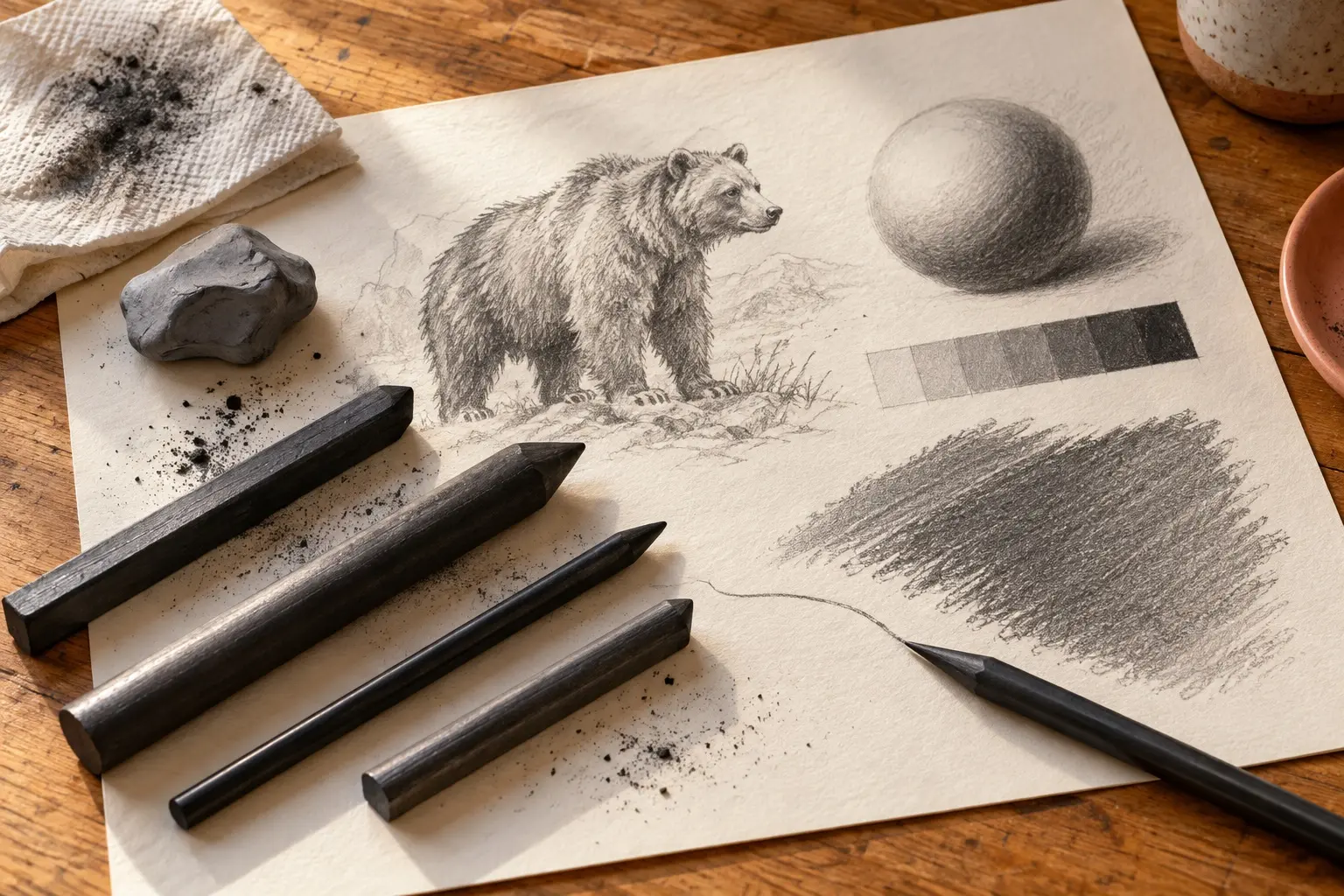
Best Woodless Graphite Pencils and Sticks for Drawing
Compare research-based woodless graphite pencils, compressed sticks and water-soluble blocks for broad shading, dark values, sketching and expressive marks.

Best Charcoal Pencils for Drawing: 10 Picks for Beginners & Shading
The best charcoal pencils for drawing and shading, compared for beginners, portraits, soft gradients, white highlights, woodless coverage and value.
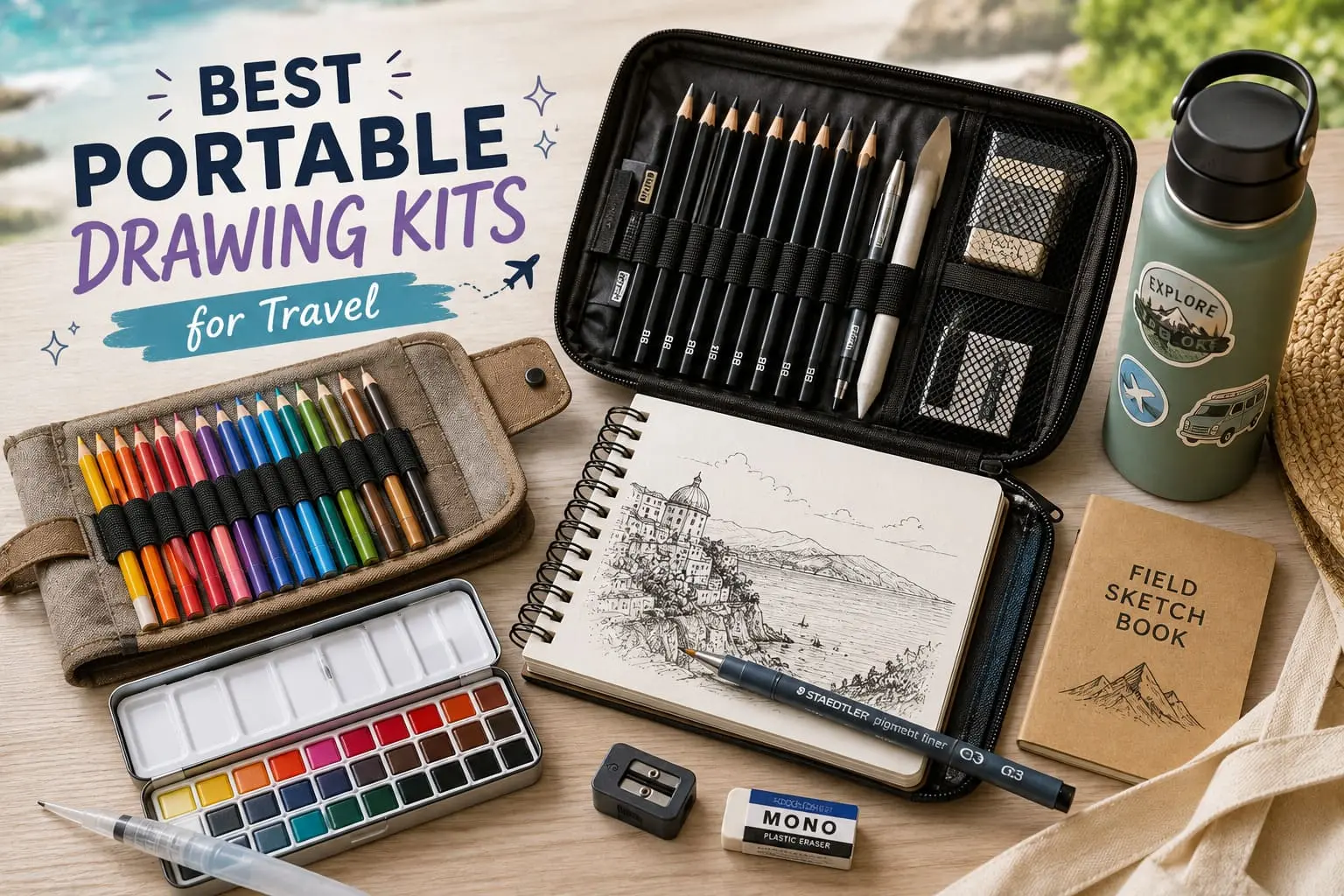
Best Portable Drawing Kits for Travel: 10 Compact Sketching Sets
The best portable drawing kits for travel, from graphite tins to mixed-media cases. Compare pencils, pads, storage, portability, and travel trade-offs.


Latest guides
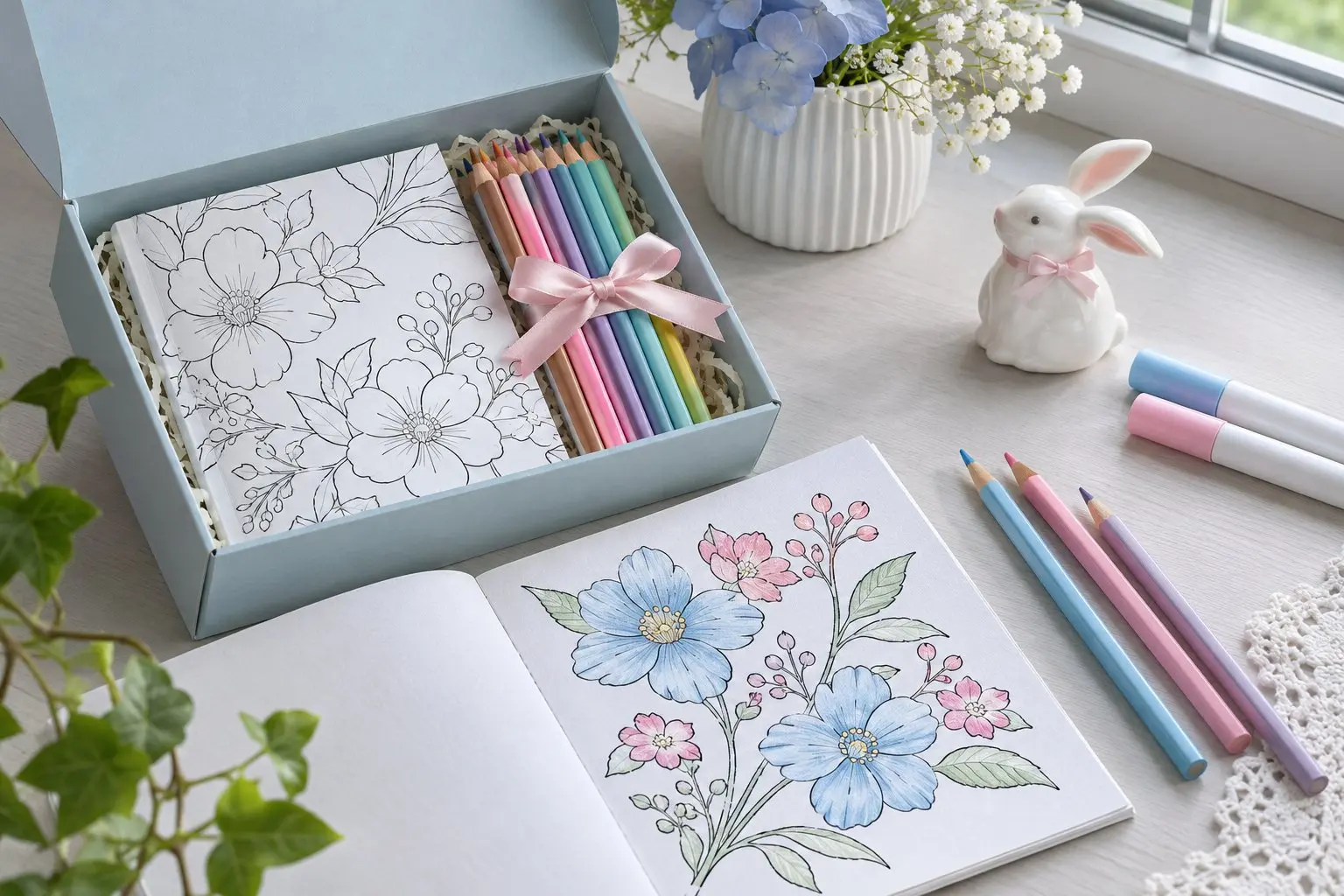
Gift Ideas for People Who Love Coloring
Thoughtful gift ideas for adults who love coloring, from marker sets and coloring books to lap desks, lamps and storage, sorted by budget and style.
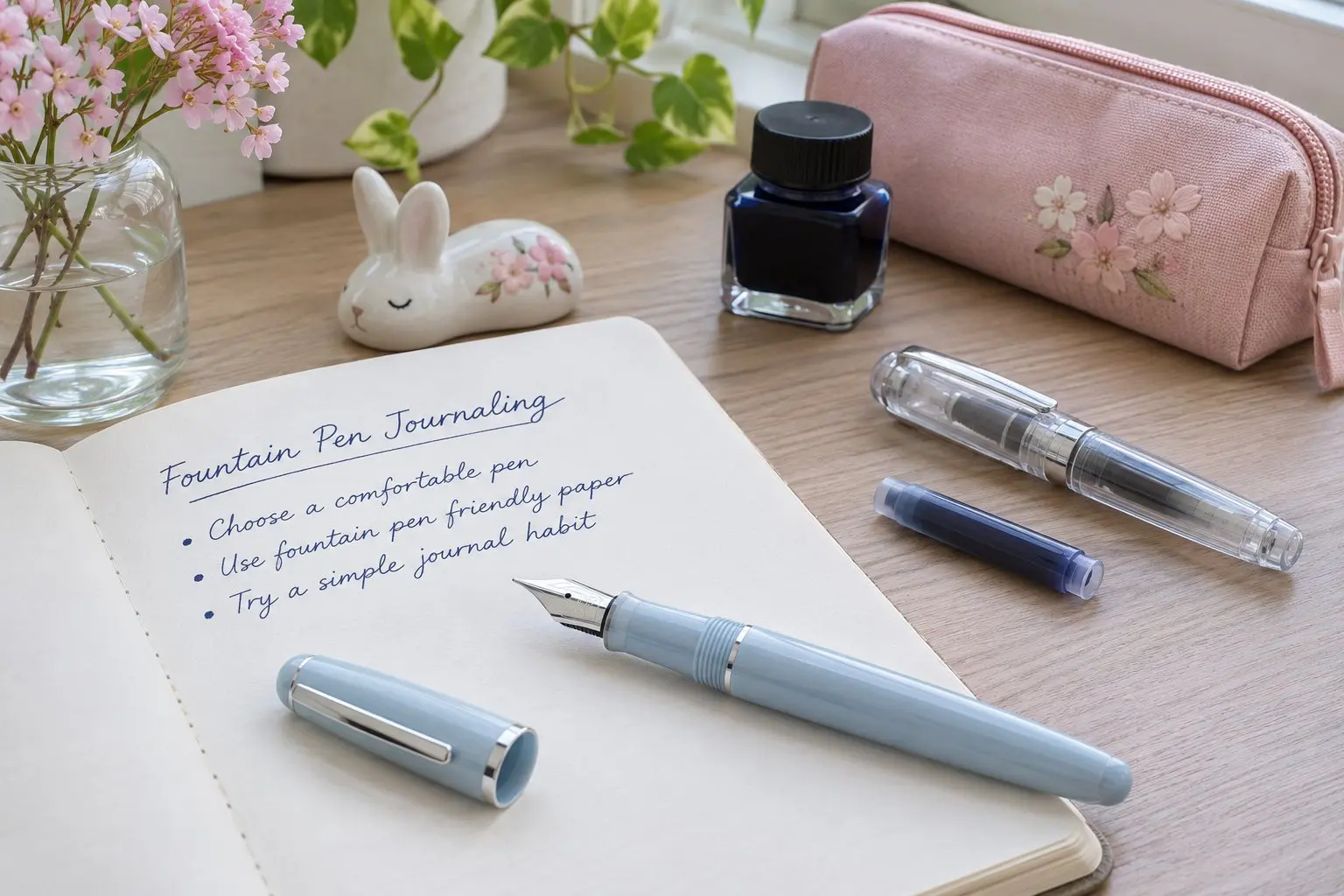
Best Fountain Pens for Beginners
Compare beginner-friendly fountain pens for journaling and everyday writing, with tips on nib sizes, cartridges vs converters, ink and paper.
Best Cute Pens and Kawaii Gel Pens
Cute and kawaii pens for notes and journals, from a bunny gel pen to pastel and multi-color pens, with clear ink, tip-size and refill comparisons.
Best Paper for Colored Pencils
Find the best paper for colored pencils, comparing tooth, weight and surface for layering and blending, with picks for beginners and detail art.
Best Travel Watercolor Sets and Pocket Palettes
Compare travel watercolor sets and pocket palettes for sketching on the go, with tips on pan count, water brushes, size and travel sketchbooks.
Best Watercolor Brush Pens and Watercolor Markers
Compare watercolor brush pens and markers that blend with water, with tips on paper, water brushes and using them safely in your coloring books.


